You see the Amazon Best Seller list and it seems like a cheat sheet for what to buy. But you're a professional buyer, not a retail customer, and their sourcing model just doesn't work for you.
Amazon's Best Sellers list is a powerful market research tool for B2B buyers. It reveals real-time data on the most popular bulb styles, consumer-demanded features, and, most importantly, the common quality complaints that highlight the weaknesses of mass-market suppliers.

The other day, I was on a call with a long-time client, a product manager from the UK. We were discussing his product roadmap for the next year. He said, "Wallson, my marketing team keeps sending me links to Amazon's top-selling bulbs. They want me to source these exact styles. But how do I know if they're any good, or if the trend will last?" His question perfectly captures the challenge for a professional buyer. The Amazon list is tempting, but it's a snapshot of the consumer world, driven by retail brands, massive marketing budgets, and a complex B2C supply chain. It's not a sourcing guide. I told him, "Don't look at it as a shopping list. Look at it as free, high-quality intelligence. Let's break down what those listings are really telling us about what your customers will want and the quality pitfalls you need to avoid." That shift in perspective changed his entire approach.
How Do You Decode Consumer Trends from a Best Seller List?
You look at the list and see a jumble of different brands, shapes, and multipacks. How can you turn this retail chaos into clear, actionable data for your B2B purchasing strategy and avoid stocking up on a product nobody wants?
To decode trends, categorize the best-selling bulbs by core attributes. Track the most common shapes (like ST64 or A60), color temperatures (2700K is dominant), and essential features (dimmability is a must). This data provides a clear picture of mass-market demand.
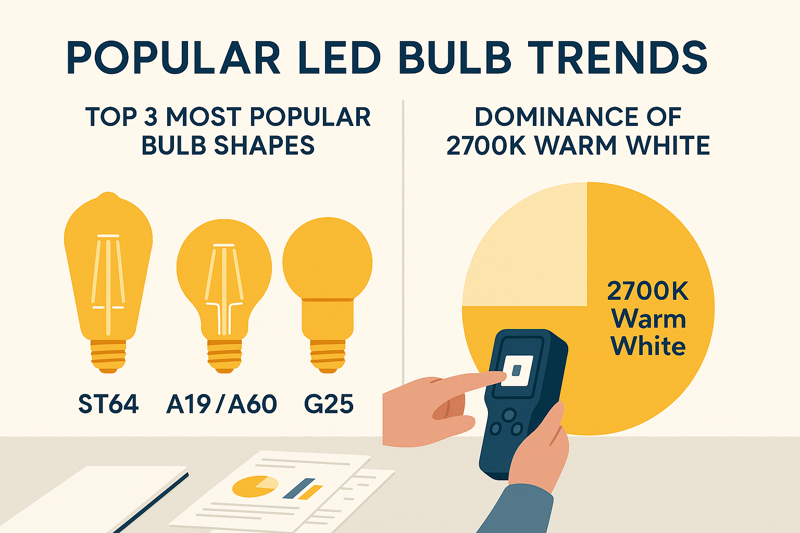
The Amazon Best Seller list is the voice of the market speaking to you directly. Instead of getting lost in the brand names, focus on the physical and technical specifications that are consistently at the top. For years, the ST64 "Edison" shape has been a leader for decorative fixtures. You'll also see the A19/A60 (the standard bulb shape) and the G25/G80 (globe shape for vanities) are always popular. This tells you where the core of the market is. Look at the color temperature; you will see that "2700K" or "Warm White" dominates the list. This confirms the market's strong preference for a cozy, traditional incandescent feel. Another critical piece of data is the features. Scan the titles of the top 20 listings. You'll see the word "Dimmable" in almost every single one. This is no longer a premium feature; it's a baseline expectation for consumers. By simply observing and tallying these attributes, you can build a reliable profile of a "safe bet" product to add to your catalog. It’s market research without the expensive consultants.
Building Your Product Profile from Amazon Data
Organize your observations to guide your next sourcing request.
- Dominant Shapes: Identify the top 3-5 shapes that appear most frequently. These are your high-volume runners.
- Key Color Temperatures: Note the most popular Kelvin ratings. While 2700K is king, you might spot a rising trend for 4000K "Cool White" in certain categories like candelabra bulbs.
- Must-Have Features1: List the features mentioned in most titles. "Dimmable" is. You might also see "High CRI" or specific watt-equivalents (e.g., "60-Watt Equivalent") appearing more often.
| Data Point | What to Look For | Actionable B2B Insight |
|---|---|---|
| Bulb Shape | ST64, A19, G25, C35 (Candelabra) | Focus your inventory on these core shapes for guaranteed sales. |
| Color Temperature2 | 2700K, 3000K, 4000K | Make 2700K your default offering; consider others for specific markets. |
| Primary Feature | "Dimmable" is in almost every title. | Do not source non-dimmable versions of these core bulbs. |
| Lumen Output | 60W and 40W equivalents (around 800 and 450 lumens). | Ensure your product offerings match these common brightness levels. |
This simple analysis transforms a confusing retail page into a clear roadmap for your purchasing decisions.
What Do Customer Reviews Reveal About a Supplier's True Quality?
The top-selling bulbs have thousands of reviews, which seems great. But how do you sift through the noise to find the critical quality complaints that signal underlying manufacturing problems?
Pay attention to the 1- and 2-star reviews. These negative reviews are a goldmine of information about common failures. Recurring complaints about flickering, buzzing, early burnout, and inconsistent color point directly to the use of low-quality drivers and cheap LED chips.
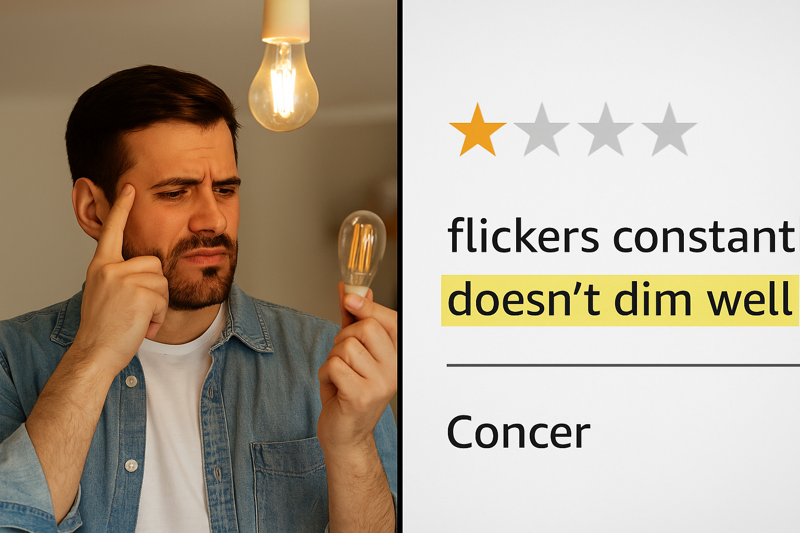
While the 5-star reviews are often brief ("Looks great!"), the 1-star reviews tell the real story. An end-user may not know what an "inferior linear driver" is, but they know exactly how to describe its symptoms. When you see dozens of reviews for a best-selling bulb saying, "These bulbs flicker when I use my dimmer," or "They make a weird buzzing sound," you are seeing evidence of a cheap, low-quality driver circuit. When you see complaints like, "I bought two packs and the colors don't match," you're seeing the result of a manufacturer who doesn't have good control over their LED chip supply (poor color consistency). And the most common complaint of all, "One of the six bulbs died after just two months," points to poor thermal management and rushed, low-quality assembly. For a B2B buyer like Jacky, these reviews are a direct warning. They show you exactly what problems you will be dealing with if you source a product built to a low-quality, mass-market standard. Your customers will have these same complaints, but they will be complaining to you.
Turning Complaints into a Quality Checklist
Use the most common negative feedback to build a technical questionnaire for potential suppliers.
- Flickering/Buzzing Complaint3: This is a driver issue. Your question to a potential factory should be: "What type of driver do you use? Is it a stable IC driver or a cheap linear driver? Can you provide a dimmer compatibility list?"
- Inconsistent Color Complaint4: This is an LED chip binning issue. Your question should be: "What is your color consistency tolerance, measured in MacAdam ellipses? Do you guarantee consistency from one batch to the next?"
- Early Failure Complaint: This points to overall build quality and thermal management. Your question should be: "What is your quality control process? What kind of inert gas do you use? Can you provide reliability test reports (e.g., LM-80)?"
| Common 1-Star Review | The Hidden Manufacturing Problem | Your Question for a Supplier |
|---|---|---|
| "Flickers and hums with my dimmer." | Use of a cheap, low-performance driver circuit. | "Can you provide your dimmer compatibility report?" |
| "The color is different from my last order." | Poor control over LED chip sourcing (binning). | "What is your color consistency tolerance (in MacAdam steps)?" |
| "Stopped working after only 3 months." | Poor heat dissipation and low-quality assembly. | "What is your documented failure rate in the first year?" |
These reviews give you the exact technical questions you need to ask to avoid sourcing a problematic product.
Why Can't You Just Buy from These Amazon Brands Directly?
You've done the research and identified a top-selling brand. It's tempting to think you can just contact them and become a distributor. But why is this direct-to-brand B2B model often a dead end for professional buyers?
The pricing structure of Amazon-focused retail brands makes them unworkable for B2B channels. Their price already includes B2C marketing costs, Amazon's fees, and their own retail profit, leaving no margin for a distributor. Sourcing requires going further up the supply chain.
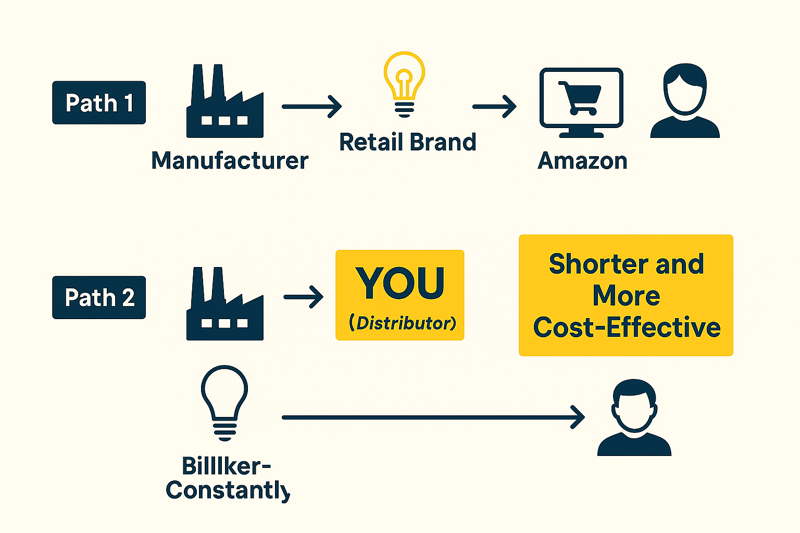
The brands that succeed on Amazon are experts in B2C marketing, not B2B distribution. Their entire business model and cost structure are built around selling directly to the end-user. Let's break down their price. It starts with the price they pay a factory in China (someone like us). To that, they add international shipping and import duties. Then, they add a huge budget for marketing—this includes the cost of their beautiful product photos, advertising on Amazon (PPC), and other promotional activities. On top of that, Amazon itself takes a significant cut of every sale (typically 15% or more). Finally, the brand adds its own profit margin. By the time you see the price on Amazon, it's already been marked up several times. If you were to contact that brand to become a distributor, they would have to offer you a "wholesale" price that is only slightly less than their Amazon price. There is simply no room for you to add your own markup and still be competitive. It’s a supply chain designed for consumers, and you cannot successfully plug a B2B model into it. The only way to get the right price is to bypass the retail brand entirely and go directly to the source manufacturer.
The B2C vs. B2B Cost Structure
Understanding the different cost layers shows why the B2C model doesn't work for wholesale.
| Cost Component Added | B2C Retail Brand (Sells on Amazon) | B2B Direct Manufacturer (Sells to You) |
|---|---|---|
| Manufacturing Cost | Included | This is your base price. |
| International Logistics5 | Included | Included in your landed cost. |
| B2C Marketing & Advertising6 | Huge Expense (10-20%+) | Minimal / Not Included |
| Amazon Referral Fees | Significant Expense (~15%) | N/A |
| Retail Brand's Profit | High Margin Required | N/A |
| Your Distributor Margin | No Room Left | You determine this yourself. |
The costs associated with Amazon's platform and B2C marketing make it impossible for those brands to offer a viable price to a distribution partner.
Related HongYu product pages
- LED Filament Bulb Product Range → — standard and decorative LED filament bulbs for wholesale and project sourcing.
- Contact HongYu Bulb → — send your target specifications, quantity, market and packaging requirements for quotation.
Conclusion
Amazon's best sellers aren't a catalog for you to shop from. They are a free, powerful source of market intelligence to help you make smarter, more profitable B2B sourcing decisions.
Exploring essential features will ensure your products meet customer expectations and stand out in the market. ↩
Understanding popular color temperatures can help you align your product offerings with market demand. ↩
Understanding the causes of flickering and buzzing can help you choose better suppliers and avoid common issues. ↩
Learning about MacAdam ellipses will enhance your knowledge of color consistency, ensuring you select suppliers who meet your standards. ↩
This link will help you understand the role of international logistics in shaping cost structures for both B2B and B2C models. ↩
Exploring this resource will provide insights into effective B2C marketing strategies, crucial for understanding cost structures. ↩