You see these codes—A19, A21, ST64—and face a critical choice for your inventory. Ordering the wrong bulb means tying up capital in products your customers can't use, a costly and frustrating mistake.
Stock the A19 as your high-volume, universal standard for lampshades. Use the A21 for high-brightness needs where a larger bulb fits. Reserve the decorative ST64 for trendy, exposed-bulb fixtures where the bulb itself is the main attraction.

A few years ago, a new buyer from the Netherlands, a very sharp product manager, placed a large opening order with us. He was focused on the decorative market and ordered thousands of our most beautiful amber glass ST64 bulbs. He called me a month later, really concerned. His sales were slow. It turned out his main distribution channel was DIY home stores, where customers were looking for bulbs for their bedside lamps and living room fixtures—all with lampshades. The ST64s were too long to fit under the harp of a standard lamp, and their warm, atmospheric light was too dim for reading. He had the perfect bulb for the wrong customer. We helped him adjust his next order to focus on the classic A19, and his sales took off. That experience taught me a vital lesson: the smartest inventory isn't about the most stylish bulb, it's about matching the right shape to the right application.
What's the Real Difference Between an A19 and an A21 Bulb?
They look almost identical on a webpage. This creates a real risk: Will your customer be angry when the bulb they ordered doesn't fit in their enclosed kitchen fixture?
The A21 is slightly larger and is designed to produce more light, making it the proper LED equivalent for a 100W or 150W incandescent bulb. The A19 is the universal standard size, perfect for replacing 40W, 60W, and 75W bulbs.
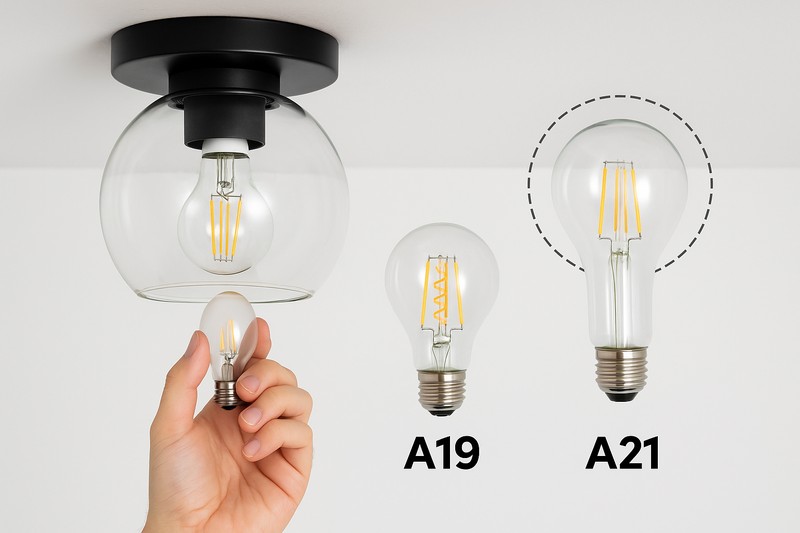
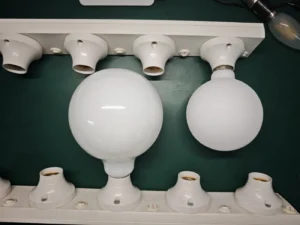
The difference between these two bulbs is subtle but incredibly important for a distributor. Both bulbs share the classic "A" shape, which stands for "Arbitrary," the designation given to the familiar pear-like shape of a standard household light bulb. The number that follows refers to the bulb's diameter at its widest point, measured in eighths of an inch. So, an A19 is 19/8ths of an inch, or about 2.4 inches (60mm) in diameter. An A21 is 21/8ths of an inch, or about 2.6 inches (68mm). While this seems like a tiny difference, it has a huge impact on two things: brightness and fit. The slightly larger glass envelope of the A21 allows our engineers to safely house more powerful LED components and provide better heat dissipation. This is why A21 bulbs are used for high-lumen applications—they are the modern, energy-efficient replacement for old 100W, 125W, or even 150W incandescent bulbs. The A19 is the global standard for everything else. It's the bulb everyone pictures for a lamp, and it's designed to replace the much more common 60W incandescent. The number one rule for your customers: an A19 will always fit in a fixture designed for an A21, but an A21 will often not fit in a fixture designed for an A19.
A Breakdown of "A" Shape Specifications
Understanding the naming convention is the first step to making an informed choice. The letters and numbers are not random; they are a standardized code.
- The Letter "A": Denotes the classic, rounded pear shape of a standard light bulb. It's the most common bulb shape in the world.
- The Number: Represents the diameter of the bulb at its widest point, measured in units of 1/8 of an inch. This is a standard used across the industry, particularly in the North American market.
| Bulb Code | Diameter (Inches) | Diameter (mm) | Typical Use Case |
|---|---|---|---|
| A191 | 2.375" | ~60mm | Universal standard, 40W/60W/75W replacement. |
| A212 | 2.625" | ~68mm | High-brightness applications, 100W/150W replacement. |
Performance and Fitment: The Key Trade-offs
The choice between A19 and A21 comes down to a balance of brightness needed versus the physical space available in the fixture.
- Brightness (Lumens)3: The primary reason to choose an A21 is for more light. If a customer needs to brightly illuminate a large space like a kitchen or a workshop with a single bulb, the A21 is the correct technical choice.
- Fitment: This is the most common point of failure for customers. A larger A21 bulb may not fit in enclosed fixtures (like outdoor lanterns or some ceiling domes) or under the metal "harp" that holds a lampshade in place. The A19 is the safer bet for universal compatibility. For a B2B buyer like Jacky, this means the A19 is your high-volume, low-risk inventory core. The A21 is a more specialized, problem-solving product for customers with specific high-lumen needs.
| Feature | A19 Bulb | A21 Bulb | B2B Stocking Strategy |
|---|---|---|---|
| Common Lumen Output | 450lm / 800lm / 1100lm | 1600lm / 2500lm | Stock A19 heavily as the default. |
| Incandescent Equivalent | 40W / 60W / 75W | 100W / 150W | A21 serves the high-wattage replacement market. |
| Universal Fit4 | Excellent | Limited | A19 has fewer customer complaints about fit. |
| Primary Market | General Residential | Commercial, Utility, Large Rooms | A19 is the volume play. |
When Should You Choose the ST64 Over an A-Shape Bulb?
You see the ST64 is popular in stylish cafes and restaurants. But you worry if it's a versatile bulb or a niche product that will only appeal to a small group of design-focused customers.
Choose the ST64 only when the bulb itself is meant to be a visible part of the decor. Its purpose is aesthetic. For any application where the bulb is hidden by a lampshade or fixture, the A19 is the superior and more cost-effective choice.
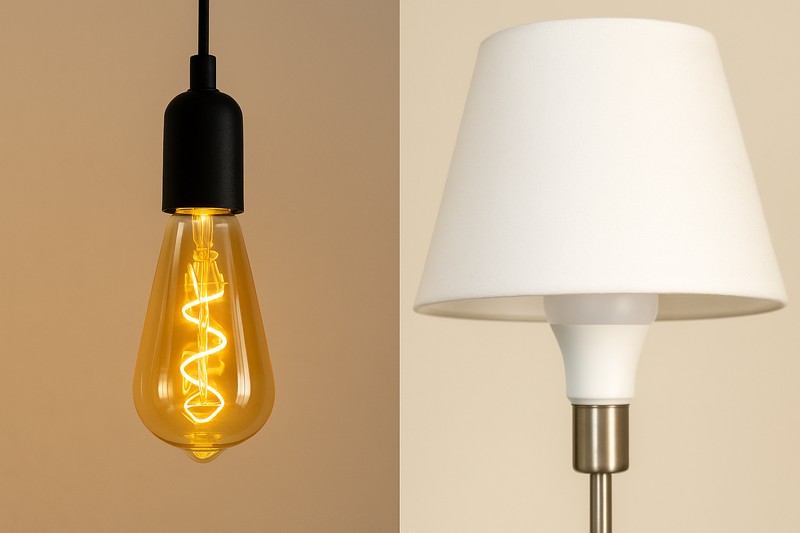
The shift from an A-shape bulb to an ST64 is a shift in philosophy. The "A" bulb is a functional object designed to create light. The ST64 is a decorative object that also happens to create light. Its entire reason for being is to be seen. The "ST" stands for "Squirrel cage Teardrop," referring to the vintage shape and the visible filaments inside. The number "64" represents its diameter in millimeters (not eighths of an inch like the "A" series), which is about 2.5 inches. It is noticeably longer and more elegant than an A19. This shape was specifically designed for the bare-bulb pendants, open-caged sconces, and multi-light "spiders" that are central to the industrial, farmhouse, and rustic design trends. Its visual appeal, especially with amber glass and a warm spiral filament, is its primary selling feature. Using an ST64 inside a lampshade is not only a waste of money (since you are paying for its beautiful shape that no one will see), but it often doesn't fit properly due to its extra length. For your inventory, the A19 is the functional workhorse. The ST64 is the high-margin, style-driven product that you sell to customers who are buying decor, not just illumination.
Design Intent: The Core Difference
The intended use of the bulb should guide your customer's selection.
- A-Shape (A19/A21)5: Designed for Omni-directional Light. The bulb's rounded shape is engineered to cast a wide, even spread of light in all directions. This makes it perfect for lighting up a lampshade from within and providing general room illumination. Its appearance is secondary.
- ST-Shape (ST64)6: Designed to be Looked At. The bulb's elongated, teardrop shape is purely for visual appeal. Its light is often warmer and dimmer, intended to create an atmosphere or "vibe" rather than for task lighting. Its appearance is primary.
Application Mismatches to Avoid
Educating your customers on these common mistakes will prevent returns and build your reputation as an expert supplier.
- Don't Use ST64 for Reading Lamps7: The warm, dim light from a typical amber ST64 (around 2200K color temperature and 300-400 lumens) is not suitable for tasks that require visual acuity. A standard 2700K, 800-lumen A19 is the correct choice.
- Don't Hide an ST64: The premium cost of an ST64 is for its shape and filament. If it's hidden behind a diffuser or shade, that money is wasted. A standard A19 will provide better light for less cost in that application.
- Check the Dimensions8: The length of an ST64 is its most common fitment issue. It can stick out of the bottom of smaller shades or clash with the scale of a small fixture.
| Feature | A-Shape (A19) | ST-Shape (ST64) | Key Customer Question |
|---|---|---|---|
| Primary Purpose | Functional Illumination | Decorative Atmosphere | "Will you see the bulb itself?" |
| Best Used | Inside lampshades, enclosed fixtures | Exposed in pendants, sconces | If yes, consider ST64. If no, use A19. |
| Typical Light | Bright, even, omni-directional | Warm, atmospheric, directional | "What is the goal: to see, or to set a mood?" |
| Design Style | Universal / Traditional | Industrial / Rustic / Vintage | Match the bulb to the room's decor. |
Which Bulb Offers the Best Profit Margin and Market Demand?
As a business owner, you need to know where to invest your inventory dollars. Which of these bulbs offers the best return, and what is the balance between sales volume and profit per unit?
The A19 is your high-volume, foundation product with thinner margins. The ST64 is your high-margin, trend-driven product. The A21 is a lower-volume, specialized problem-solver. A smart inventory includes all three, balanced accordingly.
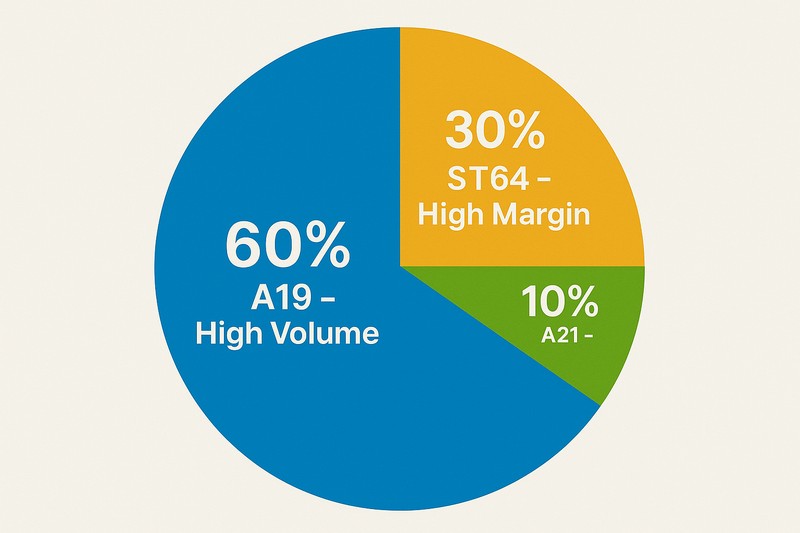
This is the most important question for any buyer. The answer lies in building a strategic product pyramid. At the base of your pyramid is the A19. You will sell more A19 bulbs than any other shape. It is a commodity, a staple product for every home and business. Because the volume is high, the market is competitive, and the profit margins are typically tighter. This is your reliable, steady-turnover business. At the top of the pyramid is the ST64. You will sell fewer units of the ST64, but each sale will be more profitable. The customer buying an ST64 is making a design choice, and they have a higher willingness to pay for the specific aesthetic they want. This is where you make your best margins. The A21 sits somewhere in the middle as a niche, functional upgrade. Demand is lower but consistent from customers who need a high-brightness solution. A successful business doesn't choose just one; it understands the role of each. You need the A19 for cash flow and market presence. You need the ST64 for profitability and to show that your brand is current with design trends. And you need the A21 to prove you have a complete, professional-grade lighting solution for every need.
Structuring Your Inventory for Success
Think of your inventory not as a list of products, but as a portfolio designed to meet different market needs.
- The Foundation (High Volume, Lower Margin9): The A19. This is your non-negotiable core product. Offer it in the most popular wattages (60W equivalent - 800 lumens is key) and color temperatures (2700K Warm White). This is what keeps your business running.
- The Profit Engine (Medium Volume, High Margin10): The ST64. This is your style product. Offer it in clear and amber glass, with attractive spiral filaments. This is what makes your business profitable. Focus on the 40W or 60W equivalent, as the goal is atmosphere, not overwhelming brightness.
- The Specialist (Low Volume, Medium Margin): The A21. This is your problem-solver. Stock the 100W equivalent (around 1600 lumens) as a standard. It shows you are a serious supplier who can handle high-output requirements for commercial or utility applications.
| Bulb Type | Sales Volume | Profit Margin per Unit | Strategic Role in Inventory |
|---|---|---|---|
| A19 | Very High | Low | Cash Flow & Market Presence |
| ST64 | Medium | High | Profitability & Brand Image |
| A21 | Low | Medium | Niche Problem-Solver & Professional Credibility |
By balancing your inventory with this strategy, you service the largest part of the market with the A19 while maximizing your profitability with the higher-value ST64.
Related HongYu product pages
- LED Filament Bulb Product Range → — standard and decorative LED filament bulbs for wholesale and project sourcing.
- Contact HongYu Bulb → — send your target specifications, quantity, market and packaging requirements for quotation.
Conclusion
Master your inventory by matching the bulb to the job: A19 for universal function, A21 for high-power needs, and the ST64 for profitable, decorative style. This targeted approach ensures customer satisfaction and business success.
Explore this link to understand the A19 bulb's specifications and its common applications in residential settings. ↩
Discover the benefits of A21 bulbs, especially for high-brightness applications, and how they can enhance your lighting solutions. ↩
Learn how lumens impact your choice of light bulbs, ensuring you select the right brightness for your space. ↩
Find out why universal fit is crucial for light bulb compatibility and how it affects your purchasing decisions. ↩
Explore the unique features of A-Shape bulbs for optimal room illumination. ↩
Discover how ST-Shape bulbs enhance decor and create the perfect atmosphere. ↩
Learn about common lighting mistakes to avoid for better visual clarity. ↩
Understanding dimensions can prevent fitment issues and enhance your lighting choices. ↩
Understanding this strategy can help you optimize your inventory for better cash flow and market presence. ↩
Exploring this concept can reveal ways to enhance your brand image and overall profitability. ↩
Browse from HongYu Bulb: EU Standard LED Filament Bulbs → · EU Vintage Straight Filament Bulbs →