Your customers still ask for "60-watt bulbs," but listing an LED by its low actual wattage causes confusion. This disconnect risks customer dissatisfaction and lost sales if the brightness doesn't meet expectations.
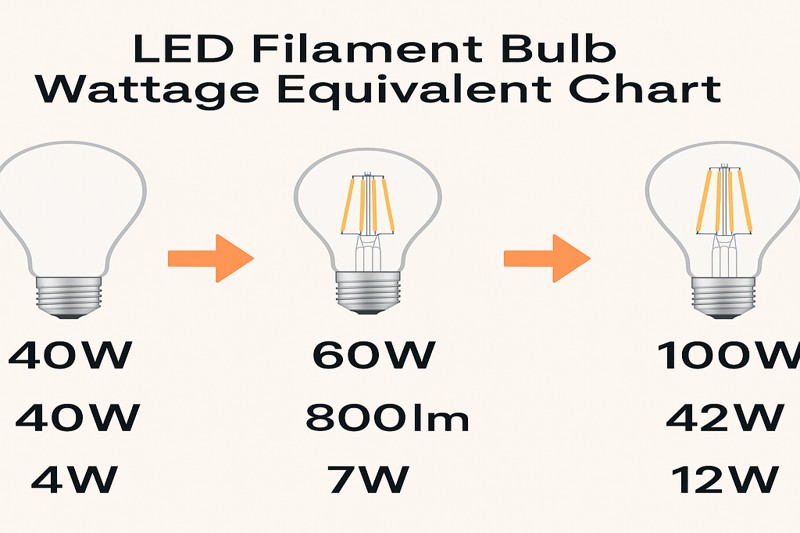
Focus on lumens, not watts. A 60W incandescent is equivalent to an 800-lumen LED, a 40W is 450 lumens, and a 100W is 1600 lumens. This lumen-to-wattage translation is the new standard for ensuring accurate brightness and customer satisfaction.
I remember when we first started heavily promoting our LED filament bulbs. A product manager from a large American distributor, let's call him Jacky, was putting together his retail packaging. He called me, sounding very frustrated. "Wallson," he said, "my designer put '7 Watts' in big letters on the box for a 60-watt equivalent bulb. My sales team says customers will think it's dim and won't buy it. But my legal team says we can't put '60 Watts' because it's not accurate. What do I do?" This was a problem we were seeing everywhere. The entire industry was struggling to re-educate a century's worth of consumer habits. It taught me that our job as a manufacturer isn't just to make great bulbs; it's to give our partners like Jacky the knowledge they need to sell them effectively. The key was to shift the conversation from watts to lumens.
Why Are Lumens More Important Than Watts for LEDs?
Your customers are stuck on watts, a familiar metric. But you know that for LED technology, watts are a poor measure of brightness, creating confusion and the potential for costly returns.
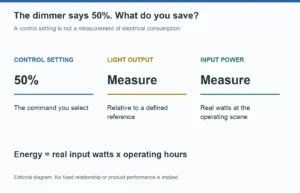
Watts measure energy consumption, not light output. Lumens measure brightness directly. Since LEDs are vastly more energy-efficient, comparing the wattage of an LED to an incandescent is like comparing apples and oranges; only lumens provide an accurate brightness comparison.
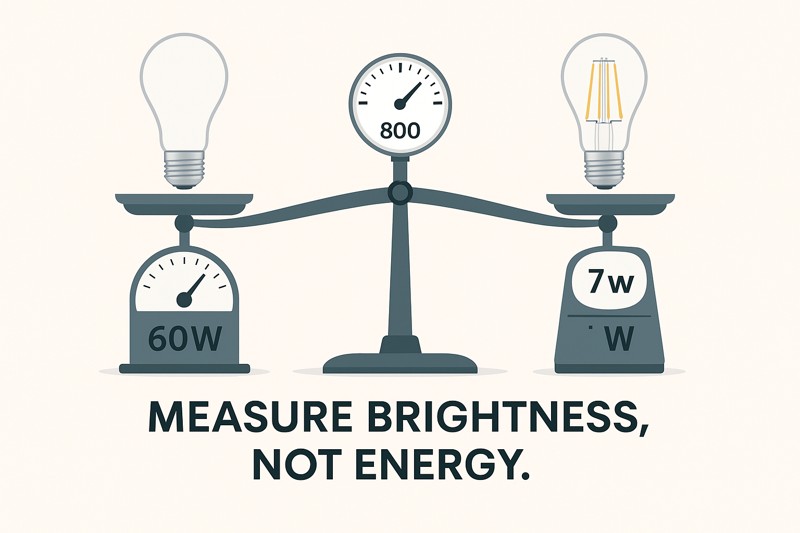
This is the single most important concept to master when selling LED lighting. For over a hundred years, the technology of incandescent bulbs was fairly standard. A 60-watt bulb from any manufacturer produced a roughly similar amount of light. As a result, we were all trained to associate the energy consumed (watts) with the brightness produced. It was a simple, reliable shortcut. LED technology completely broke this connection. An LED is a semiconductor, fundamentally different from a glowing hot wire (a filament). It can produce the same amount of light using a fraction of the energy. For example, a Hongyu Bulb LED can produce 800 lumens of light (the same as a 60W incandescent) while consuming only 6-7 watts of energy. If you sold this as a "7-watt bulb," your customer would assume it's incredibly dim, like an old 7W nightlight bulb. If you sold it as a "60-watt bulb," it would be technically inaccurate and misleading about its energy-saving benefits. This is why the entire lighting industry, led by bodies like the U.S. Federal Trade Commission (FTC), has shifted to using lumens as the primary metric for brightness on packaging. It's the only honest and accurate way to compare bulbs across different technologies. Teaching your customers to "shop for lumens" is the key to preventing confusion.
Watts vs. Lumens: The Core Concepts
Understanding this distinction is critical for your sales team and your customers.
- Watt (W): A unit of power. It tells you how much electrical energy a device consumes per second. It is a measure of cost to operate.
- Lumen (lm)1: A unit of luminous flux. It tells you the total amount of visible light produced by a source. It is a measure of brightness.
- Efficacy (lm/W)2: This is the "miles per gallon" for light bulbs. It measures how efficiently a bulb converts energy (watts) into light (lumens). Incandescent bulbs have a very low efficacy (around 13 lm/W), while LEDs have a very high efficacy (often over 100 lm/W).
The Essential Wattage Equivalent Chart
This chart is the most valuable tool for you and your customers. It directly translates the old wattage language into the new lumen standard.
| Old Incandescent Wattage | Required Brightness (Lumens) | Typical LED Filament Power (Watts) | Energy Savings |
|---|---|---|---|
| 25W | ~250 lumens | 2-3W | ~90% |
| 40W | ~450 lumens | 4-5W | ~90% |
| 60W | ~800 lumens | 6-8W | ~90% |
| 75W | ~1100 lumens | 9-10W | ~88% |
| 100W | ~1600 lumens | 12-14W | ~87% |
| 150W | ~2600 lumens | 20-25W | ~85% |
As a business owner like Jacky, you should print this chart and make it available to your sales staff. On your website and packaging, the correct format is to state the lumens prominently, followed by the wattage equivalency, like this: "800 Lumens (60-Watt Equivalent)."
How Does Color Temperature Affect Perceived Brightness?
You've sold a customer an 800-lumen bulb, a perfect 60W replacement. But they complain that it feels "dimmer" than their old bulb. This dissatisfaction could stem from a misunderstanding of color temperature.
While lumens measure the total light output, the color temperature (Kelvin) affects how our eyes perceive that light. A cooler, bluer light (4000K) often appears "brighter" or "harsher" to the human eye than a warmer, yellower light (2700K) of the exact same lumen value.
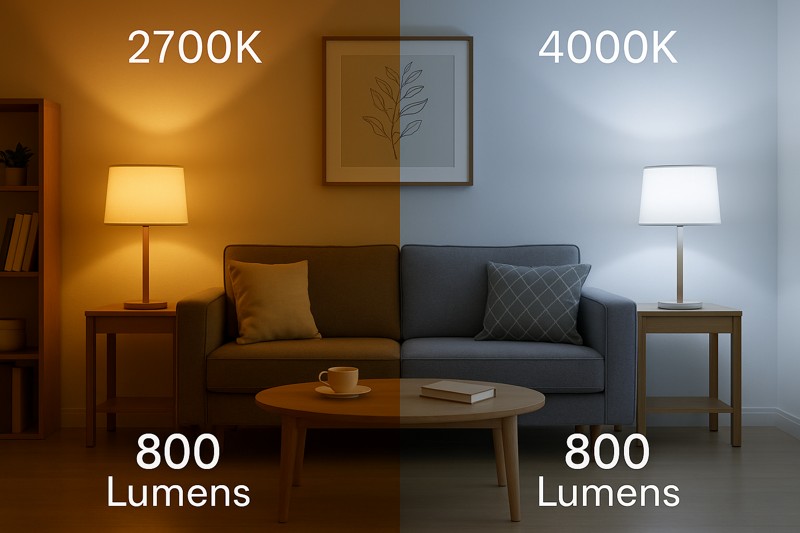
This is a subtle but crucial factor that often trips up even experienced buyers. Lumens are a pure, scientific measurement of light output. However, human perception is much more complex. We are psychologically conditioned to associate the warm, yellowish glow of a sunset or a fire with relaxation and evening. This is the light produced by traditional incandescent bulbs, which falls at around 2700 on the Kelvin (K) color temperature scale. Conversely, we associate the cooler, bluer light of midday sun with activity and alertness. This is typically 4000K to 5000K. When a customer replaces a 2700K incandescent bulb with a 2700K LED filament bulb of the same lumen output, the transition is seamless. But if they inadvertently choose a very warm 2200K "vintage amber" LED bulb, it will have a deep orange glow. Even at 800 lumens, this light can feel "dimmer" or "less effective" because our eyes are less sensitive to this end of the spectrum, and we associate that color with candlelight, not general illumination. As a supplier, it's vital to guide customers not just on lumens, but on the appropriate Kelvin for the application to ensure the perceived brightness matches their expectations.
Choosing the Right Kelvin for the Job
Matching the color temperature to the room's function is key to customer satisfaction.
- 2200K (Vintage Amber Light): The color of candlelight. This is purely for atmosphere and decoration. It creates a very warm, intimate, and relaxing mood. Best for decorative pendants in bars, restaurants, or cozy living room corners. Not for tasks.
- 2700K (Warm White)3: The standard color of incandescent bulbs. This is the most popular choice for general residential lighting—living rooms, bedrooms, dining rooms. It's inviting, comfortable, and provides excellent color rendering for a natural look. This should be your default offering.
- 3000K (Soft White): A slightly crisper, whiter light. Often used in kitchens and bathrooms where a cleaner, slightly more modern feel is desired without being harsh.
- 4000K (Cool White)4: A neutral, white light similar to midday sun. It promotes alertness and focus. Best for commercial and industrial settings like offices, workshops, garages, and retail spaces. It can feel sterile in a home environment.
The Relationship Between Lumens, Kelvin, and Application
| Application | Recommended Lumens | Recommended Kelvin (K) | Why it Works |
|---|---|---|---|
| Bedroom Reading Lamp | ~450 lumens | 2700K | Bright enough to read, but warm and relaxing. |
| Kitchen Main Fixture | ~1600 lumens | 3000K or 4000K | Bright, clean light for food prep and visibility. |
| Living Room Lamps | ~800 lumens | 2700K | Comfortable, inviting light for general activities. |
| Restaurant Accent Pendant | ~250 lumens | 2200K | Creates a moody, intimate, and decorative effect. |
| Office Overhead Lighting | ~1100 lumens per fixture | 4000K | Neutral, alert light that reduces eye strain. |
By advising on both lumens and Kelvin, you position yourself as an expert and ensure your customers get the exact lighting effect they want, preventing returns.
Do Wattage Equivalents Matter When Choosing Dimmable LEDs?
A customer buys a "60W Equivalent" dimmable LED, but it flickers or doesn't dim smoothly. They blame your bulb, threatening your reputation, when the real issue is a compatibility mismatch.
No, wattage equivalency is unrelated to dimming performance. Smooth, flicker-free dimming depends entirely on the quality of the bulb's internal driver and its compatibility with the specific dimmer switch being used. Always choose a bulb with a high-quality IC driver.
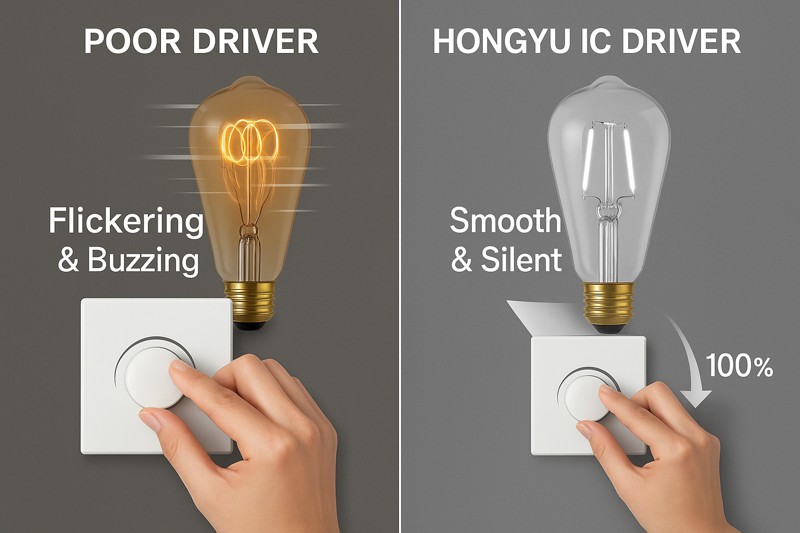
This is one of the biggest pain points in the LED transition. In the old incandescent world, dimming was simple. A dimmer just reduced the voltage to the filament, and the light got dimmer. It always worked. LEDs are different. They are complex electronic devices that require a constant forward voltage. To dim them, a sophisticated internal component called a driver is needed. The driver essentially chops up the power very quickly, and the dimming effect is created by changing the duration of the "on" and "off" cycles. The quality of this driver is everything. A cheap bulb will use a simple, low-cost "linear" driver. These are highly susceptible to fluctuations and are the main cause of the flickering, buzzing, and limited dimming range that customers complain about. A high-quality manufacturer like Hongyu Bulb uses superior IC (Integrated Circuit) drivers. These are "smart" drivers that actively manage the power, communicate better with the dimmer switch, and smooth out the electrical supply to provide a clean, stable light. This results in the smooth, silent, and wide-range dimming performance that professional customers expect. The bulb's lumen output or wattage equivalency (e.g., 60W or 100W) has absolutely no bearing on this function. The magic is all in the driver.
The Driver is the Heart of the Bulb
Educating your customer about the importance of the driver protects you from unfair complaints.
- Low-Cost Linear Drivers: Found in cheap, big-box store bulbs. They have a very limited list of compatible dimmers and are prone to flickering, especially at low light levels. They often have an audible buzz. This is the source of most dimming complaints.
- High-Quality IC Drivers5: Found in professional-grade bulbs. They have a much wider compatibility range with common dimmers (like Lutron and Leviton). They provide smooth dimming, often down to 10% or lower, with no flicker or noise. This is the standard we use at Hongyu Bulb.
- Compatibility is Key6: There is no universal standard for dimmers. Even with a high-quality IC driver, there can be rare mismatches. As a reliable supplier, we test our bulbs with a wide range of common dimmer models and can provide compatibility lists to help your customers choose the right combination, minimizing issues.
How to Sell Dimmable Bulbs with Confidence
| Buyer Concern | The Wrong Answer | The Right Answer (Your Expert Advice) |
|---|---|---|
| "Will this flicker?" | "It's a 60-watt equivalent, it should be fine." | "Our bulbs use high-quality IC drivers to prevent flicker. For best results, use a modern CL-style dimmer." |
| "How low will it dim?" | "It's dimmable." | "It is designed to dim smoothly down to 10% with most compatible dimmers. We can provide a list." |
| "It's buzzing." | "The bulb must be defective." | "Buzzing is almost always a sign of incompatibility between the dimmer and the bulb's driver. Let's check your dimmer model." |
By focusing the conversation on driver quality and dimmer compatibility, not on wattage, you demonstrate true expertise and build trust as a reliable partner.
Related HongYu product pages
- LED Filament Bulb Product Range → — standard and decorative LED filament bulbs for wholesale and project sourcing.
- Contact HongYu Bulb → — send your target specifications, quantity, market and packaging requirements for quotation.
Conclusion
Forget watts; focus on lumens and Kelvin to ensure correct brightness and mood. Use the standard chart for easy conversion, empowering your customers to choose the right light and solidifying your role as their expert supplier.
Understanding lumens is essential for choosing the right lighting for your needs, ensuring optimal brightness and energy efficiency. ↩
Learning about efficacy helps you select energy-efficient bulbs, saving money and reducing environmental impact. ↩
Explore the advantages of 2700K lighting for creating inviting and comfortable spaces in your home. ↩
Discover how 4000K lighting can enhance focus and alertness in commercial and industrial settings. ↩
Understanding High-Quality IC Drivers can help you choose the best lighting solutions, ensuring optimal performance and satisfaction. ↩
Exploring compatibility in dimmable LED bulbs can prevent flickering and buzzing, enhancing your overall lighting experience. ↩