You see scrap metal, old wood, and empty bottles as trash. But your competitors see them as high-margin "vintage" inventory. You are missing a massive revenue stream by ignoring the global upcycling movement.
Upcycling pairs vintage waste materials—like industrial piping, mason jars, or reclaimed wood—with modern LED filament technology. The low heat of LEDs allows safe installation in diverse materials, creating unique, high-value "steampunk" or "rustic" fixtures that appeal to eco-conscious consumers.
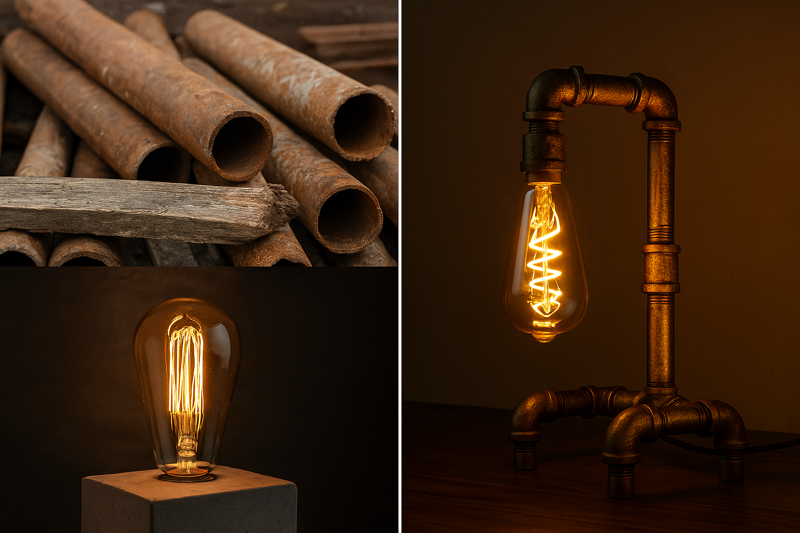
It is funny how trends work. I was walking through a flea market in London last month with a potential client. He pointed to a lamp made from an old 1950s telephone. Ideally, this is junk. But he was willing to pay $200 for it. Why? Because it had a story. As a manufacturer, I used to think we only sold glass and electronics. But now I realize we supply the "engine" for the global maker movement. The biggest barrier to turning old objects into lamps used to be heat. Old tungsten bulbs get hot enough to burn wood or crack vintage glass. LED filament technology changed this. It runs cool. This means you can put a light bulb inside almost anything without starting a fire. This opens up a completely new product line for your business: "Upcycled Decor."
Why Is Rusty Plumbing Equipment Suddenly Worth More Than Gold?
Industrial chic is everywhere. Customers pay a premium for items that look like they were ripped out of a 1920s factory, even if they are brand new.
This is the "Steampunk" aesthetic. By combining standard iron plumbing pipes with warm 2200K spiral filament bulbs, you create rugged, masculine desk lamps and wall sconces. The LED's cool running temperature ensures the metal pipes do not become dangerously hot to the touch.
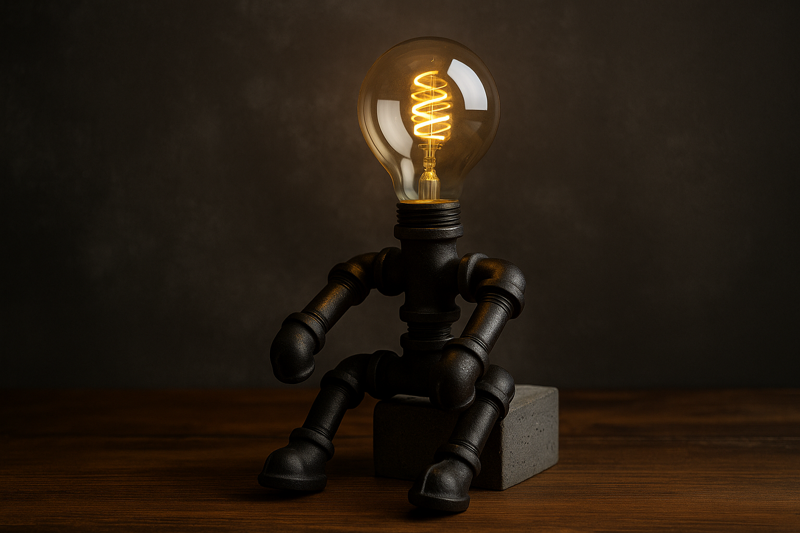
If you browse Etsy or Amazon Handmade, you will see "Pipe Lamps" selling for huge margins. The raw materials are cheap iron fittings from a hardware store. The value comes from the design and the light source.
The Heat Transfer Advantage
In the past, making a lamp out of metal pipes was risky with incandescent bulbs. Metal conducts heat. If you put a 60W incandescent bulb inside a metal cage or attached to a metal pipe, the entire fixture would become a burn hazard within ten minutes. A child touching the base of the lamp could get hurt.
With Hongyu LED filament bulbs1, the surface temperature of the glass rarely exceeds 40-50 degrees Celsius. The metal pipes create a natural heat sink, dissipating the tiny amount of heat the LED produces. This makes the fixture completely safe for residential use. You can market these lamps as "Kid Safe2" features, which is a strong selling point for family buyers.
The "Lego" Modularity for Designers
Pipes are like Lego bricks for adults3. You can screw them together to make wall shelfs, suspended ceiling grids, or table lamps. The key is choosing the right bulb to match the "tough" look. A standard white plastic LED bulb looks terrible here. It breaks the illusion. You must use a clear or amber-tinted filament bulb.
- ST64 (Teardrop): This is the classic choice. It mimics the early 20th-century aesthetic perfectly.
- T45 (Tube): This works well for wall sconces where the bulb sits parallel to the pipe.
- Spiral Filament: This adds a "high-tech retro" confusing but cool look. The flexible LED filament looks like a glowing heater coil, which fits the industrial theme perfectly.
Pipe Fitting vs. Bulb Pairing Guide
| Pipe Construction | Best Bulb Model | Why? |
|---|---|---|
| Robot / Human Shapes | G95 or G125 Globe | Acts as an oversized "head" for the figure. |
| Wall Sconce (Vertical) | T30 Long Tube | Mimics the shape of the pipe itself. |
| Desk Lamp (Angled) | ST64 Edison | The classic "Pixar" lamp look but vintage. |
| Chandelier Grid | A60 Standard | Keeps the focus on the complex pipe structure. |
When you sell these, do not just sell the bulb. Sell the "Industrial Kit4"—the bulb plus the socket.
Can You Really Turn Empty Whiskey Bottles into a High-End Chandelier?
Bars throw away hundreds of beautiful glass bottles every week. You can collect this free raw material and transform it into a luxury lighting installation.
Glass bottle upcycling relies on the slender profile of T30 or T45 tube filament bulbs. These long bulbs fit through the narrow necks of wine and spirit bottles, turning the glass container into a tinted shade that diffuses light and creates a speakeasy atmosphere.
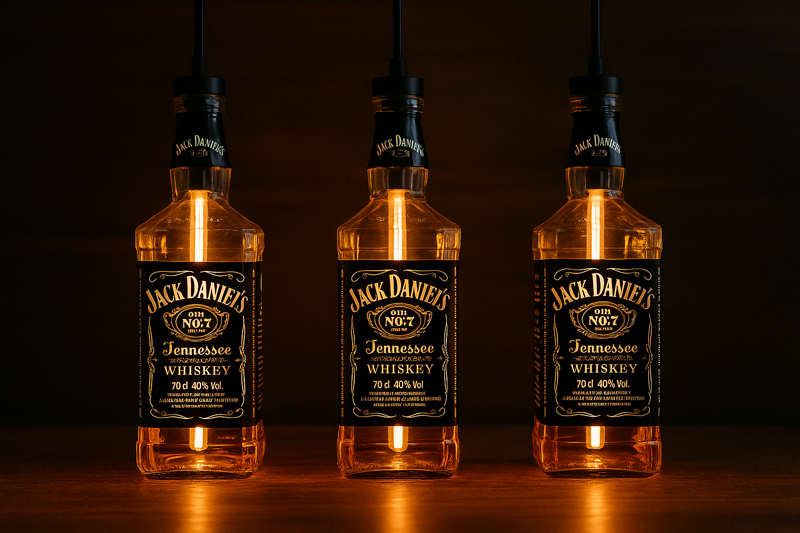
I have a client in the UK who supplies lighting to pubs. His entire business model is asking the pubs for their empty gin and whiskey bottles, cutting off the bottoms, and selling them back to the pubs as lighting fixtures for $150 each. The profit margin is insane. But this only works because of specific LED bulb shapes.
The Geometry of the Fit
The neck of a standard wine or liquor bottle is very narrow, usually around 18mm to 20mm internal diameter. A standard A60 bulb is 60mm wide. It will not fit.
This is where the T30 and T25 LED Filament Bulbs5 are essential.
- The T30: It is 30mm wide. This fits inside wide-mouth jars and some decanters.
- The T25: It is 25mm wide. This fits inside many spirit bottles.
- The Integrated String Light6: For very narrow bottles, we create a specific "cork light" where the LEDs are on a wire string attached to a fake plastic cork.
The "Tube" shape effectively turns the bottle into a glowing rod. It highlights the label and the color of the glass. If you use a green Jägermeister bottle, the light turns green. If you use a clear vodka bottle, it is bright and crisp.
Processing the Glass
For your customers who are "Makers," you need to explain the challenge of heat. Even though LEDs are cool, a sealed glass bottle is a greenhouse. Heat has nowhere to go.
If you use a cheap LED bulb, the driver (the electronic chip) inside the base will overheat and fail because there is no airflow inside the bottle.
At HongYu Bulb, we use high-temperature resistant capacitors7 in our T30 series specifically for enclosed fixtures. We advise customers to either:
- Cut the bottom off the bottle (This is best for airflow and changing the bulb).
- Drill ventilation holes (Hard to do without breaking glass).
- Use low-wattage bulbs8 (2W or 4W acts as decoration, 8W is too hot for a sealed bottle).
Bottle Type vs. Recommended Lighting Solution
| Bottle Type | Neck Width | Recommended Product | Drilling Light Effect |
|---|---|---|---|
| Wine Bottle | ~18mm | Copper Wire String Light (Battery/USB) | Starry / Fairy dust look. |
| Whiskey (Square) | ~25mm | T25 Filament Bulb | Strong vertical bar of light. |
| Mason Jar (Wide) | ~70mm | ST64 or A60 Bulb | Lantern / Farmhouse look. |
| Decanter | Variable | G45 Mini Globe | Crystal refraction / Sparkle. |
This transforms waste into a centerpiece.
Is Driftwood the Cheapest High-Design Material You Are Ignoring?
Minimalist design often feels cold. Buyers are craving organic textures to warm up their spaces, but manufacturing "natural" looks is expensive unless you use found materials.
Reclaimed wood fixtures utilize the contrast between rough, organic textures and the clean, precision glass of a G125 globe bulb. The low wattage of LED filaments prevents fire hazards, allowing you to embed lights directly into dry logs, beams, or driftwood without metal heat shields.
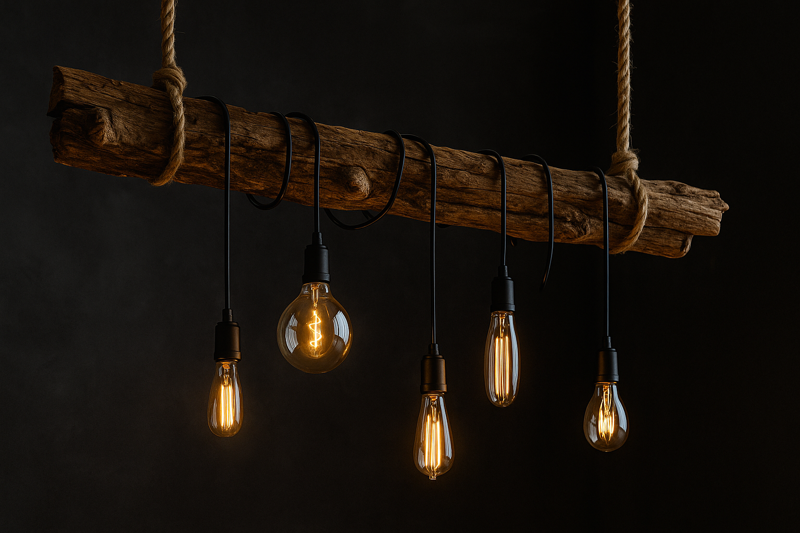
There is a massive trend in interior design called "Biophilic Design"—bringing nature indoors. People want wood, stone, and plants. I saw a hotel lobby in California where they simply took a giant fallen tree branch, suspended it from the ceiling with chains, and wrapped our pendant lights around it. It looked like a million dollars. The cost of the wood? Zero.
The Fire Safety Factor
I cannot stress this enough: Wood is flammable. In the old days, if a 100W incandescent bulb touched a dry piece of driftwood, it would eventually char the wood and could start a fire. This liability meant manufacturers had to put ugly metal cages or heat shields around the bulb. This ruined the natural look.
LED filament bulbs solve this. You can have the glass of the bulb touching the wood directly. I have even seen designers hollow out a log and put the bulb inside perfectly.
Because the heat sink of a filament bulb is usually in the metal screw base, as long as the base has a tiny bit of air, the glass surface is safe. This allows for "embedded" designs that were previously illegal under safety codes.
The "Live Edge" Aesthetic
The combination of the "Live Edge" (raw bark) and the "Soft Filament" is powerful.
- Texture Contrast: The glass is smooth and shiny. The wood is rough and matte. This contrast catches the eye.
- Color Harmony: Wood is brown/red. The 2200K light from our amber bulbs is golden/orange. These are "analogous colors" on the color wheel. They blend perfectly. If you used a cool white (6000K) bulb, it would look blue and sickly against the wood. Always use 2200K or 2700K for wood projects.
- Installation: You can use simple "pendant cord kits." Drill a hole in the wood, pass the wire through, and let the socket hang. It is the easiest manufacturing process in the world.
Wood Finishes vs. Color Temperature Guide
| Wood Tone | Best Color Temp (CCT) | Effect |
|---|---|---|
| Pine / Light Birch | 3000K (Warm White) | Keeps the wood looking fresh and airy (Scandi style). |
| Oak / Walnut | 2700K (Soft White) | Brings out the rich grain patterns. |
| Driftwood (Grey) | 2200K (Extra Warm) | Warms up the cold grey tones of the wood. |
| Burnt / Charred Wood | 2200K (Amber Glass) | Creates a moody, fireplace-like glow. |
You are selling a connection to nature, powered by technology.
How Do You Transform Kitchen Utensils into Restaurant-Grade Decor?
Walk into a trendy taco spot or a vegan cafe. Look up. The lights aren't crystal chandeliers; they are cheese graters, metal colanders, and wire whisks.
Kitchenware upcycling uses perforated metal objects as ready-made shades. Standard A60 or ST64 filament bulbs project light through the holes, casting intricate shadow patterns on the walls. This creates an immersive dining experience using low-cost, durable materials that are easy to source.
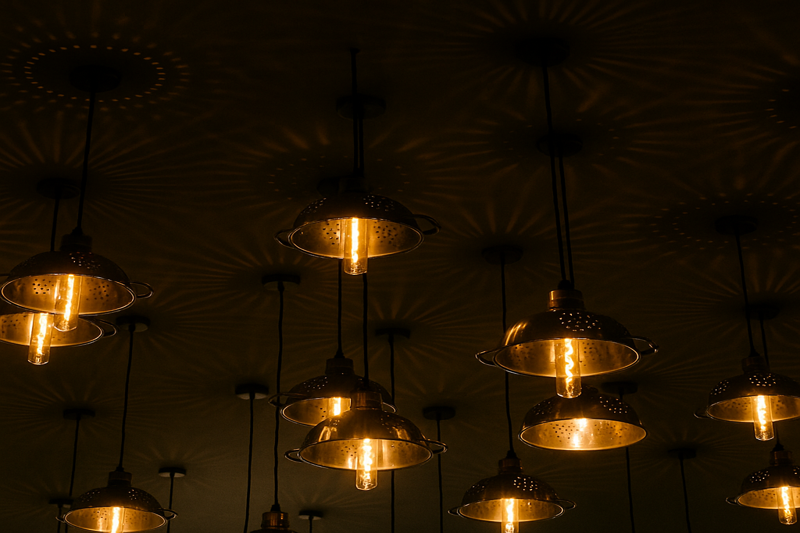
The restaurant industry is brutally competitive. Owners want unique decor but have no budget. I advise my B2B clients who sell to restaurant outfitters to look at "Thematic Upcycling." Using kitchen tools as lights tells the customer: "We care about food."
The Shadow Play
The magic here is not the object itself, but what the object does to the light. A metal colander is just a bowl with holes. But when you put a single, bright point of light inside it (like a clear filament bulb), it acts like a projector. It sprays dots of light all over the ceiling. It turns a boring white ceiling into a galaxy of stars.
- Bulb Choice Matters: You must use Clear Glass bulbs. Do not use Milky/Frosted bulbs. A frosted bulb diffuses the light too much, and the shadows will be blurry and soft. A clear filament creates sharp, crisp shadows.
- Silver Bowl Bulbs: We also make "Half-Chrome" or "Silver Bowl" bulbs. The bottom half is covered in a mirror. This reflects the light up into the colander, which then reflects it down. This stops the glare from hitting the diner's eyes directly while maximizing the reflection off the metal utensil.
Customization for Chains
I worked with a bakery chain that wanted custom lights. Manufacturing custom metal shades is expensive (tooling costs, molds, etc.). Instead, they bought 500 industrial wire whisks. We shoved a small G45 bulb inside each whisk. It looked like a drop of dough trapped in the whisk.
It cost them pennies compared to custom fabrication. And the customers loved it—it was Instagram gold.
This approach allows for rapid theming.
- Italian Restaurant: Colander lights.
- Bakery: Whisk or Rolling Pin lights.
- Bar: Cocktail shaker lights.
Pattern Generation Guide by Utensil
| Utensil | Hole Pattern | Light Effect |
|---|---|---|
| Colander | Small Circles | Starry Night / Galaxy effect. |
| Cheese Grater | Slits and Dots | Industrial "matrix" rain effect. |
| Wire Whisk | Vertical Lines | Cage-like, linear shadows. |
| Mason Jar Ring | None (Glass) | Circular refraction rings. |
This is how you turn a $2 tool into a $50 design feature.
Why Are Designers Putting Light Bulbs Inside Old Cameras and Trumpets?
Collectors love nostalgia. Combining a beloved vintage object with a functional light source creates a "statement piece" that commands a massive price tag.
Refurbishing vintage cameras or brass instruments as lamps requires compact, low-heat light sources like the G45 or C35 filament bulb. These small bulbs fit into lens cavities or horn bells, repurposing the object as a functional sculpture without damaging the original antique components.
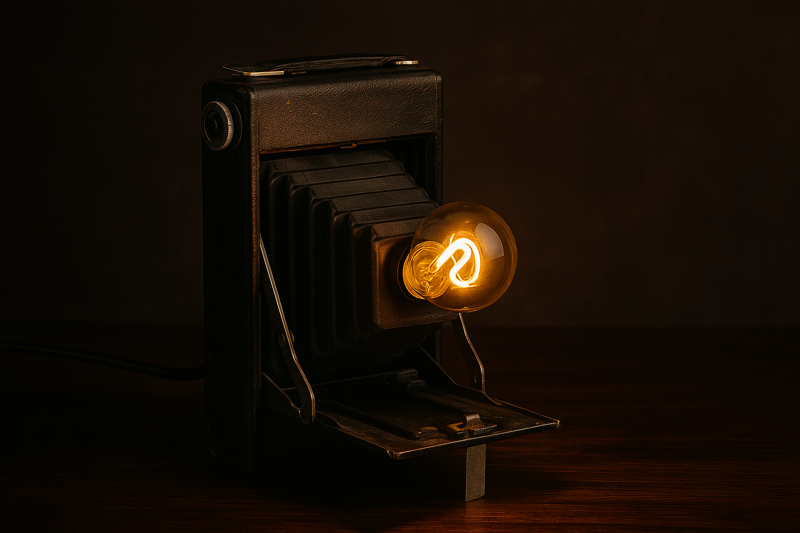
This is a niche market, but the margins are the highest. I know a maker in New York who buys old, broken trumpets and saxophones. He cleans them and puts a bulb in the bell. He sells them for $500 to jazz clubs.
The "High Value/Low Volume" Model
Unlike the bottle lights, which are cheap and fast, this is about craftsmanship. The key here is preservation. The buyer loves the camera or the trumpet. They do not want you to destroy it.
- Non-Destructive Lighting: Because Hongyu LED bulbs have standard E14 or E12 (candelabra) bases, you can often fit them into existing openings without drilling huge holes in the antique.
- Heat Sensitivity: A vintage Bakelite camera or a lacquered brass instrument can be damaged by heat. Old lacquer peels; Bakelite becomes brittle. Again, the LED filament is the savior. It preserves the integrity of the antique materials.
The "Flash" Aesthetic
For cameras specifically, the goal is to mimic the old-school magnesium flash.
We recommend using a Short Filament bulb with a higher color temperature (maybe 4000K) or a very bright warm white. It looks like the camera is in the middle of taking a photo.
For instruments (Trumpets/Tubas), the brass acts as a reflector. A warm 2200K bulb makes the brass glow gold. It looks rich and warm.
You also need to consider the Bulb Shape:
- For Cameras: Use G45 (Golf ball) or specialized "Pygmy" bulbs. They need to be short to not stick out too far.
- For Instruments: Use C35 (Candle) or G45. The bulb should sit just inside the lip of the bell to reduce glare.
Antique Item vs. Mounting Technique
| Antique Item | Challenge | Solution | Bulb |
|---|---|---|---|
| Film Camera | Very small lens opening. | Use E12/E14 socket adapter. | G45 Mini Globe. |
| Telephone (Rotary) | No obvious light exit. | Replace handset receiver with socket. | ST64 (Looks like hearing/speaking). |
| Trumpet / Tuba | Deep bell obscures light. | Use a threaded rod to extend socket. | G95 half-dipped (removes glare). |
| Typewriter | Solid object. | Use flexible gooseneck arm attached to back. | T25 Tubular. |
It honors the past while making it useful for the present.
Related HongYu Bulb product pages
- LED Filament Bulb Product Range → — standard and decorative LED filament bulbs for wholesale and project sourcing.
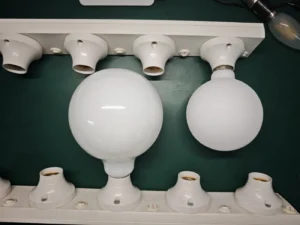
- Big Decorative Bulbs → — oversized decorative filament bulbs for hospitality, retail and statement fixtures.
- Contact HongYu Bulb → — send specifications, target market, quantity and packaging requirements for quotation.
Conclusion
Upcycling is not just a hobby; it is a profitable B2B strategy. By leveraging the safety, low heat, and aesthetic variety of LED filament bulbs, you can transform industrial waste and vintage junk into premium, story-driven lighting products that capture the modern consumer's imagination.
Discover the benefits of LED filament bulbs, including energy efficiency and safety, which can enhance your lighting projects. ↩
Explore this link to understand how Kid Safe features enhance safety in lighting, making them ideal for families. ↩
Find out how the concept of Lego bricks can inspire creativity in adult design projects, especially in lighting and furniture. ↩
Learn about the components of an Industrial Kit and how it can elevate your lighting designs with style and functionality. ↩
Explore how T30 and T25 bulbs can enhance your bottle lighting projects with their perfect fit. ↩
Learn about the innovative design of Integrated String Lights and their unique applications in bottle decor. ↩
Discover the advantages of using high-temperature resistant capacitors in LED bulbs for better performance. ↩
Find out why low-wattage bulbs are ideal for enclosed spaces and how they can prevent overheating. ↩