You select a "Vintage" bulb for a project, expecting a cozy, golden glow. But when you install it, the light is pale, the glass looks like cheap plastic, and the atmosphere feels sterile.
To truly replicate the nostalgic feel of early 20th-century lighting, you must choose the correct Amber Glass option—ranging from "Light Gold" for general hospitality to "Deep Amber" for decorative focus—paired with the correct 2200K LED filament temperature.
I face this issue almost every day. A buyer sends me an inquiry asking for "Vintage Bulbs." I ask, "Which glass tint?" They usually say, "I don't know, just make it look old."
This is a dangerous answer.
If I send them a Dark Amber bulb, and they put it in a library, it will be too dark to read.
If I send a Light Gold bulb, and they put it in a moody jazz bar, it will be too bright and kill the vibe.
Understanding the nuances of Amber Glass is the secret to high-end lighting design. It is not just "Orange paint." It is a tool to manipulate emotion. As a manufacturer in Dongguan, I see thousands of these bulbs roll off our lines. The difference between a bestseller and a dead stock item often comes down to the depth of the tint. Let me explain the options so you can buy the right one for your market.
Do You Know the Difference Between "Light Gold" and "Dark Amber" Glass?
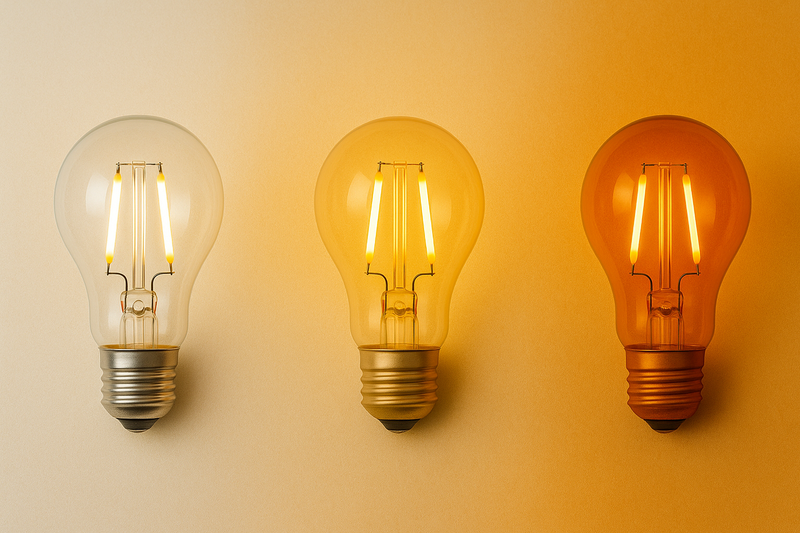
Most catalogs just say "Amber," but this covers a massive range of options. If you order blind, you might get a bulb that looks like a traffic cone or one that barely looks vintage at all.
There are two main industry standards for Amber glass: "Light Gold" (often called Tea or Champagne) which allows 80-90% light transmission for functional use, and "Dark Amber" (or Orange) which is purely decorative, lowering the light output to create a "candlelight" effect.
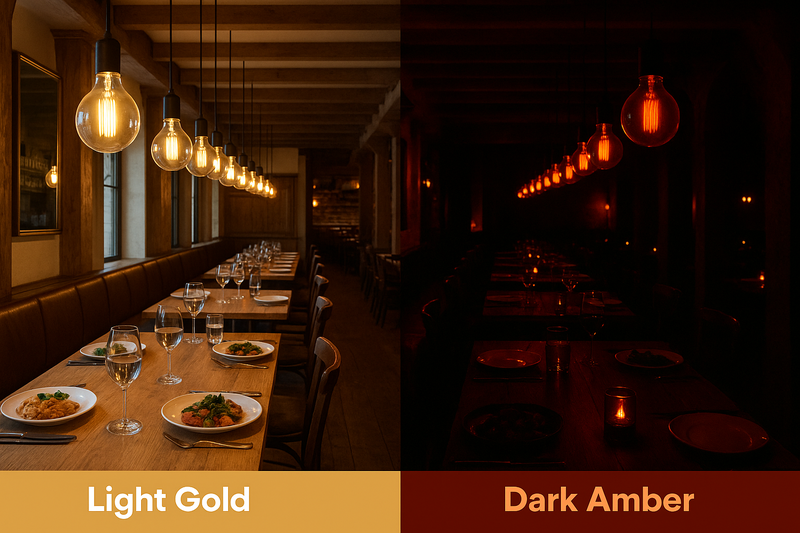
In our factory, we have specific codes for these tints, but for you as a buyer, the visual check is more important.
Light Gold (The "Champagne" Option)
This is the safest bet for most B2B buyers.
It has a very subtle tint. When the bulb is off, the glass looks slightly metallic or like weak tea.
When the bulb is on, it warms up the light color just a little bit.
- Best for: Dining tables, kitchen pendants, general room lighting.
- Why buy it: It allows the LED filament to be bright (300-400 lumens). It gives the "Vintage Look" without sacrificing the ability to see. My client Jacky sells mostly this type to homebuilders in the US because it meets general lighting codes better.
Deep Amber (The "Whiskey" Option)
This is the hardcore vintage option.
When the bulb is off, the glass looks orange or bronze. You can definitely see the color.
When the bulb is on, the light is very warm, almost fiery.
- Best for: Bars, hotels, nightlights, accent walls.
- Why buy it: It hides the "yellow stick" look of the LED filament perfectly. The heavy tint acts as a filter. It reduces glare significantly. But, it cuts lumen output by about 20-30%. You cannot use this as a main light source. It is "Furniture," not "Lighting."
Tint Selection Guide
| Tint Name | Glass Transparency1 | Resulting CCT | Best Application2 |
|---|---|---|---|
| Clear | 100% | 2700K (Standard) | Workspaces, modern clean looks. |
| Light Gold | 90% | 2400K - 2500K | Living rooms, restaurants (can see food). |
| Deep Amber | 75% | 2000K - 2200K | Bars, lounges, decorative chandeliers. |
| Heavy Orange | 60% | 1800K (Candle) | Night clubs, extreme mood lighting. |
Which Bulb Shapes Benefit the Most from Amber Tinting?
You can paint any glass amber, but some shapes look elegant while others look like confused mistakes. You need to match the tint to the era of the design.
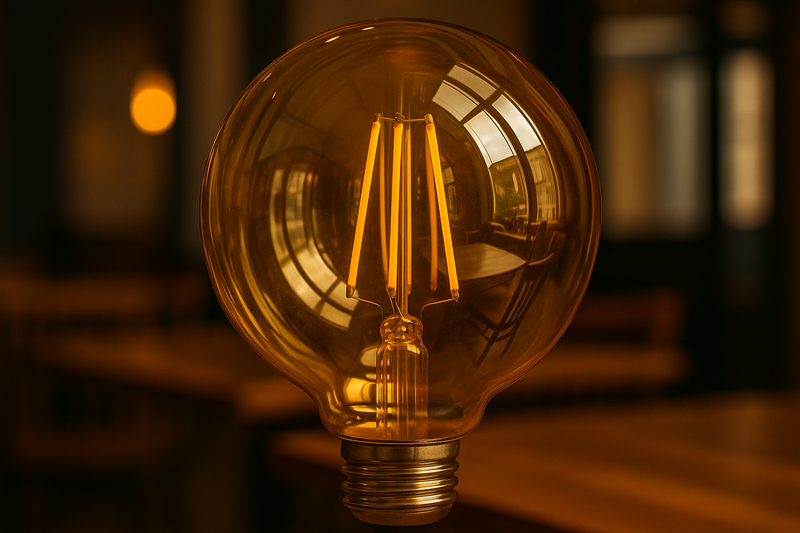
The amber tint works best on shapes that mimic early 20th-century carbon lamps, specifically the ST64 (Teardrop) and G125 (Large Globe). The tint highlights the curvature of the glass, creating reflections that make the bulb look like a solid jewel rather than a hollow vessel.
The shape of the bulb dictates how the light leaves the fixture.
If you use a frosted, white bulb, the shape doesn't matter much because the whole thing glows evenly.
With Amber Glass, the glass itself is a feature.
The ST64 (Teardrop)
The ST64 is the soul mate of Amber glass.
The tapered neck and the wide bottom create complex reflections. When you tint this glass amber, it emphasizes the "Retro" feeling.
An ST64 in clear glass looks a bit too much like a chemistry beaker.
An ST64 in amber glass looks like a history piece.
This is the number one seller for "Industrial" style lamps.
The Globes (G80, G95, G125)
Large globes with amber tint differ slightly.
Because the surface area is huge, the amber color becomes very dominant in the room.
If you have a white minimalist room and you hang a giant orange G125 bulb, it will look very strange.
However, if you have a room with wood, brick, or leather, the Amber Globe ties everything together.
The curvature of the globe also helps "trap" the light inside, making the filament look like it is floating in liquid gold.
The A60 (Standard Shape)
Be careful here.
The A60 is the shape of a normal household bulb.
If you sell an A60 with heavy amber glass, consumers sometimes get confused. They think it is a "Bug Light" (those yellow lights used to keep mosquitoes away).
Unless the filament inside is very decorative, avoid deep amber on standard small bulbs. It looks cheap.
Shape & Tint Pairing
| Bulb Shape | Recommended Tint | Reasoning |
|---|---|---|
| ST64 | Deep Amber3 | The classic "Edison" look. Non-negotiable. |
| G125 | Light Gold4 | Too much orange on a big globe is overwhelming. |
| T30 (Tube) | Light Gold | Tubes are often used for mirrors; need good light. |
| A60 | Light Gold / Clear | Keep it functional; avoid the "Bug Light" look. |
Is the Amber Coating on Your Bulbs Going to Scratch Off?
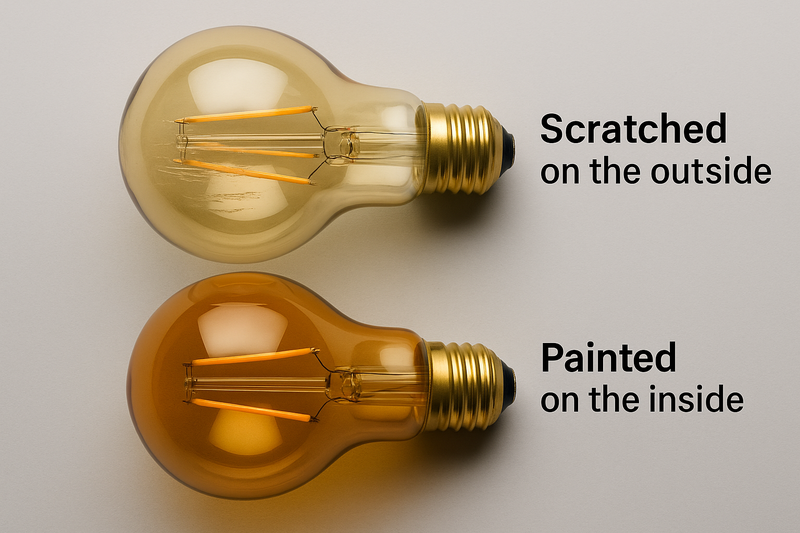
Cheap manufacturing processes involve spraying the outside of the bulb. This cuts costs, but after a month of handling or cleaning, the bulb looks damaged and old.
Quality Amber bulbs are produced using an "Inner Coating" technique or, for premium lines, solid stained glass. You must verify that your supplier sprays the tint inside the glass envelope, where it is protected from scratches, dust, and handling oils.
This is a huge quality control point.
In the lighting industry, margins are tight.
Some factories act lazy. They buy clear glass shells. They finish the bulb. Then, they spray paint the outside orange.
This is terrible for you as a buyer.
- Packaging Damage: The vibration during shipping rubs the cardboard against the glass. When you open the box, the paint is already worn off in rings.
- Heat Damage: The heat of the bulb can make external paint sticky or discolored over time.
- Cleaning Damage: A customer wipes the dusty bulb with a wet cloth. The color comes off on the cloth.
The Hongyu Solution: Inner Spraying
We use an electrostatic spray gun to coat the inside of the glass shell before the filament stem is inserted.
Then, the shell goes through a baking oven to cure the paint.
Only after the paint is baked hard do we seal the bulb.
This means:
- The outside feels like smooth, real glass.
- You can scratch it with a key, and the color remains because the color is under the glass.
- The gloss finish is natural glass gloss, not paint gloss.
Solid Amber Glass (The Premium Option)
For very high-end projects (like 5-star hotels), we can source glass that is actually melted with minerals to be brown/gold. This is "Solid Color."
It is expensive. It is about 3x the price of the sprayed shell.
For 95% of the market (including supermarkets and Amazon sellers), Inner Spraying is the correct balance of quality and price.
Does the Tint Actually Change the Color Temperature (CCT)?
You might think you can just put a standard warm chip inside an amber bulb. If you do this, the light will look greenish and sickly, ruining the atmosphere.
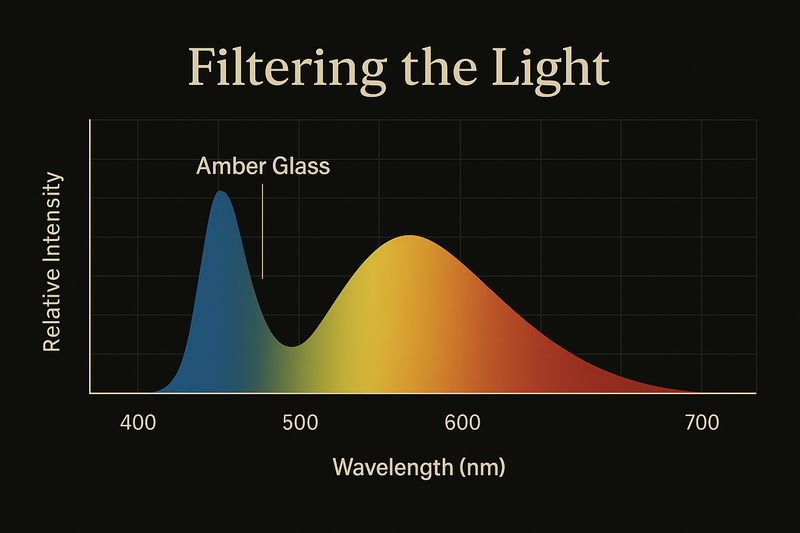
The amber tint acts as a physical filter that removes blue wavelengths. To get a true "Firelight" glow, you must pair the amber glass with a specialized 2200K LED filament chip. Putting a 2700K or 3000K chip inside amber glass creates a muddy "sulfur" color.
Color physics is tricky.
A standard LED creates white light by mixing Blue LED with Yellow Phosphor.
Amber glass blocks Blue light.
If you take a standard 3000K chip (which has a high blue peak) and put it inside amber glass, the glass blocks the blue. You are left with a weird, greenish-yellow residue. It looks like a streetlamp in a bad neighborhood.
The "Red Phosphor" Requirement
To make Amber bulbs look premium, we have to start with a very warm light source.
We use LED filaments coated with extra Red Phosphor.
The source light is already 2400K or 2200K.
When this warm light passes through the warm glass, they enhance each other.
The result is a rich, saturated Gold color.
This is how we achieve the High CRI (Color Rendering Index) in amber bulbs.
If you use the wrong chip, the CRI drops to 60. Skin looks grey.
If you use the right Red Enhanced chip, the CRI stays above 90. Skin looks healthy.
Consistency is Key
The thickness of the amber coating changes the CCT.
- Standard Coat: Shift -200K (e.g., 2200K chip becomes 2000K light).
- Heavy Coat: Shift -400K (e.g., 2200K chip becomes 1800K light).
We have to control the spray thickness to the micro-gram. If the coating is uneven, your bulbs will be different colors.
I always tell Jacky: "Don't mix batches." If you buy 1000 bulbs now, and 1000 bulbs next year, the glass tint might vary by 5%. This is the nature of painted glass. It is art, not just science.
Where Should You NEVER Use Amber Bulbs?
It is tempting to sell these bulbs for every room because they look cool. But if a customer installs them in a task-oriented space, they will return the product and complain "It's too dark."
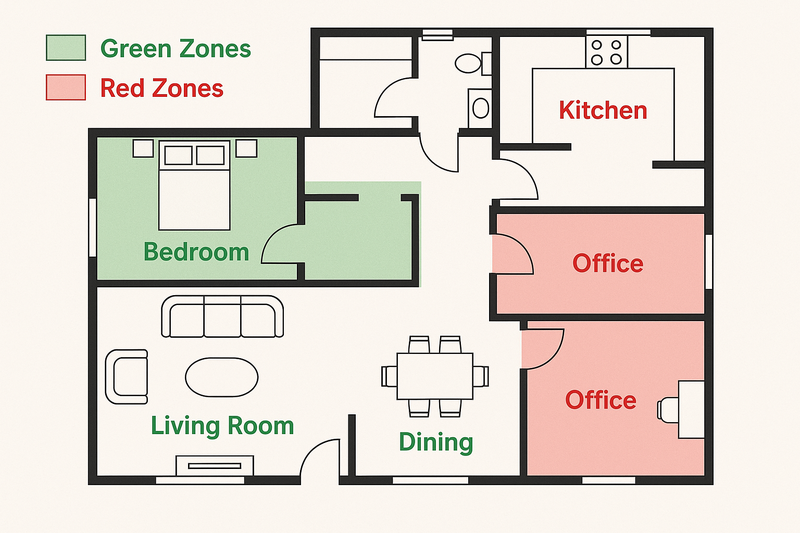
Amber Glass bulbs are strictly for "Atmospheric" or "Secondary" lighting. They should never be recommended for bathrooms, kitchens, or home offices where visual acuity is required, as the low lumen output and lack of blue light causes eye strain during focused tasks.
Part of my job is protecting my clients from bad reviews.
You must educate the consumer on the box.
Label it: "Decorative Mood Light."
Do not label it: "General Service Bulb."
The Kitchen Problem
In a kitchen, you need to see if the chicken is cooked. You need to see the color of the vegetables.
Amber light masks colors. Under 2000K light, raw meat looks cooked because the red is enhanced and the blue/white is gone. This is dangerous.
Also, the lumen output is low. A 4W Amber ST64 might only give 300 lumens. A 4W Clear filament bulb gives 470 lumens.
The coating eats the light.
The "Hygge" Opportunity
The best place to sell these bulbs is for the "Relaxation Zone."
- The Bedroom: Low blue light helps sleep. Amber bulbs are perfect bedside lamps.
- The Dining Table: It makes the room feel warmer and more intimate.
- The Lounge: It mimics a fireplace.
If you target these applications in your marketing, you will sell volume without complaints.
Application Checklist
| Room | Amber Bulb Suitability5 | Notes |
|---|---|---|
| Kitchen | LOW | Use only for decorative pendant over island; not for prep work. |
| Bathroom | VERY LOW | Bad for makeup; bad for shaving. |
| Office | LOW | Causes sleepiness; not good for reading documents. |
| Living Room | HIGH | Perfect for floor lamps and evening relaxation. |
| Bedroom | VERY HIGH | Helps melatonin production6; cozy. |
| Restaurant | HIGH | Makes customers stay longer and order more wine. |
Related HongYu Bulb product pages
- LED Filament Bulb Product Range → — standard and decorative LED filament bulbs for wholesale and project sourcing.
- EU Dim-to-Warm Bulbs → — warm dimming filament bulbs for hospitality and mood lighting.
- LED Dimming Guide → — technical guidance for TRIAC dimming, flicker and compatibility.
- Custom Color Bulbs → — custom glass color, coating and printed finish options for private-label collections.
- Custom Logo Bulbs → — printed branding and private-label decorative bulb options.
- Contact HongYu Bulb → — send specifications, target market, quantity and packaging requirements for quotation.
Conclusion
Amber Glass LED Edison bulbs are the bridge between modern efficiency and historical romance. By selecting the right level of tint—Inner-Sprayed Light Gold for visibility or Deep Amber for mood—and ensuring the internal filaments are tuned to 2200K, you provide a lighting solution that transforms a space emotionally. Just remember to guide your customers to use them for atmosphere, not for homework.
Understanding glass transparency helps in choosing the right tint for specific applications, enhancing aesthetics and functionality. ↩
Exploring the best applications for tints can guide you in making informed decisions for your space, ensuring optimal lighting and ambiance. ↩
Explore the unique aesthetic and historical significance of Deep Amber in lighting to enhance your design choices. ↩
Discover the benefits of using Light Gold tint in lighting to create a warm and inviting atmosphere. ↩
Understanding Amber Bulb Suitability can help you choose the right lighting for each room, enhancing comfort and functionality. ↩
Exploring how lighting influences melatonin production can improve your sleep quality and overall health. ↩