You stock standard round bulbs and they sell for pennies. You try exotic shapes and they sit on the shelf gathering dust. You need a product that balances high volume sales with high profit margins.
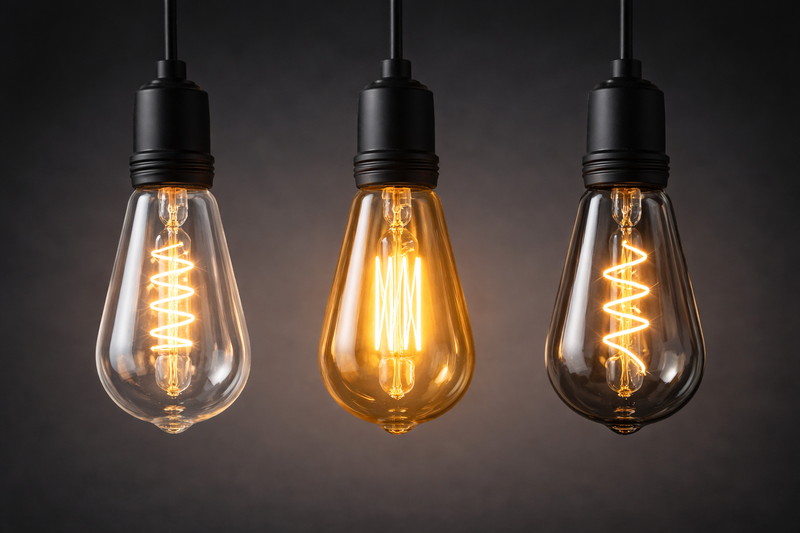
The ST64 LED Edison Bulb—often called the Teardrop or Pear shape—is the absolute standard for vintage lighting. It combines the historic aesthetic of early 20th-century carbon lamps with modern LED efficiency, making it the default choice for pendant lights, industrial cages, and exposed sockets worldwide.
Every lighting business needs a "Hero Product." For the vintage category, the ST64 is that hero.
I have visited lighting fairs in Hong Kong, Frankfurt, and Dallas for over ten years. I always see the same thing. The ST64 is everywhere.
It is the bridge between the old world and the new world.
My client Jacky calls it his "bread and butter." He sells fancy chandeliers, but the ST64 refills keep his cash flow steady.
The code ST64 tells you the shape. ST stands for Straight Tubular (though it is actually tapered), and 64 is the diameter in millimeters. In the US, you know this as the ST19 or ST21.
It is not just a light bulb. It is a piece of furniture. It is large enough to be seen, but small enough to fit anywhere. If you do not have a strong ST64 range, you are not really in the decorative lighting business.
Why Does the Unique Shape of the ST64 Matter for Fixture Compatibility?
Designers often choose fixtures that hide standard bulbs or expose them awkwardly. A standard round bulb looks "stubby" and cheap in a high-end brass socket. You need a shape that flows naturally from the fixture.
The elongated neck of the ST64 lifts the light source away from the socket base, ensuring that the filament is fully visible even in deep "cup" style holders. Its tapered 64mm body is specifically designed to fit perfectly inside standard industrial wire cages and glass jar pendants without touching the sides.
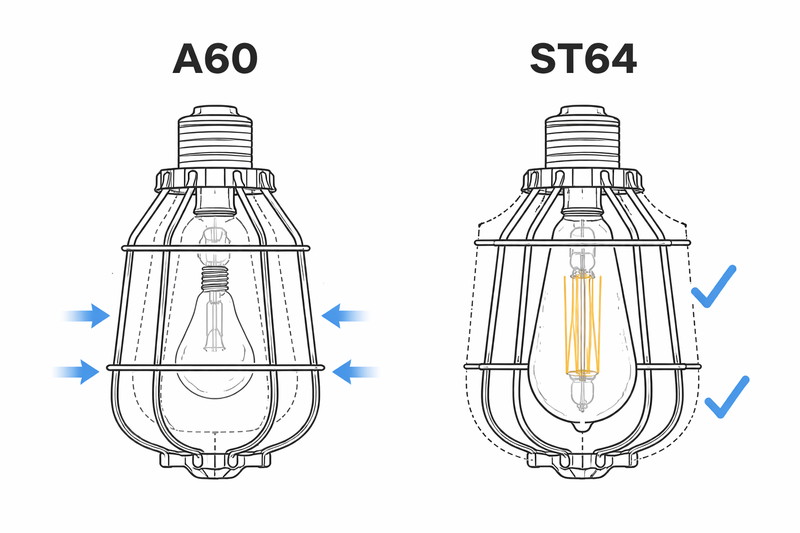
The shape of a light bulb is not accidental. It solves a mechanical problem. I often explain to my buyers that the geometry of the ST64 beats the standard A60 (A19) every time for decorative use purely based on physics and aesthetics.
The Socket Depth Problem
Many vintage fixtures use heavy, solid brass sockets or deep Bakelite holders. These sockets are designed to be substantial. If you screw a round ball bulb (A60) into them, the bottom half of the glass sinks into the cup. You lose light because it is trapped inside the socket cup. It looks like a scoop of ice cream melting into a cone. The ST641 solves this with its neck. It starts narrow at the cap (E26/E27) and stays narrow for about 2 to 3 centimeters. This extends the light source out of the socket and pushes the glowing filament down into the room where it belongs.
The Industrial Cage Fit
You have likely seen the "Barn Light2" trend, where lights are covered in wire metal cages. These cages usually have a clamp mechanism. A round bulb is too short and looks silly floating in the middle of a long cage. A long tube bulb (T30) might be too long and hit the bottom wires. The ST64 is the "Goldilocks" size—it is just right. It fills the volume of the cage, and the curve of the glass often mirrors the curve of the wire guard. This visual harmony is why coffee shops and restaurants buy them by the hundreds.
| Feature | Standard A60 / A19 | Vintage ST64 / ST19 | Benefit of ST64 |
|---|---|---|---|
| Height | 105mm ~ 110mm | 140mm ~ 148mm | More presence; fills vertical space better. |
| Diameter | 60mm | 64mm | Slightly wider; feels more premium in hand. |
| Neck Shape | Short / None | Long / Tapered | Clears deep sockets; maximizes light throw. |
| Glass Top | Hemispherical | Domed Teardrop | Matches retro industrial aesthetics perfectly. |
Can the Internal Filament Design Make or Break Your Sales?
Customers hate the look of "fake" LEDs with yellow plastic sticks. They want the charm of the 1910 originals without the heat and cost. If your filaments look cheap, your product fails.
The soul of an ST64 is its filament arrangement. Quality options replicate the vertical "Squirrel Cage" carbon design using long LED substrates, while cheaper versions use short, chaotic sticks that ruin the aesthetic. You must choose high-transmittance sapphire substrates to ensure the "wires" look invisible when the bulb is off.
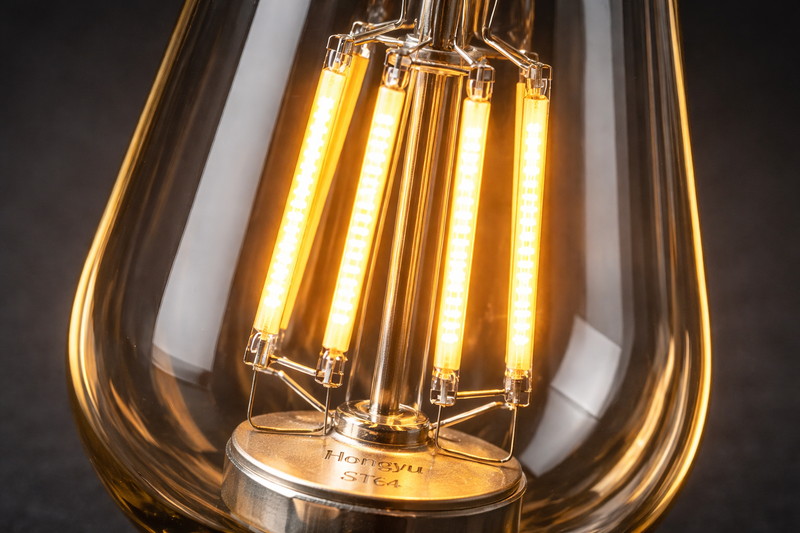
I spend a lot of time in our factory watching the assembly line. The step where we mount the filament is critical because this is what the customer is actually buying—the look of the light source.
The "Stick" Count and Arrangement
In the old days of Thomas Edison, the filament was made of carbonized bamboo or tungsten. It was long and fragile, so they had to wind it up and down to fit it inside, creating the "Cage" look. We have to copy this with LED. The cheapest ST64 on the market uses 2 sticks arranged in a 'V' shape. It looks terrible and cheap. A standard commercial ST64 uses 4 sticks. A "Premium" ST64 uses 6 or 8 sticks. When you use 6 vertical sticks, you create a cylinder of light that mimics the old Squirrel Cage3 perfectly. My client Jacky once tried to save money by buying the 2-stick version from another supplier, and his Amazon reviews crashed immediately.
Ceramic vs. Sapphire Substrate4/alphasapphire.com/benefits-of-sapphire-substrates-for-uv-leds/)3 Substrate
This is a technical secret that most buyers miss. The LED chips sit on a base material called a substrate.
- Ceramic: It is white and opaque. It is cheaper. The filament looks thick and blocky.
- Sapphire5: It is clear and transparent. It is more expensive.
For an ST64, you want Sapphire. Why? Because when the light is OFF, you want the filament to look thin and delicate, almost invisible. If you use ceramic, the yellow sticks look heavy and clunky inside the glass. A true vintage lover examines the bulb when it is off, too.
Soft Flexible Filaments
We also produce "Soft Filament6" or "Flexible LED." This material bends, allowing us to make spirals. An ST64 with a spiral filament looks fantastic, like a glowing spring. The spiral prevents glare because the light is spread out over a long curve rather than a concentrated point. However, these are more expensive and are usually reserved for high-end hotel projects or boutique stores.
| Filament Type | Structure | Visual Effect | Price Point |
|---|---|---|---|
| Simple Linear | 2-4 Sticks (V-Shape) | Basic, slightly uneven light. | Low |
| Squirrel Cage | 6-8 Sticks (Vertical) | Authentic vintage look, cylindrical light. | Medium |
| Soft Spiral | Flexible Coil | Best for anti-glare, very artistic. | High |
How Does Glass Tint Affect the Mood and Application of the ST64?
A clear bulb is bright but can be harsh. A dark amber bulb is cozy but dim. Choosing the wrong glass finish for your inventory can limit your customer base effectively.
The ST64 comes in three primary glass finishes: Clear (for maximum brightness), Amber/Gold (for vintage warmth), and Smoke/Grey (for modern industrial style). Understanding the light transmission and color temperature shift of each finish allows you to pitch the product for the correct room and application.
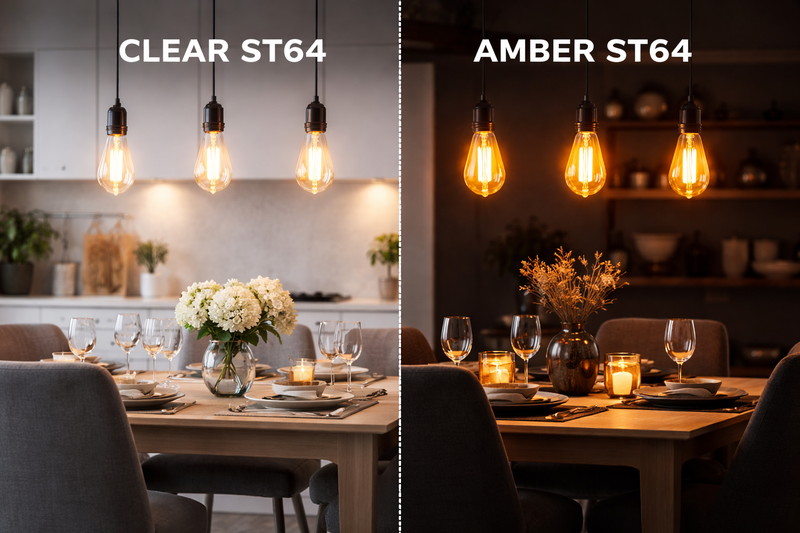
The glass acts as a filter. It essentially changes the personality of the bulb. You cannot just sell one type; you need a mix to satisfy different customer needs.
The Classic Amber (Gold) Option
This is the classic choice; about 70% of my ST64 sales are Amber. The glass is sprayed with a translucent golden paint. Its main effect is to turn the light orange and lower the Color Temperature7. If the LED chip is 2700K, the glass makes it look like 2200K. This is perfect for restaurants and bars where atmosphere is key. It also hides the yellow look of the LED filament when the bulb is off, making it look like antique glass. However, be aware that it cuts the light output by about 20-30%.
The Functional Clear Glass
This is for the practical customer who needs to see what they are doing. With clear glass, what you see is what you get—100% light transmission8. These are best used in kitchens, bathrooms, and offices. The downside is that you can clearly see the yellow LED sticks, which some people dislike (the "French Fry" look). However, we are seeing a rise in Clear ST64 sales for modern farmhouse interiors where they want the shape but need white light.
The Modern Smoke (Grey) Option
This is the "Cool Kid" option. The glass is dark grey, and the hardware is usually gunmetal or black. The effect is very dim and moody. It looks like a decoration even when turned off. This is strictly for bachelor pads, high-end tech offices, or accent lamps where the bulb is the art. Do not recommend this for reading lights.
| Glass Type | Light Transmission | Vibe | Best Room |
|---|---|---|---|
| Clear | 100% | Crisp, Bright, Honest | Kitchen, Study, Bath |
| Light Amber | 85-90% | Warm, Cozy, inviting | Dining Room, Bedroom |
| Dark Amber | 70% | Romantic, Historical | Bar, Lounge, Hallway |
| Smoke/Grey | 50-60% | Edgy, Modern, Cool | Accent lamps, Man cave |
What Technical Specifications Separate a Cheap ST64 from a Professional One?
You can buy an ST64 for $0.50 or $2.00. The outside looks the same, but the cheap one flickers, hums, and dies in three months. Your reputation relies on the invisible components inside the base.
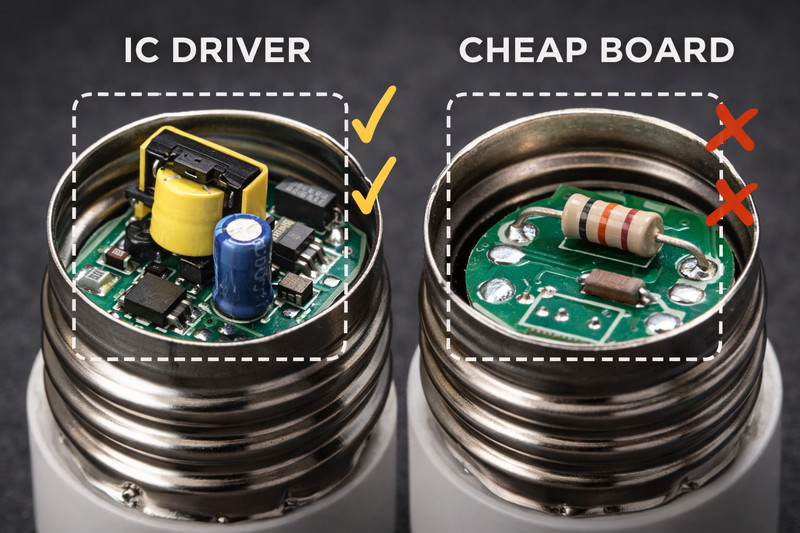
The lifespan and performance of an ST64 depend on the driver quality (IC Constant Current vs. Linear) and the cooling gas (Helium). A professional bulb offers smooth flicker-free dimming and uses high-thermal-conductivity gas to prevent the long filaments from overheating and failing prematurely.
Keep this in mind: An ST64 bulb is essentially a sealed glass oven. The filaments get hot, and unlike a spotlight, there is no metal heatsink to dissipate that heat. This is where engineering matters.
The Invisible Cooling Agent: Helium
Glass is a poor conductor of heat. If we strictly leave air inside the bulb, the LED strip will gradually overheat and burn out. To solve this, we vacuum out the air and pump in a Helium Mix. Helium moves heat very fast. It takes the heat from the LED stick and transfers it to the glass wall, where the room air cools it down. You cannot see the gas, but it is vital. Bad factories use thin glass and just air, forcing them to reduce the power to 2 Watts to stop it from burning. If you want a bright 8 Watt ST64, it must have Helium.
The Engine: IC vs. Linear Drivers
The driver is the electronic component that lives in the small metal cap.
- Linear (DOB) Driver: It is just a few chips on a board connecting directly to AC power. Only buy this if you are desperate for the lowest price. The problem is that if voltage fluctuates, the light flickers. It creates a "strobe" effect on phone cameras (bad for Instagram).
- IC (Constant Current) Driver: It has a transformer and a controller. It keeps the light steady even if the voltage changes and provides smooth dimming compatible with most wall dimmers. It costs about $0.20 more, but it saves you from returns.
The Base Cap Quality
Even the metal cap matters.
- Nickel-Plated Brass: What we use. It does not rust and conducts electricity well.
- Aluminum: What cheap factories use. In humid climates, it oxidizes and gets stuck in the socket, making it impossible to remove the bulb later.
| Component | Cheap "Supermarket" Bulb | Professional Grade Bulb | Why it matters |
|---|---|---|---|
| Gas Fill | Air or Nitrogen | Helium Mix | Helium cools the LED; Air kills it. |
| driver | Linear (Resistor) | Constant Current IC | IC stops flickering and buzzing. |
| Base Material | Aluminum | Nickel-Plated Brass | Brass never rusts or seizes. |
| Glass Thickness | Thin (Fragile) | Standard (Robust) | Thicker glass breaks less in shipping. |
Related HongYu Bulb product pages
- LED Filament Bulb Product Range → — standard and decorative LED filament bulbs for wholesale and project sourcing.
- Big Decorative Bulbs → — oversized decorative filament bulbs for hospitality, retail and statement fixtures.
- Contact HongYu Bulb → — send specifications, target market, quantity and packaging requirements for quotation.
Conclusion
The ST64 is the essential bridge between vintage style and modern utility. By selecting the right glass tints and professional internal components, you secure both aesthetic appeal and lasting reliability.
Discover how the ST64 bulb enhances lighting in vintage fixtures and industrial designs, making it a popular choice. ↩
Explore the Barn Light trend to understand its aesthetic appeal and why it's favored in cafes and restaurants. ↩
Discover why the Squirrel Cage design is favored for its authentic vintage appearance and light distribution. ↩ ↩
Understand the differences between Ceramic and Sapphire substrates to make informed choices for LED lighting. ↩
Explore the advantages of Sapphire substrate for LED bulbs, especially for achieving a delicate and vintage look. ↩
Learn about Soft Filament technology and how it enhances the aesthetic and functional qualities of LED lighting. ↩
Understanding Color Temperature is crucial for selecting the right lighting for your space, enhancing ambiance and functionality. ↩
Exploring light transmission helps you choose bulbs that meet your lighting needs while ensuring optimal brightness and efficiency. ↩
Browse from HongYu Bulb: EU Standard LED Filament Bulbs → · EU Vintage Straight Filament Bulbs →