You finish a beautiful patio installation, the string lights are draped perfectly, and the client is ecstatic. But two weeks later, a summer storm rolls through, and the wind smashes those fragile glass bulbs against the pergola, covering the dining area in dangerous shards. Now you are on the hook for the cleanup and the replacement.
To run a profitable outdoor lighting business, you must stop using fragile glass incandescents or cheap retail LEDs. You need to upgrade to "Shatterproof Commercial Grade" LED Edison bulbs. These use impact-resistant PET housings and flexible LED filaments to withstand hail, wind, and drops while perfectly mimicking the warm, vintage glow of tungsten.
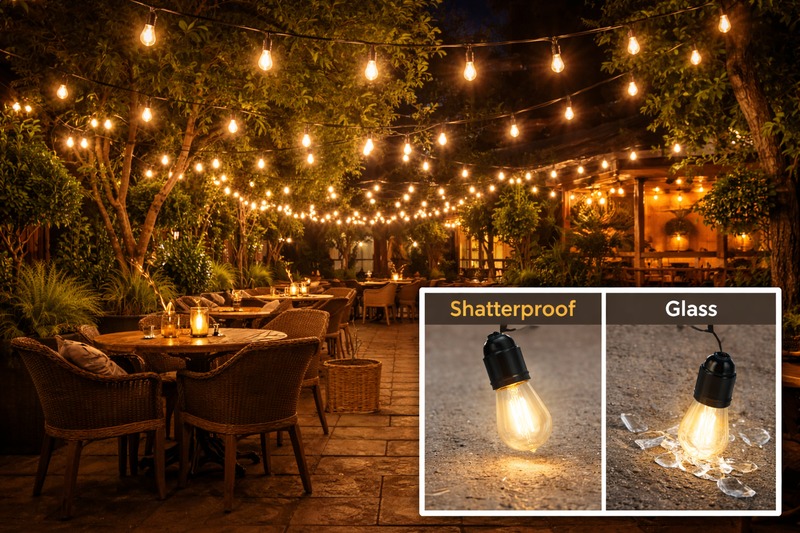
In my factory here in China, we produce millions of bulbs a year. I see the orders from big US box stores, and I see the orders from professional lighting distributors. They are not buying the same product. The retailers buy thin glass because it is cheap (cents per unit). The professionals buy heavy-duty plastic housings because they know that one service call to sweep up broken glass costs more than 50 bulbs combined. Let me explain the engineering differences so you can confidently sell the upgrade to your clients.
Why is "Glass" a Dirty Word in Professional Landscape Lighting?
Nostalgia is expensive. Your clients want the look of 1920s lighting, but they do not want the 1920s durability problems. Using real glass outdoors is a liability waiting to happen, especially near pools or food service areas.
You must switch to S14 bulbs made from High-Transmittance PET (Polyethylene Terephthalate). Unlike cheap acrylic which clouds over time, PET remains crystal clear like glass but bounces like a rubber ball, eliminating the risk of injury and reducing your replacement costs to zero.
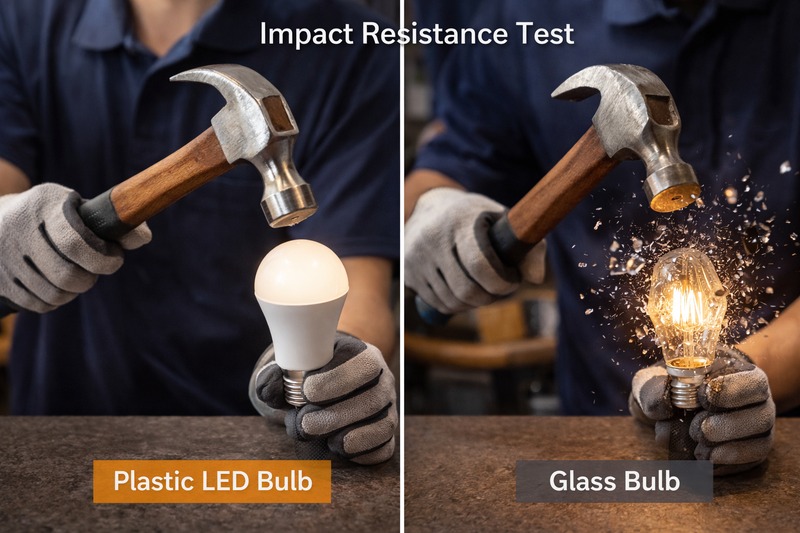
In the old days, bulbs had to be glass because the tungsten filament generated massive heat. Plastic would melt. Today, LEDs generate very little heat, yet many manufacturers still use glass simply because it's the cheapest material available. This is a trap for the contractor.
The Material Science: PET vs. Acrylic vs. Glass
Not all "plastic" bulbs are the same. In the low-end market, you find Acrylic or PC (Polycarbonate). These are tough, yes, but they have a fatal flaw: UV instability. After one summer under the Texas or Florida sun, cheap plastic turns yellow and cloudy. It looks dirty, and it cuts the light output by 30%.
For my professional clients, we use Optical Grade PET1. This material is engineered to be UV stable. It stays crystal clear for years. More importantly, it is shatterproof. You can drop a ladder on a string of these lights, and the bulbs will likely survive. If they do crack under extreme force, they do not explode into sharp shards; they just dent.
The Liability Factor
Think about your client's environment. If you are lighting a swimming pool area or a high-end restaurant patio, a broken glass bulb is a disaster. It means draining the pool to find shards or shutting down the dining service. By installing reputable shatterproof bulbs2, you are selling "peace of mind." You can tell the homeowner, "Your kids can play out here, and even if a football hits these lights, nobody is going to the emergency room." That is a massive selling point that justifies a higher markup.
| Material | Impact Resistance | UV Stability (Yellowing) | Clarity | Recommended Use |
|---|---|---|---|---|
| Glass | Very Low (Dangerous) | Perfect | 100% | Indoor chandeliers only. |
| Standard Plastic | Medium | Poor (Yellows/Fogs) | 80-90% | Cheap Christmas decor. |
| Optical PET | High (Bounce-proof) | Excellent (Stays Clear) | 99% | Professional Outdoor Patios. |
How Do You Avoid the "Fake" LED Look?
We have all seen those ugly first-generation LED bulbs. They have a white plastic base that covers half the bulb, and the light looks harsh and digital. Your design-savvy clients hate them.
You need to source "Full-Glass Style" housings with "Flexible Spiral Filaments." These bulbs hide the driver electronics in the screw base (E26), leaving the bulb entirely transparent, while the curved LED filament mimics the organic glow of burning tungsten wire.
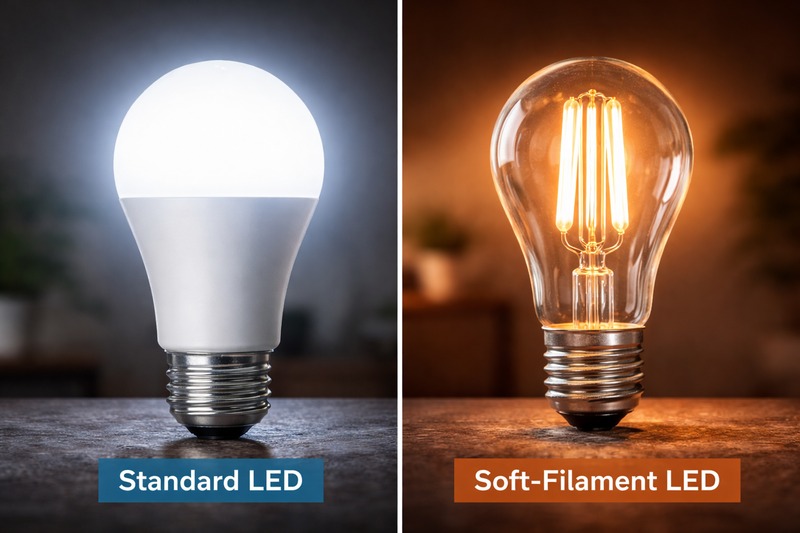
Designers often reject LEDs because they ruin the ambiance. They claim the light is too "flat" or "directional." Five years ago, they were right. Today, technology has solved this, but you need to know what to ask for.
The Evolution of the Filament
Early LED bulbs used "SMD" chips—little yellow squares pasted on a flat board. They projected light in only one direction (like a flashlight). To fix this, we invented the Straight LED Filament. These look like little yellow sticks standing up inside the bulb. They are better, but they still look distinctively "techy" and industrial.
The current standard for luxury hospitality is the Flexible (Soft) Filament3. We mount the microscopic LED diodes onto a flexible substrate that can be curled into spirals or loops. When this is lit up, it looks exactly like a carbon filament from the Edison era. It provides 360-degree light distribution, eliminating those weird shadows you get from cheap LEDs.
Color Temperature and Phosphors
The magic of the Edison bulb is that warm, candle-like glow. Standard tungsten burns at about 2200K to 2400K. Most cheap LEDs are 3000K or even 5000K (Daylight), which kills the romantic mood.
In our factory, we mix a specific red and orange phosphor blend to coat the filaments. We target 2200K (Super Warm White)4 specifically for patio products. This mimics the sunset. However, getting the color right is only half the battle. You also need a high CRI (Color Rendering Index). If the CRI is low (below 80), the food on the table looks grey and the wood of the pergola looks dull. High CRI (90+) ensures that the reds in the wine and the browns in the steak look rich and appetizing.
| Bulb Tech | Visual Appearance | Beam Angle | Ambiance Rating |
|---|---|---|---|
| SMD Chip | Ugly white base, harsh dots | 180° (Directional) | Low (Office feel) |
| Straight Filament | Industrial yellow sticks | 300° (Good) | Medium (Modern Retro) |
| Spiral/Soft Filament | Organic curved glowing line | 360° (Perfect) | High (True Vintage) |
Will Your Bulbs Rust Out After One Winter?
You might think the bulb is sealed, so it's fine. But the failure point in outdoor string lighting is rarely the glass; it is the metal screw base. If that rusts, the connection fails, and you can't even unscrew the bulb to replace it.
Avoid aluminum screw bases at all costs. You must specify "Nickel-Plated Brass" bases for any outdoor application. These metals resist corrosion from humidity and salt air, ensuring the electrical contact remains solid for the lifetime of the installation.
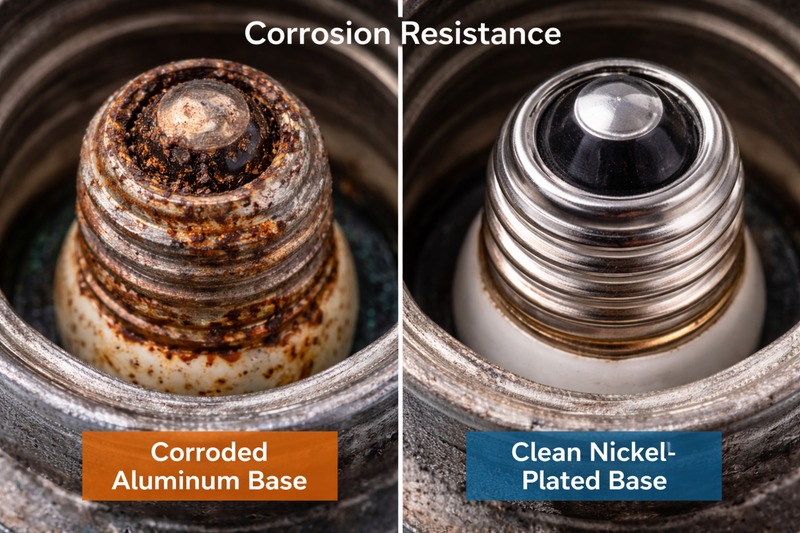
We have customers in coastal areas like Florida and California. The salt air eats aluminum for breakfast. I have seen contractors trying to use pliers to remove a rusted bulb from a socket, only to have the bulb snap off in their hands.
The Galvanic Corrosion5 Problem
Most cheap bulbs use aluminum for the screw base (the part that twists into the socket) because aluminum is cheap. However, the contact tab inside the socket is usually brass or copper. When you have two different metals touching in a humid environment, you get Galvanic Corrosion. The aluminum turns into white powder and fuses to the socket.
By paying a few cents more for Nickel-Plated Brass6 bases, you match the metals better and provide a hard, non-reactive surface. This means ten years from now, you can still unscrew that bulb easily.
The Waterproof Seal (IP Rating)
The bulb itself is sealed (usually IP65), but the system is only waterproof if the bulb fits the socket perfectly.
Commercial grade S14 bulbs are designed with a slightly longer neck and a specific curvature to mate with "Suspended Sockets." When you screw them in, the rim of the socket (the rubber flange) must create a tight seal against the bulb surface.
If you buy random consumer bulbs from Amazon, the neck might be too short. The rubber flange won't make contact. Water flows right down the bulb, past the seal, and into the live socket. Pop! Ideally, you should buy your bulbs and your stringers from the same ecosystem to guarantee this mechanical fit.
| Component | Cheap Consumer Bulb | Professional Outdoor Bulb | Consequence |
|---|---|---|---|
| Screw Base | Aluminum | Nickel-Plated Brass | Prevents seizing/rust. |
| Driver Location | Inside plastic tower | Inside the base (hidden) | Better aesthetics. |
| Neck Shape | Standard A19 style | Extended S14 | Ensures seal with socket lip. |
| Waterproof | None (IP20) | IP65 to IP67 | Survives direct rain. |
Related HongYu Bulb product pages
- LED Filament Bulb Product Range → — standard and decorative LED filament bulbs for wholesale and project sourcing.
- Custom Color Bulbs → — custom glass color, coating and printed finish options for private-label collections.
- Custom Logo Bulbs → — printed branding and private-label decorative bulb options.
- Contact HongYu Bulb → — send specifications, target market, quantity and packaging requirements for quotation.
Conclusion
Don't let a $1 bulb ruin a $5,000 project. By upgrading to IP65 Shatterproof S14s with Nickel-Plated Bases and 2200K Flexible Filaments, you deliver a safer, longer-lasting, and better-looking installation that justifies your premium pricing.
Explore this link to understand why Optical Grade PET is the superior choice for durability and clarity in lighting. ↩
Learn about the safety and peace of mind that shatterproof bulbs provide, especially in high-risk environments. ↩
Explore this link to understand how Flexible (Soft) Filament bulbs enhance ambiance and light quality, perfect for luxury settings. ↩
Discover why 2200K lighting creates a warm, inviting atmosphere, ideal for patios and enhancing your outdoor experience. ↩
Understanding Galvanic Corrosion is crucial for preventing damage in metal connections, especially in humid environments. ↩
Exploring the advantages of Nickel-Plated Brass can help you make informed choices for durable and reliable electrical connections. ↩