Industrial design is raw and unfinished. But without the right light, your exposed pipes and brick walls just look like a cold construction site.
LED Edison bulbs are the essential "softener" for Industrial design, balancing raw steel and concrete with warm, amber light. Their visible filaments mimic early 20th-century technology, providing authenticity while offering the energy efficiency required by modern building codes.
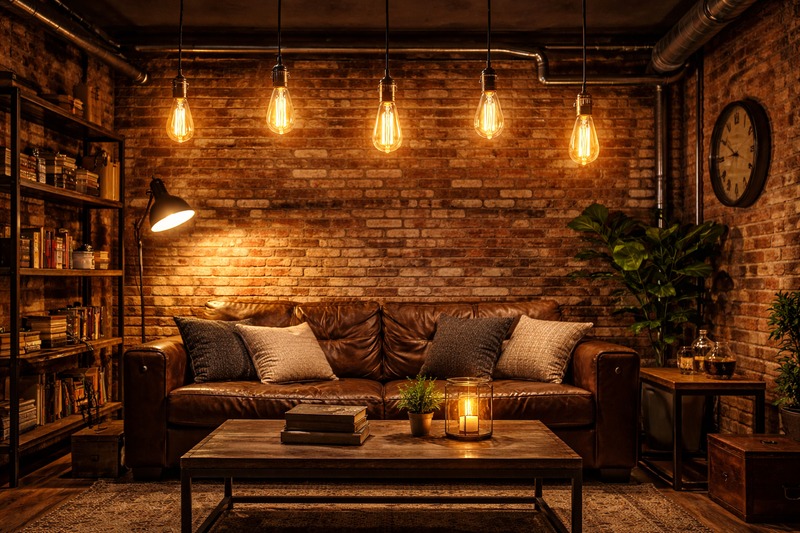
Many designers buy "vintage looking" fixtures but ruin them with modern plastic white bulbs, destroying the atmosphere instantly.
Why Do Industrial Spaces Crave 2200K Warm Light?
You walk into a coffee shop with metal chairs and concrete floors. If the lights are cool white, it feels like a hospital, not a hangout.
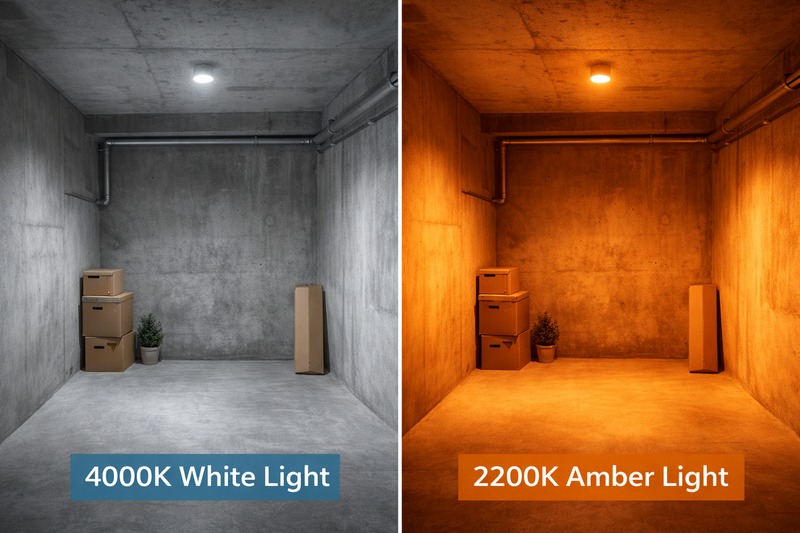
Industrial style uses cold materials like iron, steel, and concrete. To make these spaces habitable, you must use "Warm Candle Light" (2200K) LED filaments to visually warm up the greyscale color palette and soften the hard edges of the furniture.
I see this mistake constantly in commercial projects. Jacky, my main buyer in the US, supplied lighting for a renovated warehouse office in Brooklyn. The architect loved the "High Bay" steel lamps. Jacky sent over standard 3000K (Soft White) bulbs, thinking they were "cleaner" for an office. The client hated it. They said the space felt "aggressive."
The Conflict of Materials
The problem is contrast. Industrial design relies on materials that are naturally cold. Concrete is grey. Steel is black or silver. Brick is rough. If you hit these materials with white light (3000K or 4000K), you highlight the imperfections and the coldness. It looks like a garage or a morgue. You need 2200K (Amber/Gold)1 light. This creates a "Golden Hour" effect. The yellow light mixes with the grey concrete to make it look taupe or beige. It mixes with the red brick to make it look rich and deep. It softens the hard shadows cast by metal pipes.
The Glass Tint Necessity
To get this look, the LED chip itself isn't enough. You need the glass bulb to be tinted gold or amber. Clear glass with a 2200K chip looks okay when it is on. But when it is off, the yellow LED sticks look like distinct yellow lines inside clear glass. In Industrial design, the fixture is often just a bare socket. The bulb is always visible. An amber glass bulb looks like a piece of art even when the switch is off. It fits the copper and brass accents of the furniture. Never sell a clear bulb for an industrial vibe; always sell the amber version to maintain the illusion of antiquity.
| Kelvin Temp | Light Color | Effect on Concrete/Steel | Recommended Application |
|---|---|---|---|
| 2200K | Golden/Candle | Warms / Softens | Lounges, Restaurants, Homes |
| 2700K | Soft White | Neutral | General Office (if coated glass) |
| 3000K+ | Bright White | Harsh / Cold | Garages, Hospitals (Avoid here) |
| Glass Type | Appearance Off | Vibe | Verdict |
| Amber/Gold | Bronze tint | Antique/Premium | Must Have |
| Clear | Yellow strips | Modern/Cheap | Avoid |
Which Bulb Shape Fits Best in Wire Cage Fixtures?
Industrial lights often use metal cages to protect the bulb. Using a standard household bulb inside these cages looks ridiculous and disproportionate.
The ST64 (Teardrop) is the iconic shape for industrial cages because its elongated neck mirrors the vertical lines of the wire guard. Using round bulbs (A19) leaves too much empty space, while larger globes (G125) often fail to fit inside the cage's latch mechanism.
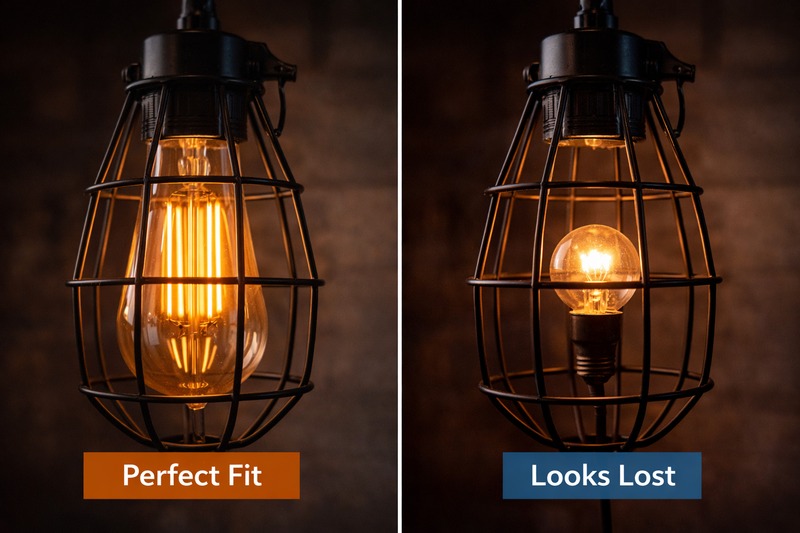
In the lighting world, geometry is everything. Industrial lighting originated from factories. The wire cages were not for decoration. They were to stop a worker from smashing the glass bulb with a ladder. The original bulbs in 1910 were long and pear-shaped. The cages were built around that shape. Today, we call this shape ST64 (or ST19 in America).
The "Void" Design Failure
I once visited a trendy bar where they installed round A19 (Standard) bulbs inside long cylindrical cages. It looked terrible. The bulb sat at the very top of the cage. The bottom half of the cage was completely empty. It looked like a small head wearing a very tall hat. The light source was trapped at the top, creating a weird shadow at the bottom. This happens when you don't consider the "negative space2" inside a fixture. A bulb must look like it belongs there, not like a temporary replacement you bought at a supermarket.
Scaling the Bulb to the Metal
You must match the bulb shape to the guard shape.
- Long Cages: Use ST64 or T45 (Tube) bulbs. They fill the vertical space. The filament stretches down, pushing light out through the unobstructed lower part of the cage.
- Wide/Flat Cages (Bulkheads): Use A19 or G45. These fixtures usually mount on walls (sconces). A long bulb might hit the glass cover.
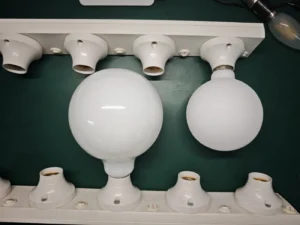
- Pipe Lamps: These are lamps made of plumbing pipes. They have no shade. Here, you use the G125 (Large Globe)3. Why? Because the lamp base (the pipes) is heavy and thick. A small bulb looks weak on top of a 1-inch iron pipe. A giant 5-inch globe balances the visual weight of the iron. If the fixture is heavy metal, the bulb must be large enough to assert itself.
| Fixture Style | Material | Best Bulb Shape | Why? |
|---|---|---|---|
| Trouble Cage | Wire/Steel | ST64 / ST58 | Fills the vertical length. |
| Pipe Lamp | Iron Piping | G95 / G125 | Balances heavy visual weight. |
| Bulkhead | Alum/Glass | A19 / T45 | fits compact enclosed space. |
| Enamel Shade | Spun Metal | A19 / G80 | Hides completely inside shade. |
Can You Make Industrial Lighting Smart Without Ruining the Look?
Your client wants the 1920s factory look but demands 2024 voice control. Hiding a white plastic smart bulb destroys the aesthetic instantly.
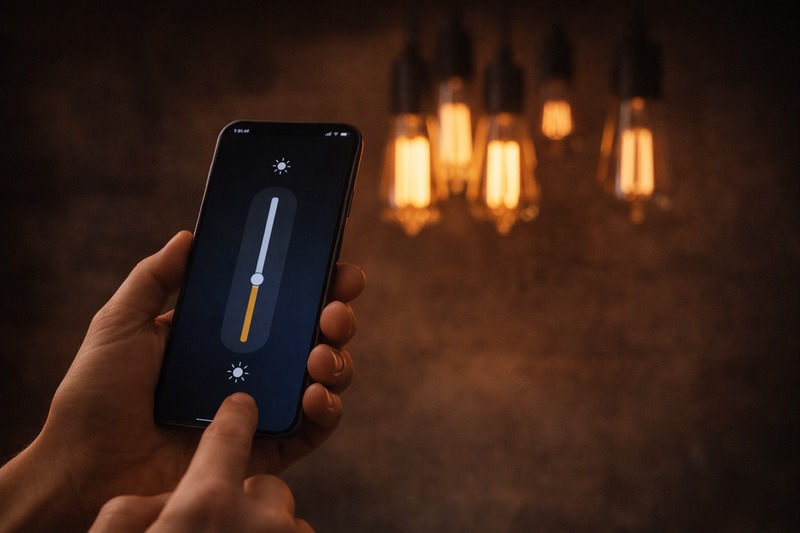
You no longer need to choose between style and convenience. New "Filament Smart Bulbs" hide WiFi chips in the base, allowing you to voice-control vintage-style amber lighting without visible plastic casings, maintaining the authentic industrial illusion.
This is the biggest conflict in modern design. We want the "Steam Age" look, but we are addicted to "Space Age" convenience. Three years ago, if you wanted a smart bulb, you bought a Philips Hue or a generic Tuya bulb. It was half white plastic, half frosted plastic. If you screw that into a $500 vintage brass socket, it is a crime. It looks like a cheap toy.
The Invisible Tech Revolution
Factories like mine have figured out how to shrink the WiFi or Zigbee module. We hide it inside the standard metal screw base (E26/E27). The glass remains clear or amber. The filaments remain visible. From the outside, it looks exactly like a "dumb" antique bulb. Inside, it connects to Alexa or Google Home. This is critical for Industrial spaces because these spaces usually have high ceilings. Changing a light switch is expensive (wireless wiring is easier). Reaching the bulbs to dim them manually is impossible. Smart filaments solve the access problem without breaking the visual theme.
Deep Dimming for Atmosphere
Crucially, industrial style needs deep dimming4. A factory bulb looks best when it is barely on—just a glowing orange wire against a brick wall. This is "mood lighting." Cheap smart bulbs flicker at 10% brightness. You need to source smart filaments that support 1% - 100% stable dimming. Jacky had a client with a 20-foot ceiling in a restaurant. They installed 50 Industrial Pendants. Using standard wall dimmers for 50 bulbs is a wiring nightmare. We supplied Smart Filament ST64 bulbs5. The owner grouped them in the app: "Lunch Mode" (80% brightness) and "Dinner Mode" (30% brightness). This functionality is only possible because the technology is now hidden inside the vintage form factor.
| Feature | Standard Smart Bulb | Filament Smart Bulb | Industrial Fit |
|---|---|---|---|
| Appearance | White Plastic Housing | Full Glass Body | Perfect |
| Light Source | SMD Chips (Flat) | Linear LED Filament | Authentic |
| Beam Angle | 180° (Directional) | 360° (Omni) | Classic |
| Aesthetic Off | Ugly Plastic lump | Vintage Glassware | Beautiful |
Related HongYu Bulb product pages
- LED Filament Bulb Product Range → — standard and decorative LED filament bulbs for wholesale and project sourcing.
- Contact HongYu Bulb → — send specifications, target market, quantity and packaging requirements for quotation.
Conclusion
Industrial style is about raw honesty, so never fake it with plastic bulbs. Use 2200K amber ST64s to add warmth to cold steel, ensure the bulb shape fills the wire cage, and utilize hidden smart tech to keep the vintage look modern.
Explore how 2200K light transforms industrial spaces, enhancing warmth and aesthetics. ↩
Understanding negative space is crucial for effective design. Explore this link to enhance your design skills. ↩
Learn about the G125 bulb's applications and benefits to make informed lighting choices for your space. ↩
Understanding deep dimming can enhance your lighting design, ensuring optimal ambiance and functionality in various settings. ↩
Exploring the benefits of Smart Filament ST64 bulbs can help you choose the right lighting solution for your space, combining aesthetics with technology. ↩