You have installed the white shiplap walls and the matte black hardware. The room looks clean, but it feels lifeless and cold, like a clinic rather than a home.
Modern Farmhouse style relies on the contrast between cool white backgrounds and warm accents. LED Edison bulbs provide the necessary 2700K Soft White glow and visual texture to bridge the gap between "clinical" and "cozy" without compromising the clean aesthetic.
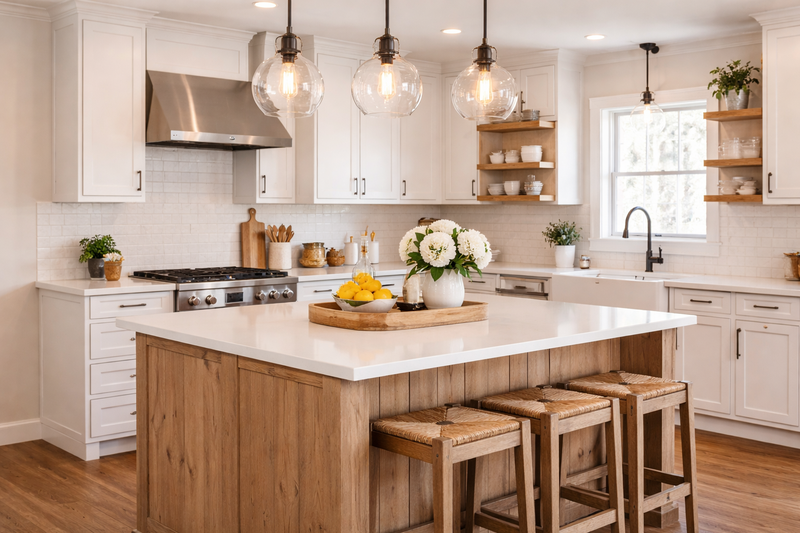
Modern Farmhouse is the most popular design style in America right now.
It is a mix of the old and the new.
The "Modern" part means clean lines and neutral colors.
The "Farmhouse" part means rustic wood and vintage shapes.
Lighting is the glue that holds these two opposites together.
If you use a standard plastic bulb, the room looks too cheap.
If you use a very dark amber antique bulb, the room looks too yellow and old.
You need a balance.
My client Jacky sells lighting to interior designers in Texas.
They love the "Chip and Joanna Gaines" look.
He often asks me for advice on which bulbs to stock for these projects.
I always tell him: "Focus on the glass clarity and the filament shape."
The bulb is the jewelry of the room.
In a Modern Farmhouse, the fixture is often just a simple black frame or a clear glass jar.
The bulb is fully visible.
Therefore, the bulb must be beautiful.
Why Is Clear Glass Superior to Amber Glass for White Interiors?
You want the vintage shape of the bulb, but you have painted your entire house crisp white. Putting a dark amber bulb in a white room makes the walls look dirty and stained.
For Modern Farmhouse decor, you should choose clear glass LED filament bulbs with a 2700K color temperature. This maintains the pristine, clean look of your white walls during the day while providing a warm, inviting glow at night, avoiding the "nicotine stain" effect of heavy amber tint.
The biggest mistake people make is confusing "Industrial" with "Modern Farmhouse."
Industrial style loves grit. It loves dark bricks and concrete.
For Industrial style, we use "Amber Gold" glass bulbs. The glass is actually yellow.
Modern Farmhouse loves brightness. It uses white paint, white marble, and light oak wood.
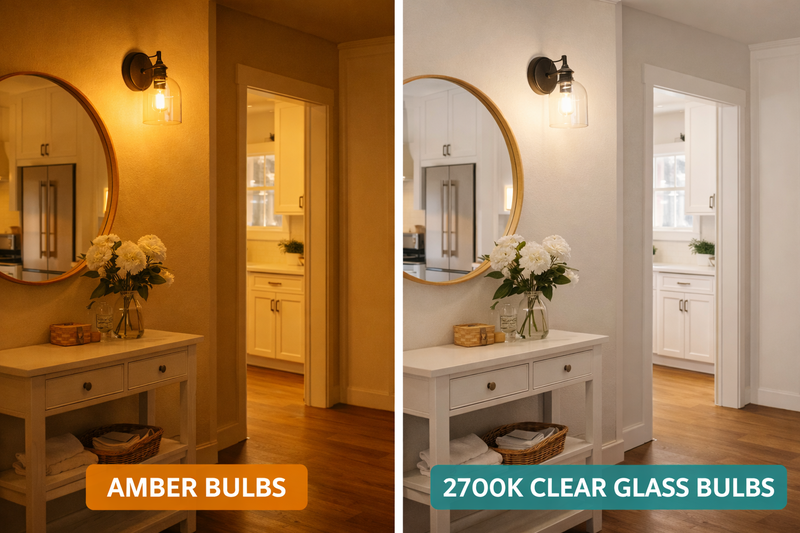
If you put an amber glass bulb in a white kitchen, it looks bad.
When the light is off, you see a brown object inside a clear fixture. It clashes with the clean white cabinets.
When the light is on, the amber glass filters the light and turns it orange (2200K).
This orange light hits your white walls and turns them beige or yellow.
Jacky had a customer return 500 bulbs because of this.
The customer painted their living room "Chantilly Lace" (a pure white).
They installed our ST64 Amber bulbs.
The customer screamed, "My walls look like someone has been smoking here for 20 years!"
I told Jacky to send them the Clear Glass Filament series.
This bulb uses a clear transparent glass shell.
Inside, we use LED filaments that glow at 2700K (Soft White).
2700K is the color of a traditional incandescent light bulb.
It is warm, but it is not orange.
This is the perfect middle ground.
It keeps your whites looking white, but it stops the room from feeling like a hospital.
In my factory, we coat the LED chips with a specific phosphor mix to achieve this.
We want the filament to look yellow when off, but shine soft white when on.
Glass Translucency and Paint Interaction
You must consider how the bulb looks when it is turned off. In a farmhouse kitchen, the lights are often off during the day because you have big windows. A clear bulb disappears. It looks light and airy. An amber bulb sits there like a heavy dark rock.
The Color Rendering Issue
Clear glass allows for a higher CRI (Color Rendering Index1). Amber glass distorts colors. In a kitchen, you want to see the true color of your food. A clear glass 2700K bulb usually has a CRI of 85+. An amber bulb might drop to CRI 75 because the glass filters out the blue spectrum. High CRI makes your wood floors look rich and natural.
| Feature | Amber Glass (Industrial) | Clear Glass (Modern Farmhouse) | Winner |
|---|---|---|---|
| Appearance (Off) | Dark / Bronze | Transparent / Invisible | Clear |
| Light Color | 2200K (Orange/Gold) | 2700K (Soft White) | Clear |
| Wall Effect | Turns white walls beige | Keeps white walls crisp | Clear |
| CRI Quality | Lower (~80) | Higher (~90) | Clear |
| Vibe | Moody / Dim | Bright / Airy | Clear |
Which Bulb Shape Best Fits Open-Frame Lantern Fixtures?
Farmhouse decor often features large, open geometric lanterns made of black metal or wood. Using a tiny, round bulb in these large frames breaks the visual proportion and looks cheap.
You must use the ST64 (Teardrop) or the larger ST21 bulb shape for open lantern fixtures. The elongated body of the ST64 mimics the vertical lines of the lantern, filling the negative space perfectly and asserting enough visual weight to balance the heavy metal frame.
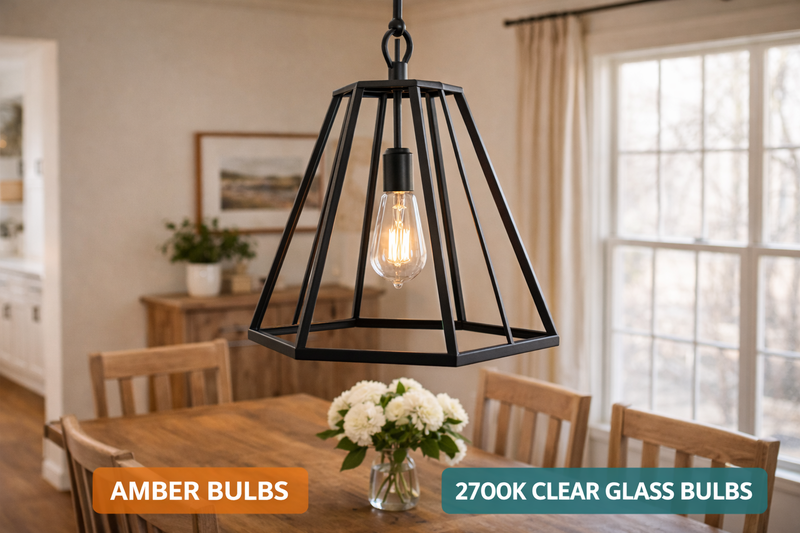
Geometry is a language.
In Modern Farmhouse, you see a lot of "Open Cage" fixtures.
These are pendants that look like old street lanterns or birdcages.
They have no glass panels, just a metal frame.
This means the bulb is 100% exposed.
It is the centerpiece of the fixture.
Common household bulbs are shape A19. They are short and round.
If you put an A19 in a tall lantern, it looks like a mistake.
It looks like a head without a body.
The bulb sits at the top of the socket, leaving 6 inches of empty space below it.
For these fixtures, I produce the ST64.
In America, you might call it the "Edison" shape or ST19.
It is pear-shaped with a long neck.
The length creates harmony.
The lantern is tall; the bulb is tall.
They match.
The Role of Candle Bulbs in Chandeliers
Another common Farmhouse fixture is the "Wagon Wheel" chandelier.
This is a big round metal ring with many bulbs on top.
For this, you cannot use the ST64. It is too fat.
You must use the CA10 (Candle Tip) or B11 (Bullet).
However, standard white plastic candle bulbs look terrible on a black wagon wheel.
You must use Filament LED Candle bulbs2.
These look like real flames.
Specifically, we make a "Bent Tip" version where the glass has a little hook at the top.
It mimics a flickering flame.
Jacky had a project for a wedding barn.
They had 10 huge wagon wheels.
He installed clear glass bent-tip filament bulbs.
The effect was magical.
It looked like 100 real candles floating in the air.
If he had used frosted plastic bulbs, it would have looked like a cheap motel lobby.
Scaling Up for Pendants
Sometimes, the lantern is huge.
I see these "Foyer Lanterns" that are 20 inches tall.
Even the ST64 looks small here.
For these, you need the ST21 or even the T10 (Tubular)3.
The T10 is a long tube, like a test tube.
It looks very modern.
It fits perfectly in the center of a tall, narrow cage.
It creates a column of light.
It gives the "Modern" edge to the "Farmhouse" frame.
| Fixture Type | Description | Best Bulb Shape | Why? |
|---|---|---|---|
| Open Lantern | Tall, rectangular cage | ST64 (Vintage) | Fills vertical space. |
| Wagon Wheel | Round ring, multiple sockets | CA10 (Candle) | Mimics real candles. |
| Glass Dome | Clear glass shade | G25 (Globe) | Round shape matches round glass. |
| Linear Island | Long rectangular bar | T10 (Tube) | Clean, straight lines. |
How Can You Use Filament Bulbs in Bathrooms Without Sacrificing Vision?
Vintage bulbs are famous for being dim and yellow, which is terrible for shaving or applying makeup. You need the aesthetic of the filament but the performance of a vanity light.
You need to select "High-Lumen" LED filament bulbs with a CRI of 90+ for bathroom vanities. These specific bulbs are engineered to produce daylight-quality brightness (500+ lumens) while retaining the decorative filament look, ensuring functionality matches the style.
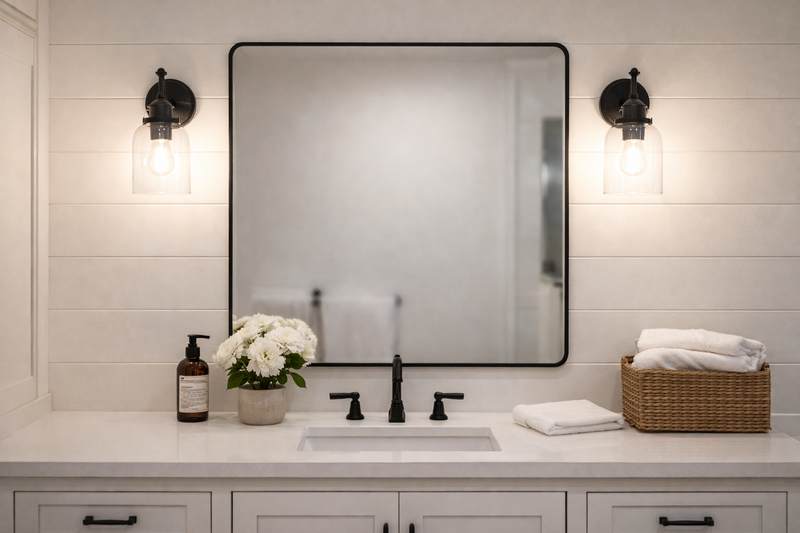
The bathroom is the hardest room to light in this style.
You want the sconces to look rustic.
Maybe they are pipe fixtures or gooseneck barn lights.
But if the light is bad, your wife will hate it.
Standard decorative filament bulbs are usually 2 watts or 4 watts.
They produce about 200 to 400 lumens.
This is "mood lighting."
It is fine for a hallway. It is useless for a bathroom vanity.
If you apply makeup in 2200K dim light, you will look orange.
When you walk outside into the sun, your foundation will look wrong.
For bathrooms, I manufacture a special line for my B2B clients.
We call it the "High Performance Filament."
We use more powerful LED chips on the filament stick.
We drive them harder to reach 6W or 8W.
This gives you 800 Lumens per bulb.
This is as bright as a standard 60W lightbulb.
If you have three of these above a mirror, you have plenty of light.
The Importance of R9 Red Rendering
It is not just about brightness. It is about Color Rendering Index (CRI)4.
Standard LEDs have a CRI of 80.
They are weak in the "Red" spectrum (R9 value).
Skin, blood, and lips are red.
If the R9 value is low, you look pale and sick in the mirror.
For the High Performance line, we boost the Red phosphors.
We aim for CRI 90+.
This makes skin tones look natural and healthy.
Jacky supplied a hotel chain in Nashville.
They did a modern farmhouse renovation.
They put standard industrial bulbs in the bathrooms.
Guests complained they couldn't see to shave.
The hotel owner was furious.
We rushed an air shipment of High-Lumen 3000K filament bulbs.
3000K is slightly whiter than 2700K.
It is better for bathrooms because it is closer to neutral white.
It solved the problem instantly.
The fixtures kept the rust look, but the light quality became professional.
Managing Glare at Eye Level
The distinct problem in bathrooms is that the sconces are often at eye level (flanking the mirror).
A bright 800-lumen filament creates glare.
It hurts your eyes.
The solution is Frosted or Milky Glass.
Yes, I said clear glass in the kitchen.
But in the bathroom, at eye level, frosted glass is safer.
Or, you use the "Porcelain" LED bulb.
This is a new trend. The glass looks like white matte porcelain.
When lit, the whole bulb glows evenly. You don't see the harsh filament line.
It fits the white modern farmhouse palette perfectly and eliminates glare.
| Room | Bulb Requirement | CRI Needed | Rec. Brightness |
|---|---|---|---|
| Living Room | Mood / Ambient | > 80 | 400 Lumens (Dimmable) |
| Kitchen | Task / General | > 85 | 800 Lumens |
| Bathroom | Precision Task | > 90 | 800+ Lumens |
| Bedroom | Relaxation | > 80 | 200-400 Lumens |
Why Are Spiral Filaments the Future of Modern Farmhouse?
The straight yellow filament lines of traditional Edison bulbs can sometimes look too "hard" or "industrial" for a family home. New flexible LED technology allows for softer curves that blend better with textiles and soft furnishings.
Flexible "Spiral" LED filaments offer a softer, more organic light pattern that complements the comfortable, homely side of Modern Farmhouse decor. These curving filaments reduce the harsh shadows created by straight linear LEDs and add an artistic, modern touch to vintage-style fixtures.
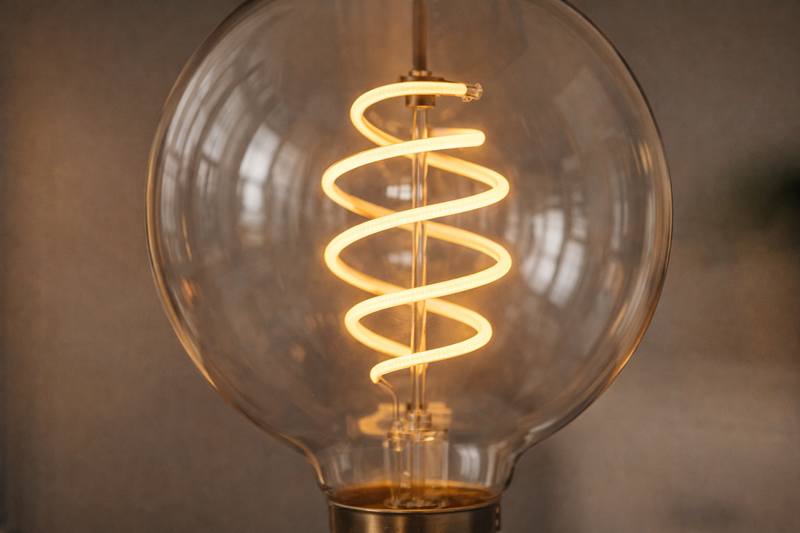
Technology never stops moving.
The first generation of LED Edison bulbs had straight sticks.
We call them "hard filaments."
They look like rigid orange bars.
They are great for factories, but they can look a bit aggressive in a cozy home.
Five years ago, we invented the Soft Filament (Flexible LED).
We use a special flexible substrate that allows us to bend the LED strip.
We can make spirals, loops, and even heart shapes.
For Modern Farmhouse, the Spiral is the winner.
Why?
Because Farmhouse style uses a lot of soft textures.
You have wool blankets, linen curtains, and round wreaths.
A rigid straight line fights against these soft shapes.
A spiral curve flows with them.
The light distribution is also better.
A straight filament throws light sideways. It leaves shadows at the top and bottom of the bulb.
A spiral filament throws light 360 degrees. It has no dark spots.
It looks more like a glowing cloud.
The "Dimmability" and Atmosphere
Spiral filaments look stunning when dimmed.
Because the coil is long, there is more surface area glowing.
When you dim it down to 10%, it creates a beautiful intricate pattern.
It looks like complex jewelry inside the glass.
I have a client who makes custom dining tables.
He puts a single large Globe (G125) with a spiral filament5 over the center of the table.
He says it is a "conversation starter."
Guests stare at the bulb because it looks like a piece of modern art, not just a light source.
This fits the "Modern" part of the design brief perfectly.
It is tech-forward but visually vintage.
Durability and Efficiency
From a manufacturing standpoint, flexible filaments are also very durable.
They withstand vibration better than rigid sticks.
This is important if you have a house with kids running around on the floor above, vibrating the chandelier.
The only downside is cost.
A spiral bulb costs about 30% more to produce than a straight stick bulb.
But for the centerpiece of your home, that extra $2 is worth it.
Do not use them everywhere.
Use standard straight filaments for hallways and high ceilings.
Use the special spiral filament5s for eye-level fixtures: table lamps, low pendants, and dining chandeliers.
| Filament Type | Structure | Light Pattern | Aesthetic Feel |
|---|---|---|---|
| Straight Linear | Rigid Sticks | Directional (Side) | Industrial / Tough |
| Spiral / Flex | Coiled Curve | Omnidirectional (360) | Soft / Artistic |
| Squirrel Cage | Vertical Zigzag | Classic pattern | Antique / Retro |
| Loop | Single C-shape | Focused | Minimalist |
Related HongYu Bulb product pages
- LED Filament Bulb Product Range → — standard and decorative LED filament bulbs for wholesale and project sourcing.
- Contact HongYu Bulb → — send specifications, target market, quantity and packaging requirements for quotation.
Conclusion
Modern Farmhouse is all about balance, and your lighting must reflect that. By choosing clear glass to protect your white walls, selecting geometric shapes like the ST64 to fill your lanterns, and upgrading to high-CRI filaments for your bathrooms, you create a home that is both stylishly rustic and functionally modern.
Understanding CRI helps you choose lighting that enhances the true colors in your space, especially in kitchens. ↩
Explore the benefits of Filament LED Candle bulbs for a warm, flickering flame effect in your lighting. ↩
Learn about T10 (Tubular) bulbs and how they can enhance modern lighting designs. ↩
Understanding CRI is crucial for selecting lighting that enhances colors accurately, especially in spaces like bathrooms. ↩
Explore the advantages of spiral filament bulbs, including their unique aesthetic and energy efficiency, to enhance your lighting choices. ↩ ↩
Browse from HongYu Bulb: EU Vintage Straight Filament Bulbs → · EU Vintage Flexible Filament Bulbs →