Your expensive new chandelier hangs over the dining table, looking impressive in the catalog, but when you turn it on, it blinds everyone sitting down like an interrogation light. You wanted elegance, but you got a headache.
To successfully light an exposed bulb chandelier, you must ignore standard wattage rules and calculate "Total Lumen Output." You should choose low-lumen (200-400lm) bulbs, utilize "Half-Chrome" designs to deflect direct glare, and ensure the bulb shape mimics the geometry of the fixture arms.
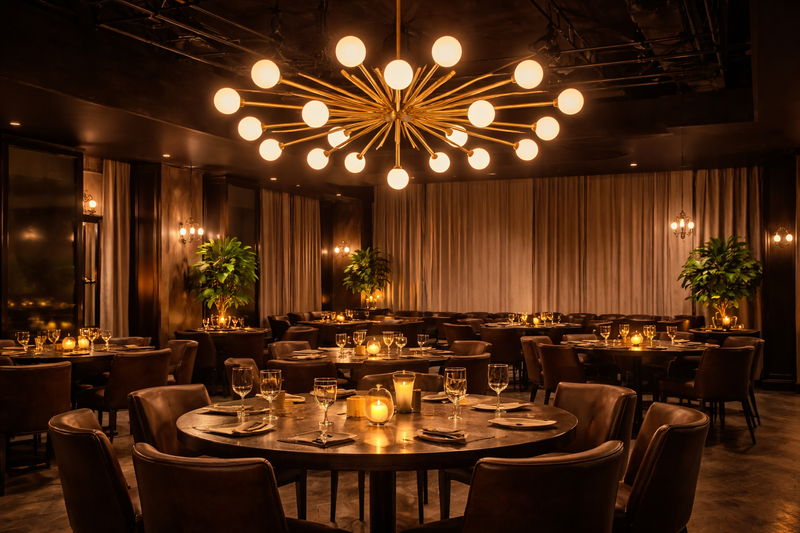
The "Exposed Bulb" trend is not going away.
It started in coffee shops and moved into the living room.
In these fixtures, there is no fabric shade. There is no frosted glass diffuser.
The bulb is the fixture.
This is dangerous territory for a beginner.
When you strip away the shade, you strip away the protection.
I see this problem every week.
My client Jacky calls me from a construction site in California.
He says, "Wallson, the interior designer picked a 12-arm Sputnik chandelier. We put in standard A19 bulbs. It is so bright the homeowner put sunglasses on."
The problem is simple math mixed with bad aesthetics.
A standard bulb is designed to be hidden. It shouts.
An Edison bulb is designed to be seen. It whispers.
But even among Edison bulbs, you can make terrible mistakes.
To turn a metal skeleton into a piece of art, we need to balance four critical elements: Brightness, Glare, Shape, and Tint.
Why Is the "Total Lumen Calculation" More Important Than Individual Wattage?
Most people buy bulbs by habit, picking a "60-watt equivalent" because that is what they grew up with. If you do this with a multi-socket chandelier, you will accidentally create a miniature sun in your living room.
You must calculate the total lumens required for the room and divide that by the number of sockets in the chandelier. For a 10-socket fixture, you should use dim 2-watt or 4-watt bulbs (200 lumens each) to achieve a comfortable ambient light, rather than standard bulbs which would be blindingly bright.
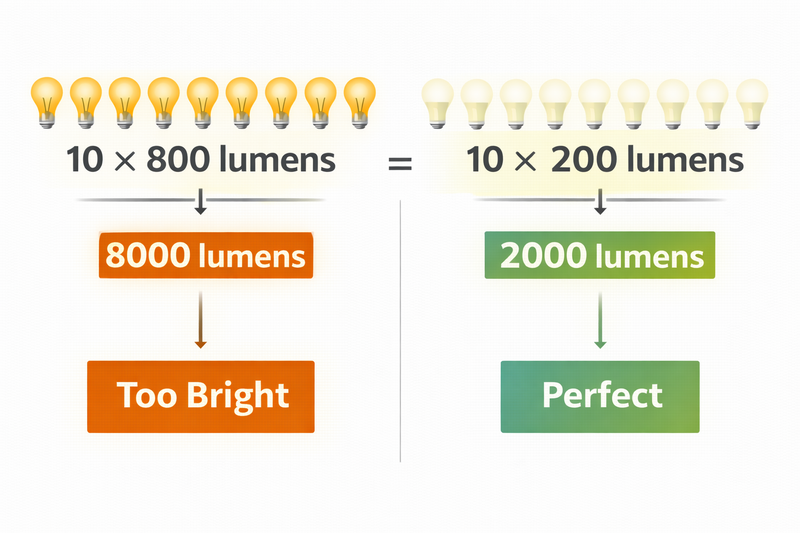
Lighting is cumulative.
If you have a single pendant light in a hallway, you need an 800-lumen bulb (60W equivalent) to see.
If you have a "Sputnik" or "Wagon Wheel" chandelier with 12 sockets, that math changes.
If you put that same 800-lumen bulb in all 12 sockets, you have 9,600 lumens.
That is not a dining room; that is a surgery operating theater.
I always teach Jacky this rule: The Chandelier Rule of Division.
First, determine how much light the room needs.
A dining room needs about 3,000 lumens total.
If your chandelier has 15 arms, you divide 3,000 by 15.
The result is 200 lumens per bulb.
This is a very dim bulb!
This is virtually a night light.
This is usually a 2-Watt LED Filament Bulb.
Many customers are afraid to buy 2-Watt bulbs. They think, "That is too weak."
Trust me. When you multiply it by 15, it is powerful.
If you use standard bulbs, you will have to dim them down to 10% brightness permanently.
This is a waste of money, and cheap LEDs often flicker at 10%.
By buying lower wattage capabilities from the start, you get a stable, comfortable glow at full power.
In my factory, we produce specific "Decorative Series" bulbs that are labeled 40W Equivalent but are actually much softer, designed specifically for these multi-arm monsters.
The Filament Visibility Factor
The other reason for low lumens is aesthetics.
Why did you buy an exposed bulb chandelier1?
Because you like the look of the glowing filament.
If the bulb is too bright (800+ lumens), the glare masks the filament.
Your eye cannot process the detail. It just sees a painfully bright white ball.
When you drop the lumens down to 200 or 300, the glare disappears.
Suddenly, the human eye can focus on the orange squiggly line inside the glass.
You can see the "Spiral" or the "Squirrel Cage" design.
The bulb becomes a texture, not just a light source.
This is vital for the "Vintage" look.
If you cannot see the filament, you wasted your money on the fixture.
| Number of Sockets | Recommended Lumens/Bulb | Approx Wattage | Total Output |
|---|---|---|---|
| 1 - 3 | 800 Lumens | 6W - 8W | ~2000 lm |
| 4 - 6 | 400 Lumens | 4W | ~2000 lm |
| 8 - 12 | 250 Lumens | 2.5W | ~2500 lm |
| 16+ | 150 Lumens | 1.5W | ~2400 lm |
But getting the brightness right is only the first step; next, you have to look at the shape of the chaos.
Which Bulb Shape Best Complements Your Chandelier's Geometry?
An exposed chandelier is essentially a sculpture made of metal and glass. Putting the wrong shape bulb into the socket is like putting square tires on a sports car; it ruins the lines of the design.
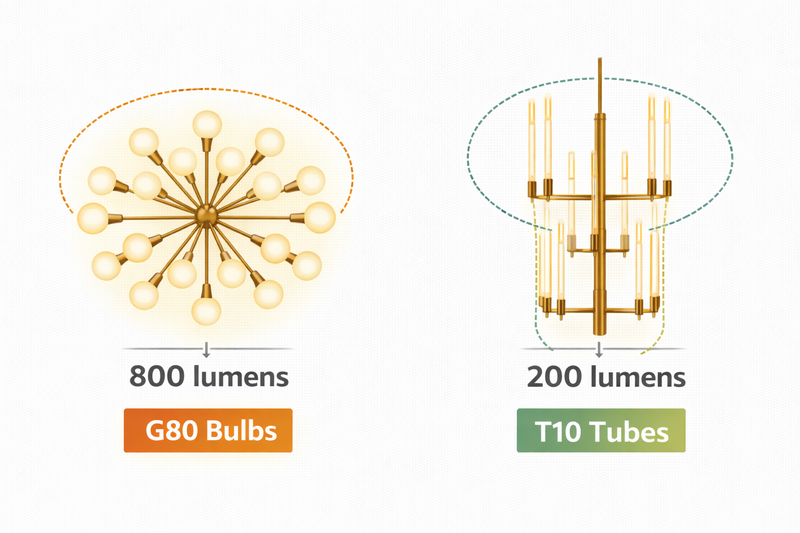
You should match the bulb shape to the direction of the chandelier arms: use Round Globes (G45/G80) for radial "starburst" fixtures to maintain symmetry, and Candletip (CA10) or Tube (T10) bulbs for vertical fixtures to elongate the height.
Geometry is the language of design.
If you ignore it, the fixture looks awkward.
I categorize chandeliers into three shapes for my clients.
1. The Explosion (Radial).
This is the Sputnik, the Starburst, or the Atom style.
The arms shoot out from a center point in all directions.
These fixtures are about spheres.
You must use Globe Bulbs (G-Series).
If the fixture is small, use the G45 (Golf ball size).
If the fixture is massive, use the G80 or G95 (Grapefruit size).
If you put a long, pear-shaped ST64 bulb in a Sputnik, it looks like a prickly sea urchin. It looks dangerous.
Round bulbs make it look balanced and intentional.
2. The Circle (Horizontal).
This is the Wagon Wheel or the Ring Glazier.
The sockets sit on a horizontal ring, pointing up.
Historically, these were candle holders.
You should honor that history.
Use Candle shapes (C35/CA10) or small Teardrops (ST58).
These shapes draw the eye upward toward the ceiling.
They mimic flame.
Do not put big round globes on a wagon wheel. It looks like a carnival game.
3. The Structure (Linear/Vertical).
These are modern industrial pipes or tiered frames.
They have hard, straight lines.
Here, you can use Tubular Bulbs (T10/T30).
A tube bulb is a cylinder.
It continues the line of the metal pipe.
It looks sleek and modern.
Jacky had a project for a modern art gallery.
They had these black pipe fixtures.
We installed T30 "Gold Tint" long tubes using a fast spiral filament.
It looked like glowing bars of gold suspended in the air.
If we had used round bulbs, it would have looked too "cute" for the gallery.
The Scale of the Socket
You must also look at the socket cup.
Some chandeliers have a metal cup that covers the base of the bulb.
If you use a bulb with a short neck, the glass might hit the metal cup before it screws in all the way.
Or, the "ugly" plastic base of the LED might stick out.
For exposed chandeliers, I always recommend "Base-Up" Filament Bulbs.
This means the glass goes all the way down to the metal screw.
There is no white plastic ring.
When the bulb is exposed, seeing a plastic ring ruins the illusion of high quality.
It looks like a cheap supermarket replacement.
Always ensure the glass shape transitions2 smoothly into the metal socket of the fixture.
| Fixture Style | Recommended Shape | Visual Effect | Design Goal |
|---|---|---|---|
| Sputnik / Atomic | G16.5 or G25 Globe | Bubbles / Atoms | Symmetry |
| Wagon Wheel | CA10 Bent Tip | Candle Flames | Tradition |
| Modern Linear | T10 / T30 Tube | Glowing Rods | Sleekness |
| Industrial Pipe | ST64 Edison | Vintage Engine | Retro Grit |
Now that we have the shape, we must discuss the color of the glass itself, which defines the era of the design.
How Does Glass Tint Define the "Style Era" of Your Room?
The bulb is visible even when it is turned off, acting as a decorative object. The color of the glass shell—whether clear, amber, or smoke—determines whether your room feels like a 1920s factory or a 2020s modern loft.
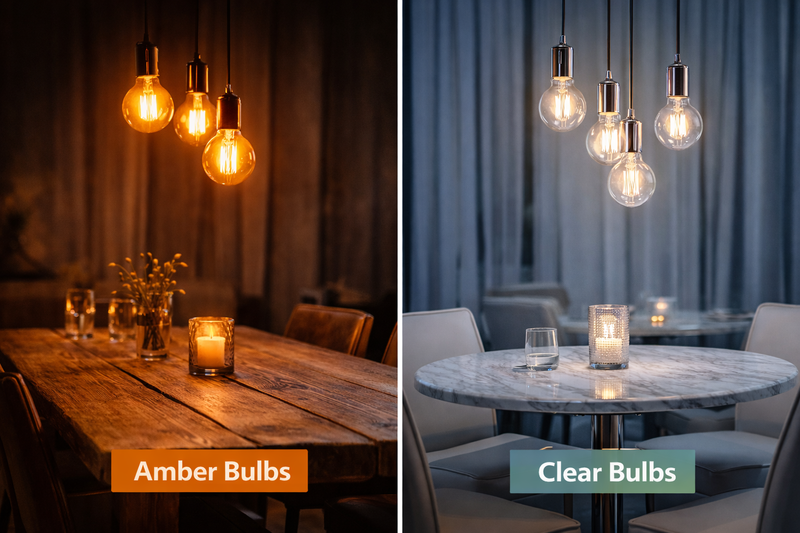
Use Amber/Gold tinted glass for Rustic or Industrial settings where you want to emphasize warmth and wood tones. Use Clear or Gradient Smoke glass for Modern, Mid-Century, or Minimalist settings to keep the look crisp and avoid clashing with chrome or silver finishes.
When you buy a standard light bulb, you don't care what the glass looks like because it is hidden.
With an exposed chandelier, the bulb is the "Jewelry."
During the day, when the light is off, that glass is a physical object in the room.
Amber Glass (The Nostalgic Choice):
This is traditional. We call it "Tea Stain."
It looks like an antique.
It is perfect if you have a wooden table, brick walls, or leather chairs.
The amber glass creates a localized warmth.
However, be careful.
If you put amber bulbs in a fixture that is Chrome or Nickel, it looks weird.
Silver and Orange do not mix well. It looks mismatched.
Clear Glass (The Modern Choice):
This is becoming more popular.
Mid-Century Modern (MCM) style uses a lot of brass and white marble.
Amber glass looks "dirty" against white marble.
Clear glass looks pristine.
It sparkles.
The challenge with clear glass is the filament.
Since the glass doesn't filter anything, the yellow LED filament strip is very visible when off.
It looks like a yellow caterpillar inside the bulb.
Some designers hate this.
To fix this, we developed the "Silver Mirror" or "Smoke" fade.
Or we use clear glass with a CRI 95 filament that is paler yellow, so it is less noticeable.
Smoke/Grey Glass (The Edgy Choice):
This is the new trend for 2024.
The glass is tinted titanium grey.
When off, it looks like a black pearl.
It looks very expensive and masculine.
When on, the light is subtle and moody.
It reduces the lumen output significantly (by about 40%).
But for a pure mood chandelier in a cocktail lounge or a bachelor pad, nothing beats Smoke glass.
The "Color Cast" on Walls
You must remember that the glass tint affects the color of the light hitting your walls.
An amber bulb will turn your white walls cream or beige.
If you just paid $5,000 for a perfectly crisp white paint job, amber bulbs3 will ruin it.
Jacky had a client sue him (almost) over this.
The client painted the room "Cool Gray."
Jacky sold him deeply amber bulbs3.
The room looked muddy green because Gray + Yellow = Greenish Mud.
We had to swap them for "Gradient Gold" bulbs which are lighter, or Clear bulbs.
Always match the tint of the bulb to the palette of the room's paint.
| Glass Tint4 | Fixture Material | Room Style | Light Quality |
|---|---|---|---|
| Amber / Gold | Black Iron, Bronze, Wood | Farmhouse, Industrial | Very Warm (2200K) |
| Clear | Chrome, Brass, Glass | Modern, MCM, Scandi | Crisp Warm (2700K) |
| Smoke / Grey | Matte Black, Concrete | Urban, Minimalist | Cool / Moody |
| Frosted | White Metal, Plastic | Contemporary | Diffused (No Glare) |
We have the lumens, the shape, and the tint. Now we must solve the physical pain of looking at the light.
Can "Half-Chrome" Bulbs Solve the Overhead Glare Problem?
If your chandelier hangs directly over a dining table, guests sitting below will look up directly into the glowing filaments, which causes eye strain. You need a way to block this direct line of sight without hiding the bulb.
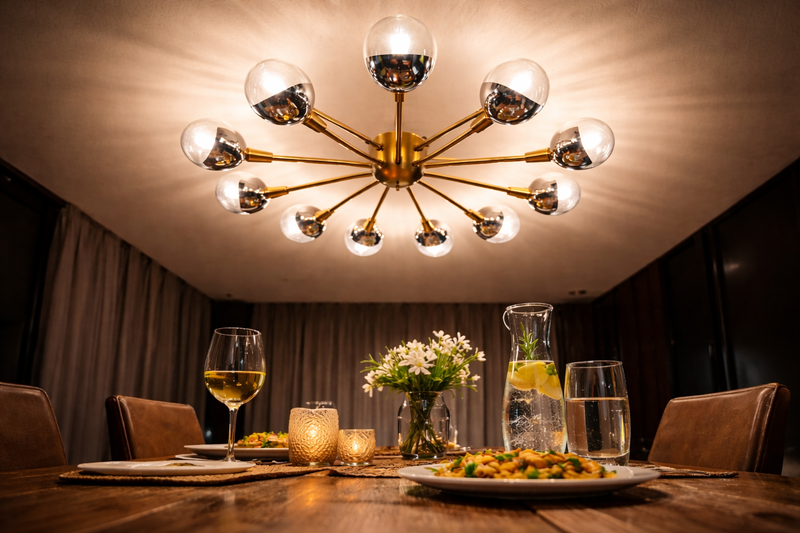
"Half-Chrome" or "A-Mirror" bulbs feature a reflective silver or gold coating on the bottom half of the glass. This directs the light upward into the fixture and reflects it off the ceiling, providing softer indirect light and shielding the diners' eyes from the harsh filament.
This is my secret weapon.
I sell thousands of these to restaurant designers, but homeowners rarely know about them.
The Half-Chrome Bulb.
Imagine a standard round bulb.
Now imagine we dip the bottom half in liquid chrome.
When you screw it into a pendant or chandelier, the bottom is opaque.
It acts like a mirror.
When you turn it on, the light cannot go down. It goes up.
It hits the ceiling or the metal arms of the chandelier and bounces back down as "diffused light."
This creates a shadowless, soft environment.
More importantly, when you sit at the dinner table and look up, you do not see a burning wire.
You see a reflection of your own room in the silver bottom.
It is incredibly comfortable.
Combining Aesthetics with Function
The mirror coating comes in Silver, Gold, and Copper.
You match the coating to your fixture.
If you have a brass chandelier, use Gold-Tipped bulbs.
It looks like the bulb is part of the metalwork.
It integrates the light source into the sculpture.
This is critical for low-hanging chandeliers.
If a fixture is 7 feet off the ground, standard bulbs are fine.
If a fixture is 30 inches above your dining table (eye level for a standing person), standard bulbs are blinding.
The Half-Chrome5 is the only way to have an exposed bulb fixture at eye level without causing pain.
The Trade-off: Effeciency
The trade-off is efficiency6.
You lose about 30% of the useful light because it is bouncing off the ceiling.
You need to buy slightly higher wattage to compensate if you need the room bright.
However, for dining, "bright" is usually not the goal. "Comfort" is the goal.
I often suggest these for the main chandelier, and then using recessed can lights (pot lights) for the actual cleaning or working light in the room.
| Bulb Type | Direction of Light | Glare Level | Best Application |
|---|---|---|---|
| Standard Filament | 360 Degrees (All) | High (Direct) | High Ceilings / Hallways |
| Half-Chrome5 | 180 Degrees (Up) | Zero (Indirect) | Dining Tables / Eye Level |
| Frosted | Diffused | Low | Bathrooms / Workspaces |
Related HongYu Bulb product pages
- LED Filament Bulb Product Range → — standard and decorative LED filament bulbs for wholesale and project sourcing.
- Big Decorative Bulbs → — oversized decorative filament bulbs for hospitality, retail and statement fixtures.
- Contact HongYu Bulb → — send specifications, target market, quantity and packaging requirements for quotation.
Conclusion
Exposed bulb chandeliers are unforgiving; they magnify every mistake in your bulb choice. By ignoring standard wattage and instead focusing on low-lumen output for multi-socket fixtures, matching the glass geometry to the arm structure, and using half-chrome technology for dining zones, you turn a potential eyesore into the sophisticated art piece it was meant to be.
Explore this link to understand the charm and appeal of exposed bulb chandeliers, enhancing your decor choices. ↩
Discover the significance of glass shape transitions for achieving a seamless and elegant look in lighting fixtures. ↩
Exploring the effects of amber bulbs can prevent costly mistakes in your lighting choices and paint selections. ↩ ↩
Understanding glass tint can help you choose the right lighting for your space, enhancing aesthetics and mood. ↩
Explore the advantages of Half-Chrome bulbs for eye-level fixtures, ensuring comfort without glare. ↩ ↩
Learn effective strategies to enhance lighting efficiency while maintaining comfort in your living spaces. ↩