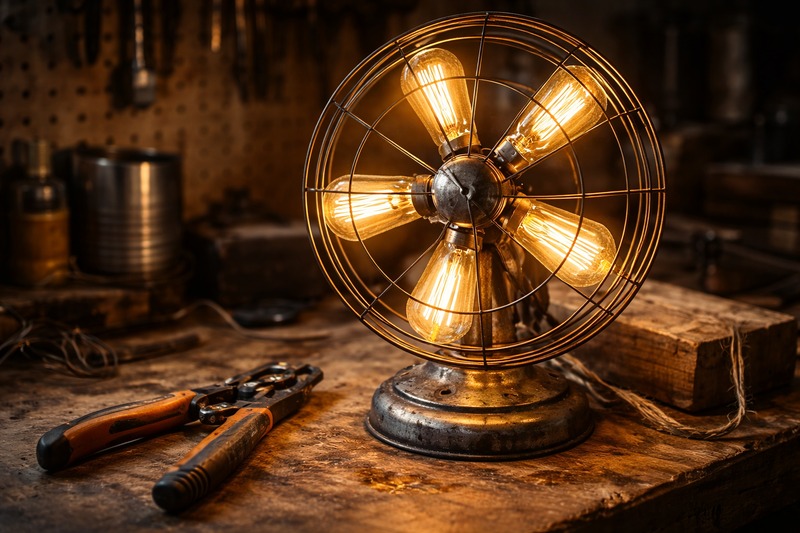
We live in a world of fast furniture. You buy a lamp, it breaks, and you buy another one. But recently, I have seen a massive shift in my B2B orders. Designers and boutique store owners are not just buying bulbs for standard sockets; they are buying them to put inside pipes, cameras, and even musical instruments.
Upcycling is the art of taking waste and turning it into something of higher value, and the vintage aesthetic of LED Edison bulbs is the perfect "missing link" that transforms rusty junk into high-end industrial décor. Because LED filaments produce negligible heat and come in versatile shapes, they can be safely wired into wood, metal, and plastic antiques without the fire risks associated with traditional lighting.
I have a customer named Jacky, a DIY enthusiast in Denver.
He used to walk past flea markets and see "junk."
Now, he sees "housings."
He told me, "Wallson, the old incandescent bulbs were too hot. If I put one inside a wooden radio, it would burn the wood. But your LEDs run cool. That changed everything."
He now runs a side business selling "Steampunk Lamps" for $300 each. His cost of materials? Maybe $20 plus my bulb.
The key to upcycling isn't being a master electrician. It is seeing the potential in an object.
Any object with a hollow space can be a lamp.
Let me walk you through three specific projects that my customers are building right now, from beginner to advanced.
The Mason Jar & Pipe Lamp: Is It Still Trendy?
Some people say the "farmhouse" trend is over. I disagree. The demand for industrial pipe lamps is higher than ever, but the designs are getting smarter. It is the easiest entry point for a beginner.
The "Industrial Pipe Lamp" combines standard ¾-inch iron plumbing pipes (available at any hardware store) with Mason jars acting as glass shades. The threading of plumbing pipes matches perfectly with standard lighting parts, allowing you to screw together a custom armature that protects the LED bulb while diffusing its light through the vintage glass of the jar.
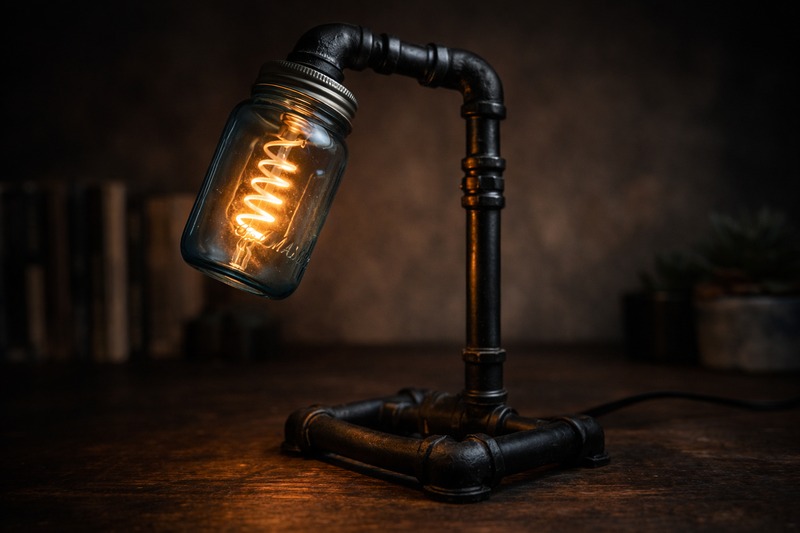
Jacky started with this because it requires no drilling.
It is like playing with heavy, metal LEGOs.
The logic of the build:
- The Spine: You buy black iron flanges, elbows, and nipples (short pipes). You screw them together to make a robot shape or a simple hook.
- The wiring: This is the clever part. The pipe is hollow. You run the electrical cord inside the pipe. It is hidden. It looks clean.
- The Jar Connection:
How do you attach a glass jar to a metal pipe?
You drill a hole in the lid of the Mason jar.
You sandwich the lid between the light socket and the pipe fitting.
Then, you screw the glass jar onto the lid just like you are canning pickles.
Why the Bulb Matters Here:
If you put a frosted white bulb in a clear Mason jar, it looks cheap. It looks like a mistake.
You need a bulb that demands to be seen.
Use the ST64 "Squirrel Cage" Filament.
The vertical lines of the filament match the vertical lines of the pipe.
Heat Management in Jars:
This is critical.
A Mason jar is a closed environment.
An old 40W tungsten bulb would get so hot inside a closed jar that the glass might crack from thermal shock.
My 4W LED Filament produces almost no heat.
The air inside the jar stays lukewarm. It is perfectly safe to screw the lid on tight.
The "Blue Glass" Hack
Vintage Mason jars (the expensive ones) are blue or green.
Cheap modern ones are clear.
Pro Tip: Don't paint the jar. It looks messy.
Use my Amber Tint Bulb1 inside a clear jar.
The amber light hitting the thick clear glass creates a warm, honey-colored glow that looks like expensive antique glass.
If you find a real blue jar, use a 4000K (Daylight) LED2. The cool white light punches through the blue glass and makes it glow like sapphire.
The "Vintage Camera" Flash: How to Electrify Memories?
We all have an old film camera sitting on a shelf collecting dust. It looks cool, but it does nothing. Turning it into a desk lamp gives it a second life as a functional piece of art.
Converting a vintage camera into a lamp involves utilizing the "flash shoe" or the tripod mount as an anchor point for a light socket. By attaching a flexible gooseneck or a rigid rod to the camera body, you position a large globe Edison bulb to hover above the lens, mimicking the look of an old-school flash explosion frozen in time.
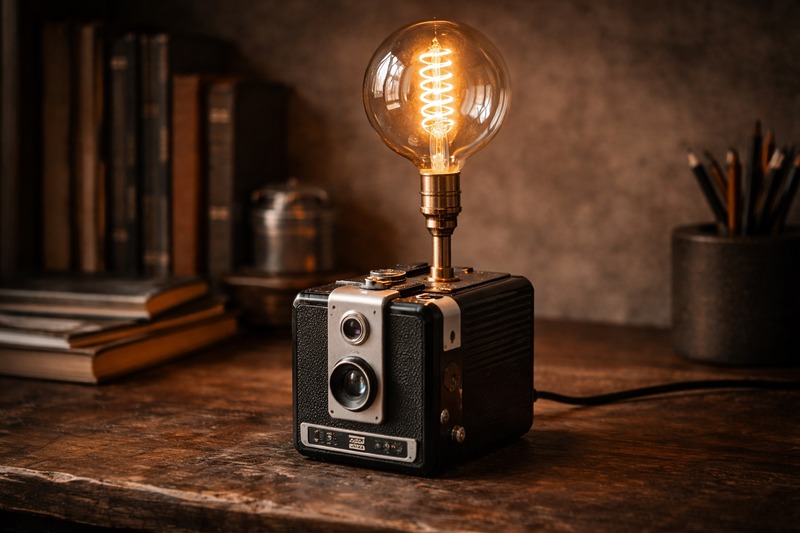
Jacky found a broken Kodak Brownie from the 1950s.
He couldn't fix the shutter, but the box was beautiful.
The "Non-Destructive" Method:
Collectors hate it when you drill holes in antiques.
The smart way to upcycle is to use existing holes.
Every camera has a threaded hole on the bottom for a tripod.
You can buy a "hollow threaded rod" (lamp nipple) that fits this hole.
Bolt the camera to a wooden base using that hole.
Then, mount the lighting part to the wooden base next to the camera, or creatively route the wire so you don't damage the camera body.
The "Flashbulb" Look:
In the 1940s, camera flashes were these giant, round glass bulbs that exploded with light.
We want to recreate that look.
Do not use a pointy candle bulb.
Use the G80 or G95 Globe Bulb.
The round shape mimics the old flash hardware.
The Switch:
This is where you get creative.
Jacky wired a "toggle switch" into the wooden base.
But for his advanced version, he wired the switch to the actual shutter button of the camera.
When you click the photo button, the lamp turns on.
This requires micro-electronics work, but he sells these for $400 because the "click" feeling is so satisfying.
The Cord is Part of the Art
Don't use cheap white plastic wire.
Vintage cameras have leather and metal textures.
Use Twisted Cloth Cord3.
Get a "Houndstooth" pattern or a brown rayon texture.
It looks like the old strap of the camera.
Upcycling fails when you mix "Antique Object4" with "Modern Plastic Wire." It breaks the illusion.
The "Driftwood & Beam" Chandelier: Is Simplicity Better?
Sometimes the upcycling object isn't a machine; it’s nature. Driftwood, reclaimed barn beams, or even an old wooden ladder found in a shed.
Wrapping lighting cords around a piece of reclaimed wood is the purest form of upcycling because it requires zero structural modification to the wood itself. The contrast between the rough, weathered texture of the timber and the smooth, precise glass of the LED bulbs creates a "rustic-modern" balance that is highly sought after in interior design.
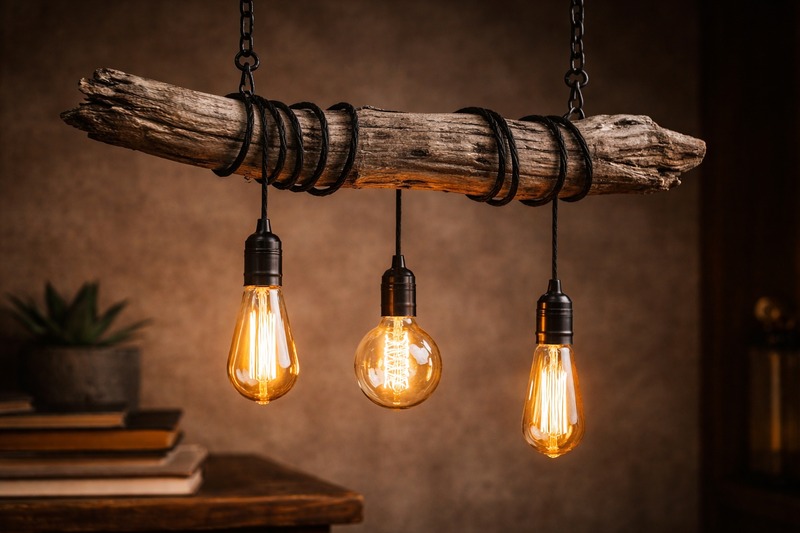
Jacky lives near the mountains, so barn wood is everywhere.
He makes "Beam Chandeliers" for restaurants.
The Balance of Textures:
The wood is rough, grey, and matte.
The bulb is smooth, shiny, and bright.
This contrast is visual candy.
The "Knot" Technique:
You don't need to drill strict holes.
Just wrap the electrical cord over the wood.
The friction of the cloth cord on the rough wood holds it in place.
This allows you to adjust the height of the bulb just by pulling the cord up or down.
Choosing the Right Bulb for Wood:
Wood absorbs light. Dark wood sucks up lumens.
If you use a dim bulb, the chandelier will look glomy.
You need High Lumen vintage bulbs.
I recommend my ST64 8W Filament.
It is twice as bright as the standard decorative bulb.
It pushes enough light down to illuminate the table, while still looking vintage.
The "Smoke" Effect:
For lighter driftwood (bleached white by the sun), try using Smoked Grey Glass bulbs.
The grey glass matches the grey wood tone when off.
When on, the spiral filament looks like a fire burning inside the wood.
Safety Note: The "Knot" Strain Relief
If you hang a bulb by its cord, gravity pulls on the wire connections inside the socket.
Eventually, the wire might pull out and spark.
The Underwriter's Knot5:
When you wire the socket, tie a specific knot (called an Underwriter's Knot5) with the two wires inside the socket shell.
This way, if you pull on the cord, the knot takes the pressure, not the electrical screws.
This is essential for any hanging "pendant" style upcycle projects.
Related HongYu Bulb product pages
- LED Filament Bulb Product Range → — standard and decorative LED filament bulbs for wholesale and project sourcing.
- Contact HongYu Bulb → — send specifications, target market, quantity and packaging requirements for quotation.
Conclusion
Upcycling is more than just a fun weekend hobby; it is a way to create one-of-a-kind lighting that tells a story. Whether you are screwing pipes together, repurposing an old camera, or hanging lights from a piece of driftwood, the success of the project always comes down to the bulb. The bulb is the soul of the lamp. By using cool-running, safe, and beautiful LED Edison filaments, you can light up objects that were never meant to be lamps, turning the forgotten trash of yesterday into the centerpieces of today. So, before you throw that old fan or radio away, ask yourself: "How would this look with a light inside?"
Discover how an Amber Tint Bulb can transform your lighting and enhance the aesthetic of your space. ↩
Learn about the advantages of 4000K LED lights for achieving vibrant and true-to-color illumination. ↩
Explore this link to understand the benefits of using Twisted Cloth Cord for vintage aesthetics and durability. ↩
Discover techniques for upcycling Antique Objects effectively, preserving their charm while avoiding modern materials. ↩
Understanding the Underwriter's Knot is crucial for safe electrical projects, ensuring secure connections and preventing hazards. ↩ ↩