Garden lighting usually means hiding the fixtures in the bushes, but a new trend is bringing the light source front and center as a design element.
LED Edison bulbs are transforming landscape lighting by moving beyond hidden spotlights to becoming visible "jewels" in the garden. By using low-voltage (12V/24V) filament bulbs in exposed fixtures, designers can add a warm, nostalgic charm to pathways and pergolas while maintaining the energy efficiency and safety required for outdoor environments.
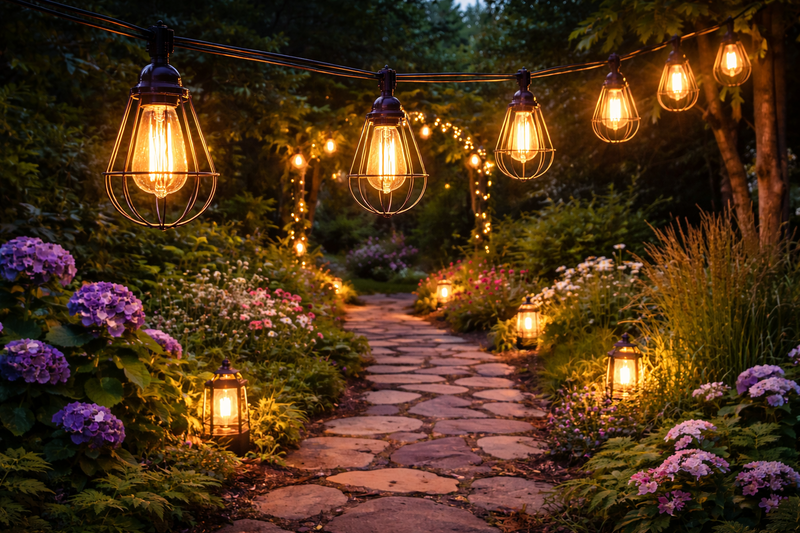
For the last twenty years, landscape lighting followed one rule: "See the light, not the fixture." Architects wanted the source to be invisible. But recently, things have changed. Homeowners want their gardens to feel like outdoor living rooms. They want personality. They want warmth. This shift has brought the vintage Edison bulb out of the dining room and into the flower bed. But you cannot just take an indoor bulb and stick it in the dirt.
Why Is Low Voltage Crucial for Garden Safety?
Running standard household electricity through your garden soil is a recipe for danger, especially where children, pets, and water are constantly mixing.
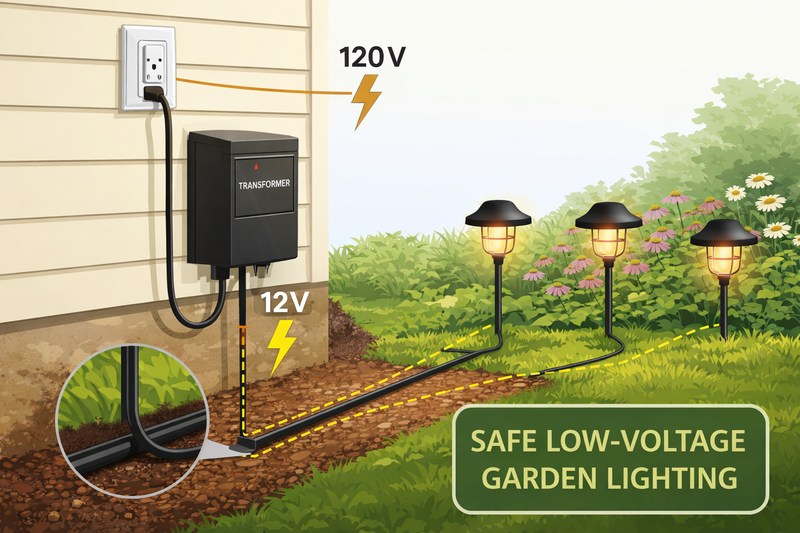
The global standard for landscape lighting is 12V or 24V low-voltage systems, which eliminate the risk of fatal electric shock. Using low-voltage LED Edison bulbs ensures that even if a cable is accidentally cut by a shovel or chewed by a dog, the current is too weak to cause harm.
I remember the first time Jacky, my American distributor, asked me for "12V Edison Bulbs."
"Wallson," he said, "My clients are scared of 120V in the grass."
He was right to be scared.
In the old days, people ran high-voltage lines to their garden lamps.
If you were digging a hole for a new rose bush and hit that line with a metal shovel, you could be seriously hurt.
If a heavy rainstorm flooded the junction box, it could trip the breaker for the whole house.
The Low Voltage Advangage
This is why 90% of professional landscape lighting today is 12V AC/DC system1.
Normally, an Edison bulb is designed for 110V or 220V.
To make it work for a garden, we had to redesign the internal driver completely.
We built a "Buck Converter" inside the base of the vintage bulb.
It takes the 12V from the transformer and steps it down to the 3V needed for the LED filament.
Here is the safety comparison that convinced Jacky to switch his entire inventory:
| Feature | High Voltage (120V/220V) | Low Voltage (12V/24V) |
|---|---|---|
| Shock Risk | High (Fatal) | Zero (Harmless) |
| Cable Depth | Must bury 18 inches deep | Can just hide under mulch |
| Installation | Need a licensed electrician | DIY (Do It Yourself) friendly |
| Safety Cost | High (Conduit pipes required) | Low (Direct burial wire) |
By using our S14 LV (Low Voltage)2 series, Jacky's customers can install these lights themselves on a Saturday afternoon without calling an electrician. It makes the project cheaper and infinitely safer.
How Do You Choose the Right "Color" for Greenery?
The color of light you choose can turn a beautiful tree into a sickly gray ghost, or it can make your plants look vibrant and alive.
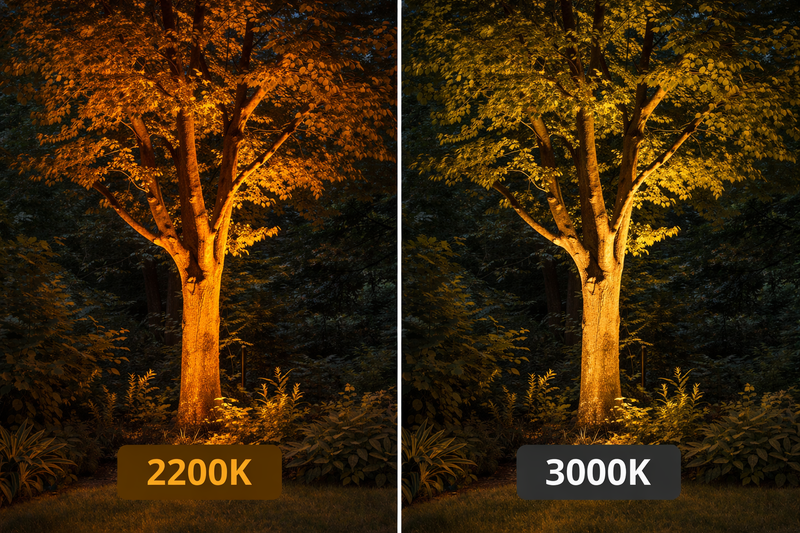
For landscape lighting, the Color Rendering Index (CRI) and temperature are critical; a 2700K Warm White is the sweet spot for hardscapes like stone and wood, while a 3000K Soft White is better for illuminating green foliage to prevent it from looking muddy or yellow.
Lighting a garden is not like lighting a kitchen.
In a kitchen, you want to see clearly. In a garden, you want "drama."
But you have to be careful.
Jacky once did an installation for a luxury hotel in California.
They wanted "Super Vintage" vibes, so they installed 2200K Amber (Golden) bulbs everywhere.
The wooden decks looked amazing. The stone paths looked rich and expensive.
But the palm trees looked... dead.
"Wallson, the leaves look brown," Jacky complained.
I explained the physics of color spectrum to him.
Amber light (2200K) has a lot of red and orange in it. It lacks blue.
Green leaves need some blue spectrum to bounce back to your eye so they look green.
If you shine orange light on a green leaf, the leaf absorbs the light and looks muddy or gray.
The "Zone" Strategy
We developed a solution: The Mix-and-Match Approach3.
You use different Kelvin temperatures4 for different objects in the same garden.
You don't have to use one single color.
| Target Object | Recommended Color | Why? |
|---|---|---|
| Wooden Deck/Pergola | 2200K Amber | Enhances the grain of the wood; extremely cozy. |
| Stone Pathway | 2700K Warm White | Standard incandescent color; welcoming but clear. |
| Green Bushes/Trees | 3000K Soft White | Makes the green pop; "Crisp" look. |
| Blue Spruce/Statues | 4000K Cool White | Highlights cool tones and architectural details. |
We now sell Jacky a "Garden Pack" that includes varied temperatures.
The ST64 bulbs for the fixtures on the house are 2200K.
The small G45 bulbs for the path lights are 3000K.
The result is depth. The wood feels warm, but the plants look healthy.
Can Exposed Bulbs Withstand Sprinklers?
Garden lights are constantly attacked by water, not just from rain, but from high-pressure irrigation systems that spray water upwards from the ground.
Standard light bulbs have ventilation holes for heat cooling, which are fatal in a garden environment. For landscape use, you must select "IP65 Wet Rated" LED bulbs that use sealed bases and gas-cooling technology to prevent water ingress from sprinklers and soil moisture.
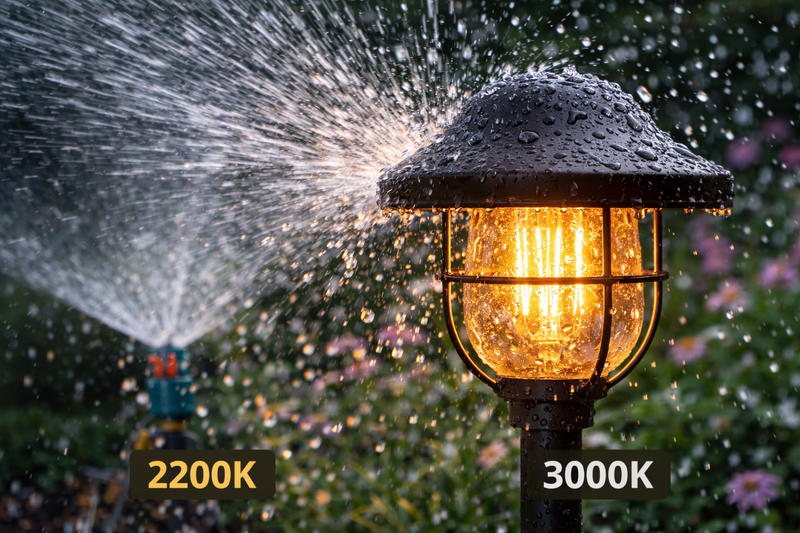
Irrigation is the silent killer of garden lights.
Rain falls down. Gravity helps keep rain out of most fixtures.
But sprinklers spray up. They spray sideways. They spray with pressure.
Jacky had a huge failure rate at a golf course project.
The maintenance crew turned on the high-pressure sprinklers at 2 AM.
The water shot directly under the "hat" of the path lights and hit the bulbs.
The bulbs were standard indoor LEDs. They had tiny holes near the base to let heat escape.
The water went right in. Pop.
He lost 200 bulbs in one night.
"I need a submarine bulb," he told me.
I introduced him to our Landscape Sealed Series.
The Engineering of Waterproofing
We don't rely on the fixture to protect the bulb. We protect the bulb itself.
- No Holes: We removed all heat-sink vents.
- Helium Filled5: Since we have no vents, we fill the glass globe with Helium gas to conduct the heat away from the LED filament.
- Glue Seal: We use a marine-grade silicone sealant between the glass and the metal base.
We test these bulbs with a "Water Jet" machine (IP65 Test6).
We blast water at the bulb from every angle for 15 minutes.
| Feature | Indoor Bulb | Landscape Bulb |
|---|---|---|
| Housing | Vented Plastic/Glass | Sealed Glass/PET |
| Cooling Method | Air Convection (Holes) | Gas Conduction (Helium) |
| Water Resistance | IP20 (Dry Only) | IP65 (Water Jet Safe) |
| Vunerability | Sprinklers, High Humidity | Submersion (Brief), Rain |
Since switching to these dedicated garden bulbs, Jacky's golf course client hasn't had a single failure.
How Do You Stop the Glare from Blinding You?
The extensive problem with using exposed filament bulbs outdoors is that they can be too bright to look at directly, turning a relaxing evening into a headache.
To maintain a comfortable visual environment, you should use low-lumen output bulbs (under 200 lumens) or dimmable smart bulbs for eye-level fixtures. The goal of landscape lighting is to create a glow, not a spotlight, ensuring that pathways are lit without blinding the homeowner.
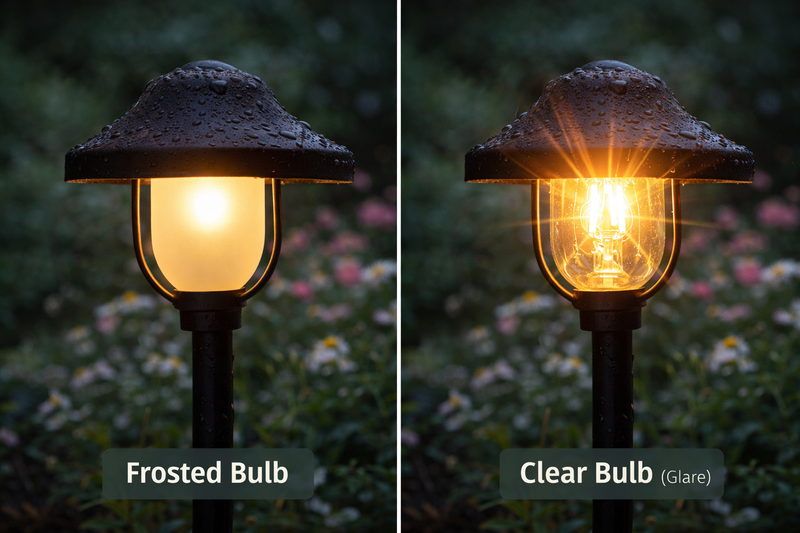
There is a big difference between a street light and a garden light.
A street light needs to be bright for safety.
A garden light is for mood.
A common mistake DIY homeowners make is buying "Brightest LED" bulbs.
They buy a 6-watt LED filament bulb (which equals a 60-watt old bulb).
They put it in a path light that is only 2 feet off the ground.
When you walk down the path, you look down.
Boom. You are blinded. It hurts your eyes. You see spots.
It ruins the "relaxing" vibe.
Jacky ran into this complaint frequently. "My customers say it looks like a runway at an airport," he said.
The "Less is More" Lumen Strategy
I taught Jacky the "Lumen Protocol" for landscapes.
For garden paths, you almost never need more than 100 to 150 Lumens7.
That is roughly 1 or 1.5 Watts of LED power.
It is very dim compared to a kitchen bulb, but at night, your eyes are adjusted to the dark.
100 Lumens looks very bright in the dark.
We created a custom S14 "Low-Glow" Bulb8 specifically for this.
It runs at only 1 Watt.
It creates a gentle pools of light on the ground, rather than a harsh glare.
We also use Amber Tinted Glass.
The gold tint on the glass acts as a sunglass lens. It softens the harsh white point of the LED diode.
| Application | Recommended Wattage | Recommended Lumens | Effect |
|---|---|---|---|
| Path Light | 1W | 80-100lm | Guide your feet, no glare. |
| Tree Uplight | 4-5W | 400lm | Reach the top branches. |
| Deck Post | 2W | 150-180lm | Conversational light. |
| Security Spot | 10W+ | 1000lm+ | Deter intruders. |
Using the right intensity for the right height is the secret to professional lighting design.
Related HongYu Bulb product pages
- LED Filament Bulb Product Range → — standard and decorative LED filament bulbs for wholesale and project sourcing.
- Contact HongYu Bulb → — send specifications, target market, quantity and packaging requirements for quotation.
Conclusion
Your garden should be a retreat, not a source of stress or safety hazards. by switching to low-voltage, water-sealed, and lumen-appropriate LED Edison bulbs, you bridge the gap between vintage style and modern durability. You get the romantic look of the 1920s with the safety and technology of the 2020s, ensuring that your landscape shines brightly—and safely—through every storm and sprinkler cycle.
Explore this link to understand why a 12V AC/DC system is preferred for safety and efficiency in landscape lighting. ↩
Discover the advantages of the S14 LV series, which allows for easy DIY installation and enhanced safety. ↩
Explore this link to understand how the Mix-and-Match Approach can enhance your garden's aesthetic with varied lighting. ↩
Learn about Kelvin temperatures and their impact on garden lighting to create the perfect ambiance. ↩
Explore how helium-filled bulbs enhance heat conduction and improve durability, making them ideal for outdoor use. ↩
Learn about the IP65 rating and its significance in ensuring products are water-resistant, crucial for outdoor lighting. ↩
Understanding the ideal lumen level can help you create a beautifully lit garden path that enhances safety and aesthetics. ↩
Exploring the benefits of S14 Low-Glow bulbs can guide you in choosing energy-efficient lighting that creates a warm ambiance. ↩