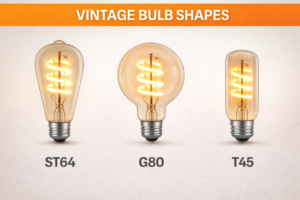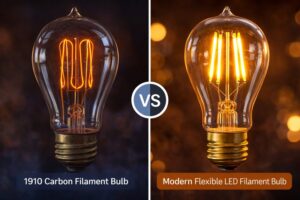
You walk into a gallery or a high-end boutique hotel. You expect to see paintings illuminated by spotlights, but instead, you see a cascading sculpture made entirely of glowing glass spheres, creating a mesmerizing cloud of warm light.
This is the new frontier of lighting art. LED filament bulbs are no longer just functional items; they are the medium itself. Their low heat output, flexible filament designs, and vintage aesthetics allow artists and designers to build structural installations that were impossible with hot, fragile incandescent bulbs.
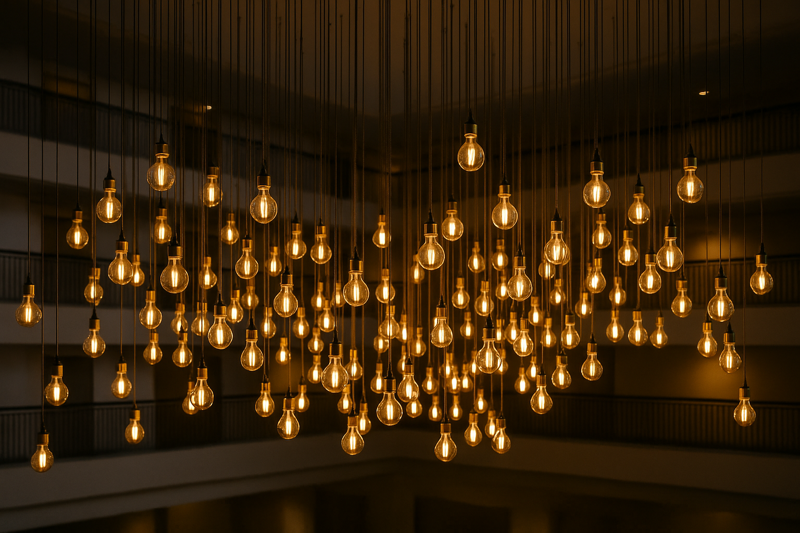
I recently visited a design exhibition in Milan. I saw crowd after crowd gathering around a specific booth. It wasn't a high-tech screen or a piece of furniture. It was a simple wall of 500 of our G125 globe bulbs, pulsating gently in a rhythm. The artist told me, "Wallson, I used to work with neon, but it was too fragile and dangerous. These filaments give me the same glowing line work, but I can screw them in and out in seconds." This conversation highlighted a massive shift in the creative industry. Creators are moving away from hiding the light source behind a shade. They are exposing the bulb, celebrating the internal mechanics, and using the bulb itself as the building block for sculpture. For my B2B clients, this opens a new market: selling not just to electricians, but to interior architects and installation artists.
Can You Bend Light into Words Without Using Expensive Neon Glass?
You want to create a custom sign for a cafe client or a personalized gift item that spells out a name. Traditional neon requires a glassblower, high voltage transformers, and is incredibly fragile to ship.
Yes, using flexible "Soft Filament" LED technology. We can mount tiny LED chips onto flexible substrates that bend, twist, and loop inside the bulb, allowing us to spell words, create logos, or form complex shapes like flowers or hearts directly inside standard glass envelopes.
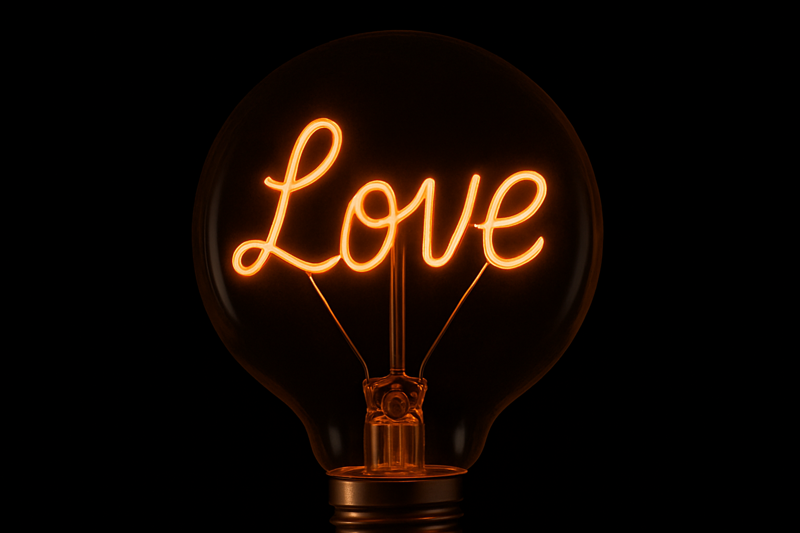
Transitioning from standard lighting to "Message Lighting" is a huge trend in the gift and decor sector. We are seeing massive demand for this.
The Technology Behind Soft Filament Art
The rigid, stick-like filaments you see in standard bulbs are made of ceramic or sapphire substrates. They are straight and brittle. To make art, we use "Soft Filaments1." This technology uses a flexible polymer material as the base layer. We mount microscopic LED chips onto this flexible line and then coat it in yellow phosphor. Because the base is flexible, we can manipulate it by hand or machine before it is sealed inside the glass bulb. This removes the limits of geometry.
For a Product Manager like you, this is a customization goldmine. We can create a "Happy Birthday" bulb, a bulb with a spiral that looks like a double helix for a science museum, or a bulb shaped like a Christmas tree. Unlike neon, which requires a dangerous 3,000-volt transformer, these art bulbs run on standard 110V or 220V mains power (or even 12V for table lamps). This means you can sell a piece of "Neon Art" that the customer simply screws into a regular table lamp socket. It democratizes light art. It makes custom signage2 accessible to home consumers, not just businesses. We are currently working with a UK brand to produce a line of "City Spirit" bulbs, where the filament traces the skyline of London and New York. The possibilities are limited only by the length of the filament strip.
Comparison: Old Neon vs. New Soft Filament
| Feature | Traditional Glass Neon | Soft LED Filament Bulb |
|---|---|---|
| Fragility | Extremely High (Breaks easily) | Low (Protected by outer glass) |
| Voltage | High Voltage (3kV - 15kV) | Standard Mains (110V/220V) |
| Installation | Requires professional installer | DIY (Screw into E27 socket) |
| Energy Use | High | Very Low (2W - 4W) |
| Shipping | Hazardous/Difficult | Standard Retail Packaging |
This technology allows you to sell "Art" in a cardboard box.
Is It Safe to Cluster Hundreds of Bulbs for a Mega-Structure?
You have a vision of a massive "cloud" chandelier made of 200 bulbs clumping together. If you used traditional tungsten bulbs, the combined heat would be over 10,000 watts—enough to start a fire or melt the fixture wiring.
Absolutely, provided you use LED filaments. Because LEDs convert 90% of their energy into light rather than heat, you can tightly cluster hundreds of bulbs without creating a fire hazard, enabling massive, dense lighting sculptures that are cool to the touch.
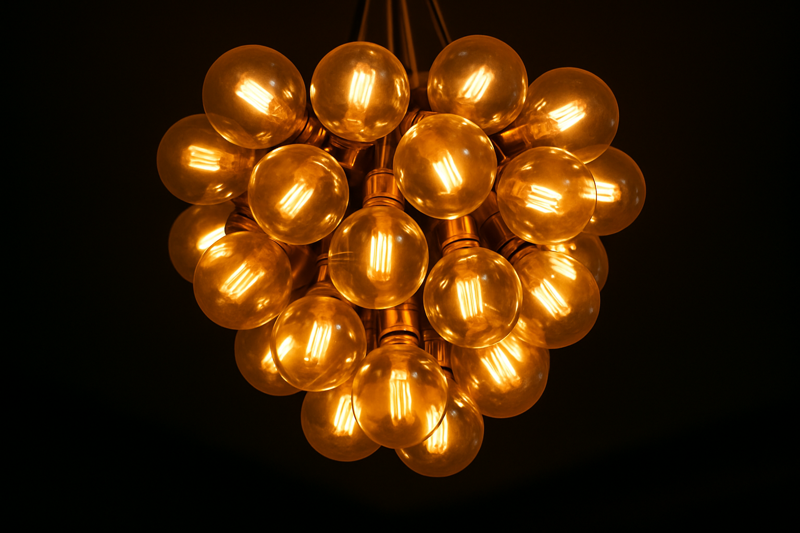
Safety is the boring part of art, but it is the most important part for a manufacturer. When specific designers want to create those trendy "Cluster" lights, they are effectively building a heater if they use old technology.
Thermal Management in Large Installations
Let's look at the math. A traditional 40W incandescent Edison bulb produces about 38 watts of heat and 2 watts of light. If you bundle 100 of them for an art piece in a hotel lobby, you are generating 3,800 watts of heat. That is equivalent to running two or three industrial space heaters on the ceiling. This damages the wire insulation, yellows the ceiling paint, and overworks the building's air conditioning.
In contrast, a 40W-equivalent LED filament bulb consumes only 4 watts. It produces about 2 watts of heat and 2 watts of light. A cluster of 100 LED bulbs generates only 200 watts of heat total. This is negligible. This thermal drop changes the materials artists can use. You can now wrap bulbs in paper, mount them in wood, or place them against fabrics without fear of combustion. I have clients who build "Infinity Mirror" boxes lined with our T30 tube bulbs. The enclosed space would get oven-hot with incandescent, but with our LEDs, it stays at room temperature. Furthermore, the longevity of LEDs (15,000+ hours) creates a low-maintenance art piece. If you install a sculpture 20 feet in the air, you do not want to rent a scissor lift every month to replace dead bulbs. Using reliable Hongyu filaments ensures the art survives intact for years.
Key Engineering Benefits for Art Installations
- Zero UV Emission: LED filaments do not emit ultraviolet light, meaning they won't fade the colors of nearby paintings or textiles.
- Low In-rush Current: You can power more bulbs on a single circuit breaker.
- Plastic/Glass Options: For public spaces concerned about breakage, we can replicate the glass bulb look using high-transparency PET plastic, making the art shatterproof.
Can Light Bulbs Respond to Music and Movement?
Static lighting is beautiful, but interactive art creates viral moments. You want the lights to dim, pulse, or flash in time with music for a nightclub or an immersive museum exhibit.
Yes, by utilizing Dimmable Drivers and DMX control systems. Modern LED filaments can be paired with smart controllers to react to sound sensors or motion detectors, transforming a static sculpture into a living, breathing organism.
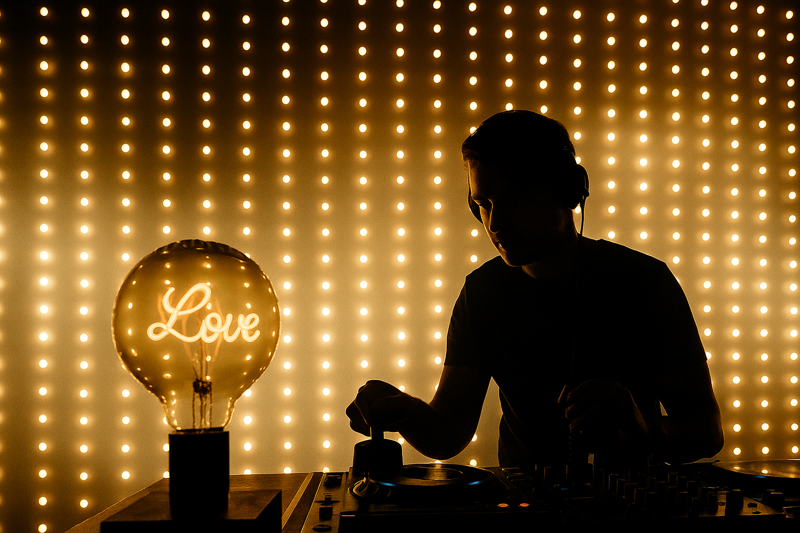
Art is becoming experiential. Buyers want products that "do" something. The era of the static light is ending in the entertainment sector.
Thermal Management in Large Installations
Let's look at the math. A traditional 40W incandescent Edison bulb produces about 38 watts of heat and 2 watts of light. If you bundle 100 of them for an art piece in a hotel lobby, you are generating 3,800 watts of heat. That is equivalent to running two or three industrial space heaters on the ceiling. This damages the wire insulation, yellows the ceiling paint, and overworks the building's air conditioning.
In contrast, a 40W-equivalent LED filament bulb consumes only 4 watts. It produces about 2 watts of heat and 2 watts of light. A cluster of 100 LED bulbs generates only 200 watts of heat total. This is negligible. This thermal drop changes the materials artists can use. You can now wrap bulbs in paper, mount them in wood, or place them against fabrics without fear of combustion. I have clients who build "Infinity Mirror" boxes lined with our T30 tube bulbs. The enclosed space would get oven-hot with incandescent, but with our LEDs, it stays at room temperature. Furthermore, the longevity of LEDs (15,000+ hours) creates a low-maintenance art piece. If you install a sculpture 20 feet in the air, you do not want to rent a scissor lift every month to replace dead bulbs. Using reliable Hongyu filaments ensures the art survives intact for years.
Key Engineering Benefits for Art Installations
- Zero UV Emission3: LED filaments4 do not emit ultraviolet light, meaning they won't fade the colors of nearby paintings or textiles.
- Low In-rush Current: You can power more bulbs on a single circuit breaker.
- Plastic/Glass Options: For public spaces concerned about breakage, we can replicate the glass bulb look using high-transparency PET plastic, making the art shatterproof.
Can Light Bulbs Respond to Music and Movement?
Static lighting is beautiful, but interactive art creates viral moments. You want the lights to dim, pulse, or flash in time with music for a nightclub or an immersive museum exhibit.
Yes, by utilizing Dimmable Drivers5 and DMX control systems4. Modern LED filaments can be paired with smart controllers to react to sound sensors or motion detectors, transforming a static sculpture into a living, breathing organism.
Art is becoming experiential. Buyers want products that "do" something. The era of the static light is ending in the entertainment sector.
The "Breathing" Light Effect
The most popular request we get from installation artists is for the "Breathing" effect. This is where the light slowly fades from 100% down to 20% and back up, mimicking a human breath. This creates a calming, hypnotic atmosphere in spa lobbies or lounges. To achieve this with filament bulbs, the quality of the driver is critical. Cheap drivers will "step" down visibly (100, 90, 80...) or flicker at the bottom range.
We use high-performance IC drivers that allow for smooth, analog-style dimming curves. When connected to a DMX system (the standard protocol for stage lighting), each bulb or group of bulbs can be controlled individually. Imagine a hallway where the filament bulbs brighten as a person walks past them, and then dim behind them. This requires the bulb to handle rapid voltage changes without burning out. Our filaments are stress-tested for this exact behavior. We reinforce the internal wire bonds to handle the thermal expansion and contraction that comes with constant dimming.
Also, consider "Sound-to-Light6." In a bar setting, the filaments can flash to the beat of the drums. Because the filament is instant-on/instant-off (unlike old CFL bulbs that took time to warm up), the reaction is snappy and precise. This blends the vintage aesthetic of the Edison bulb with the high-energy vibe of a modern club. It is "Steampunk meets Cyberpunk."
System Compatibility Guidelines
| Control System | Bulb Requirement | Best Application |
|---|---|---|
| Triac / Phase Cut | Standard Dimmable Filament | Home dimming, simple restaurant ambience. |
| 0-10V / DALI | Requires external dimming module | Office spacse, hotel lobbies (smooth gradients). |
| DMX 512 | Addressable Sockets + Dimmable Bulbs | Stage shows, complex kinetic sculptures. |
| Smart (Wi-Fi/Zigbee) | "Smart Filament7" Bulbs (built-in chip) | Residential "Party Mode", Google Home integration. |
How Do You Frame a Light Bulb as a Solo Sculpture?
Sometimes less is more. You don't want a massive chandelier; you want a small, desktop object that celebrates the industrial beauty of the bulb itself.
By pairing oversized, uniquely shaped bulbs with minimalist raw materials like concrete, marble, or heavy brass. The "lamp" becomes an invisible pedestal, forcing the viewer to stare directly at the intricate filament design as the primary sculpted object.
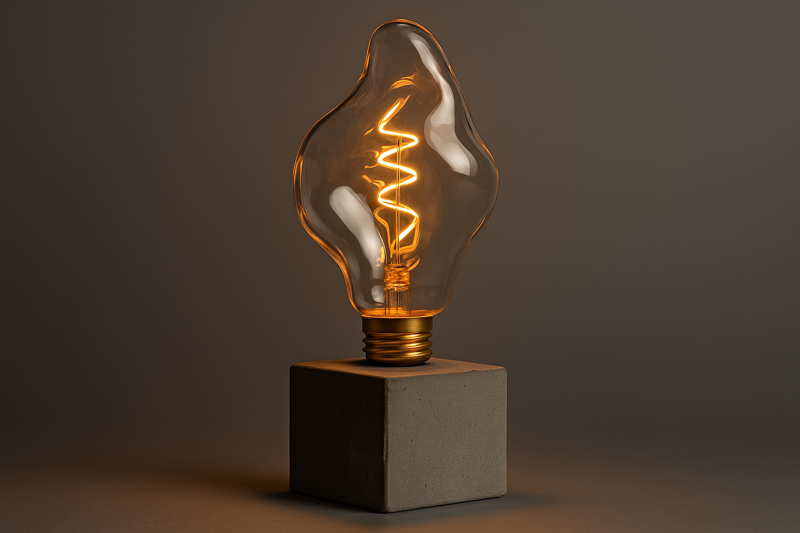
The paradox of the LED filament revolution is that we are now manufacturing bulbs that are too beautiful to cover up.
The Rise of "Oversized" Glass
In the past, a light bulb was the size of a lemon (A60). Now, we manufacture bulbs the size of a watermelon (PS160 or G200). These giant bulbs are not replacement parts; they are furniture.
The trend I see in high-end retail is "Table Top Totems8." Designers are taking our largest, most complex shaped bulbs—like the "Alien" organic shapes or the massive T300 tubes—and mounting them on expensive, heavy bases.
- Concrete: The rough, grey texture of concrete contrasts perfectly with the smooth, fragile glass and the warm, golden light. It feels Architectural.
- Wood: A live-edge block of oak with a single giant filament bulb growing out of it looks like an organic mushroom made of light.
- Brass: Polished brass bases create a "Gatsby" or 1920s luxury feel. The reflection of the filament in the brass base doubles the light output.
This minimalist approach relies entirely on the glass quality. You cannot hide imperfections. Cheap bulbs have bubbles in the glass, glue marks near the base, or crooked filaments. For these "Solo Sculptures," we use our "Diamond Grade9" quality control. We ensure the glass envelope is perfectly clear (or perfectly colored if using amber/smoke finish) and that the internal stem is perfectly straight. When the object is this simple, the details matter more. A desk lamp consisting of just a socket and a bulb has nowhere to hide. This is a high-margin product for retailers. They buy the bulb and the base for $20 and sell it as "Industrial Art10" for $100.
Creative Upcycling Projects
This also appeals to the "Maker" community. I have seen artists use our filament bulbs in:
- Steampunk Pipe Lamps11: Using iron plumbing pipes to create robot-like figures holding a bulb as a head.
- Book Lamps: Hollowing out an old hardcover book and mounting a low-wattage filament bulb inside, so it looks like an idea emerging from the story.
- Bottle Lights: Cutting the bottom off vintage whiskey bottles and sliding a T30 filament bulb inside.
Conclusion
LED filament bulbs have transcended their role as mere utilities to become legitimate artistic mediums. Whether through flexible typography, massive cool-touch installations, interactive dimming, or standalone minimalist sculptures, they offer creators the safety and versatility to paint with light in three dimensions.
Explore this link to understand how Soft Filaments revolutionize lighting design and customization. ↩
Discover how custom signage can elevate your brand's visibility and customer engagement. ↩
Understand the significance of Zero UV Emission in protecting artworks from fading and damage. ↩
Explore the advantages of LED filaments, including energy efficiency and low heat output, which are crucial for art installations. ↩ ↩
Learn how Dimmable Drivers enhance LED lighting, allowing for dynamic interactions in art and entertainment. ↩
Learn about DMX control systems and their role in creating complex lighting effects for art installations. ↩
Find out how Sound-to-Light technology transforms environments by syncing lights with music, creating immersive experiences. ↩
Explore the innovative concept of Table Top Totems, where lighting meets art, enhancing your space with unique designs. ↩
Learn about Diamond Grade quality control and how it ensures the highest quality in glass products, crucial for aesthetic appeal. ↩
Delve into the world of Industrial Art, where functional lighting transforms into stunning artistic pieces for your home. ↩
Discover creative DIY ideas for Steampunk Pipe Lamps, blending vintage style with modern lighting solutions. ↩