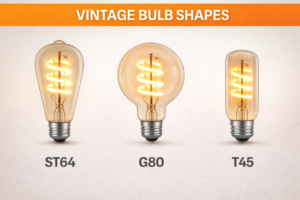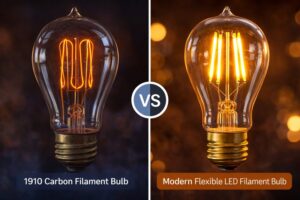
For years, lighting designers faced a painful choice: use beautiful but energy-hungry incandescent bulbs that get dangerously hot, or switch to ugly, futuristic LEDs that ruin the vintage aesthetic.
The best LED vintage bulbs for retro lighting are now indistinguishable from their carbon-filament ancestors. By utilizing flexible "soft filament" technology, high-CRI (90+) color rendering, and warm 2200K amber glass, these bulbs provide the exact look of 1910-era industrial lighting while consuming 90% less energy and lasting 15 times longer.
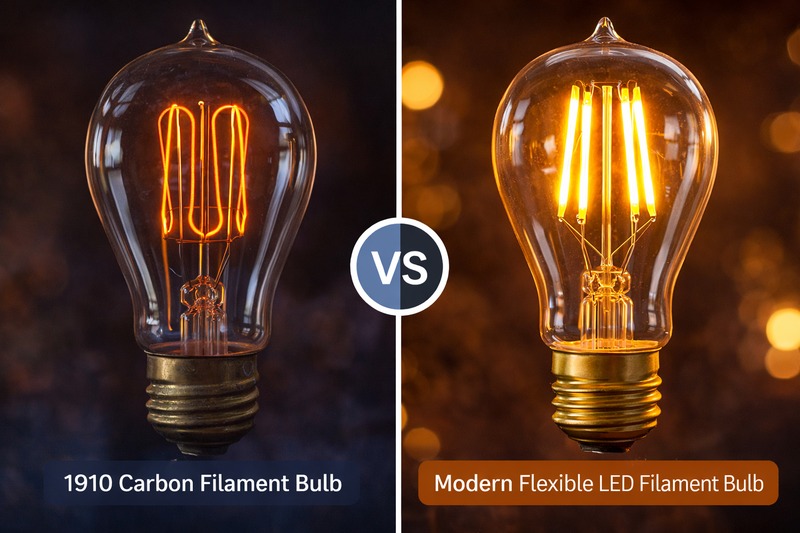
When the first "Edison style" LED bulbs came out ten years ago, honestly, they were terrible. They had ugly yellow plastic strips inside that looked like french fries. The glass was too orange. The light was too dim. I remember showing them to my clients, and they laughed. "Wallson," they said, "I can't put that robot light in my nice brass lamp." I agreed with them. But the technology has moved fast. Today, I can hand you an LED bulb and an incandescent bulb, and unless you touch them to feel the heat, you can't tell the difference.
Why Is the "Spiral" Filament Essential for the Retro Look?
The defining feature of a classic Edison bulb is the intricate, hand-wound carbon filament that glows like a piece of art, a look that early straight-stick LEDs failed to capture completely.
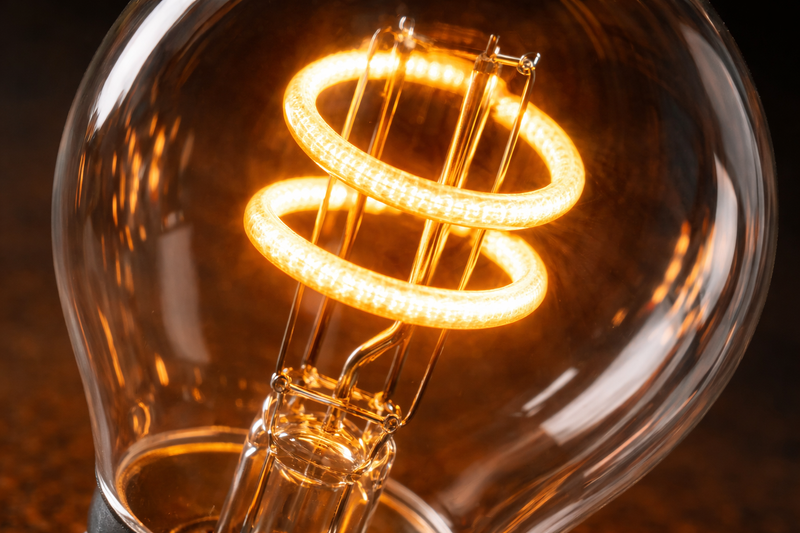
To successfully replicate the vintage vibe, you must choose "Flexible LED Filament" (often called Soft Filament) bulbs. These use a pliable polymer substrate that allows the LED diodes to be bent into spirals, loops, and "squirrel cage" designs, eliminating the rigid, artificial look of standard straight-filament LEDs.
I have a very picky client named Jacky who supplies lighting to high-end steakhouses in New York.
He is obsessed with "atmosphere."
He used to buy thousands of 60-watt incandescent carbon bulbs from me.
They looked amazing. The filament was a long, spiraling coil.
But they got so hot they melted the glue on cheap sockets. And they raised the air conditioning bill.
When I first tried to sell him LEDs, he rejected them.
"Wallson, they look like sticks," he said.
He was right. The early LED filaments were straight yellow bars made of sapphire or ceramic.
They looked stiff. They didn't have that organic, hand-made feel.
The Flexible Revolution
Then, we developed the Soft Filament1.
This is a game-changer.
Instead of a hard stick, we mount the tiny LED chips on a flexible polymer chain.
We can bend this chain. We can twist it.
We can make the "Spiral" shape that Jacky loves.
We can make the "Christmas Tree" shape.
When you dim these down, you see the individual glowing line, just like tungsten.
When Jacky saw the sample of my ST64 Spiral Flex2, he finally switched.
"It looks like jewelry," he admitted.
Now, his restaurant clients get the mood they want, but they pay $500 less a month in electricity.
| Feature | Standard "Stick" LED | Flexible "Soft" LED | Vintage Carbon Incandescent |
|---|---|---|---|
| Appearance | Rigid, Vertical Lines | Curved, Organic Spirals | Curved, Organic Spirals |
| Aesthetic Value | Low (Looks fake) | High (Looks authentic) | High (The Original) |
| Heat Output | Low | Low | Very High |
| Fragility | Solid | Solid | Very Fragile |
If you are restoring a 1920s lamp or building a steampunk fixture, do not buy the stick LEDs. Spend the extra money for the Spiral.
Is "Amber" Glass Too Orange for Your Living Room?
Many cheap vintage bulbs use heavily tinted glass to mask the harshness of the LEDs, resulting in a light that looks more like a spooky Halloween decoration than a sophisticated interior upgrade.
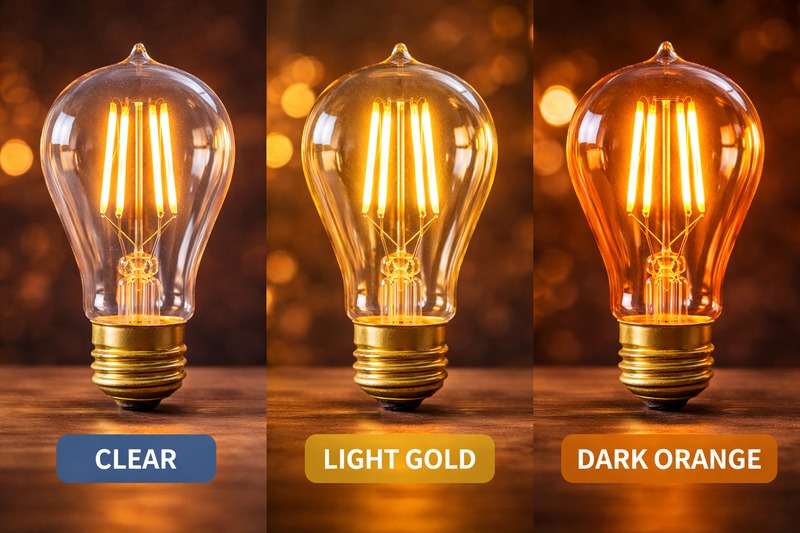
The glass finish is critical for light quality. For a true "Golden Hour" glow, choose "Gold Tint" (light amber) which warms the light to 2200K without looking fake. Avoid "Dark Amber" or heavily painted orange glass unless you want a purely decorative, very dim light that makes reading impossible.
This is the most common mistake buyers make.
They see a picture online of a "Vintage Bulb" and buy it.
When it arrives, the glass looks like a beer bottle.
When they turn it on, the whole room turns deep orange.
Jacky had a lot of returns because of this.
"My customers say it looks like a darkroom," he complained.
The problem is the Glass Coating.
To make cool LEDs look warm, some factories cheat. They just paint the glass orange.
This kills the light output (lumens).
You put in a 6-watt bulb, but only 2 watts of light come out. The rest is trapped by the paint.
The Goldilocks Solution: Light Gold
We advise a middle ground.
- Clear Glass: Good for modern fixtures, but the LED filament can look too yellow/harsh when off.
- Gold (Champagne) Tint3: This is the best for retro lighting. It is a subtle, transparent gold. It warms the color temperature to 2200K. It looks elegant even when the light is off.
- Smokey/Grey Glass: This is purely for modern industrial lofts. It creates a mysterious, moody vibe, but it is not "vintage" in the traditional sense.
| Glass Tint | Color Temperature4 | Lumen Output (Brightness) | Best Application |
|---|---|---|---|
| Clear | 2700K (Warm White) | High (100%) | Kitchens, Bathrooms, Task Lighting |
| Gold / Light Amber | 2200K (Warm Glow) | Medium (85%) | Living Rooms, Dining tables, Restaurants |
| Dark Amber | 1800K (Candlelight) | Low (50%) | Decorative accent only (don't try to read) |
| Smokey Grey | 4000K-2200K | Low (60%) | Modern Industrial Design |
I sent Jacky our "Champagne Gold" series.
It gives that nostalgic feeling without making your skin look orange. It is the perfect balance of style and function.
How Do You Ensure the Colors in Your Room Don't Look Dead?
Old incandescent bulbs had perfect color rendering, making wood and skin look rich and natural, whereas early LEDs often washed out colors, making a beautiful room look gray and lifeless.
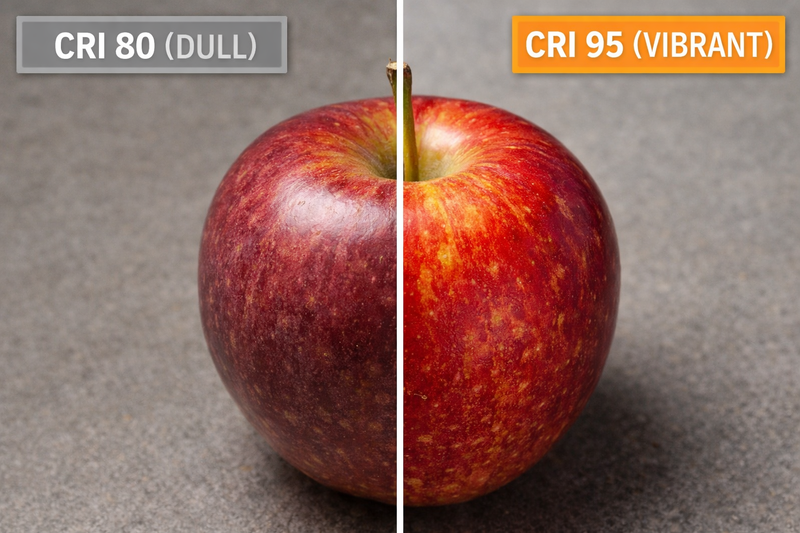
Color Rendering Index (CRI) measures how accurately a light source reveals colors compared to natural sunlight. For high-end retro lighting, you must demand a CRI of 90 or higher (denoted as CRI90+ or Ra90). Standard CRI80 LEDs will make rich wood furniture and red brickwork look dull and flat.
Vintage lighting is usually about wood, brass, leather, and brick.
These are rich, warm materials.
If you shine a cheap LED on a mahogany table, it looks like plastic.
Why? Because the Spectrum is missing red.
Standard LEDs have a big spike in blue light and a drop in red light.
The CRI (Color Rendering Index) is usually 80.
That is okay for a garage. It is not okay for a dining room.
Incandescent bulbs have a CRI of 100. That is perfect.
Jacky's clients were luxury hotels.
They spent millions on interior design.
If the light bulb makes the expensive velvet curtains look cheap, the designer screams at Jacky.
The High-CRI Difference
In our Pro-Vintage Series, we change the phosphor mix on the LED chip.
We boost the R9 Value5 (this is the specific score for red colors).
We achieve CRI 90+6 or even CRI 95.
It costs about 15% more to manufacture.
But the difference is visible to the naked eye.
Under a CRI 95 bulb, a steak looks juicy and red.
Under a CRI 80 bulb, it looks brownish-gray.
Jacky did a blind test with a designer.
He put two lamps side by side.
The designer pointed to the CRI 90 lamp immediately. "That one," she said. "It feels 'real'."
| Metric | Standard LED Bulb | High-End Vintage LED | Incandescent Bulb |
|---|---|---|---|
| CRI (Ra) | 80 | 90 - 95 | 100 (Perfect) |
| R9 (Red) | < 10 (Poor) | > 60 (Excellent) | 100 (Perfect) |
| Visual Effect | Flat, Dull | Vibrant, Deep | Vibrant, Deep |
| Cost | $ | $$ | $$$ (in energy) |
You are buying vintage bulbs for the look. Don't ruin the look with low-quality light.
Why Does Dimming Cause Most LED Bulbs to Fail?
Creating a retro atmosphere almost always requires dimming the lights, but old-fashioned wall dimmers and modern LED drivers often clash, causing annoying buzzing or flickering.
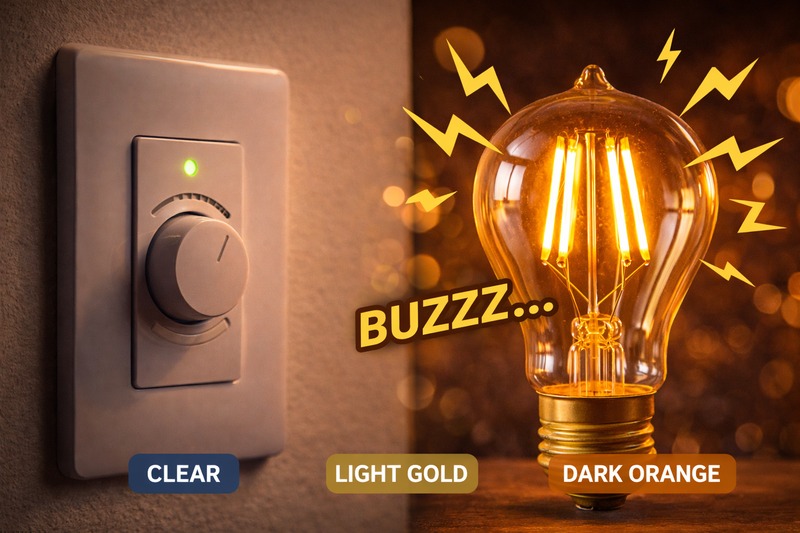
Unlike simple resistive incandescent bulbs, LEDs require complex electronic drivers to interpret dimmer signals. To avoid strobing and noise, you must use "Triac Dimmable" LED bulbs and pair them with "LED Compatible" (Trailing Edge) dimmers. Using an old rotary dimmer from the 90s will likely damage the bulb's internal circuitry.
The magic of an Edison bulb happens when you dim it to 20%.
That is when you see the glowing filament coils. That is the "mood."
But Jacky told me his number one technical support call is: "My lights are buzzing."
Or: "They flicker when I go below 50%."
This happens because the customer is using an old Leading Edge (TRIAC) dimmer meant for high-wattage tungsten bulbs.
An old dimmer chops the AC wave violently.
An incandescent bulb is just a hot wire. It acts like a shock absorber. It doesn't care.
An LED bulb is a computer. It hates violent power chops.
If the driver inside the bulb is cheap, it gets confused. It buzzes. It strobes.
The Smooth Dimming Driver
We build our vintage LEDs with IC Dimmable Drivers7.
We test them with major dimmer brands like Lutron and Leviton.
We optimize them for Trailing Edge8 dimming, which is smoother.
But we also make them robust enough to handle older dimmers (to a point).
The range is important.
A cheap dimmable LED will turn off at 20%.
A good vintage LED should dim down to 5% or 10% smoothly without dropping out.
I told Jacky to always ask his electricians: "Are you changing the switch?"
If they say no, I warn them.
"Buy the bulbs, but budget $20 for a new dimmer switch just in case."
| Feature | Cheap "Dimmable" | Premium "Smooth" Dimmable |
|---|---|---|
| Dimming Range | 100% to 30% (then shuts off) | 100% to 5% (smooth glow) |
| Compatibility | Picky (Flickers on old switches) | Universal (Works on most) |
| Audible Noise | Hum / Buzz | Silent |
| Filament Look | Jumps/Steps down | Fluid fade |
If you want the romance of a dimmed restaurant, you need a driver that can handle the low end of the curve.
Conclusion
The era of choosing between style and efficiency is over. By selecting LED vintage bulbs with flexible spiral filaments, high CRI (90+), champagne gold glass, and smooth dimming drivers, you get all the romance of the 1920s with the reliability of the 2020s. Don't settle for stiff, yellow sticks; demand the artful curve that makes retro lighting truly timeless.
Explore the advantages of Soft Filament LEDs for unique lighting solutions and energy savings. ↩
Discover how ST64 Spiral Flex can enhance your lighting design with its aesthetic appeal and efficiency. ↩
Explore the benefits of Gold (Champagne) Tint for lighting to enhance your space with warmth and elegance. ↩
Understanding Color Temperature is crucial for effective lighting design; discover how it impacts ambiance and functionality. ↩
Understanding R9 Value helps you choose lighting that enhances red colors, making your space more vibrant and appealing. ↩
Exploring CRI 90+ will reveal how high color rendering improves the appearance of your home and the quality of light. ↩
Explore this link to understand the technology behind IC Dimmable Drivers and their benefits for vintage LEDs. ↩
Learn about Trailing Edge dimming to see why it's preferred for smoother LED performance. ↩