Your customers are complaining that colors in their store or home look "dull," "flat," or just plain "wrong" under your new LED filament bulbs. This leads to costly product returns and damages your brand's reputation for quality.
A high Color Rendering Index (CRI) of 90 or above ensures that your bulbs reveal the true, vibrant colors of objects. This prevents color-related complaints by accurately rendering everything from fashion and food to skin tones and artwork, making spaces look more appealing.
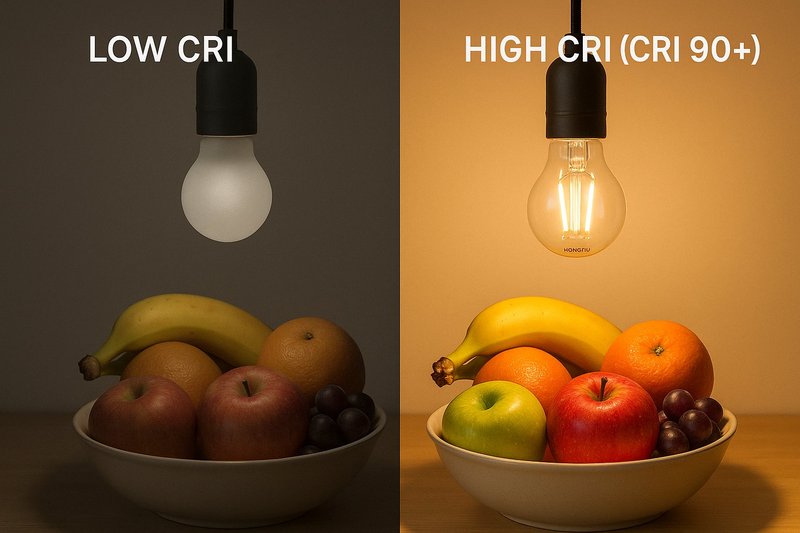
I'll never forget a large project we quoted for a chain of high-end grocery stores in the United States. The product manager, a sharp guy we'll call Jacky, was under immense pressure to cut costs. He had a quote from us for our CRI 90+ filament bulbs and another from a competitor for a similar-looking bulb at a 15% lower price. He was leaning towards the cheaper option. I asked him to send me one of the competitor's bulbs. When it arrived, we put it in our integrating sphere and the tests confirmed my suspicion: it had a CRI of 78. I didn't just send him the data sheet. I set up a demonstration. In our lab, we lit a display of fresh produce—red tomatoes, green peppers, yellow lemons—with two lights side-by-side. Under the competitor's CRI 78 bulb, the tomatoes looked slightly brownish and the greens looked muted. Under our CRI 92 bulb, the colors were rich, vibrant, and looked delicious. I sent him a video of this simple test. The next day, he signed the order with us. He said, "Wallson, you didn't just sell me a light bulb, you saved me from thousands of customers thinking my fresh produce is old."
What Exactly is CRI and Why Does a "Good" Score Matter?
You see "CRI 80" or "CRI 90" on a specification sheet, but what does this technical number actually mean for your business? Ignoring this value can lead to a flood of complaints about poor light quality, even if the brightness and color are correct.
The Color Rendering Index (CRI) is a 0-100 scale that measures how accurately a light source reveals the true colors of an object compared to a natural light source (like the sun). A higher score means more accurate, vibrant colors.
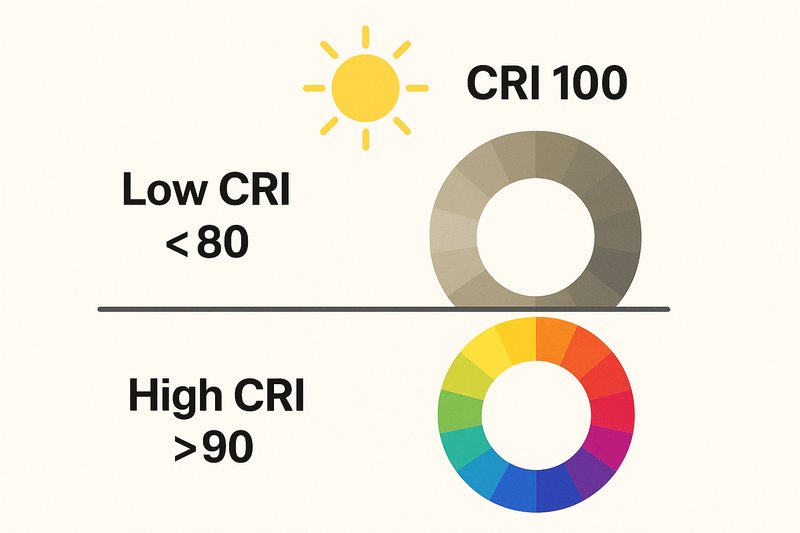
Think of CRI as a measure of light quality. Natural sunlight has a perfect CRI of 100. It contains a full, balanced spectrum of all colors. When this light hits an object, the object reflects its true color back to our eyes. Artificial light sources try to replicate this full spectrum. A low-cost, low-CRI bulb has an incomplete spectrum—it might be missing certain shades of red or green. So, when its light hits an object, the "missing" colors can't be reflected, and the object's color appears distorted, dull, or washed out. The CRI scale is based on testing how well a light source renders a set of eight standard pastel colors (called R1-R8). A score of 80 was once considered "good" for LEDs, but it's now the bare minimum for acceptable performance in general applications. For any situation where color appearance matters—which is nearly everywhere—a CRI of 90 or higher is the new standard of quality. As a manufacturer at Hongyu Bulb, we have invested heavily in the technology to produce high-CRI filament bulbs because we know that light quality is just as important as light quantity.
CRI Levels and Their Ideal Applications
Choosing the right CRI level is critical to matching the product to the customer's needs. Sourcing a bulb with a CRI below 80 for anything other than industrial or utility use is a significant business risk.
| CRI Score | Light Quality | Typical Applications | Customer Perception |
|---|---|---|---|
| CRI < 80 | Poor / Acceptable | Garages, streetlights, some industrial areas. | Colors appear noticeably washed out or distorted. |
| CRI 80-89 | Good / Standard | Offices, schools, general home use (the baseline). | Colors are acceptable for most tasks, but not vibrant. |
| CRI 90-941 | Excellent | Retail stores, restaurants, high-end homes, art galleries. | Colors are rich, deep, and true-to-life. A premium experience. |
| CRI 95+ | Superb / Professional | Museums, medical examination rooms, professional printing shops. | Near-perfect color accuracy, for color-critical tasks. |
For B2B buyers like you, specifying a minimum CRI of 902 is a simple and effective way to guarantee a high-quality product that will satisfy discerning end-users and protect your brand's reputation.
How Does CRI 90+ Transform a Customer's Experience?
Your lighting is functional, but it fails to make products in a retail store look appealing or food in a restaurant look appetizing. Why is a simple change from CRI 80 to CRI 90 lighting one of the highest-impact upgrades you can offer your clients?
High CRI 90+ lighting makes colors pop with vibrancy and realism. This directly enhances the perceived quality of goods, the freshness of food, and the healthiness of skin tones, fundamentally improving the commercial and personal value of a space.

The impact of high-fidelity color rendering is not just aesthetic; it’s psychological and commercial. When colors are rendered poorly, the world feels a little off. But when they are rendered beautifully, the effect is profound. In a retail environment, a CRI 90+ bulb ensures that a navy blue suit doesn't look black and a vibrant red scarf doesn't appear dull orange. The customer sees the true color, trusts their purchase, and is less likely to return it. In a restaurant, high CRI lighting makes the steak look richer, the salad greens look fresher, and the wine look deeper, enhancing the appetite and the overall dining experience. It can literally make food taste better because our perception of taste is so closely linked to our vision. In a home, it makes wood floors look warmer, furniture fabrics look richer, and most importantly, it makes people look healthier and more vibrant. Low CRI light can give skin a sickly, pale, or greenish tint, which is subconsciously unsettling. Investing in high CRI lighting is investing in the visual and emotional experience of a space.
The R93 Value: The Secret to Perfect Reds?
Beyond the standard CRI score, there is another crucial metric for quality: R9. While the standard CRI averages the first eight test colors (R1-R8), R9 specifically measures how accurately a light source reproduces strong, saturated red. This is critically important because many low-cost LEDs are very poor at rendering red, and red is a key color in everything from food and clothing to skin tones and wood finishes. A bulb can have a "good" CRI of 82 but have a negative R9 value, meaning it makes reds look brown and lifeless. A truly high-quality light source will have both a CRI over 90 and an R9 value over 50. At Hongyu Bulb, we specifically engineer our phosphor blends to deliver a high R9 value, ensuring that the light our bulbs produce is not only accurate but also warm, rich, and pleasing. When you source high CRI bulbs4, always ask your supplier for the R9 value. It's the mark of a truly superior product.
Is There a Hidden Cost to High CRI Bulbs?
You see that CRI 90+ bulbs are slightly more expensive than their CRI 80 counterparts. You're a savvy buyer focused on getting the best price. Is the extra cost justified, or is it an unnecessary expense that will hurt your margins?
While high CRI bulbs carry a small premium due to advanced materials, this is a high-value investment. The minimal extra cost prevents expensive returns, builds brand loyalty, and enables you to command a higher price for a visibly superior product.
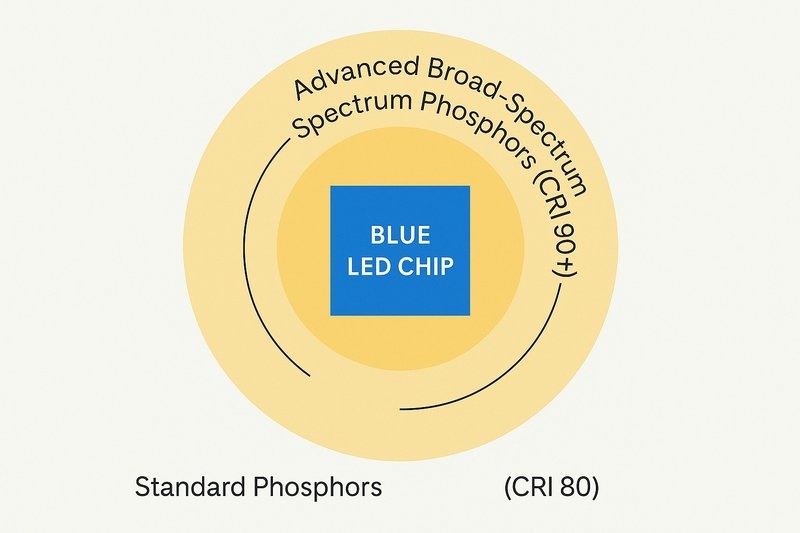
The price difference isn't arbitrary; it comes down to the fundamental technology of how a white LED works. An LED filament starts with a tiny blue LED chip. To create white light, this chip is coated with a layer of phosphors. When the blue light excites the phosphors, they glow, producing yellow, green, and red light. The combination of this glow and the original blue light creates the white light we see. To achieve a basic CRI 80 light, a manufacturer can use a relatively simple and inexpensive phosphor blend. However, this simple blend leaves gaps in the light spectrum, particularly in the deep red and cyan frequencies. To fill these gaps and create a full, continuous spectrum that results in a CRI of 90 or more, we must use a much more complex and expensive blend of phosphors, often including special red phosphors. This is a deliberate engineering choice and a materials science challenge. There is also a slight trade-off in efficiency; creating this higher quality light can sometimes result in a slightly lower lumen-per-watt output. Cheaper manufacturers will always choose the most efficient, lowest-cost phosphors to maximize their lumen output and minimize their price, sacrificing color quality in the process. We at Hongyu Bulb believe this is a false economy.
Cost-Benefit Analysis: Investing in Light Quality
For a product manager like Jacky, every cent counts. But the calculation must include the hidden costs of poor quality and the revenue opportunities of a superior product.
| Factor | CRI 80 Bulb (Low Cost) | CRI 90+ Bulb (Value Investment)5 | Impact on Your Business |
|---|---|---|---|
| Unit Cost | Lower | Slightly Higher (e.g., +10-15%) | A small, manageable increase in COGS. |
| Perceived Quality | Basic, functional. | Premium, professional. | Allows for higher retail pricing and better margins. |
| Customer Satisfaction6 | Risk of complaints about color. | High satisfaction, colors look "right." | Reduces returns, protects brand reputation. |
| Market Position | Competes on price alone. | Competes on quality and performance. | Builds a stronger, more defensible brand. |
| Return on Investment | Low. Can lose money on returns. | High. Prevents costly problems and drives sales. | The small upfront cost is an insurance policy against failure. |
Investing in CRI 90+ is not an expense; it is a strategic decision to deliver a superior product that protects your brand and opens up access to more profitable, quality-focused markets.
Conclusion
Standardize on CRI 90+ to guarantee customer satisfaction and elevate your brand. This small investment in quality prevents color complaints, enhances every space, and delivers a visually superior product that discerning customers will value.
Explore how CRI 90-94 lighting enhances color accuracy and customer experience in retail and dining environments. ↩
Learn why specifying a minimum CRI of 90 ensures high-quality lighting that meets customer expectations and protects brand reputation. ↩
Understanding R9 can help you choose better lighting for vibrant colors in your home or business. ↩
High CRI bulbs enhance color accuracy, making them essential for photography, art, and interior design. ↩
Explore the advantages of CRI 90+ bulbs to understand how they can enhance product quality and customer satisfaction. ↩
Learn about the critical role of customer satisfaction in driving sales and maintaining a strong brand reputation. ↩