Your chef cooks the perfect steak, but the customer sends it back because it looks grey. Your chairs are comfortable, but people leave after 30 minutes. The problem is not your food; it is your lighting.
Restaurant lighting requires a strategic mix of 2200K ambient LED filaments for mood and directed task lighting for the table. By creating "pools of light," you guide the customer’s focus to the food and their partner, creating a psychological "stay and spend" effect.
We eat with our eyes first.
If the light is flat, the food looks boring.
If the light is too bright, the romance dies.
I have worked with restaurant owners in New York and London for ten years.
They all make the same mistake.
They buy lights based on how the fixture looks, not how the light behaves.
They install expensive chandeliers with cheap, low-CRI bulbs.
Jacky, my main distributor in the US, told me a story about a steakhouse client.
They spent $1 million on the renovation.
But they bought cool white 4000K LEDs to save energy.
On opening night, the expensive ribeye steaks looked like cafeteria meat. The fat looked grey.
The customers did not know why, but the food "didn't look fresh."
Jacky called me in a panic.
We swapped everything to High-CRI 2200K dimmable filaments.
The meat looked red and juicy again. Sales went up.
This is the power of the bulb. It is an ingredient in the recipe.
To master this, you must understand Contrast, Color Rendering, and Efficiency.
Do You Know How to Balance Intimacy and Menu Readability?
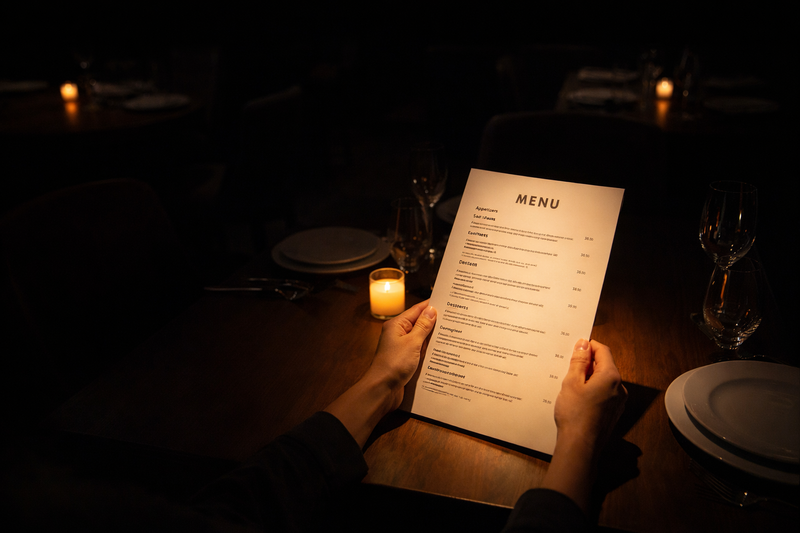
A romantic restaurant must be dark, but if it is too dark, customers use their phone flashlights to read the menu. You must find the balance effectively.
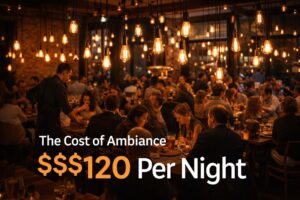
You must implement a "High Contrast" lighting plan where the table surface measures around 100-150 Lux, while the surrounding aisles drop to 30-50 Lux. This guides the customer's eye to the table and hides the bustle of the service area.
Lighting in a restaurant is about control.
You want to control where the customer looks.
Humans are phototropic.
This means we naturally look toward light, like insects.
If the whole room is evenly lit, our eyes wander everywhere.
We look at the kitchen door. We look at the dirty floor. We look at the other tables.
This destroys the experience.
We want the customer to look at two things: the food and their partner.
To do this, we use the "Pool of Light" technique.
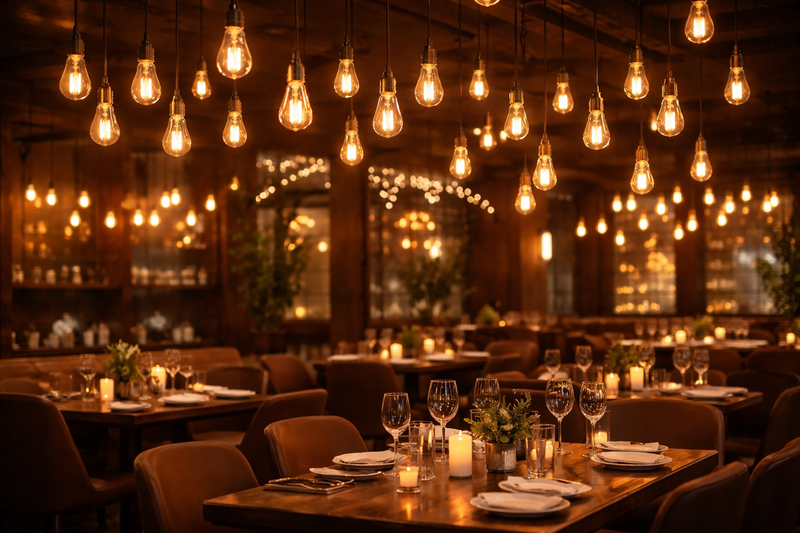
We hang the pendant lights low.
We use ST64 or G95 Edison bulbs.
These creates a soft glow.
But here is the trick: the bulb itself should not be the primary light source for reading.
The Edison bulb is for the feeling.
For the reading, we often pair it with a hidden narrow-beam spotlight in the ceiling.
Or, we use a higher lumen filament bulb (400 lumens) on a dimmer.
The Dimming Protocol
You simply cannot run a restaurant without dimmers.
Sunlight changes everything.
At lunch (12:00 PM), the sun is bright.
Your internal lights must be bright (100% power) to balance the window glare.
If they are distinctively dim, the restaurant looks closed.
At dinner (8:00 PM), the sun is gone.
You must dim the lights to 20% or 30%.
If you leave them at 100%, it feels like a fast-food joint.
Fast food wants high turnover. They use bright lights to make you eat fast and leave.
Fine dining wants low turnover. They use dim lights to make you relax and order dessert.
I manufacture my drivers to be smooth-dimming1.
Cheap drivers drop out at 20%. They turn off suddenly.
Our drivers go down to 5% smoothly.
This allows the manager to dial in the exact mood.
The Height Matters
The position of the bulb determines the intimacy.
If you hang the bulb 6 feet above the table, the light spreads everywhere.
The private bubble pops.
If you hang the bulb 30 inches above the table, the light stays on the table.
The faces of the diners are lit, but the tops of their heads are in shadow.
This is flattering. It hides thinning hair. It highlights the smile.
It creates a "virtual wall" around the table.
Jacky's clients often fear blocking the view.
I tell them: visual privacy2 is more valuable than a view of the kitchen.
| Meal Time | Lux Level (Table) | Bulb Brightness | Atmosphere Goal |
|---|---|---|---|
| Lunch | 300 Lux | 100% | energetic, Visible, Fast |
| Early Dinner | 150 Lux | 60% | Welcoming, Transition |
| Late Night | 50-70 Lux | 20% | Intimate, Private, Slow |
How Does Color Rendering Affect the Taste of Your Food?
Standard vintage bulbs emit a very orange light that can muddy the vibrant colors of fresh salads and sushi. You need a spectrum that enhances food, not dulls it.
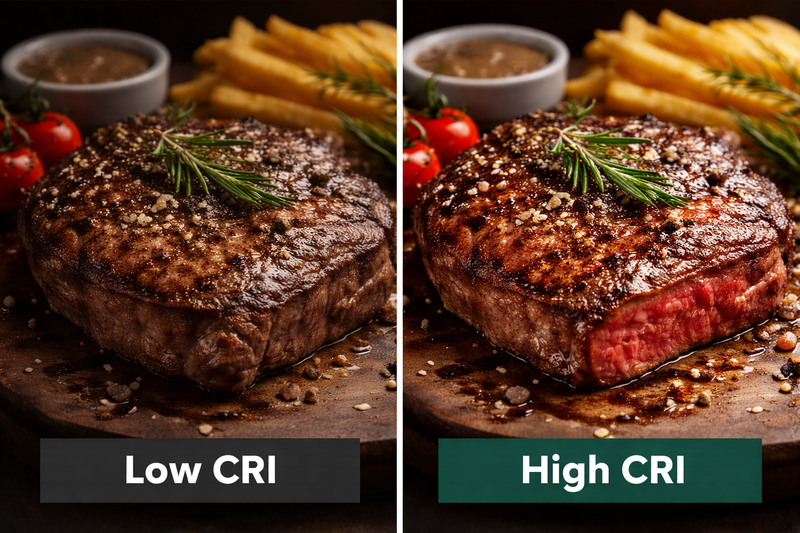
For dining areas, you must select LED filaments with a high Color Rendering Index (CRI > 90) and a high R9 value (Red rendering). This ensures that meats look red, vegetables look green, and wine looks rich, even under warm 2200K lighting.
This is the most technical part, but it is the most critical for sales.
Light has a quality score called CRI.
The sun is CRI 100.
Most cheap LEDs are CRI 80.
Old incandescent bulbs were CRI 99.
When we switched to LED, we lost color quality.
Under a CRI 80 bulb, colors look flat.
But it gets purely complicated with "Warm" vintage bulbs.
A 2200K bulb is very yellow/orange.
In color updates, yellow neutralizes blue and violet.
It turns greens into mud.
If you serve a fresh green salad under a distinctively orange light, the lettuce looks wilted.
If you serve a rare steak, it looks well-done (brown) because the light lacks the spectrum to show the red blood.
To fix this, we engineer High-CRI Filament Bulbs.
We use a special phosphor mix.
We inject a specific red wavelength into the LED chip.
We call this the R9 Value.
Standard bulbs have an R9 of 0 or even negative.
Our restaurant-grade bulbs have an R9 of >50.
This allows the red color to punch through the yellow glass.
The light still feels warm and cozy, but the food pops.
The "Salad Problem"
Jacky supplies a lot of Vegan restaurants now.
This is a challenge.
Vegan food relies on green and purple colors (kale, beets, eggplant).
Warm 2200K light kills these colors.
For these clients, I recommend 2700K Clear Glass3 bulbs, not Amber.
2700K is less orange. It is a "Soft White."
It respects the green spectrum better.
It creates a cleaner look, which fits the "healthy" image of the restaurant.
For a Steakhouse or a Whiskey Bar, we go back to 2200K Amber.
The amber tone enhances the wood of the bar and the brown of the whiskey.
It makes the meat look rich.
You must match the Kelvin temperature to your menu.
Visual Freshness
Customers judge freshness by color.
If the strawberries on the cheesecake look dark, they assume they are old.
With High-CRI lighting4, the strawberries shine bright red.
The customer perceives them as "picked today."
You are manipulating their perception.
It costs maybe $1 more per bulb to buy High-CRI.
But one returned dish costs you $30.
The ROI is obvious.
| Food Type | Recommended Temp | Key Color Need | Bulb Type |
|---|---|---|---|
| Steak / BBQ | 2200K (Warm) | R9 (Red) | Amber Filament |
| Sushi / Seafood | 3000K (Neutral) | R1-R15 (All) | Clear / Frosted |
| Vegan / Salad | 2700K (Soft) | R9 & R11 (Green) | Clear Filament |
| Bakery / Bread | 2500K (Gold) | Yellow/Orange | Gold Tint Filament |
Can You Reduce Energy Costs Without Killing the Vibe?
Restaurants run lights for 12 to 16 hours a day, making electricity a massive overhead cost. You can switch to LED to save money, but you must avoid the "synthetic" look of cheap LEDs.
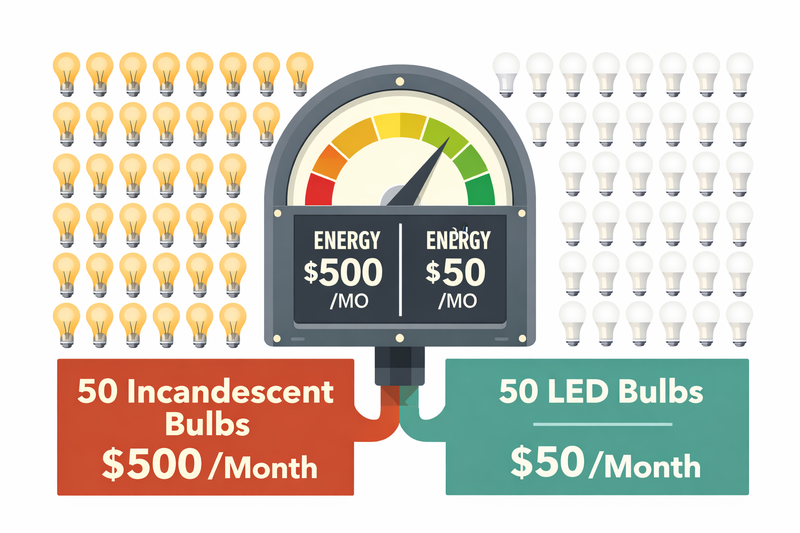
Switching from 60W incandescent Edisons to 6W LED filaments reduces energy consumption by 90% and eliminates heat generation. This lowers your air conditioning bills significantly, as purely incandescent bulbs act as small heaters in a crowded dining room.
Let's do the math.
A typical bistro has 50 decorative bulbs.
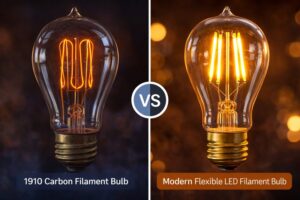
Old Carbon Filament bulbs use 60 Watts each.
50 bulbs x 60W = 3,000 Watts (3 kW).
If you run them 12 hours a day, that is 36 kWh per day.
At $0.15 per kWh, that costs you about $160 per month just for decorative light.
Not too bad?
Wait.
Incandescent bulbs are 90% heat, 10% light.
You have 50 small heaters running in your dining room.
In summer, your Air Conditioning has to work harder to remove that heat.
This doubles your cost.
Also, carbon filaments break every 2,000 hours (about 6 months).
You have to pay staff to climb ladders and change them.
If a bulb breaks during service, it looks unprofessional.
Now, look at the LED Filament Bulb.
It uses 4 to 6 Watts.
50 bulbs x 6W = 300 Watts (0.3 kW).
That is 3.6 kWh per day.
The cost is $16 per month.
You satisfy the same visual need for 10% of the price.
Plus, they last 25,000 hours (5 to 7 years).
The "Heat" Factor for Comfort
The heat issue is not just about money; it is about comfort.
I have sat in restaurants with low-hanging incandescent lamps.
You feel the heat on your forehead.
It makes you sweat.
It dries out the food on the table.
LEDs run cool.
You can touch an LED bulb after it has been on for 10 hours.
This means you can hang them closer to the customers without risking their comfort.
Jacky had a client in Florida.
Their AC unit was struggling in July.
They replaced 200 light bulbs with our LED versions.
The room temperature dropped by 2 degrees.
The AC unit could finally keep up.
It was an accidental benefit that saved them upgrading their HVAC system.
The Maintenance Hidden Cost
B2B buyers often ignore maintenance.
Changing a lightbulb in a restaurant is annoying.
You have to move tables. You have to bring a ladder.
You can only do it when the restaurant is closed.
If you have high ceilings, you need a scaffold.
Buying a $1 cheap bulb that dies in 6 months is expensive in labor.
Buying a $5 quality LED that lasts 5 years is cheap.
I emphasize the "Sapphire Substrate5" we use in our filaments.
It manages heat better inside the bulb, ensuring the electronics survive the hot environment of a commercial kitchen.
| Factor | Old Incandescent | Hongyu LED Filament | Impact |
|---|---|---|---|
| Power per Bulb | 60 Watts | 6 Watts | 90% Savings |
| Lifespan | 2,000 Hours | 25,000 Hours | Less Maintenance |
| Heat Emission | Very High | Near Zero | AC efficiency |
| Glass Temp | Dangerous (>200°F) | Safe (<100°F) | Customer Safety |
What Is the Best Bulb Shape for Different Restaurant Zones?
A uniform row of identical bulbs can look boring. To create a dynamic visual interest, you should vary the bulb shapes according to the furniture layout and ceiling height.
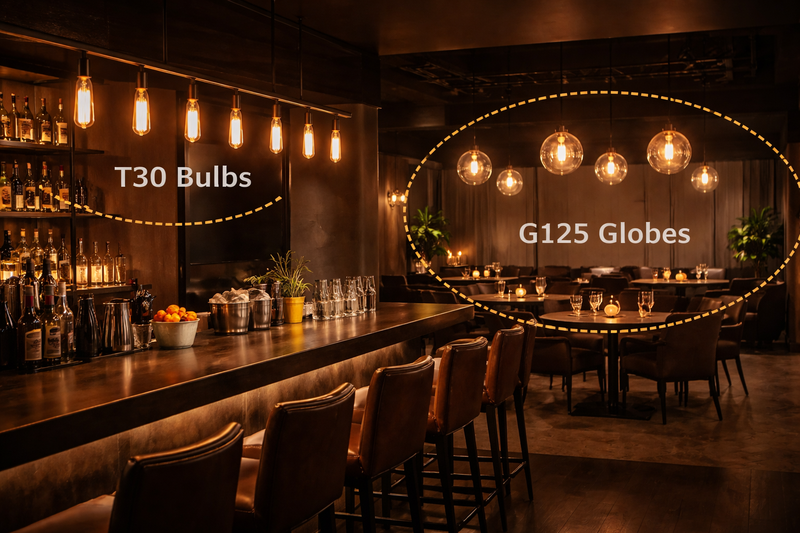
Use large oversized globes (G125/G200) over round tables to center the group, and use linear tubular bulbs (T30/T185) over long bar counters or communal tables. This matches the geometry of the light source to the geometry of the furniture.
Design is about geometry.
If you put a small bulb over a big table, it looks weak.
If you put a huge bulb over a small bar, it looks crowded.
You must scale the bulb to the furniture.
The Round Table:
For a round dining table, use a round bulb.
The G125 (Globe 125mm) is the king of restaurant lighting.
It is big enough to act as a fixture on its own.
You don't need a lampshade. Just a nice brass socket and a black cord.
Hang it low. Ideally, use a cluster of three at slightly different heights.
This creates a centerpiece.
It anchors the table.
The Bar Counter:
The bar is linear. It is a long straight line.
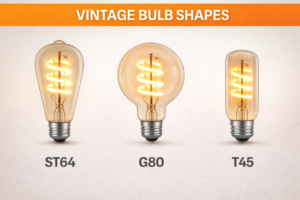
You should use Tubular Bulbs (T30 or T45).
These are often called "Test Tube" bulbs.
They are 185mm or 300mm long.
By hanging a row of them, you mimic the line of the bar.
It looks clean and organized.
Also, tubes take up less visual width.
Customers leaning over the bar won't hit their heads on them as easily as they would a wide globe.
The "Spider" Chandelier
A popular trend Jacky sells now is the "Spider" or "Octopus" fixture.
It creates a "Chandelier" effect with just wires and bulbs.
You drape the cords from a central point to hooks on the ceiling.
For this, you use the standard ST64 (Teardrop) shape.
It is classic. It looks like the original 1879 Edison patent.
This is perfect for the center of the dining room where the tables might move.
Because the lights are high and spread out, they provide general ambient light.
Then you use the shapes to define specific fixed zones.
Glass Finish Options
Finally, consider the glass finish.
Clear Glass: Clean, bright, modern. Good for Bistros.
Amber/Gold: Warm, vintage, cozy. Good for Pubs and Steakhouses.
Smokey/Grey6: Moody, modern, sophisticated. Good for Cocktail Lounges.
Smokey glass is a big trend in 2024.
The glass is tinted grey.
The filament looks cooler, less yellow.
It fits very modern, concrete-wall restaurants.
However, be careful. Smoke glass reduces the light output by 30%.
You will need more bulbs to get the same brightness.
| Zone | Best Shape | Why? | Installation Tip |
|---|---|---|---|
| Round Table | G125 / G95 Globe | Matches table geometry | Cluster of 3 |
| Bar Counter | T30 / T185 Tube | Matches linear counter | Straight Row |
| General Area | ST64 Teardrop | Classic, recognizable | Spider Drape |
| Booth Seating | A19 / A60 | Small, unobtrusive | Wall Sconce |
Conclusion
Restaurant lighting is the silent service staff. It guides customers, makes food look delicious, and encourages guests to stay longer. By investing in High-CRI LED filaments, choosing the right shapes for your furniture, and mastering the art of dimming, you turn a simple meal into a memorable experience that customers will pay a premium for.
Explore this link to understand how smooth-dimming enhances ambiance and customer experience in restaurants. ↩
Discover the significance of visual privacy in creating intimate dining experiences and how it affects customer satisfaction. ↩
Explore how 2700K Clear Glass bulbs enhance the vibrant colors of vegan dishes, creating a fresh and appealing dining experience. ↩
Learn how High-CRI lighting can significantly improve the visual appeal of food, leading to better customer perceptions and increased sales. ↩
Learn about Sapphire Substrate technology and how it improves LED bulb performance and longevity. ↩
Discover the advantages of Smokey/Grey glass in lighting, including its aesthetic appeal and modern trends. ↩