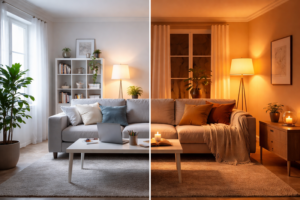
You glued brass gears to a top hat and painted some PVC pipes black. You think you have created Steampunk decor. But when you flip the switch, the cold white light makes your room look like a messy craft project, not a Victorian submarine.
Steampunk aesthetic relies on the illusion of primitive technology, specifically the look of gas lamps and early electricity. You must use oversized Amber-tinted LED filaments with a color temperature of 2200K to create the "dirty" atmospheric glow that blends with brass, copper, and dark leather.
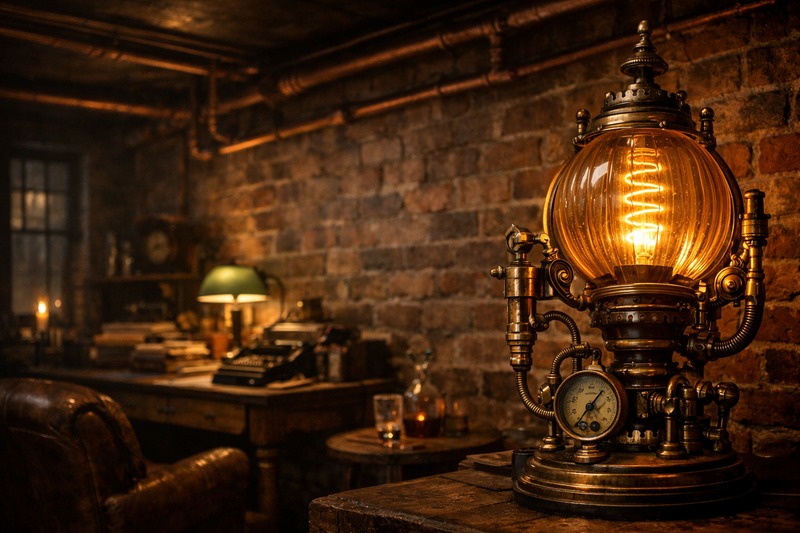
Steampunk is a difficult style to master.
It is a mix of history and science fiction.
It imagines a world where the future happened in the past.
It is Jules Verne meets the Industrial Revolution.
The materials are metal, wood, and glass.
The most common mistake is the lighting.
I see people build incredible metal pipe shelves.
Then they screw in a standard white plastic A19 bulb.
Instant failure.
The white plastic destroys the illusion.
Steampunk is about "visible mechanics."
You want to see how things work.
You see the gears in the clock. You see the steam in the engine.
You must see the electricity in the light bulb.
Lighting is not just a tool here; it is the main character.
My client Jacky has a customer in Seattle who builds "themed bars."
He built a bar called "The Nautilus."
He spent $50,000 on brass portholes.
But he almost ruined it with 3000K clear bulbs.
The light was too clean.
Steampunk needs to feel a little bit "dirty," like soot and oil.
We fixed it by swapping everything to my Golden Tint Spiral Series.
Suddenly, the brass shined gold, not yellow.
The shadows became deep and dramatic.
To get this right, you need to understand the relationship between the bulb shape, the glass tint, and the fixture material.
Why Is 2200K "Candle Light" Essential for the Industrial Look?
Modern lights are designed to be efficient and white, like sunlight at noon. Steampunk mimics an era when light was weak, rare, and fire-based. You must lower the color temperature to convince the eye that the room is lit by gas or primitive batteries.
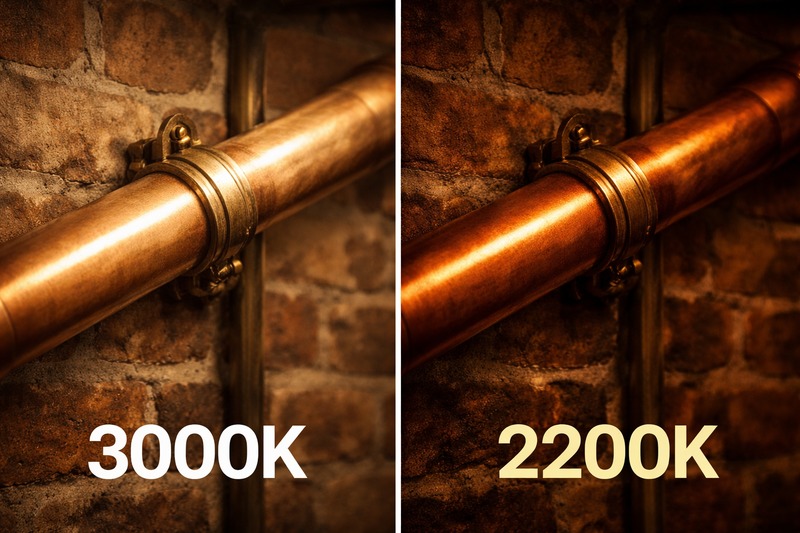
You must reject the standard 2700K Soft White and choose 2200K "Super Warm" LED bulbs. This specific color temperature mimics the orange flame of a gas lamp or a burning carbon filament, creating the necessary nostalgic and mysterious atmosphere that defines the genre.
Color temperature is the single most important metric for this style.
I cannot stress this enough to my B2B partners.
Steampunk is about "The Age of Steam."
Before electricity was stable, we had gas lamps.
Gas lamps burn orange.
Early carbon filament bulbs (invented by Edison) burned orange.
They did not burn white.
If you use a 3000K or 4000K bulb, you are telling the brain: "This is a modern office."
If you use a 2200K bulb, you are telling the brain: "This is an old factory."
In my factory, we achieve this by using a gold-colored phosphor coating on the LED strip.
We also often tint the glass shell itself to a color we call "Amber Gold."
This means even when the light is off, the bulb looks bronzed and aged.
Ideally, you want a light that feels like it is struggling to stay on.
That sounds bad for a lighting engineer to say.
Usually, we want bright, stable light.
But for Steampunk, we want "moody" light.
Jacky's biggest selling product for this niche is the ST64 Gold Tint 4W.
It is not bright enough to read a textbook comfortably.
That is the point.
It creates pools of light and deep shadows.
Steampunk relies on shadow to hide the modern world.
Shadows make the gears and pipes look more complex and mysterious.
The Material Interaction
Consider what your furniture is made of.
You probably have dark walnut wood, brown leather chairs, and copper piping.
These are "warm" materials.
Blue-heavy light (4000K) makes wood look gray.
It makes copper look pink.
Orange-heavy light (2200K) reinforces the wood tones.
It makes the copper shine like gold.
It creates a harmonious palette.
I once walked into a Steampunk coffee shop that used 5000K Daylight bulbs.
The leather chairs looked fake and plastic under that harsh light.
It felt like a hospital waiting room, not a Victorian lounge.
Lighting is the paint you put on your furniture.
| Kelvin Temp1 | Color Visual | Steampunk Suitability | Why? |
|---|---|---|---|
| 5000K | Blue-White | 0/10 (Fail) | Looks like a hospital/lab. |
| 3000K | White | 2/10 (Bad) | Looks like a standard kitchen. |
| 2700K | Soft Yellow | 5/10 (Okay) | Acceptable, but too clean. |
| 2200K | Deep Orange | 10/10 (Perfect) | Mimics gaslight and fire. |
How Do You Pair Bulb Shapes with Iron Pipe Fixtures?
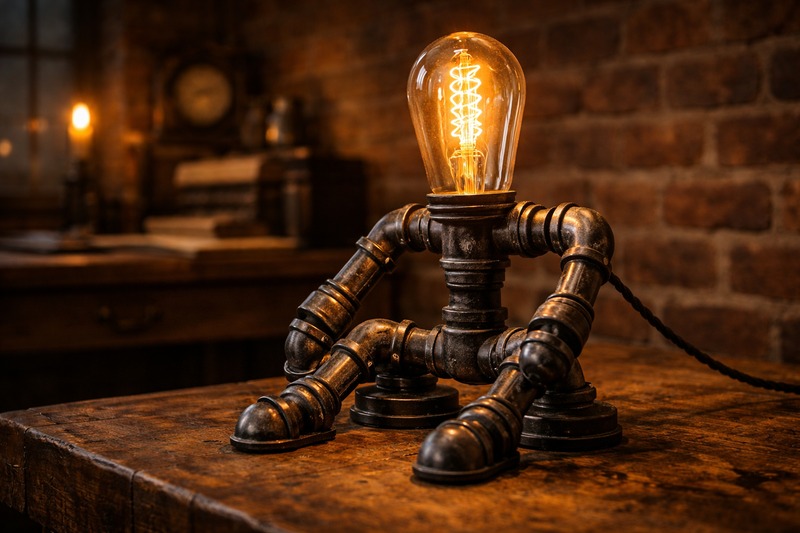
One of the staples of Steampunk DIY is the "Black Iron Pipe" lamp. These fixtures are thick, heavy, and industrial. If you pair them with a small, delicate bulb, the proportions look ridiculous, like a bodybuilder with a tiny head.
You must use "Oversized" bulbs like the G125 (5-inch Globe) or the ST64 (Edison shape) to match the visual weight of plumbing pipe fixtures. The substantial size of the bulb acts as the "glass lung" of your mechanical creation, balancing the heavy metal structure.
Balance is critical in design.
Steampunk fixtures are usually made of 1/2-inch or 3/4-inch iron plumbing pipes.
They are painted matte black or gunmetal grey.
They are visually "heavy."
A standard A19 household bulb is small (60mm wide).
If you screw a small A19 into a heavy iron elbow joint, it looks weak.
You need the bulb to look like a critical component of the machine.
I recommend using Oversized Bulbs.
The G125 Globe is my favorite for purely pipe-based designs.
It is a large sphere, 125mm in diameter (about 5 inches).
It looks like a containment field or a plasma chamber.
When you screw this into a pipe fitting, the transition from metal to glass is dramatic.
The ST64 (Teardrop) is the classic choice.
It mimics the original 19th-century shape.
It looks like a vacuum tube from an old radio.
This shape works perfectly for "Robot" lamps or "Sconces."
When Jacky sells DIY kits to makers, he always includes the ST64, not the A19.
He knows that if the customer uses a small bulb, they will be disappointed with their own creation.
The "Visible Socket" Aesthetic
In most decor styles, we try to hide the socket.
In Steampunk, we celebrate the socket.
You should use Brass or Copper sockets2 with keyless switches or rotary knobs.
The bulb must have a base that looks good exposed.
Cheap LED bulbs have a white plastic cooling collar at the base.
This white plastic ring is the enemy of Steampunk.
It screams "Modern Cheap Tech."
You must buy "Base-Up" or "Full Glass" filament bulbs.
This means the glass goes all the way down to the metal screw base.
There is no plastic ring.
When you screw it into a brass socket, it looks like one continuous piece of technology.
I manufacture a special line where the metal base is colored "Antique Bronze" instead of silver nickel.
This way, it blends perfectly with the dark sockets used in these lamps.
It is a tiny detail, but Steampunk is all about details.
| Fixture Type | Pipe Thickness | Best Bulb Shape | Visual Effect |
|---|---|---|---|
| Desk "Robot" | 1/2 inch | ST64 Teardrop | Looks like a head/helmet. |
| Ceiling Grid | 3/4 inch | G125 Globe | Looks like a power core. |
| Wall Sconce | Flange Mount | T45 Tube | Looks like a gauge/meter. |
| Floor Lamp | 1 inch | G200 Huge Globe | Massive visual anchor. |
Which Filament Patterns Create the "Mad Scientist" Laboratory Look?
Steampunk is not just about heavy metal; it is about delicate science. You want your room to look like the laboratory of a Victorian inventor. Standard straight filaments look boring and static inside these wild fixtures.
Choose "Spiral" or "Squirrel Cage" LED filaments to add complexity to the light source. The intricate winding of the LED strip mimics the fragile experimental nature of early electrical prototypes, turning the light bulb into a piece of scientific art.
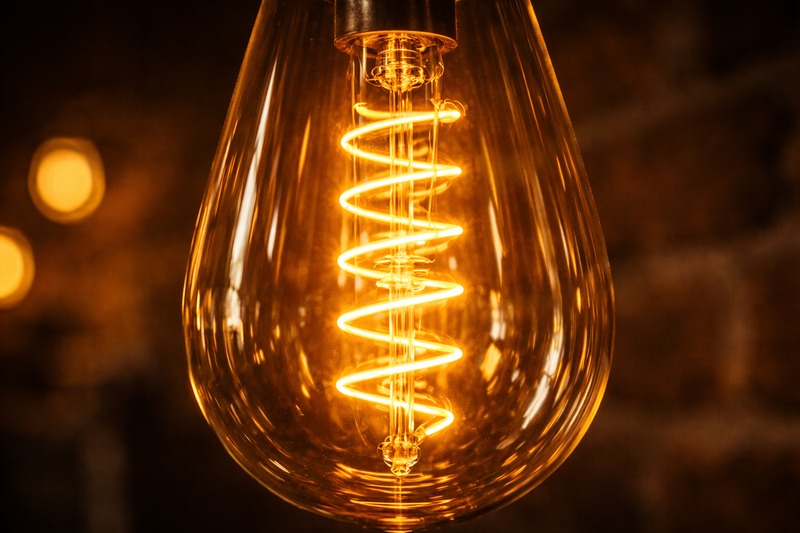
Standard LED bulbs use vertical sticks of yellow phosphor.
They look utilitarian.
They do not spark the imagination.
Steampunk is about "The Wonder of Science."
Think of Nikola Tesla and his coils.
Think of Frankenstein and his lightning machines.
You want the inside of the bulb to look complicated.
We have developed Flexible LED Filaments (Soft LED) to solve this.
We can bend the light source.
For Steampunk, the Spiral filament is king.
It looks like a coiled spring.
When dimmed, you can see every loop of the coil.
It creates a "Vortex" of light.
It looks like captured energy.
Jacky had a client designing an Escape Room with a "Submarine" theme.
They needed lights that looked like engine indicators.
We used T30 Tubular Bulbs with a long spiral filament.
It looked exactly like a voltage regulator from 1900.
The players spent minutes just staring at the lights because they looked so "techy."
If we had used straight lines, nobody would have looked twice.
The "Squirrel Cage3" Classic
If the Spiral is too wild for you, use the "Squirrel Cage".
This is the classic zigzag pattern running up and down.
It is historically accurate to the early 1900s.
It looks structured and engineered.
It conveys a sense of "Industry."
It fits well in "Factory" style Steampunk decor—think gears, chains, and pulleys.
The Spiral fits better in "Inventor" style—think chemicals, electricity, and time travel.
You are telling a story with the squiggly yellow line.
Choose the line that fits your narrative.
The Dimmability Factor
Crucially, these complex filaments must be dimmable.
When a bulb is at 100% brightness, it is too bright to see the pattern.
It is just a bright ball.
To show off the "Science," you need to run the bulb at 30% or 50% power.
This is where the magic happens.
The glare fades, and the glowing gold wire stands out sharp and clear.
I advise builders to use Rotary Dimmers4 built into the pipes.
The act of physically turning a brass knob to dim the filament makes the user feel like they are operating a machine.
It adds a tactile element to the visual experience.
It connects the human to the light.
| Filament Type | Shape | Vibe | Best For |
|---|---|---|---|
| Linear Stick | Vertical Lines | Basic / Boring | High-up ceiling lights. |
| Squirrel Cage | Up/Down Zigzag | Industrial / Strong | Factory themes. |
| Spiral / Helix | Coiled Spring | Energy / Science | Mad Scientist labs. |
| Cross-Loop | Twisted X | Artistic | Decorative pendants. |
How Can Tubular Bulbs Simulate "Fluid Tanks" and Gauges?
Spheres and teardrops are classic, but the "Tube" shape offers a unique opportunity to mimic liquid-filled chambers, test tubes, or pressure gauges, which are essential elements of the fantasy machinery in Steampunk.
Use the T30 or T185 Tubular Edison bulbs to invoke the look of laboratory glassware or "liquid light" columns. Their straight, narrow form allows them to be mounted in tight vertical clusters or inside wire mesh cages, resembling the capacitors and fluid tanks of a steam-powered engine.
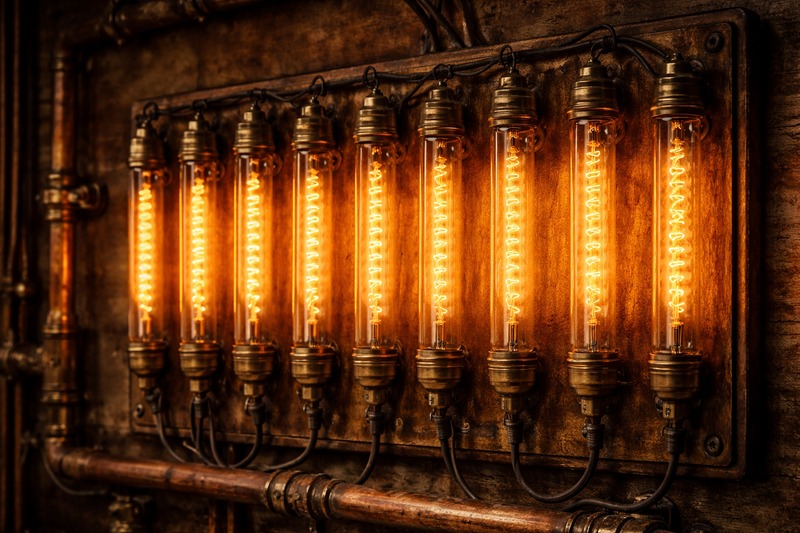
The Tubular Bulb (T-Series) is the most underused weapon in decor.
It changes the visual language completely.
A round bulb says "Lamp."
A tubular bulb says "Component."
In Steampunk, you are often building fake machines.
Machines do not usually have round bulbs sticking out of them.
They have gauges, fuses, and levels.
The T30 (30mm wide, 185mm or 300mm long) is perfect for this.
I have a personal project in my office.
It is a "Time Machine" clock.
I used four T30 bulbs mounted vertically, side-by-side.
They don't provide room light.
They just glow intensely with a spiral filament.
They look like the "Fuel Cells" of the clock.
When visitors come in, they ask, "What does that machine do?"
They don't ask, "Where did you buy that lamp?"
That is the difference. The tube shape disguises the object's function.
The Cage and Mesh Protection
In an industrial setting, glass is fragile.
Workers would protect glass with metal cages.
You should do the same.
Put your T30 bulbs inside Wire Cages5 or "Trouble Lights."
These are metal baskets that clamp onto the socket.
This adds another layer of texture.
Light + Glass + Filament + Metal Cage = Depth.
It creates interesting shadows on the wall.
The cage lines cast stripes across the room.
This makes the space feel enclosed and secure, like a bunker or a ship's hold.
Jacky sells a "Bunker Lamp" kit which is just a T30 bulb inside a heavy explosion-proof glass casting with a metal cage.
It is incredibly heavy.
It feels real.
If you use a round bulb in a cage, it often looks squeezed.
The tube fits perfectly, floating in the center of the protection.
Mounting Orientation
Think about direction.
Most people hang lights down.
But machinery often has lights pointing up or sticking out horizontally.
Tubes look amazing when mounted horizontally on a wall.
They look like glowing pipes carrying plasma.
They act as "Wayfinding" lights in a hallway.
Or mount them vertically on a wooden backboard to create a "Control Panel."
The versatility of the tube shape allows you to be an inventor, not just a decorator.
| Bulb Code | Dimensions | Best Application | Visual Analogy |
|---|---|---|---|
| T45 | Short / Fat | Sconces | The "Valve" |
| T30-185 | Medium / Thin | Pendants / Cages | The "Test Tube" |
| T30-300 | Long / Thin | Linear Lamps | The "Fuel Rod" |
| T9 | Very Thin | Delicate Fixtures | The "Fuse" |
Conclusion
Steampunk is a fantasy that requires total commitment to the aesthetic. You cannot let a single modern detail break the spell. By replacing harsh white lights with 2200K amber filaments, matching the bulb scale to your heavy iron pipes, and utilizing complex spirals and tubes to mimic machinery, you transform your room from a costume party into a living, breathing engine of the Victorian imagination.
This link will provide insights into how Kelvin temperature affects lighting and color perception in interior design. ↩
Explore the unique aesthetic and durability of Brass or Copper sockets that enhance Steampunk designs. ↩
Explore the Squirrel Cage design to understand its historical significance and how it enhances Factory style Steampunk decor. ↩
Learn about Rotary Dimmers and discover how they add a tactile and immersive element to your lighting setup. ↩
Explore how Wire Cages enhance safety and aesthetics in lighting, making your space both secure and visually appealing. ↩