You stock "60-watt equivalent" bulbs, but customers complain they seem dim. Your inventory is now a mix of confusing lumen counts, leading to unhappy clients, returned products, and lost sales because the light simply doesn't meet expectations.
For a classic "60-watt equivalent" feel, target 800 lumens. Use this as your benchmark: stock 450 lumens for 40W replacements and 1100 lumens for 75W. Offering clear lumen-to-wattage equivalents on your packaging is critical to guide customer choice and prevent dissatisfaction.
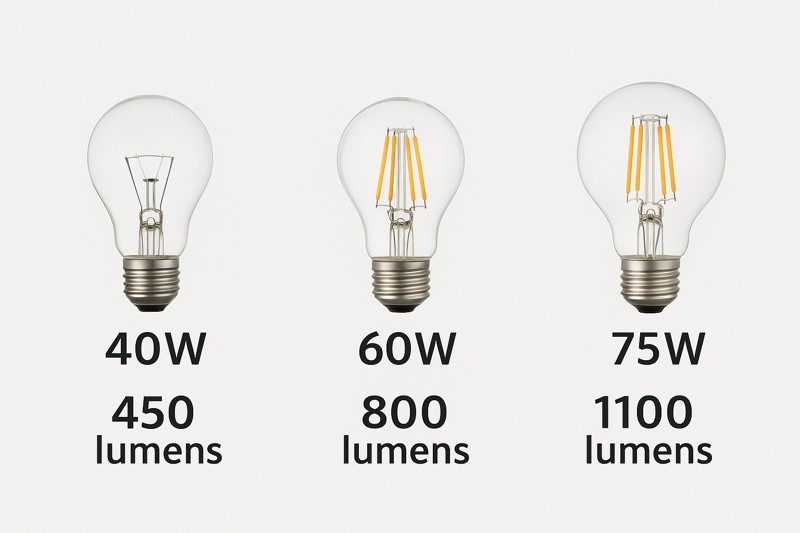
I'll never forget a conversation with a product manager from a large American retail chain. We can call him Jacky. He was launching a new private-label brand of lighting and wanted to be extremely competitive on price. He found a supplier—not us at the time—who offered a "60-watt equivalent" LED filament bulb for an incredibly low cost. The packaging looked great, the specs seemed right, and he placed a huge order. Three months later, he called me, deeply concerned. His stores were flooded with returns. The customer complaint was always the same: "This bulb is not as bright as my old 60-watt bulb." I asked him to check the fine print on his box. His super low-cost bulb was only producing 600 lumens. For decades, consumers have been conditioned that a 60-watt incandescent produces around 800 lumens of light. His supplier saved money by using a less efficient, lower-output LED chip. He saved a few cents per bulb on the purchase order but lost dollars in returns and brand reputation. That day, we established a core principle for his brand: lumen output is a promise to the customer, and 800 lumens is the non-negotiable standard for a 60-watt replacement.
Why Are Lumens More Important Than Watts Today?
Customers walk into a store looking for a "60-watt bulb," a habit from the last century. Why is this old way of thinking causing so many problems with modern LED products, and how can you educate your customers to make better choices?
Watts measure energy consumption, while lumens measure brightness. With inefficient incandescents, the two were directly related. With highly efficient LEDs, a bulb can be very bright (high lumens) while using very little energy (low watts), breaking the old rule of thumb.
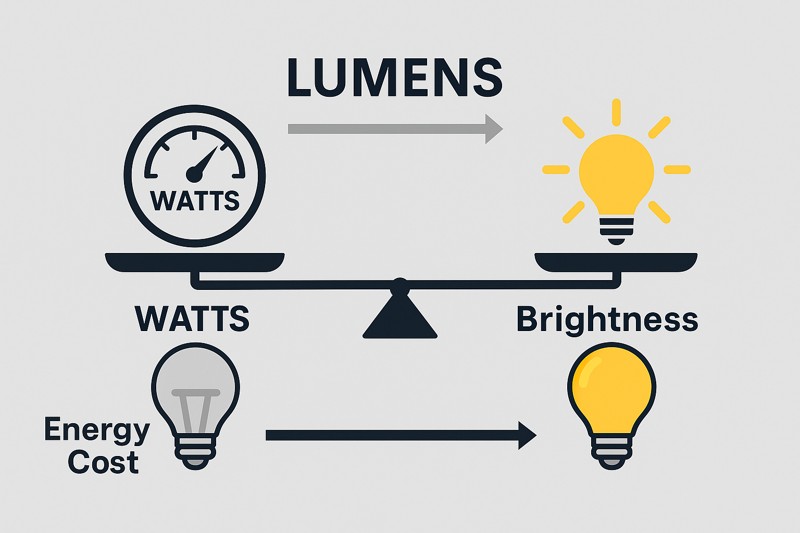
For over a hundred years, the relationship was simple. If you wanted a brighter light, you bought a bulb with a higher wattage. A 100W bulb was always brighter than a 40W bulb. This connection became deeply embedded in the consumer's mind. The arrival of LED technology completely shattered this relationship. The goal of an LED is to be highly efficient—to produce the most light using the least amount of energy. This efficiency is called Luminous Efficacy, and it's measured in Lumens per Watt (lm/W). A traditional incandescent bulb had a terrible efficacy of around 13-15 lm/W. A modern LED filament bulb from a quality manufacturer like Hongyu Bulb can easily achieve over 100 lm/W. This is why the old thinking fails. A customer might see a 7W LED and an 11W LED on the shelf. In the old days, they'd assume the 11W is brighter. But if the 7W bulb has superior LED chips and driver design, it could produce 800 lumens, while the cheap, inefficient 11W bulb might only produce 750 lumens. The lower wattage bulb is actually brighter. Therefore, teaching the market to "shop for lumens, not watts" is the single most important educational step for a lighting seller.
The New Translation Table: Watts to Lumens
To prevent customer confusion, it's essential to stock products that meet established brightness expectations. Here is the industry-standard translation table you must use.
| Old Incandescent | Expected Brightness (Minimum) | Typical LED Power Consumption | Luminous Efficacy (lm/W) |
|---|---|---|---|
| 25 Watts | 250 Lumens | 2.5 - 3 Watts | ~90 lm/W |
| 40 Watts | 450 Lumens | 4 - 5 Watts | ~100 lm/W |
| 60 Watts | 800 Lumens1 | 7 - 8 Watts | ~115 lm/W |
| 75 Watts | 1100 Lumens | 9 - 10 Watts | ~120 lm/W |
| 100 Watts | 1600 Lumens | 13 - 15 Watts | ~125 lm/W |
As a B2B buyer, your specification sheet should focus on the lumen column. If a supplier offers you an "800 lumen" bulb that uses 10W (80 lm/W), you know it's using older, less efficient technology compared to a supplier whose 800 lumen bulb uses only 7W (114 lm/W). Focusing on lumens protects your customer, and focusing on luminous efficacy2 protects your brand's reputation for quality and innovation.
What Lumen Levels Should You Stock for Different Rooms?
A customer installs your 800-lumen bulbs in their bathroom vanity and finds them too dim for applying makeup. Another puts the same bulbs in a bedroom lamp and finds them too harsh for relaxing. How do you guide buyers to the right brightness for each space?
Provide lumen recommendations based on room function. Task-oriented spaces like kitchens and bathrooms require higher lumen levels (300-500 lumens per sq. meter), while ambient spaces like bedrooms and living rooms need lower levels (150-300 lumens per sq. meter).
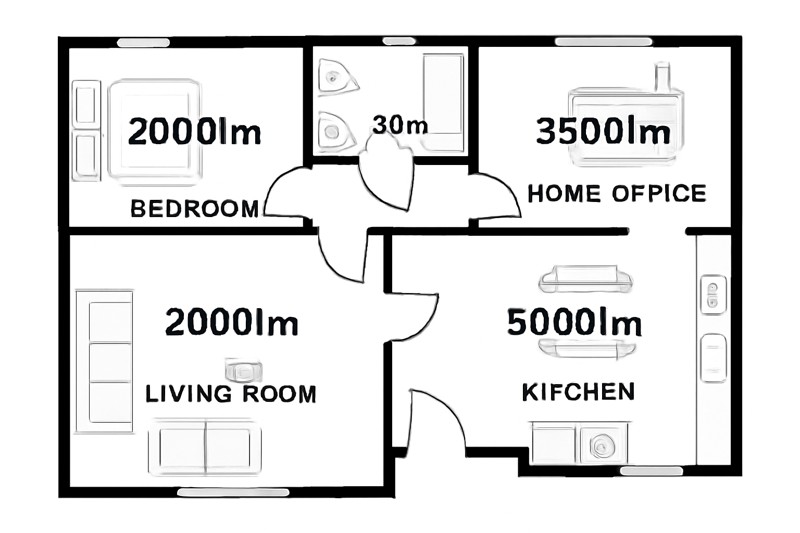
Selling "one size fits all" is a recipe for dissatisfaction. The function of a room dictates its lighting needs. As a supplier, your role is to help your clients—and their end-users—understand these needs. We can break down lighting into three main categories: Ambient, Task, and Accent. Ambient lighting provides the overall illumination for a room. Task lighting is focused on a specific activity like reading or cooking. Accent lighting highlights specific features like artwork. Each requires a different lumen level. An 800-lumen (60W equiv.) A19 bulb is a fantastic choice for general ambient lighting in a floor lamp, but it's likely insufficient on its own over a kitchen counter where fine knife work is being done. Conversely, a 1600-lumen (100W equiv.) bulb that's perfect for a workshop would feel clinical and uncomfortable in a bedside lamp. At Hongyu Bulb, we manufacture a wide range of lumen outputs for this very reason. By helping your customers think about the activities in their spaces, you can guide them to a more satisfying purchase and position yourself as an expert advisor, not just a product seller.
A Practical Guide to Recommending Lumens
Here is a simple framework you can use to guide your customers. These are general recommendations, and the final choice depends on room size, ceiling height, and personal preference.
| Room | Primary Function | Recommended Lumens (per fixture)3 | Example Bulb |
|---|---|---|---|
| Kitchen (General) | Ambient + Task | 800 - 1600 Lumens | High-output A19 or PAR lamps |
| Kitchen (Under-Cabinet) | Focused Task | 300 - 500 Lumens | LED Strips or small puck lights |
| Bathroom (Vanity) | Focused Task | 800 - 1100 Lumens per side | Clear G25 Globe bulbs |
| Living Room | Ambient / Reading | 450 - 800 Lumens | Dimmable A19 or ST64 filament bulbs |
| Bedroom | Ambient / Relaxing | 250 - 450 Lumens | Low-lumen, warm CCT filament bulbs |
| Dining Room | Ambient (Dimmable) | 450 - 800 Lumens | Candelabra (E12) or ST64 decorative bulbs |
By stocking a strategic mix—primarily high-volume 450lm and 800lm bulbs, with smaller quantities of 1100lm+ bulbs—you can meet the needs of nearly any residential application and avoid the problem of having the "wrong" brightness on your shelves.
Do Decorative Filament Bulbs Have Different Lumen Rules?
You're selling a beautiful ST64 Edison bulb with a warm 2200K glow. A customer buys it to replace the main light in their office, then complains it's far too dim to work under, even though the lumens match their old bulb. What went wrong?
Yes, the primary goal of most decorative filament bulbs is atmosphere, not illumination. Their lumen output is often intentionally lower, and the very warm color temperature (2200K-2400K) is perceived by the human eye as being significantly dimmer than a neutral 2700K-3000K bulb of the same lumen rating.
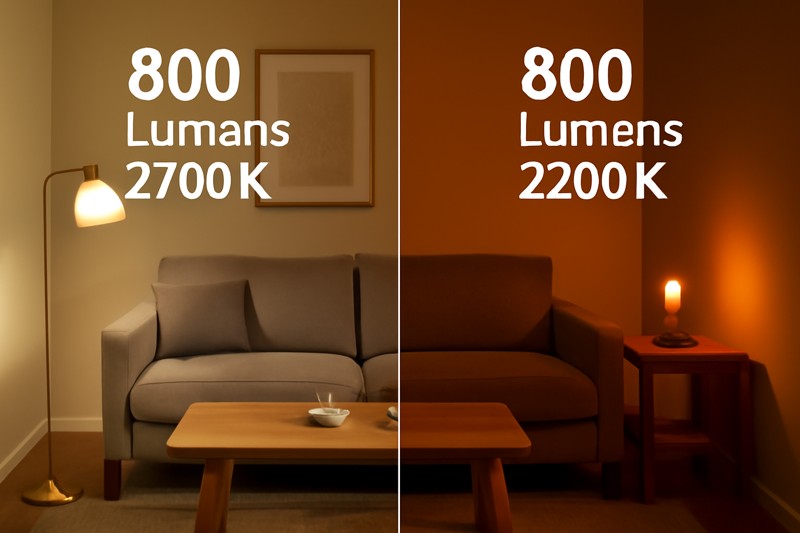
This is a subtle but critical distinction that trips up many buyers. Lumen is a scientific measurement of total light output, but perceived brightness is a human, psychological response. Our eyes are most sensitive to light in the yellowish-green part of the spectrum and less sensitive to deep reds and blues. A warm, amber-colored 2200K bulb has much more red and orange in its spectrum, so even if it measures 500 lumens, it will feel dimmer to a person than a whiter 3000K bulb that also measures 500 lumens. This is a feature, not a bug! Decorative bulbs, especially vintage styles like our ST64s or G95s, are designed for applications where the bulb itself is meant to be seen. They are part of the decor. Their job is to create a mood—cozy, romantic, nostalgic. They are not intended to be the primary workhorse for lighting a space. When a customer buys a decorative bulb, they are buying an aesthetic. It's crucial to position these products correctly: they are for table lamps, exposed pendant fixtures in a dining room, or sconces in a hallway where atmosphere is more important than raw illuminating power.
Guiding Choices for Decorative vs. Functional Bulbs
Clear communication is key to preventing returns for "dim" decorative bulbs1.
| Bulb Type | Primary Goal | Typical Color Temp (CCT) | Typical Lumen Range | Best Application |
|---|---|---|---|---|
| Functional (e.g., A19) | Illumination | 2700K - 4000K | 800 - 1600 Lumens | Main room lighting, task areas, kitchens. |
| Decorative (e.g., ST64) | Atmosphere | 2200K - 2700K | 250 - 600 Lumens | Exposed pendants, bars, restaurants, mood lighting. |
| Candelabra (e.g., B11) | Decoration & Accent | 2200K - 2700K | 250 - 500 Lumens | Chandeliers, sconces, decorative fixtures. |
When selling decorative bulbs4, shift the conversation from "How bright is it?" to "What mood does it create?" This framing helps the customer make the right choice and appreciate the product for its intended purpose, protecting you from unwarranted complaints.
Does Dimming a Bulb Change Its Lumen Output?
A customer installs your "800 lumen" dimmable bulbs. They set their dimmer to 50%, so they expect to get 400 lumens of light. But the room feels much darker than that. Are your bulbs or their dimmer not performing correctly?
Yes, dimming directly reduces lumen output. However, the relationship is not linear. Due to how the human eye perceives brightness, a dimmer set to 50% power may result in light that feels only 25-30% as bright, not 50%. This perceptual curve is normal for all lighting.
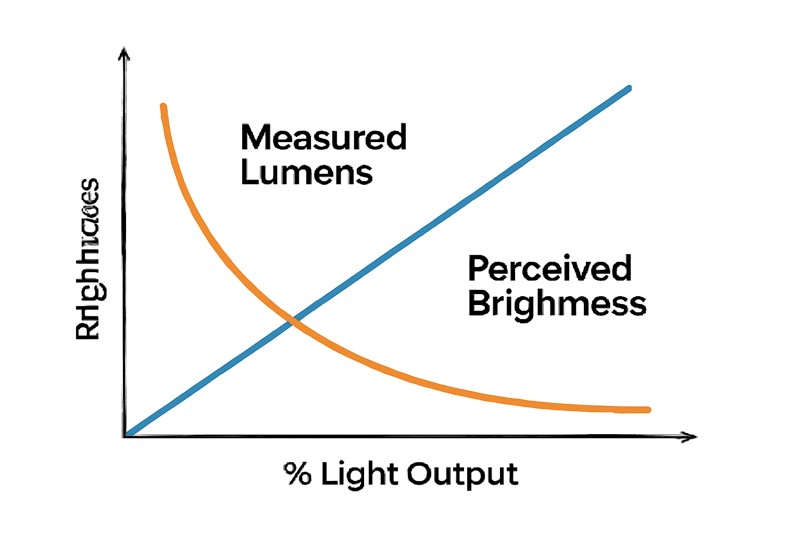
This is a common point of confusion rooted in human biology. Our eyes are amazing at adapting to different light levels. When you dim a light source, your pupils dilate to let more light in, partially compensating for the change. The result is that a linear reduction in measured power does not lead to a linear reduction in perceived brightness. This phenomenon is known as the Stevens' Power Law of brightness perception. Most modern, high-quality dimmers are engineered to account for this. They have a "dimming curve" designed to make the dimming feel smooth and linear to the human eye, even though the power they are delivering to the bulb is changing on a logarithmic scale. So, when a customer complains that the bulb dimmed to 50% seems too dark, it's often not a fault of the bulb. It's the difference between the physical measurement of light (lumens) and the complex, adaptive way our brains interpret that light. As a manufacturer at Hongyu Bulb, our responsibility is to ensure our LED drivers can respond smoothly across the entire dimming curve that a high-quality dimmer provides, from 100% down to 1%, without flicker or drop-out.
Understanding Dimming Performance Metrics
| Concept | Technical Definition | What it Means for the Customer |
|---|---|---|
| Dimming Range5 | The percentage of full brightness the bulb can dim to (e.g., 1%). | Can the bulb create a very dim, moody light, or does it just turn off? |
| Dimming Curve | The relationship between the dimmer's position and the lumen output. | Does the dimming feel smooth and gradual, or does it change abruptly? |
| Linear Dimming | A bulb that dims smoothly across the human-perceived range. | The light level appears to change in direct response to the dimmer control. |
| Warm Dim6 | A premium feature where the color temperature gets warmer as the bulb dims. | The bulb perfectly mimics an incandescent, shifting from 2700K to 2200K for a cozier feel. |
Offering bulbs with a wide dimming range and a smooth, linear dimming curve is a mark of quality. Offering premium "Warm Dim" bulbs that also adjust color temperature is a way to capture the high-end market that demands the absolute best atmospheric lighting experience.
Conclusion
Focus on lumens, not watts, to meet customer expectations. Use 800 lumens as the 60W benchmark. Stock varied outputs for different rooms, and position decorative bulbs by mood, not just brightness.
Exploring the meaning of 800 lumens will clarify brightness expectations, ensuring you make informed lighting choices. ↩ ↩
Understanding luminous efficacy helps you choose energy-efficient lighting, enhancing both performance and sustainability. ↩
Understanding recommended lumens helps ensure proper lighting for each room, enhancing comfort and functionality. ↩
Explore this link to discover how decorative bulbs can enhance the ambiance of your space, creating the perfect mood. ↩
Understanding dimming range helps you choose bulbs that create the desired ambiance, enhancing your lighting experience. ↩
Exploring warm dim lighting can reveal how it creates a cozy atmosphere, perfect for enhancing your home’s comfort. ↩