Your coffee shop feels sterile and your customers drink their latte and leave immediately. You want them to stay, relax, and order a second pastry, but the lighting feels like a hospital waiting room.
To build a vintage atmosphere, you must replace standard lighting with 2200K Amber LED Filament bulbs, dim them to create "pools of light" over tables, and hang them low to create intimacy. This specific light spectrum triggers relaxation and mimics the comfort of a campfire.
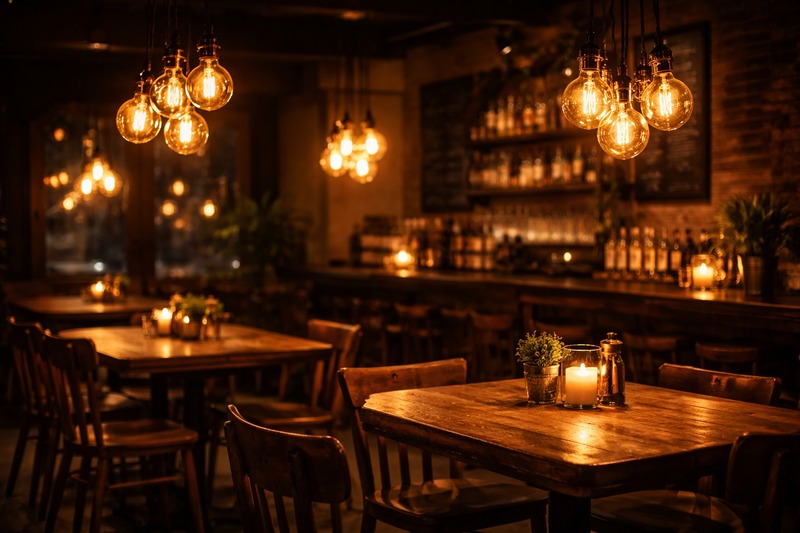
Lighting is not just about seeing. It is about feeling. In the hospitality business, lighting is the distinct difference between a fast-food joint and a premium lounge. I have seen many business owners spend $50,000 on espresso machines and vintage brick walls. Then, they ruin it all with cheap 4000K subtle white bulbs from the supermarket. Jacky, my client from the US, made this mistake. He opened a bistro in Chicago. He called me and said, "Wallson, the place looks cold. The brick looks grey." The problem was the color temperature. He was using standard LEDs. To fix this, we need to understand the physics of "cozy." We need to talk about Color, Brightness, Position, and Zoning.
Why Is 2200K the Only Color Temperature That Matters for Cafes?
Standard "Soft White" bulbs are still too white for a true vintage mood. If you want your cafe to feel like a 1920s speakeasy, you need to push the color spectrum further into the orange zone.
You must strictly use 2200K "Candle Light" temperature LED bulbs with amber-tinted glass. This color temperature enhances the wood grains and brick textures common in cafes, whereas standard 2700K or 3000K bulbs will wash out these textures and make the space feel energetic rather than relaxing.
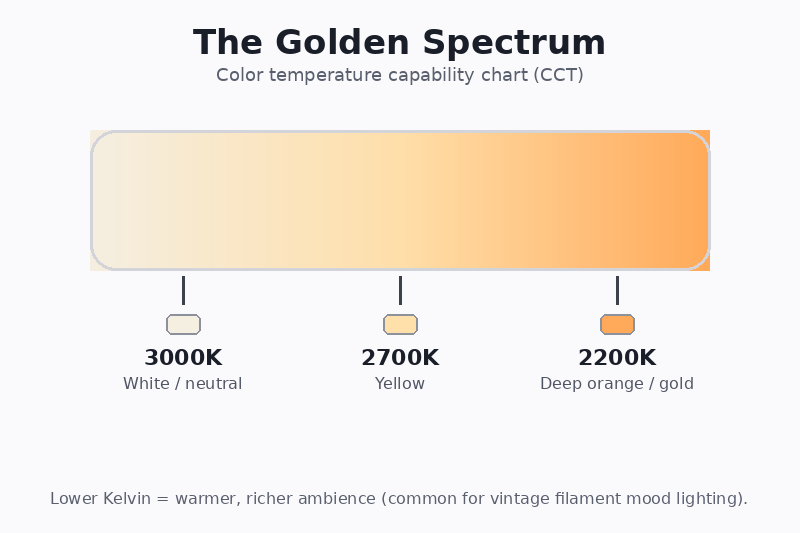
Color temperature is the foundation of mood. Most people think "Warm White" (2700K) is warm enough. For a living room, maybe it is. For a vintage cafe, it is too bright. Industrial and vintage styles rely on rich materials. You have mahogany wood tables. You have red brick walls. You have leather chairs. If you hit red brick with white light, it looks flat. If you hit it with 2200K Golden light, the red pops. The wood looks expensive. This is the "Golden Hour" effect that photographers use.
The Physics of the Amber Coat
The bulb construction plays a huge role here. A standard LED bulb has a clear glass or frosted plastic cover. To get the true vintage look, the glass itself must be tinted. We call this "Amber Gold1" or "Tea" glass in our factory. Even when the bulb is turned off during the day, the golden glass acts as a decoration. When it is turned on, it filters the harsh blue spikes out of the LED spectrum. Standard LEDs produce a lot of blue light, even if they look white. This blue light suppresses melatonin. It wakes people up. A golden-tinted bulb physically blocks that blue spectrum. This biologically signals the customer's brain to relax.
The Selfie Factor
The result is a light that makes customers look healthy. White light shows every wrinkle and blemish on a person's face. Golden light acts like a real-life Instagram filter. It smoothes the skin. It adds warmth to pale complexions. If your customers feel they look good in your cafe, they will take more selfies. They will tag your shop on social media. This is free marketing driven entirely by the Kelvin rating2 of your bulbs. I always tell my B2B clients: you are not selling light; you are selling confidence.
Consistency is Key
You cannot mix temperatures. If you have one 2200K bulb and one 3000K bulb next to each other, the 3000K will look blue by comparison. It looks broken. You need absolute uniformity across the main seating area. We test our batches to ensure every bulb is exactly 2200K +/- 50K.
| Kelvin Rating | Visual Effect | Best For | Cafe Suitability |
|---|---|---|---|
| 2200K (Amber) | Golden, Candle-like | Mood, Intimacy, Romance | Perfect |
| 2700K (Soft) | Yellow-White | Reading, General Home | Average |
| 3000K (Bright) | Neutral White | Kitchens, Retail | Poor (Too harsh) |
| 4000K (Cool) | Blue-White | Hospitals, Offices | Disaster |
Can Lower Brightness Actually Increase Your Customer Dwell Time?
A brightly lit room tells the human brain to be alert and active. If you want customers to relax, linger, and order a second drink, you must lower the lumen output to trigger a psychological rest state.
High brightness increases table turnover, which is good for fast food but bad for cafes; you should aim for 40-100 Lux at the table level using low-wattage (2W-4W) Edison bulbs. This dimness creates a "private bubble" for the customer, encouraging them to stay longer.
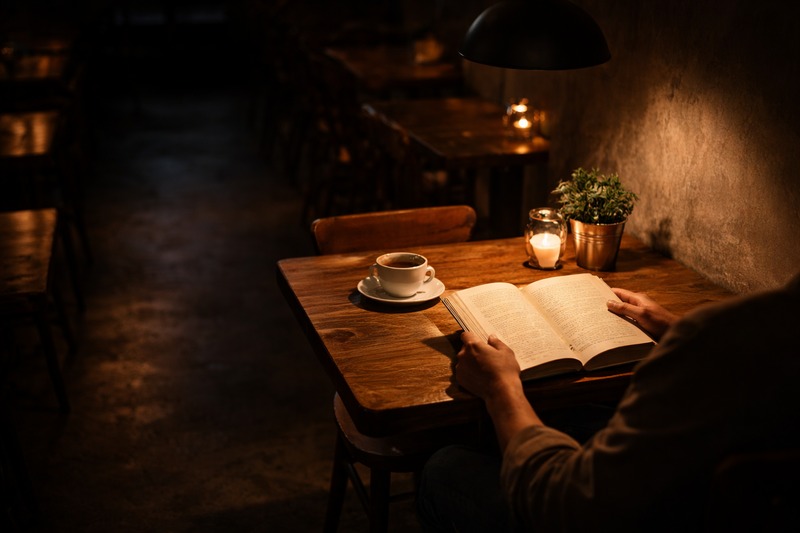
There is a direct link between Lux (brightness) and speed. McDonald's is bright. They want you to eat and leave in 15 minutes. A fine dining restaurant is dark. They want you to stay for 2 hours and buy wine. A vintage cafe sits in the middle but leans toward the dark side. The goal is "Intimacy." When the general lighting is dim, and the table lighting is warm, you create a psychological wall. The customer feels isolated with their coffee or their friend. They do not feel watched by the rest of the room. This comfort leads to the "second order effect." If I feel exposed, I finish my coffee and leave. If I feel cozy, I stay and look at the menu again.
The Dimming Curve Necessity
Technically, this means you need dimmable drivers3. Do not buy non-dimmable bulbs for a cafe. The sunlight changes throughout the day. At 10 AM, you might need the bulbs at 100% power to compete with the window light. At 7 PM, 100% power will look like a stadium. You need to dim them to 20%. I always tell Jacky: "The dimmer switch is your profit lever." You adjust the atmosphere to match the time of day.
The Flicker Problem
You must buy quality TRIAC dimmable drivers4s](https://www.wired4signsusa.com/collections/dimmable-led-drivers-types-of-dimming-technology-and-faqs?srsltid=AfmBOopq_KvJqPI9vsWSl_YItFCp_G11iKPj8sSxow2F0rG5xA3gQ6k1)[^3]. This is where many owners fail. They buy cheap bulbs and cheap dimmers. The result is flickering. Cheap LEDs struggle at low voltages. They strobe. This strobing might be invisible to the eye, but the brain registers it. It causes headaches and anxiety. If your lights flicker, customers will not know why, but they will feel agitated. They will leave early. We engineer our filament drivers to handle "Deep Dimming" (down to 5%) without noise or flicker. This ensures the vibe remains stable even at very low light levels.
Energy vs. Atmosphere
Some owners worry that 4-watt bulbs are too weak. In a vintage cafe, you do not need lumens. You need visible filaments. A 40-watt equivalent (4W LED) is actually too bright if looked at directly. You will likely run it at 2 watts. Efficiency is not the priority here; control is the priority. The shadowy corners are just as important as the lit tables.
| Time of Day | Bulb Brightness | Goal | Customer Psychology |
|---|---|---|---|
| Morning (8 AM) | 100% Power | Energy / Awakening | "Start the day" |
| Afternoon (2 PM) | 70% Power | Focus / Work | "Productive buzz" |
| Evening (6 PM) | 30% Power | Relax / Socialize | "Wind down" |
| Late Night (9 PM) | 10% Power | Intimacy / Romero | "Stay all night" |
How Do You Stop the Bulbs from Blinding Your Customers?
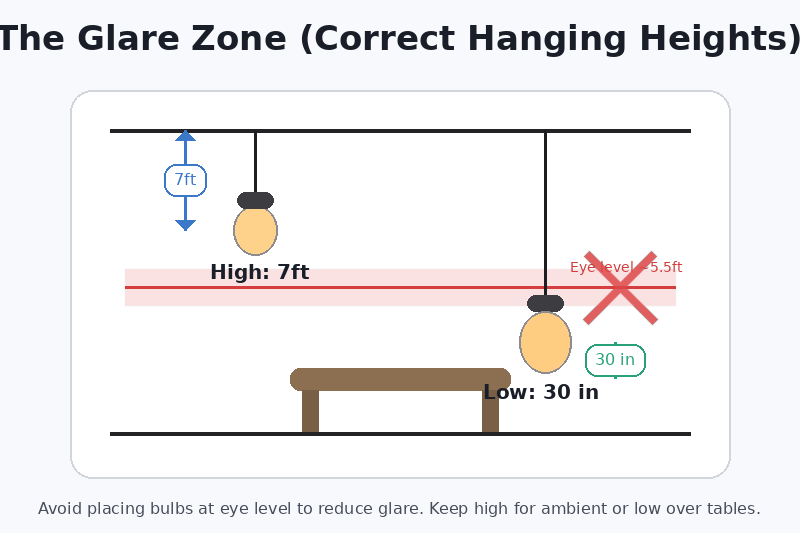
Edison bulbs are beautiful to look at, but staring directly into a filament can be painful. The most common mistake new cafe owners make is hanging bare bulbs at eye level, causing glare that hurts customers' eyes.
You must hang bare filament bulbs either significantly above eye level (walking path) or low enough that they fall below the direct line of sight while seated. Alternatively, use "Half-Chrome" silver-tipped bulbs or large G125 globes which diffuse the intensity over a larger surface area.
The main appeal of the Edison bulb is the visible filament. We want to see the glowing wire. But LED filaments are intense. Even a 4-watt bulb can leave spots in your vision if you look straight at it. This is called "Disability Glare." In a cafe, you are selling comfort. Pain is not comfortable. You have three solutions here.
The Geometric Solution
Solution one is Geometry. A standard dining table is 30 inches high. The bottom of your pendant light should be 30 to 36 inches above the table surface. This puts the light below the eye level of a person standing, and slightly above the eye level of a person sitting. It illuminates the coffee, not the eyes. It creates a cone of light that defines the table space. If you hang them at face height (5 to 6 feet high), you are blinding every person who walks to the bathroom.
The Scale Solution
Solution two is Size. A small A19 bulb concentrates brightness in a small point. It is sharp. A large G125 or PS160 bulb spreads the same brightness over a huge glass bubble. The bigger the bulb, the softer the glare. For cafes, I always recommend the G125 (5-inch globe). It has presence. It acts as furniture. It fills the vertical space without needing a lampshade.
The Half-Chrome Technology
Solution three is the Half-Chrome Bulb5. This is a standard filament bulb with a mirror coating on the bottom half. The light is dipped in silver or gold paint. The light shoots up, hits the socket or shade, and reflects down. The filament is completely hidden from the direct view of the customer below. It creates a mysterious, indirect glow. It is very popular in high-end steakhouses and coffee bars because it guarantees zero glare. The customer looks up and sees a golden mirror reflecting the room, not a burning wire.
| Bulb Type | Glare Level | Best Placement | Ideal Height |
|---|---|---|---|
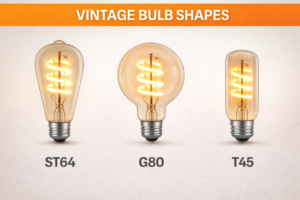
| Standard ST64 | High | High Ceilings / Walkways | > 7 feet |
| Large G1256 | Medium | Over Tables | 30" above table |
| Half-Chrome | Zero (Direct) | Eye Level / Low Pendants | Face height ok |
| T45 Tube | High | Wall Sconces | Above eye level |
How Do You Mix Vintage Bulbs with Functional Task Lighting?
A dark, moody cafe is great for customers, but your baristas cannot make latte art in the dark. You must separate the lighting zones to ensure staff can work efficiently while maintaining the vintage vibe for the guests.
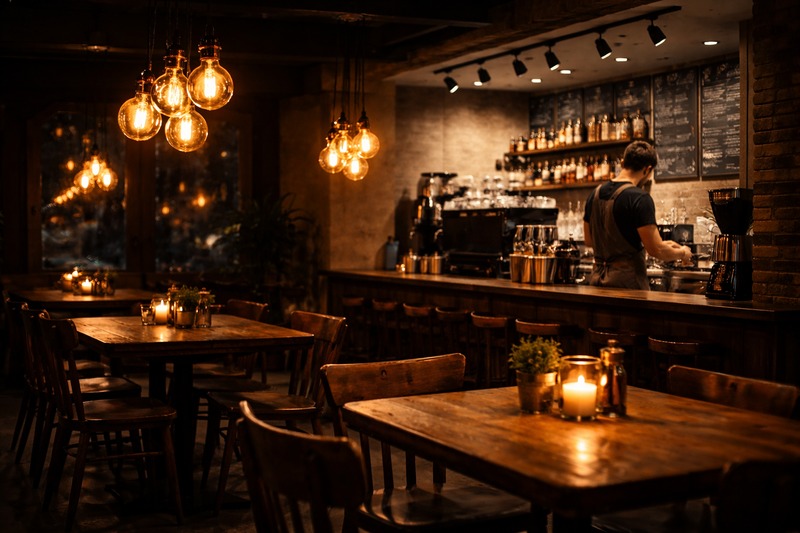
You should adopt a "Layered Lighting" approach where the seating area uses warm 2200K Edison bulbs for atmosphere, while the barista station and kitchen use targeted 3000K recessed spotlights or track lights. Position the functional lights so they do not bleed into the customer seating area.
This is where the "Form vs. Function" battle happens. A vintage bulb usually has a CRI (Color Rendering Index) of 80. This is fine for drinking coffee. It makes the bread look good. But if you are a barista roasting beans or checking the color of the espresso crema, you need accuracy. You need bright light to clean the machines and read the orders. If you put vintage bulbs over the espresso machine, the barista will make mistakes. If you put bright spotlights over the customers, they will feel anxious.
Establishing Zones
You must split the circuits. We define two zones.
Zone A: The Stage (Barista Station). This requires high visibility. Use Directional Track Lighting. Use COB (Chip on Board) LEDs. Color: 3000K (Clean White). CRI: 90+. Point these beams strictly at the counter. Use "Barn Doors" or strict beam angles (24 degrees) so the bright light does not spill onto the nearby tables. The coffee machine is the star of the show; light it up like a stage.
Zone B: The Audience (Seating). This requires low visibility. Use Omnidirectional Edison Bulbs. Color: 2200K. This creates a visual hierarchy. The bright coffee bar draws attention. The seating area is the darkened audience.
The Contrast Ratio
Jacky tried to use Edison bulbs everywhere in his first shop. His staff complained they couldn't see the dirt on the tables to clean them. He had to install ugly fluorescent tubes later to fix it. This looked terrible. The solution is the contrast ratio. The workspace should be roughly 3 times brighter than the seating space (3:1 ratio). This guides the customer's eye. If the kitchen is dark, it looks dirty. If the seating is too bright, it lacks privacy.
Hiding the Tech
The key is to hide the modern lights. Use black track lights painted to match the dark ceiling. Recess the spotlights deep into the wood beams. The customer should see the glowing vintage filaments. They should not see the source of the functional light. The functional light should just "appear" where it is needed on the work surface.
| Zone | Fixture Type | Bulb Tech | Color Temp |
|---|---|---|---|
| Barista Counter | Track / Recessed | COB Spot | 3000K |
| Customer Tables | Pendant Pendants | Filament LED | 2200K |
| Restrooms | Wall Sconce | Frosted LED | 2700K |
| Kitchen (Back) | Panel Light | SMD LED | 4000K |
Conclusion
Creating a vintage cafe atmosphere is not about buying old-looking things; it is about manipulating light spectrums and zones. By insisting on 2200K amber glass, lowering the lux levels to encourage lingering, and carefully layering functional light for staff, you turn a coffee shop into a destination.
Explore the unique properties of Amber Gold glass and how it enhances lighting aesthetics and health. ↩
Understanding Kelvin ratings can help you choose the right lighting for your space, enhancing mood and comfort. ↩
Explore this link to find top-rated dimmable drivers that ensure optimal lighting control and enhance your cafe's atmosphere. ↩
Learn about TRIAC dimmable drivers to understand their role in preventing flicker and ensuring a pleasant experience for your customers. ↩
Explore this link to understand the innovative design of Half-Chrome Bulbs and their benefits in reducing glare. ↩
Discover why the Large G125 bulb is recommended for cafes and how it enhances ambiance and space. ↩