You hang a single bulb from the ceiling and expect it to look like a trendy coffee shop, but instead, it looks like an unfinished basement. You are missing the crucial elements of height, grouping, and cable styling that transform a simple wire into a design feature.
To successfully style pendant lights with LED Edison bulbs, you must move beyond the "single hanging bulb" concept. You should use "Cluster" arrangements to create volume, experiment with colorful fabric twisted cords to add texture, utilize oversized glass shapes as focal points, and vary the hanging heights to create visual rhythm.
A pendant light is the simplest form of lighting.
It is just a cord and a socket.
Because it is simple, every detail matters.
If you make a mistake, there is nowhere to hide.
I have been making bulbs in Dongguan for 30 years.
I look at lighting plans every day.
The biggest mistake I see is "The Lonely Bulb."
A client hangs one small ST64 bulb in the middle of a big room.
It looks weak.
It looks like they ran out of money.
To make Edison bulbs look expensive, you have to be intentional.
My client Jacky calls me from New York often.
He says, "Wallson, the restaurant owner wants the 'Industrial Look' but the single pendants look boring."
I tell him: "Connect them."
Design is about relationships between objects.
One bulb is a dot. Three bulbs are a line. Five bulbs are a sculpture.
You need to stop thinking about the bulb as a light source.
Think of it as a glowing jewel.
You need to hang the jewel correctly.
You need to consider the cord, the socket material, the height, and the grouping.
Why Is the "Cluster Method" More Effective Than Single Pendants?
A single vintage bulb produces about 300 to 500 lumens, which is not enough to light a room and often lacks visual weight. Grouping them together solves the brightness problem and creates a substantial centerpiece that commands attention.
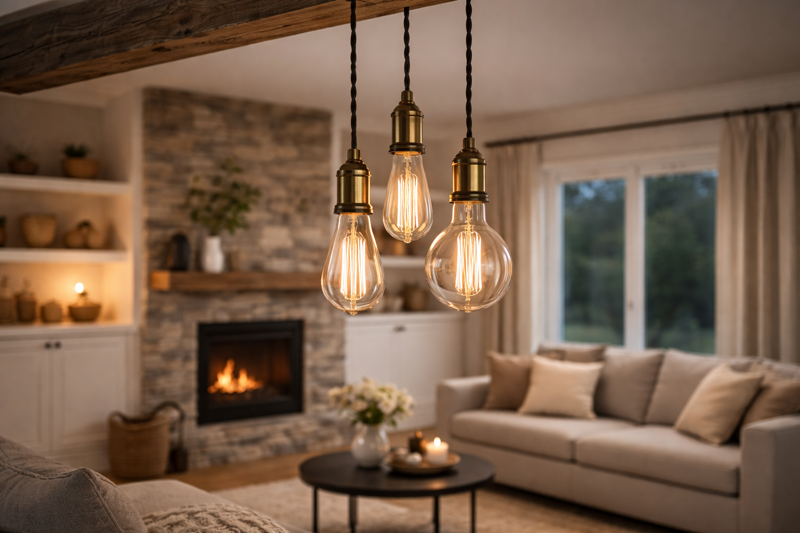
You should group 3, 5, or 7 pendants together using a single ceiling canopy or a "Spider" hook system. Odd numbers are visually more pleasing to the human eye than even numbers, and the combined mass of the bulbs creates a chandelier effect without the heavy metal frame.
One is the loneliest number in lighting.
Unless you have a very small hallway, never hang just one.
The human brain loves patterns.
It loves odd numbers.
Three lights are infinitely better than two.
When you hang three pendants over a kitchen island, you define the space.
You create a "Zone."
There are two ways to cluster.
1. The Linear Cluster.
This is for long tables or islands.
You space them out evenly.
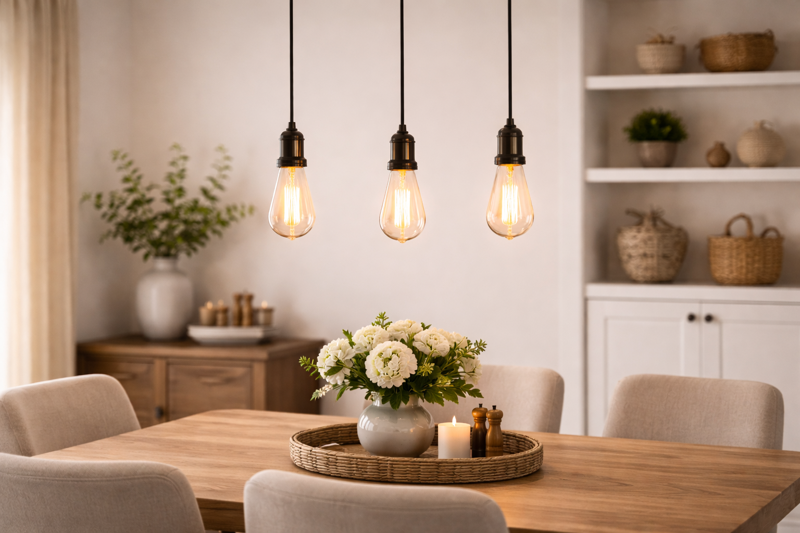
Jacky sets them 30 inches apart.
It creates a rhythm.
Here, uniformity is key. Use the same bulb shape (like three ST64s or three G125s).
2. The Bouquet Cluster.
This is for round tables or living room centers.
You bunch them tight together.
They hang from one central plate.
Here, you can mix the shapes.
I love seeing a G125 (Globe), an ST64 (Teardrop), and a T45 (Tube) hanging together.
It looks like a collection of chemistry bottles.
It feels organic.
But remember the "Lumen Math."
If you cluster 5 bulbs together, and each is 800 lumens (60W equivalent), you have 4000 lumens.
That is too bright for a dinner party.
If you cluster, you must use lower wattage bulbs.
Use my 4-Watt Series.
Five 4-Watt bulbs equal roughly 2000 lumens total.
This is comfortable. It glows; it does not blind.
Variable Heights
The other secret of clustering is height.
In a linear row, they should be level.
In a "Bouquet," they must be different.
Never hang a bunch of bulbs at exactly the same height.
It looks like they bumped into each other.
Stagger them by 3 to 5 inches.
It creates a "Waterfall" effect.
It lets the eye travel up and down.
| Cluster Type | Best Location | Arrangement Rule | Bulb Tip |
|---|---|---|---|
| Linear Row | Kitchen Island | Perfectly Level | Match the shapes identical. |
| Central Bouquet | Round Dining Table | Staggered Heights1 | Mix shapes for interest. |
| Spider Spread | Living Room | Wide spacing with hooks | Use large Globes (G125). |
| Corner Waterfall | Reading Nook | Vertical Drop | Use tall Tubes (T30). |
Creating a cluster is the first step, but what physically holds the bulbs up? The cord is not just a wire; it is part of the styling.
How Does Fabric Cord Choice Change the Personality of the Light?
In standard lighting, the electrical cord is ugly plastic that you try to hide. In exposed pendant lighting, the cord is a featured design element that connects the bulb to the ceiling, acting like the stem of a flower.
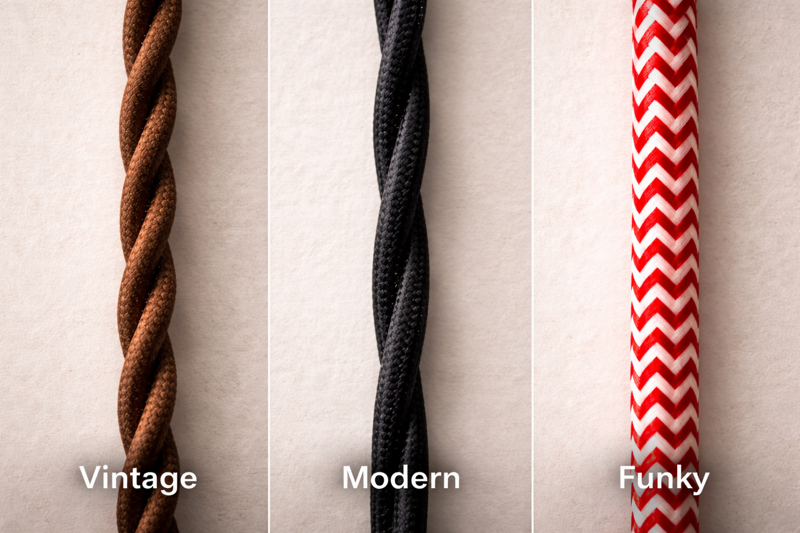
Replace standard plastic PVC cables with "Twisted Fabric" or "Braided Silk" cords in colors that contrast or complement your room. A twisted brown rayon cord adds vintage authenticity, while a bright red or zigzag patterned cord adds a modern, playful pop of art.
The cable is 50% of the fixture.
If you buy a cheap pendant kit on Amazon, it comes with a bent plastic wire.
It never hangs straight. It looks cheap.
Fabric cord hangs heavy and straight.
Gravity pulls it down beautifully.
This is called "Drape."
In my factory, we source specific textile cables for our high-end kits.
The Vintage Twist:
This is two wires twisted together, covered in brown or gold rayon.
It looks exactly like 1910 wiring.
It is essential for Steampunk or Farmhouse styles.
Pairing this with an Amber ST64 bulb is the classic "Edison Look."
The Modern Round:
This is a smooth, round cable covered in black or white matte fabric.
It looks crisp.
Use this for Scandinavian or Minimalist styles.
Pair it with a Clear Glass Globe (G95) and a silver socket.
The Pop Color:
Sometimes you want fun.
Jacky did a project for a toy store.
We used bright Red fabric cords and oversized White Globe bulbs.
It looked like balloons floating on the ceiling.
Don't be afraid of color.
A grey kitchen looks amazing with yellow electrical cords.
It shows you have a personality.
The Knot Trick
If your cord is too long, do not cut it.
Knot it.
Tie a loose overhand knot2 in the cord halfway down.
This creates visual interest.
It looks casual and effortless.
It also shortens the light without needing an electrician.
This only works with fabric cords3. Plastic cords look terrible knotted.
Fabric cords are soft and flexible; they hold the knot shape elegantly.
| Cord Style | Material Texture | Best Vibe | Socket Pairing |
|---|---|---|---|
| Twisted Brown | Rough / Rayon | Rustic / Vintage | Antique Brass |
| Round Black | Smooth / Cotton | Modern / Industrial | Matte Black |
| Zigzag Pattern | Graphic Weave | Retro / Funky | White Ceramic |
| Hemp Rope | Thick / Natural | Nautical / Coastal | Copper |
The cord sets the vibe, but the actual glass shape of the bulb determines the scale. Sometimes, standard bulbs are just too small for high ceilings.
When Should You Use Oversized "Giant" Bulbs as Solo Pendants?
Sometimes you only have one outlet power source and you cannot install a cluster. A standard bulb looks puny, but a massive bulb acts as a complete light fixture all by itself.
For single-drop pendant locations, use "Oversized" or "Jumbo" LED filaments like the G200 (Basketball size) or the PS160. These bulbs are so large (8-12 inches wide) that they function as both the light source and the shade, holding their own in large open spaces.
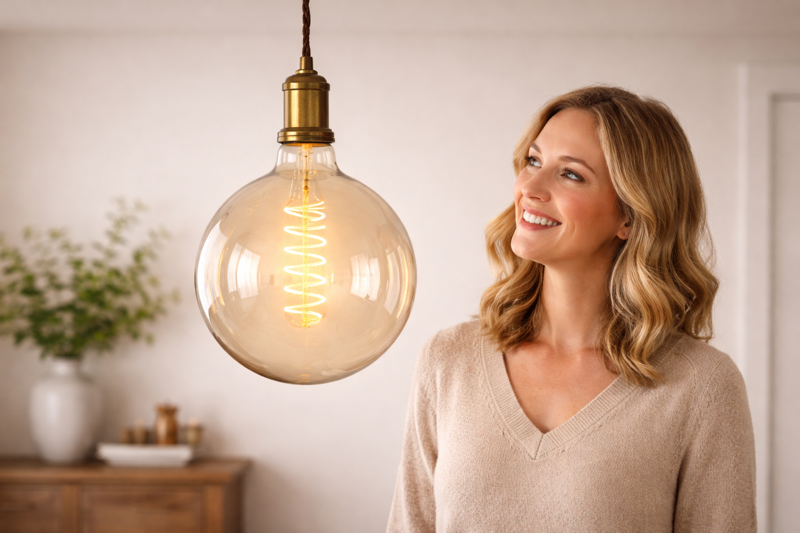
Size matters in design.
Scale is the relationship between the object and the room.
If you have a 12-foot ceiling, a standard A19 bulb is invisible.
You need the Giant Series.
These are special molds we make.
The G200 is a globe with a diameter of 200mm.
That is 8 inches across.
It is huge.
When you hang this bulb, you don't need a shade.
The glass surface area is massive.
It reflects the room.
It commands attention.
Cost is a factor here.
A normal Edison bulb is $4.
A Giant G200 is $30 or $40.
But remember: you are not buying a bulb. You are buying a fixture.
You are saving money because you don't have to buy a metal shade or a glass chandelier.
The bulb is the chandelier.
Jacky sells these to loft apartments in Brooklyn.
These apartments have huge empty spaces.
One single G200 over a reading chair fills that space instantly.
The Filament Challenge in Giants
With a giant bulb, the filament is very visible.
We use extra-long LED filaments.
We float them in the center of the huge glass sphere.
Make sure you choose a Straight Floating Filament4 or a Double Spiral5.
If the filament is too small, it looks silly inside the big glass.
It looks like a tiny candle in a cave.
You need the light source to fill the volume of the glass.
Also, ensure your socket is strong.
These bulbs are heavy. Heavy glass.
Ensure your cord clamp (strain relief) is tight.
You don't want a 1-pound glass ball falling on your head.
| Bulb Code | Diameter | Analogy | Best Use |
|---|---|---|---|
| G80 | 3 inches | Grapefruit | Clusters |
| G125 | 5 inches | Cantaloupe | Kitchen Island |
| PS160 | 6.5 inches | Bowling Ball | Entryway |
| G200 | 8 inches | Basketball | Loft Centerpiece |
We have the cluster, the cord, and the size. Finally, we must look at the "Jewelry" of the pendant: the socket itself.
How Do Socket Materials Upgrade the Finished Look?
The socket (the part the bulb screws into) is the connection point between the rustic bulb and the elegant cord. Cheap plastic sockets ruin the illusion of quality.
Upgrade to solid metal sockets in Brass, Copper, or Matte Black finishes, or use Porcelain for a clean retro look. The weight and finish of a metal socket add a tactile sense of luxury and balance the visual weight of the glass bulb below it.
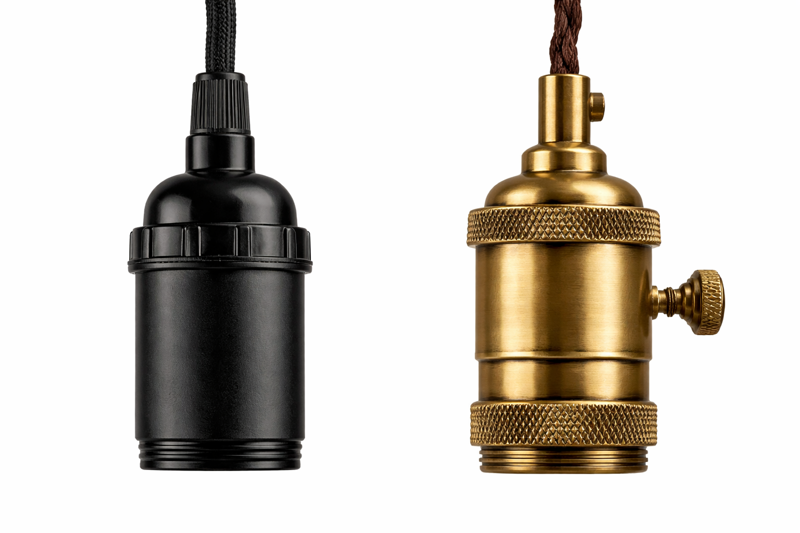
Details make the product.
If you look at a luxury watch, you look at the clasp.
If you look at a light fixture, you look at the socket cup.
A standard plastic socket costs $0.50.
A solid brass knurled socket costs $4.00.
Spend the $3.50.
It transforms the look.
Solid Brass:
This is the king of Edison lighting.
It starts shiny and gold.
Over time, it gets a patina. It gets darker.
It feels heavy in your hand.
When you touch it to change the bulb, it feels like a pipe fitting.
It matches perfectly with Amber glass.
Porcelain / Ceramic:
This is white and glossy.
It is very 1920s kitchen style.
It looks clean and sterile.
Use this with Twisted White cords and clear bulbs.
It is a very fresh, bright look.
The "Switch" Feature:
I love sockets that have the switch on them.
A "Rotary Paddle" or a "Pull Chain."
Even if you control the light from a wall switch, the little brass key on the socket adds detail.
It looks mechanical.
It invites interaction.
It tells the user: "This is a machine, not just a decoration."
Jacky's clients love the Knurled Texture.
Knurling is the diamond cross pattern cut into the metal.
It catches the light.
It looks like a tool handle.
It adds a masculine, industrial texture to the pendant.
| Socket Material | Visual Character | Matching Bulb Tint | Room Style |
|---|---|---|---|
| Polished Brass | Shiny / Gold | Amber / Gold | Classic / Traditional |
| Antique Bronze | Dark / Aged | Amber | Steampunk / Rustic |
| Chrome / Nickel | Silver / Mirror | Clear / Smoke | Modern / MCM |
| White Porcelain | Clean / Simple | Clear | Farmhouse Kitchen |
Conclusion
Pendant lighting with LED Edison bulbs is an exercise in creativity, not just utility. By clustering bulbs to create volume, selecting fabric cords that add texture, utilizing giant bulbs for scale, and investing in high-quality metal sockets, you transform a simple hanging light into a custom design statement that defines your space.
Exploring this link will provide insights into how staggered heights enhance visual interest and ambiance in any space. ↩
Learn how to tie an overhand knot effectively, a simple technique that enhances both functionality and style in your decor. ↩
Explore the advantages of fabric cords, including their aesthetic appeal and flexibility, perfect for stylish lighting solutions. ↩
Explore this link to understand how Straight Floating Filaments enhance lighting aesthetics and functionality. ↩
Discover the advantages of Double Spiral filaments for unique lighting effects and energy efficiency. ↩