You spend hours designing your backyard oasis, but one heavy rainstorm can ruin your ambiance and destroy your lighting investment instantly. Stop buying replacements every season.
The solution lies in choosing commercial-grade LED Edison bulbs with an IP65 or IP67 waterproof rating and shatterproof PET housing. These bulbs are engineered to withstand rain, snow, and impact, ensuring your outdoor string lights remain safe and functional year-round without constant maintenance.
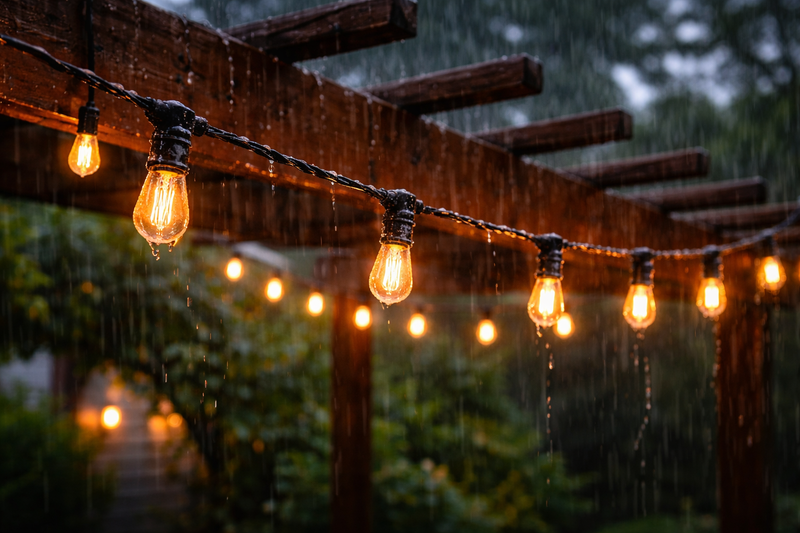
Most homeowners treat outdoor lighting like indoor lighting. They buy the cheapest glass bulbs they can find on Amazon. They screw them in. They look great for one week. Then the rain comes. Then the wind blows. Suddenly, you have broken glass on your deck and half the string is dark. I have seen this happen a thousand times. But there is a better way.
What Actually Happens When Water Gets Inside a Light Bulb?
Water is the natural enemy of electricity, and standard indoor bulbs have zero defense against moisture intrusion. The result is dangerous.
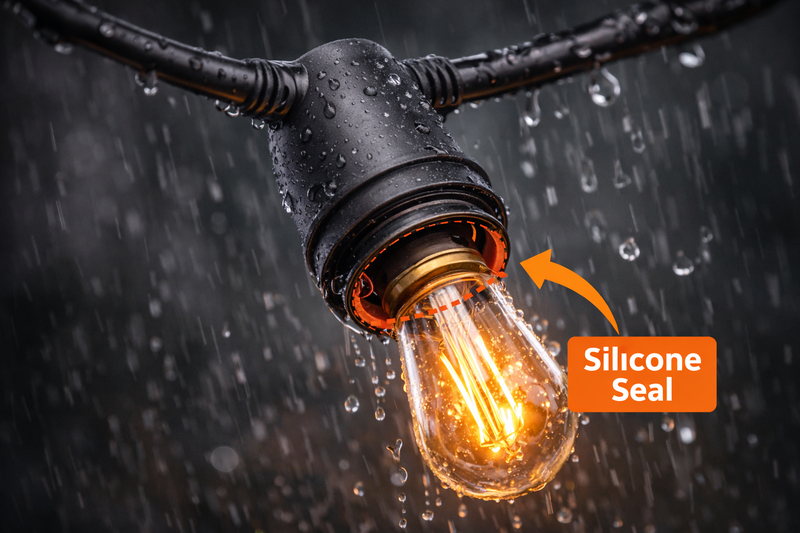
When water breaches the seal of a light bulb, it corrodes the metal contact points and can cause a short circuit in the LED driver. To prevent this, you must look for "fully sealed" bases where the glass or plastic lens is fused directly to the metal cap.
I have a customer named Jacky. He runs a large event lighting company in Miami.
Miami has hurricanes. It rains sideways.
Jacky called me last year in a panic. He said, "Wallson, I am losing money."
He was using standard IP44 residential bulbs for his permanent restaurant installs.
"IP44 is only splash-proof," I explained to him. "It is fine for a covered porch. But if you hang lights in the open air, you need IP65."
The Mechanism of Failure: Capillary Action
Let me break down what happens physically.
A cheap bulb has a glass top glued to a metal screw base.
Over time, the sun heats that glue. The glue dries out. It cracks.
Then the rain comes.
Water wicks into that tiny crack through capillary action1.
It pools at the bottom of the bulb, right where the electronics live.
The first sign is fog. You see condensation inside the glass.
The second sign is flickering. The water is bridging the electrical contacts.
The final stage is death. The driver rusts out.
Or worse, in a string light system, that water travels down the wire and shorts out the entire line.
Jacky was replacing 500 bulbs a month.
I upgraded him to our S14 Fully Sealed Series2.
We use a solid-state injection molding process.
The lens is not glued; it is molded as one piece with the base.
Water cannot get in because there is no hole.
We tested these by submerging them in a tank of water for 24 hours. They stayed lit.
Jacky's replacement rate dropped to zero.
This is the difference between a toy and a tool.
Can Your Lights Survive a Drop onto Concrete?
Patios have hard surfaces like stone, concrete, or wood, and glass bulbs are fragile hazards waiting to break during installation or windstorms.
Shatterproof LED bulbs made from high-transparency PET plastic are the safety standard for outdoor spaces. They mimic the crystal-clear look of glass but can bounce off hard surfaces without breaking, making them essential for households with children, pets, or high wind conditions.

The biggest fear for any patio owner is broken glass.
Imagine you are hosting a barbecue. People are walking around barefoot.
The wind picks up. A string of lights swings hard and hits the wooden post of your pergola.
Smash.
Now you have invisible shards of glass in the grass or on the deck.
The party stops. Everyone puts their shoes on. You have to get the broom.
It ruins the mood.
Jacky told me, "Wallson, my crew hates glass bulbs."
When his team takes down lights after a wedding, they work fast.
They throw the strings into crates.
With glass bulbs, he loses 10% of his inventory every time they move a crate.
"You need PET plastic," I told him.
The Evolution of Plastic: From Cloudy to Crystal
Many people think plastic looks cheap. They think it looks cloudy.
That was true ten years ago.
Today, we use Optical Grade PET (Polyethylene Terephthalate)3.
It is the same material used for high-end water bottles.
It is crystal clear. It has the same gloss index as glass.
From 5 feet away, you cannot tell the difference.
But the physical properties are totally opposite.
You can take my G45 plastic bulb4 and throw it against a brick wall.
It will just bounce.
For Jacky, this was a game-changer.
He stopped buying replacement bulbs for his rental strings.
For a homeowner, it means peace of mind.
If a squirrel chews the wire and the line falls down, you just pick it up.
You don't have to sweep up dangerous debris.
Safety is just as important as aesthetics.
Will the Weather Ruin the Bulb connection?
Even the best waterproof bulb will fail if the connection point between the bulb and the socket is loose or poorly sealed against the elements.
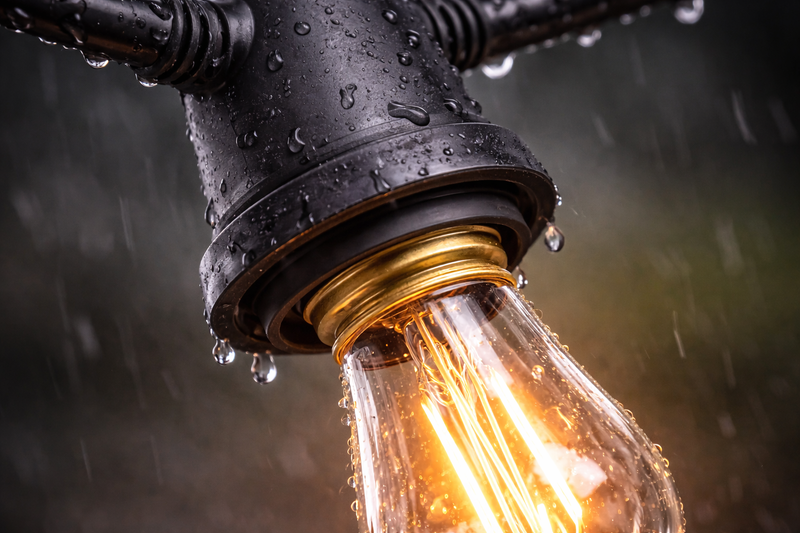
The "weakest link" in any patio light system is the socket lip. You must ensure your bulb creates a hermetic seal against the rubber gasket of the string socket, preventing water from trickling down the threads and causing rust or electrical failure.
You buy the expensive waterproof bulb.
You buy the heavy-duty string.
But your lights still fail. Why?
I often have to troubleshoot this for Jacky's installation team.
It is almost always "User Error" during installation.
Here is the physics of the problem.
The string light socket is a cup.
If that cup is facing up, it catches rain.
You should strictly avoid installing sockets facing upwards, but sometimes you can't help it.
Even if the socket faces down, wind blows rain sideways.
The critical point is where the bulb meets the socket.
Good commercial string lights (like the ones I sell Jacky) have a flexible PVC or rubber flange around the rim of the socket.
The "Torque" Factor and Corrosion
When you screw the bulb in, you must screw it in hard.
You want the base of the bulb to compress that rubber flange.
This creates a gasket seal5.
If you leave it loose, there is a gap.
Water runs down the side of the bulb, through the gap, and into the threads.
The metal threads are usually copper or aluminum.
When water hits them, they oxidize. They turn green or white.
The electricity stops flowing.
I told Jacky, "Tell your guys, when they think it is tight, give it one more turn."
Also, look at the shape of the bulb.
Some decorative bulbs have a very wide neck.
Sometimes the neck is too wide for the socket flange.
The bulb hits the rubber before it is fully screwed in.
The electrical contact never touches the bottom.
You think the bulb is broken, but really, it just isn't touching the power.
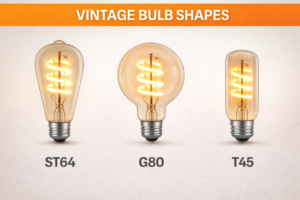
We designed our S14 and ST64 bulbs6 with a specifically tapered neck (we call it the "slim profile").
It ensures that the bulb fits deep into any standard E26 waterproof socket.
The seal is tight. The water stays out.
How Do Extreme Temperatures Affect LED Life?
Your lights sit outside in the freezing winter and the scorching summer, and these temperature swings can destroy the internal electronics of cheap bulbs.
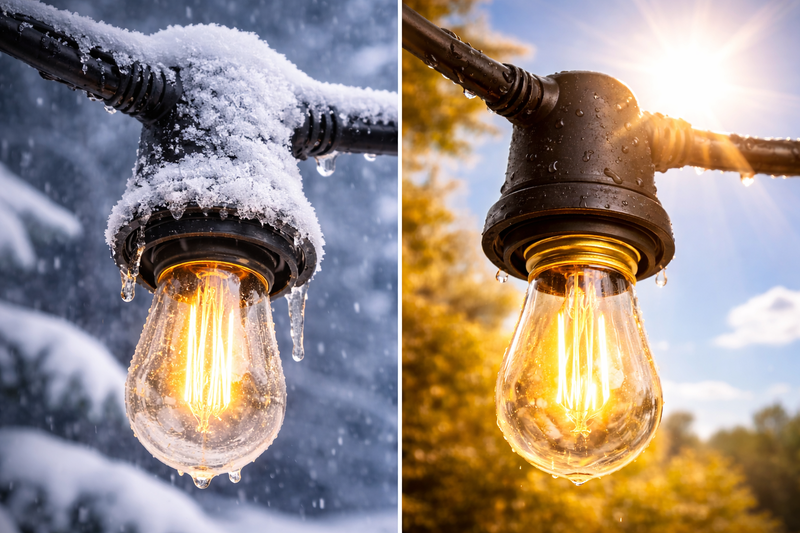
Extreme thermal expansion and contraction can crack the seals of inferior bulbs or overheat the LED chips. High-quality outdoor bulbs use commercial-grade potting compounds and thermal management drivers designed to operate reliably between -4°F and 104°F (-20°C to 40°C).
I have clients in Canada and clients in Dubai.
They have opposite problems, but the result is the same: Dead bulbs.
Let's talk about the cold first.
Jacky has a client in Aspen, Colorado. They light up a ski lodge.
In the winter, it gets down to -10°C.
Cheap plastic becomes brittle in the cold.
If a strong wind hits a frozen plastic bulb, it can crack.
Also, the thermal contraction affects the metal base.
Metal shrinks in the cold. Plastic shrinks less.
This difference can break the waterproof seal we talked about earlier.
We use specialized glues and materials that stay flexible even when frozen.
The Heat Trap: Why LEDs Die in Summer
Now, let's talk about the heat. This is actually the bigger killer.
LEDs hate heat.
If the semiconductor chip gets too hot, it loses brightness. It degrades.
Inside a sealed plastic bulb sitting in the sun in July, the temperature can reach 60°C or 70°C.
It is a greenhouse.
Most cheap drivers (the little chip that converts power) will burn out.
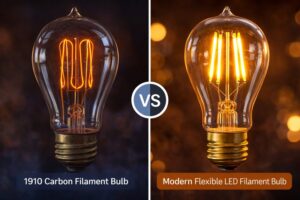
We use Sapphire Filaments7 and COB (Chip on Board)8 technology.
Sapphire conducts heat very well.
It pulls the heat away from the LED and dissipates it through the gas inside the bulb.
Yes, our bulbs are filled with an inert gas, usually Helium.
Helium moves heat away from the filament to the outer shell, where the wind can cool it down.
Cheap bulbs are filled with air. Air is a terrible conductor of heat.
Jacky's client in Dubai leaves their lights up all year.
It hits 45°C in the summer.
Our helium-filled bulbs survive. The air-filled ones cook themselves to death in two weeks.
When you buy a specialized weatherproof bulb, you are paying for that Helium and that superior thermal engineering.
Conclusion
You would not put a cardboard box in the rain and expect it to last. Do not do the same with your lighting. By investing in IP65 rated, shatterproof PET bulbs with proper thermal management, you stop fighting the weather. You stop climbing ladders to change dead bulbs. You save money, you save time, and you ensure that your patio remains a safe, glowing sanctuary, no matter what the forecast says.
Understanding capillary action is crucial for grasping how water interacts with materials, which can help in various applications. ↩
Exploring the S14 Fully Sealed Series can reveal innovative lighting solutions that prevent water damage and enhance durability. ↩
Explore the advantages of Optical Grade PET, a revolutionary material that combines clarity and durability, perfect for modern applications. ↩
Learn about the G45 plastic bulb, its durability, and how it can save you money and enhance safety in your home. ↩
Learn how a gasket seal enhances waterproofing in lighting, ensuring longevity and safety. ↩
Explore the advantages of S14 and ST64 bulbs for better lighting solutions and durability. ↩
Explore how Sapphire Filaments enhance LED performance and longevity, especially in high-temperature environments. ↩
Learn about COB technology's advantages in LED design, offering better heat management and brightness. ↩