You spend hours selecting the perfect vintage LED bulbs, admiring their spiral filaments and golden tint. Then, you screw them into a frosted glass shade or a fabric lamp, and all that beauty vanishes instantly. You just turned a piece of art into a regular light.
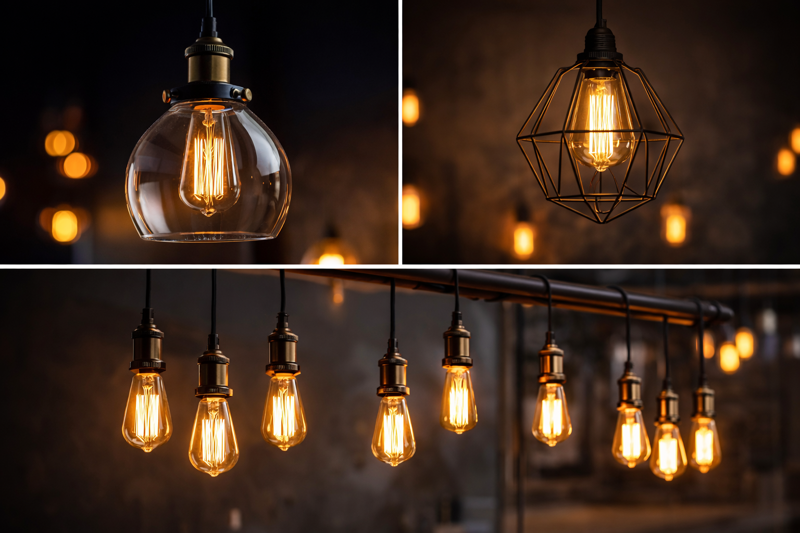
The best fixtures for Edison bulbs are "Exposed Socket" pendants, "Clear Glass" globes/cloches, and "Wire Cage" industrial guards. These designs frame the bulb without obstructing the delicate filament, allowing the bulb itself to serve as the primary decorative element of the room.
I have been manufacturing light bulbs in Dongguan for 30 years.
I have seen thousands of orders go out to designers in the UK and USA.
The saddest thing is when I visit a client's project and see my beautiful, high-tech spiral flexible filaments hidden behind a thick linen shade.
It is a waste of money.
The LED Edison bulb is unique because it is both the light source and the decoration.
Most bulbs are ugly. They are white plastic mushrooms. You want to hide them.
But my bulbs are designed to be naked.
Jacky, my main distributor in America, often asks me which fixtures he should bundle with our bulbs to increase sales.
I tell him: "Sell the frame, not the cover."
If you put a painting in a museum, you don't throw a blanket over it.
You put a frame around it.
Lighting fixtures for Edison bulbs must act as frames.
They must protect the bulb but show it off.
To maximize the impact of your lighting renovation, you need to understand Transparency, Grouping, and Shadow Play.
Why Are Clear Glass Pendants Superior to Frosted Shades?
Many homeowners buy frosted or "milky" glass fixtures thinking they will diffuse the light and reduce glare. However, when you use a vintage bulb, the frost kills the visual texture of the filament, defeating the purpose of paying extra for a vintage design.
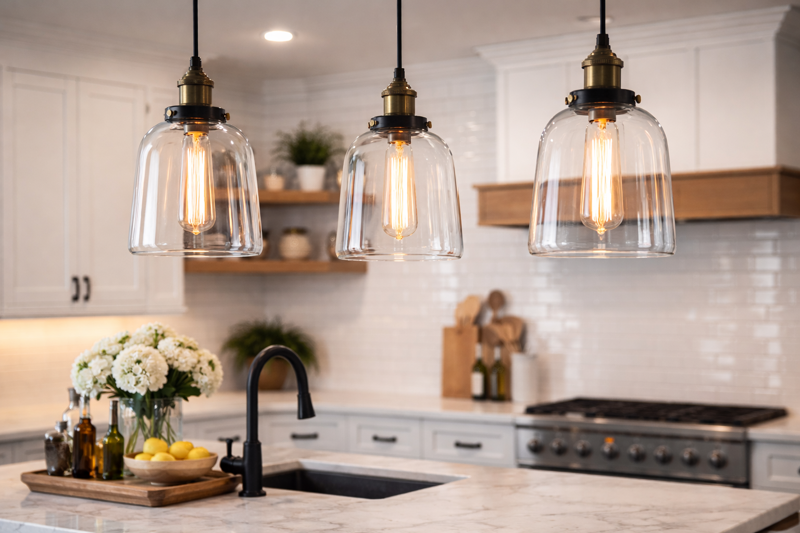
You must use Clear Glass, Seeded Glass, or "Water" Glass shades that offer 100% transparency. These materials allow the intricate design of the internal LED filament to be seen clearly from any angle while still adding a physical "volume" to the fixture that makes it feel substantial.
Let's look at the physics of light transmission.
A frosted glass shade blocks the view of the source.
It creates a glowing white ball.
If you use a cheap $1 plastic LED bulb inside a frosted shade, it looks like a glowing white ball.
If you use an expensive $8 Spiral Filament Edison bulb inside a frosted shade, it looks like... a glowing white ball.
You have just wasted $7.
When Jacky creates a catalog for his B2B buyers, I force him to pair our ST64 Gold bulbs with Clear Glass Cloches.
A "Cloche" or a "Bell Jar" shape is perfect.
It adds size.
A bare bulb hanging on a wire can look a bit "unfinished" or cheap, like a construction site.
But when you put a glass jar around it, it becomes "Furniture."
It becomes designed.
The clear glass catches the reflection of the filament.
You get a double image—the real filament and the reflection in the glass.
It makes the light look sparkling and expensive.
Seeded Glass is another great option.
This is glass with tiny air bubbles trapped inside.
It looks like antique hand-blown glass.
The bubbles catch the light and create a little sparkle, but you can still see the orange glow inside perfectly.
It fits the "Vintage" narrative perfectly.
The "Jar" Effect
There is a psychological effect here.
We associate glass jars with preservation.
We put valuable things in cases.
When you put a bulb inside a clear glass pendant, you are subliminally telling the guest: "This bulb is special. Look at it."
It elevates the perceived value of the entire room.
The only downside of clear glass is dust.
You have to clean them.
Dust on clear glass is very visible.
But for the visual payoff, it is worth the labor.
I always recommend Open Bottom glass shades.
If the glass is a fully enclosed sphere, you have to take the whole fixture apart to change the bulb.
If the bottom is open, you can reach up and unscrew it easily.
Also, heat escapes better from an open bottom, which helps my LED drivers last longer.
| Glass Type | Visibility of Filament | Glare Factor | Best Bulb Pairing |
|---|---|---|---|
| Clear Glass1 | 100% (High) | High | Low Lumen (warm glow) |
| Seeded Glass | 90% (Distorted) | Medium | Spiral Filament |
| Frosted/Milk | 0% (Hidden) | Low | Standard Plastic LED |
| Smoked Glass | 100% (Tinted) | Low | Titanium/Grey Tint |
Glass protects the bulb and adds volume, but sometimes you need to make a bold statement without any glass at all, using raw numbers to your advantage.
How Can "Spider" and Cluster Fixtures Replace Traditional Chandeliers?
A single exposed bulb hanging from the ceiling looks weak and lonely in a large room. To get the grandeur of a chandelier without the crystal fuss, you need to use quantity to create a focal point.
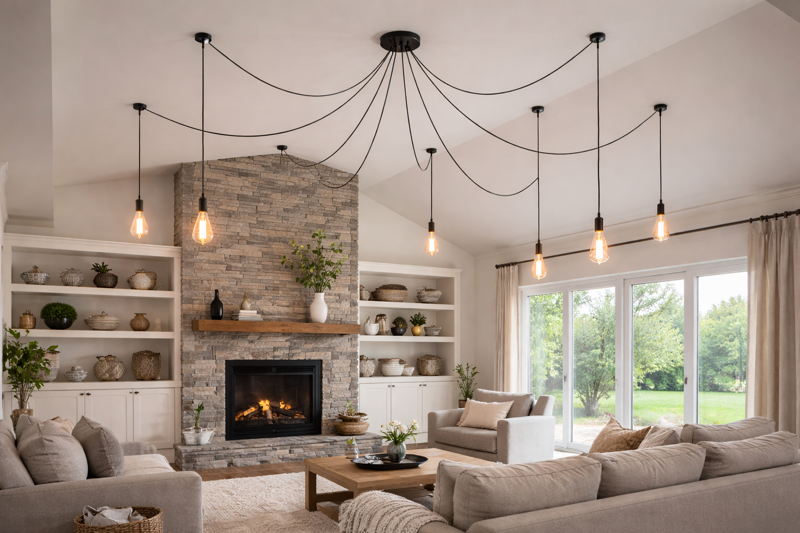
You should utilize "Multi-Port" ceiling canopies or "Spider" fixtures that allow you to hang 5, 8, or even 12 exposed bulbs in a cluster. By staggering the cord lengths at different heights, you create a "Waterfall of Light" that acts as a massive, sculptural centerpiece.
Volume is the secret to luxury.
Rich people do not have one small light. They have big lights.
But big chandeliers are expensive and heavy.
The Cluster Pendant is the modern solution.
It is very popular in restaurants, but I see it in homes now too.
You take a single ceiling plate (canopy).
Out of it comes 6 or 10 cords.
You hang them at random heights.
You put a beautiful G95 (Globe) or ST64 (Teardrop) bulb on each cord.
Suddenly, you have a fixture that is 1 meter wide and 1 meter tall.
It fills the empty space in a high-ceiling room.
Jacky sold 500 of these kits to a hotel chain in Chicago.
They used them in the lobby.
The cost was a fraction of a crystal chandelier.
But the look was "Industrial Chic."
The key here is Cord Management.
Don't just let them hang straight down in a messy bunch.
Use "Swag Hooks" on the ceiling to pull the cords out wide.
This is called the Spider Look.
It spreads the light across the room.
It eliminates shadows in the corners.
Because you have so many bulbs, you must be careful with brightness.
I mentioned this in previous articles, but it applies here strictly.
If you have 10 bulbs, do not use 800 lumens each.
You will blind your guests.
Use my 200 Lumen vintage series.
10 bulbs x 200 lumens = 2000 lumens.
That is perfect for a living room.
Mixing Shapes in a Cluster
This is a pro tip I give to designers.
In a cluster fixture, you don't have to use the same bulb in every socket.
You can mix them.
Use three Round Globes (G80)2 and three Long Tubes (T45)3.
Keep the color temperature the same (always 2200K), but vary the shape.
This makes the fixture look curated and artistic.
It looks like a collection of different glass vessels.
It draws the eye.
People will stare at it trying to figure out the pattern.
It becomes a conversation starter.
Just make sure the "finish" of the glass is consistent (e.g., all Amber or all Clear). Do not mix Amber and Smoke; that looks like a mistake.
| Cluster Size | Ceiling Height | Best Hanging Style | Bulb Recommendation |
|---|---|---|---|
| 3 - 5 Lights | 8 Feet (Standard) | Tight Bouquet (Staggered) | ST64 Teardrop |
| 6 - 9 Lights | 10 Feet | Linear Row (Kitchen Island) | G95 Globe |
| 10+ Lights | 12+ Feet (Vaulted) | Wide Spider (Swag Hooks) | Mix of Shapes |
Glass and clusters are elegant, but for a more rugged, masculine, or historic look, we need to strip away the fragility and use metal.
What Impact Do Wire Cages Have on Shadow and Texture?
If you leave a bulb completely bare, it can feel too modern or too fragile. Putting a metal cage around it immediately changes the context to "Industrial," "Nautical," or "Steampunk," while adding a critical layer of visual texture to your walls.
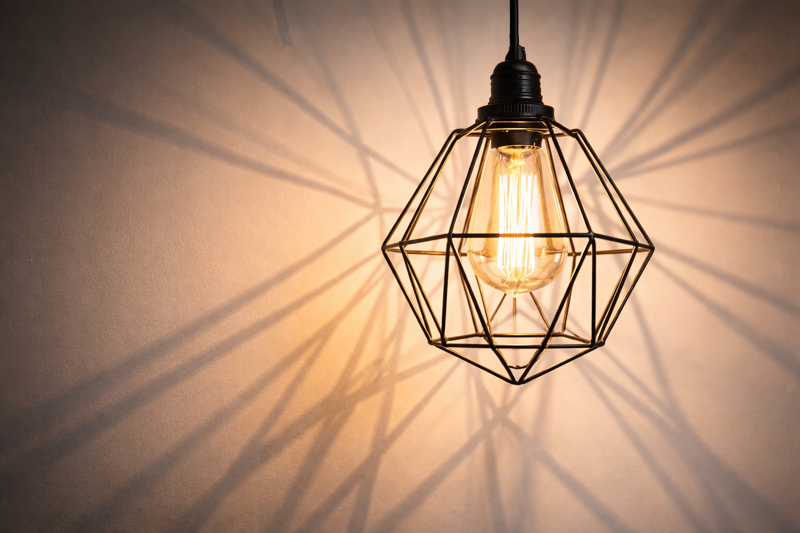
Wire cages, also known as "Bulb Guards," not only protect the glass from breakage but also cast intricate shadow patterns on the surrounding walls and ceiling. These geometric shadows add depth and complexity to the room, turning the light fixture into a pattern projector.
The Wire Cage originated in factories.
Workers would hit the bulbs with ladders, so they put wire baskets over them.
Now, it is purely fashion.
It is the "Blue Jeans" of lighting.
It is rough, durable, and stylish.
I sell thousands of cages to bar owners.
They love them because they are cheap and indestructible.
But the real beauty is the shadow.
When the filament glows, it is a point source of light.
The wires of the cage block that light.
This projects stripes, diamonds, or spider-webs onto your walls.
If you have plain white walls, this is amazing decoration.
It is like wallpaper made of light.
If you have very busy wallpaper, maybe avoid cages, as it will look chaotic.
Open Cages (Geometric):
These are diamond shapes or cubes.
They frame the bulb loosely. They don't touch it.
They are modern and airy.
They look great with G125 Globes. The round bulb inside the sharp diamond cage creates "Contrast of Form." Round vs. Sharp.
Trouble Lights (Tight Cage):
These clamp directly onto the socket. They are tight.
They look like mechanic lights.
They fit A19 or ST64 bulbs best.
Don't try to cram a big globe in there; it won't fit.
This look is very "Grunge" or "Rustic."
Matching Metals
You must coordinate the metal of the cage with the tone of the bulb.
Most cages are Matte Black.
This works with everything.
But we also see Copper and Brass cages.
If you use a Copper cage, use an Amber4 bulb.
The orange light reflects off the copper wire and makes it glow red.
If you use a Chrome cage, use a Clear or Smoke bulb.
The cool silver matches the cool glass.
Do not put a Chrome cage5 on an Amber bulb.
It looks mismatched, like wearing brown shoes with a black tuxedo.
Jacky had a client who did this, and the feedback from customers was that the place looked "confused."
Harmony in materials is essential.
| Cage Style | Visual Shadow | Vibe | Best Room |
|---|---|---|---|
| Diamond / Geometric | Sharp Lines | Modern Industrial | Kitchen Island |
| Mechanic / Clam | Grid Pattern | Rustic / Grunge | Garage / Man Cave |
| Flower / Petal | Soft Curves | Boho / Eclectic | Bedroom |
| None (Bare) | No Shadow | Minimalist | Hallway |
We have covered hanging lights, but what about lights on the wall? This is where people make the most painful mistakes with glare.
How Can Sconces and Vanity Lights Use Exposed Bulbs Safely?
Wall sconces are usually mounted at eye level (about 60-66 inches from the floor). If you stick a bright exposed bulb directly in front of someone's face, it is uncomfortable. You need fixtures that direct the view or modify the bulb choice.
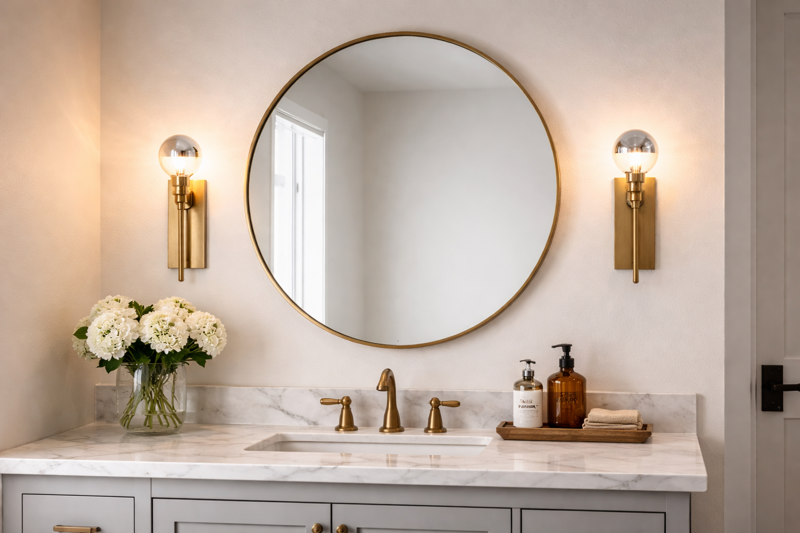
For wall applications, use "Gooseneck" or "Barn Light" sconces that direct the light downwards, or minimalist vertical holders paired with "Half-Chrome" mirror bulbs. This prevents the filament from shining directly into your retina while still illuminating the space effectively.
The bathroom vanity and the hallway sconce are the danger zones.
You are standing right next to them.
If you use a clear glass shade with a bright bulb here, you will see spots in your eyes.
I always advise Jacky to sell Directional Fixtures for walls.
The Barn Light:
This is a metal shade that curves down (Gooseneck).
The bulb is hidden inside the metal shade.
The light goes down onto the floor or the sink.
You see the pool of light, but you don't see the punishment of the glare.
This is great for farmhouses.
But what if you want to see the bulb?
What if you want that "exposed" industrial look next to your mirror?
Then you must use the Half-Chrome Bulb (Mirror Top).
I wrote about this in the Chandelier article, but it is even more critical for Sconces.
You put a simple vertical socket on the wall. No shade.
You screw in a Half-Chrome bulb.
The silver tip blocks the direct line of sight to your eye.
The light bounces back against the wall.
It creates a "Halo" effect around the fixture.
It makes the wall glow, and that glow lights your face.
It is the most flattering light for makeup because it is indirect.
It is soft.
It hides wrinkles.
Direct harsh light creates shadows under your eyes (makes you look tired).
Indirect bounce light fills in those shadows.
Vertical vs. Horizontal Mounting
The orientation of the bulb matters for lifespan too.
Filament bulbs6 prefer to be vertical (Base Up or Base Down).
Some sconces mount the bulb horizontally (sideways).
Inside the bulb, the filament is a long distinct wire.
When horizontal, gravity pulls the hot wire down over years.
It can sag.
If it creates a sag, it might touch the glass or break.
High-quality bulbs (like ours with Sapphire supprt) are fine.
But cheap bulbs will fail faster horizontally.
For the best aesthetic, vertical mounting usually looks more "proud" and elegant.
Horizontal mounting above a mirror often looks like a "Hollywood Dressing Room7," which is a specific look (Globe bulbs).
If you do the Hollywood look, you absolutely need a dimmer switch.
No exceptions.
| Wall Fixture Type | Glare Risk | Solution | Best Bulb |
|---|---|---|---|
| Exposed Vertical | High | Half-Chrome Bulb | A19 Silver Bowl |
| Glass Cylinder | Medium | Low Wattage | T30 Tube |
| Barn Light (Metal) | None | None needed | Standard A19 |
| Hollywood Strip | High | Dimmer Switch | G45 Mini Globe |
Conclusion
The fixture is the stage, and the LED Edison bulb is the actor. To get the best performance, you must stop hiding the actor behind curtains of frosted glass. By choosing clear glass for elegance, multi-port clusters for drama, wire cages for texture, and directed sconces for comfort, you create a lighting system where the bulb and the fixture work together to tell a unified story of vintage craftsmanship.
Discover the advantages of Clear Glass in lighting design, including its aesthetic appeal and visibility of bulbs. ↩
Explore this link to understand the unique features and benefits of Round Globes (G80) light bulbs for your design projects. ↩
Discover the advantages of using Long Tubes (T45) light bulbs in your lighting designs and how they can enhance your space. ↩
Explore how Amber bulbs enhance the beauty of Copper cages, creating a warm and inviting atmosphere. ↩
Learn why pairing a Chrome cage with an Amber bulb can lead to a mismatched and confusing aesthetic. ↩
Explore the advantages of Filament bulbs for better lighting and longevity in your fixtures. ↩
Discover tips and tricks to create the glamorous Hollywood Dressing Room look in your space. ↩