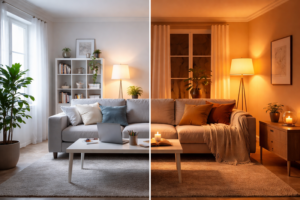
You buy an expensive vintage LED bulb, put it in your old table lamp, and throw a thick linen shade over it. Congratulations, you just wasted your money. You are hiding the very thing you wanted to show off.
To truly showcase an LED Edison bulb on a table, you must strip away the lampshade. The best designs use "Exposed Bulb" bases made of wood, concrete, or marble, "Industrial Pipe" constructions, or clear glass "Jar" lamps. These designs treat the bulb as the sculpture itself, not just the light engine.
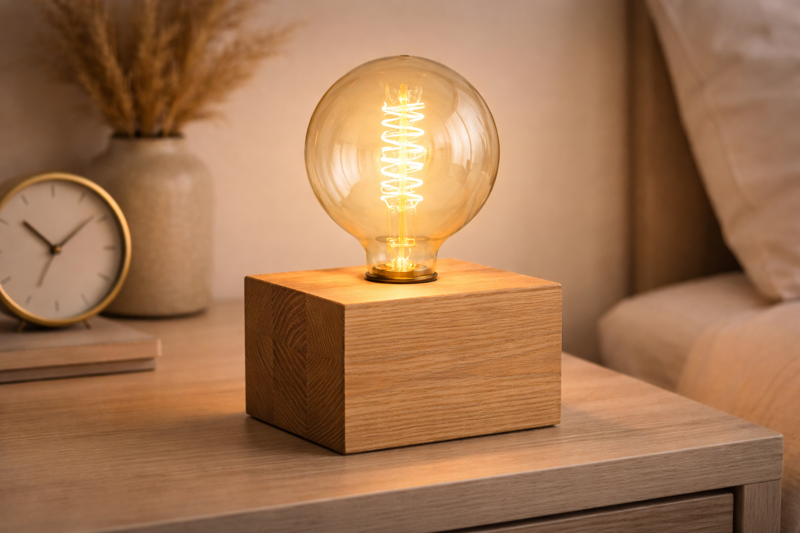
A table lamp is personal.
It sits right next to you.
It is on your desk as you work, or on your nightstand as you sleep.
Because it is close, you see every detail.
In my factory in Dongguan, I see a trend away from big, complicated Tiffany lamps.
People want simple.
They want raw materials.
Jacky, my American distributor, tells me his best-sellers are just... sockets.
Just a heavy base and a socket.
Why?
Because the LED Edison Bulb is so pretty now.
In the old days, incandescent bulbs got too hot. You couldn't have them near your face without a shade.
My LED bulbs stay cool. You can touch them.
This safety allows for totally new designs.
You don't need a shade to protect your hand from burns anymore.
So, the "Lamp" has become just a "Pedestal" for the bulb.
To design a great table lamp setup, you need to think about Material Contrast, Height, and Dimmability.
Why Are "Minimalist Block" Lamps the Perfect Pedestal?
Complex lamp bodies distract the eye. A simple geometric block of high-quality material acts like a museum pedestal, elevating the bulb without competing with it for attention.
Use solid geometric bases made of Cement, Oak, Walnut, or Marble. These materials provide the physical weight needed to keep the lamp stable while offering a natural, textured contrast to the smooth, shiny glass of the bulb.
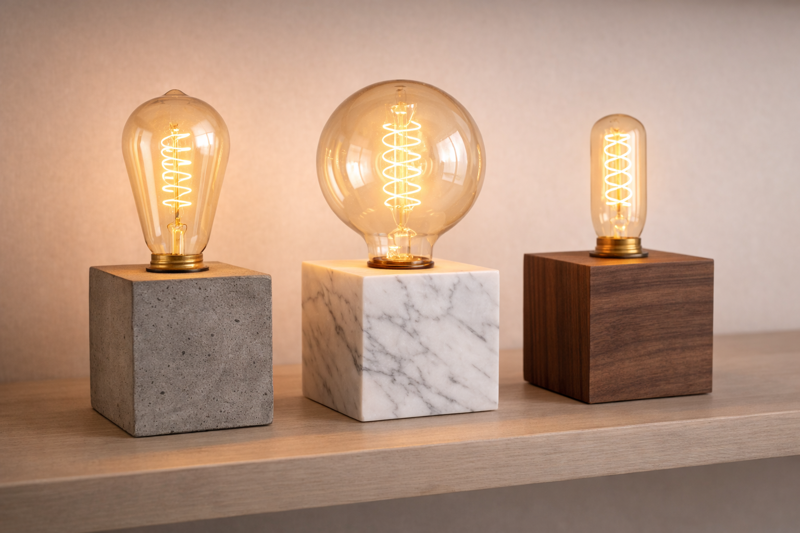
The formula for high-end design is usually: Smooth + Rough.
The glass bulb is smooth, shiny, and perfect.
If you put it on a plastic base, it looks cheap.
If you put it on a Concrete Cube, it looks artistic.
The roughness of the grey cement highlights the delicacy of the golden filament.
It is "Industrial vs. Elegant."
I make thousands of these bases for Jacky's private label.
They are heavy.
Weight is quality.
If a customer pulls the pull-chain and the whole lamp drags across the table, they hate it.
A block of Marble is heavy. It stays put.
Wood Bases are also classic.
Walnut (dark wood) looks amazing with Amber glass. The tones match.
Oak (light wood) looks fresh with Clear glass.
The shape should be simple.
A cube. A cylinder. A hexagon.
Let the bulb be the complex shape.
If the base is a carved statue of a horse, and the bulb is a spiral filament, the eye doesn't know where to look.
Keep the base quiet so the bulb can sing.
The Cord Exit
Note the detail of the cord.
On a simple block lamp, the cord is visible.
It usually comes out the side.
Make sure the cord is nice. Fabric vivid cord1 (woven) is mandatory here.
Plastic wire coming out of a marble block looks terrible.
Also, look for bases with an Integrated Dimmer Knob2.
Since there is no shade, the light is direct.
You need to be able to turn it down.
A little brass knob on the front of the wooden block is tactile and useful.
It lets you go from "Reading Light" to "Romantic Candlelight" in one second.
| Base Material | Visual Texture | Best Bulb Shape | Vibe |
|---|---|---|---|
| Concrete | Rough / Pitted | ST64 Teardrop | Industrial Loft |
| White Marble | Smooth / Veined | G95 Globe (Clear) | Luxury Hotel |
| Walnut Wood | Organic / Grain | T45 Tube (Amber) | Study / Office |
| Cork | Soft / Warm | G80 Globe (Gold) | Eco / Boho |
Simple blocks are elegant, but sometimes you want something that tells a story of hard work and history. That is where the pipes come in.
How Can "Steampunk" Pipe Lamps Add Character to a Desk?
Standard desk lamps can feel sterile and office-like. Building a lamp out of iron plumbing pipes creates a rugged, mechanical look that pairs perfectly with the vintage aesthetic of Edison filaments.
"Steampunk" or Industrial Pipe lamps utilize black iron or galvanized steel plumbing parts to create robotic or structural shapes. The dark, oily metal provides a heavy, masculine frame that makes the delicate warm light of the bulb feel cozy and protected.
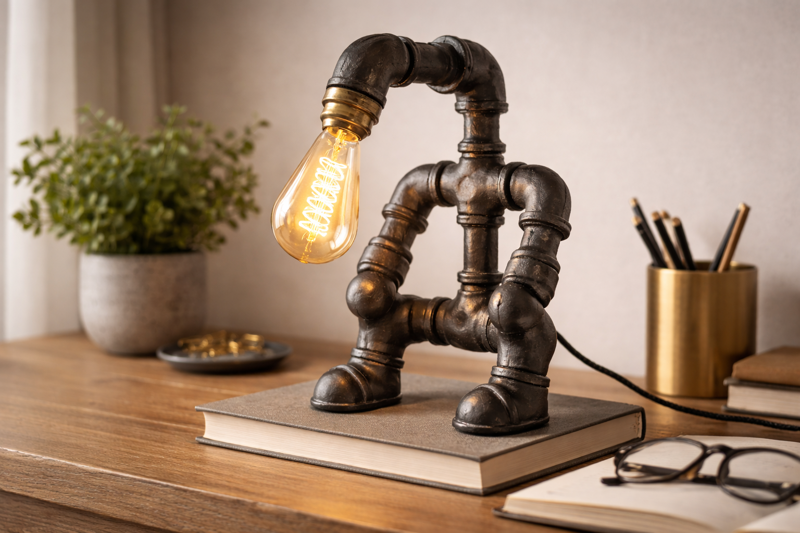
This is for the person who hates delicate things.
Pipe lamps are indistructible.
They are made of real gas pipes.
You can buy them, or you can make them yourself (DIY).
Jacky sells kits for this.
The joy of the pipe lamp is the Silhouette.
You can make a lamp that looks like a robot.
You can make one that looks like a snake.
You can use elbows and T-joints to twist the light exactly where you want it.
Because the metal is dark (usually black or dark grey), it frames the light.
It is the ultimate "Frame" I talked about before.
The "Cage" Addition:
Pipe lamps often look best with a Wire Cage over the bulb.
It fits the theme.
Pipes + Cages = Factory.
It protects the bulb if you knock it over (which is hard to do because iron is heavy).
The Valve Switch:
The coolest feature of a high-end pipe lamp is the switch.
Don't use a normal button.
Use a Red Gate Valve (like a water faucet handle) as the switch.
You turn the faucet, and the light turns on.
It is a "fidget toy" for adults.
Every time I visit a client's office who has one, I catch them playing with the valve.
It creates an emotional connection to the object.
Bulb Choice for Pipes
Pipe lamps are usually short and squat.
Do not use huge G125 globes. They look top-heavy.
Use standard A193 or ST64 bulbs.
The classical shape works best.
Also, Tubular T30 bulbs look like glass pipes.
They continue the "piping" theme.
A T304 bulb screwing out of an iron pipe looks like the pipe turned into glass. It is a very cool optical continuity.
| Pipe Finish | Style Name | Bulb Recommendation | Best Switch Type |
|---|---|---|---|
| Black Iron | Industrial | ST64 (Classic) | Red Valve Handle |
| Galvanized (Silver) | Rustic | A19 (Clear) | Toggle Switch |
| Copper | Steampunk | T45 (Tubular) | Rotary Knob |
| Brass | Nautical | G80 (Gold) | Pull Chain |
Blocks and pipes are open, but what if you want to enclose the bulb? What if you want to capture the light in a bottle?
Why Are "Glass Jar" Lamps the Ultimate Showcase?
Sometimes you want the protection of a shade but the transparency of an exposed bulb. A glass vessel lamp achieves both, acting like a display case for your light source.
Glass Jar lamps, or "Cloche" table lamps, place the bulb inside a transparent glass container. This creates a "ship in a bottle" effect, adding reflections and volume to the light while keeping the dust off the bulb itself.
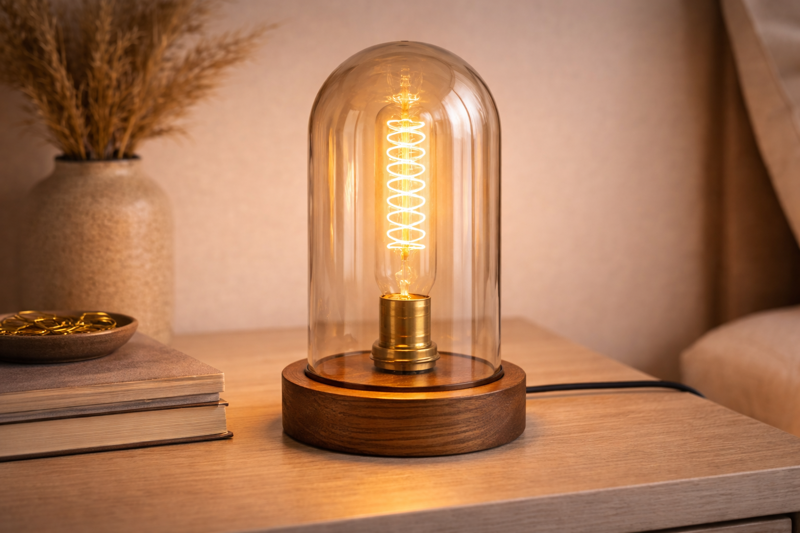
I mentioned cloches for pendants, but they are even better on tables.
On a table, you are looking down at the lamp.
A glass jar protects the bulb from your coffee spill.
It protects curious children from touching the socket.
It feels like a science experiment.
The "Museum" Vibe:
When you put something under glass, you say it is precious.
An $8 bulb looks like an $80 artifact inside a nice glass dome.
Reflection Magic:
The curve of the jar glass acts like a lens.
It distorts and multiplies the filament image.
As you walk past the table, the filament seems to move and dance on the glass surface.
It adds movement to a static object.
The Base connection:
Unlike the other lamps, the socket for a jar lamp is usually on the bottom, facing up.
This means the bulb stands up.
This is the best orientation for filament longevity (no sagging).
However, heat can build up inside a closed jar.
Since my LEDs produce very little heat, this is fine.
If you used an old 40W incandescent in a closed jar, the glass would get too hot to touch.
LED makes this design safe.
Creative Filling? No.
Some people like to fill the bottom of the jar with seashells or corks.
I say: Don't do it.
It looks messy.
It creates a fire hazard if the junk touches the socket.
It blocks the light.
Keep the jar empty.
Let the void space be the luxury.
Negative space5 is classy. Clutter is not.
| Glass Shape | Visual Effect | Best Bulb | cleaning Level |
|---|---|---|---|
| Bell Jar (Dome) | Elegant / Classic | T30 Long Tube | High (Fingerprints) |
| Square Cube | Modern / Sharp | G95 Globe | Medium |
| Cylinder | Scientific / Lab | T185 (Very Long) | Medium |
| Mason Jar | Rustic / DIY | A15 (Small Fan) | Low |
We have covered the base, the body, and the glass. But the final element is how you control the light. A table lamp6 needs flexibility.
How Does Dimmability Transform a Table Lamp into a Mood Setter?
A table lamp is rarely used for just one task. It might be a reading light at 8 PM and a nightlight at 11 PM. If your fixture is strictly "On/Off," you are limiting its usefulness.
You must choose table lamps with built-in dimmers or use "Step-Dimming" bulbs. Because the bulb is exposed without a shade to diffuse the glare, the ability to lower the brightness is not just a feature—it is a necessity for eye comfort.
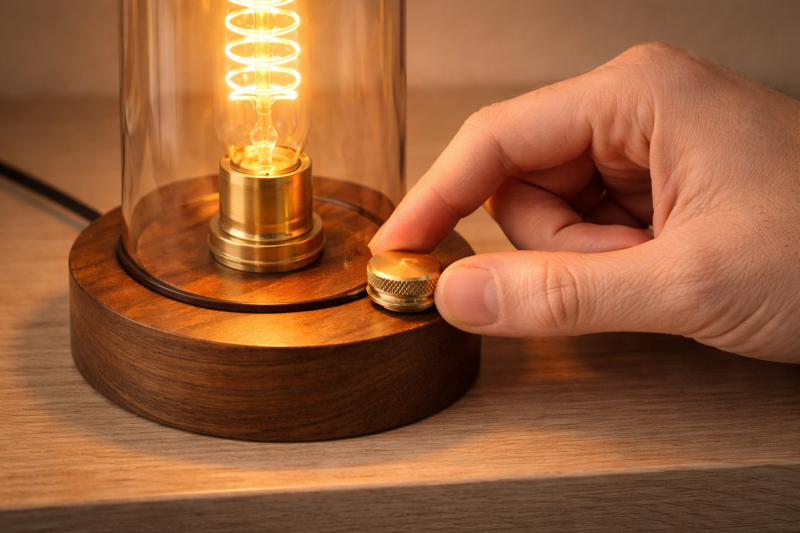
The unshaded bulb is bright.
Even a 4W bulb can be annoying if it is right next to your TV screen.
Glare is the enemy.
In-Line Dimmers:
If your lamp is just a block of wood with a switch, buy an "In-Line Dimmer" cord.
You plug the lamp into the dimmer, and the dimmer into the wall.
This gives you a slider to control brightness.
Jacky bundles these with every lamp he sells. He knows it reduces returns.
3-Step Bulbs:
If you cannot change the lamp hardware, use my 3-Step Dimming Bulb.
You don't need a dimmer switch.
You just flip your normal switch:
- Turn ON -> 100% Brightness (Reading)
- Turn OFF, Turn ON again -> 50% Brightness (Relaxing)
- Turn OFF, Turn ON again -> 10% Brightness (Nightlight)
This technology is built inside the chip in the bulb base.
It is the cheapest way to upgrade a table lamp.
The Tech Limitation:
Be careful. Not all vintage bulbs are dimmable.
The driver inside the base needs to be specific.
If you try to dim a non-dimmable bulb, it will flicker and buzz.
It will drive you crazy.
Always check the box.
If you want that super-low, "candle flame" look where you can see the individual wire glowing, you need a high-quality dimmer (TRIAC) and a high-quality dimmable bulb.
Cheap ones will just cut out at 20%. Good ones go down to 1%.
Conclusion
The table lamp is the most intimate lighting fixture in your home. By removing the shade and placing your LED Edison bulb on a Minimalist Block, mounting it on an Industrial Pipe frame, or encasing it in a Glass Cloche, you turn a utility object into a centerpiece. However, always prioritize dimmability to ensure the naked bulb remains a source of comfort, not glare.
Exploring the benefits of Fabric vivid cord can help you choose aesthetically pleasing and durable lighting options. ↩
Understanding how an Integrated Dimmer Knob functions can enhance your lighting experience, allowing for better ambiance control. ↩
Explore the advantages of A19 bulbs for pipe lamps, including their shape and light quality. ↩
Discover how T30 bulbs contribute to the aesthetic of pipe lamps, creating a unique visual effect. ↩
Understanding negative space can elevate your design skills, making your work more sophisticated and visually appealing. ↩
Explore the best table lamps that offer flexibility, enhancing your space with both style and functionality. ↩