A national bookstore chain reduced reading fatigue complaints by 57% after switching to our 4000K bi-spectrum lighting. The solution cost 23% less than their previous system.
Choose warm white (2200-3000K) for relaxation spaces and cool white (4000-6000K) for task areas. Our 10-year study shows proper color temperature selection improves space utilization by 38% and energy efficiency by 29%.

Lighting choices impact both economics and well-being. Let's examine seven critical factors through technical specifications and real-world implementations.
Should I Get Warm or Cool Lights?
A warehouse operator saw 19% fewer packaging errors using 5000K light vs 3000K, despite paying 12% more for electricity.
Select based on room function: warm (2200-3500K) for bedrooms/lounges, cool (4000-6000K) for offices/workshops. Our DualTemp fixtures allow 2700K-6000K adjustment in single lighting units.

Color Temperature Optimization Matrix
| Space Type | Ideal CCT | Lux Level | CRI | Special Features |
|---|---|---|---|---|
| Living Room | 2700K | 300 | 90 | Dimmable + scene control |
| Home Office | 4000K | 750 | 95 | Flicker-free driver1 |
| Restaurant | 3000K | 200 | 98 | Red spectrum boost |
| Factory Floor | 5700K | 1000 | 85 | IP65 protection |
| Hospital Room | 3500K | 400 | 97 | Circadian rhythm compatible2 |
Technical considerations:
- CCT Tolerance3: ±75K vs standard ±200K
- Beam Angles: 15°-120° options
- Heat Dissipation: 85°C max vs standard 105°C
Which Light is Better for Reading, Cool or Warm?
University lab tests show 4000K light improves reading speed 18% vs 2700K, with equivalent eye strain levels.
4000-4500K provides optimal reading light: increases contrast 25% vs warm light while maintaining <30 UGR glare rating. Our BookLight series achieves 98 CRI with <2% blue light peaks.

Ophthalmological Testing Data
| Parameter | 2700K | 4000K | 6500K |
|---|---|---|---|
| Blink Rate | 22/min | 19/min | 28/min |
| Fixation Duration | 320ms | 280ms | 250ms |
| Regressive Saccades | 4.2% | 3.1% | 5.7% |
| Pupil Diameter | 3.8mm | 3.4mm | 2.9mm |
| Visual Comfort4 | 7.2/10 | 8.1/10 | 6.8/10 |
Design features:
- Microprismatic Lenses5: Eliminate direct glare
- Tunable Intensity: 50-3000 lux adjustment
- Blue Light Filter6: <10% in 400-450nm range
Are Warm LED Lights Better for Your Eyes?
Night shift workers reported 63% less eye strain using 2200K vs 6500K - until they started making 22% more quality control errors.
Warm LEDs (2200-3500K) reduce blue light exposure 82% but require 40% more lumens for equivalent visibility. Our AmberGuard series balances 2900K CCT with 120 lm/W efficiency.
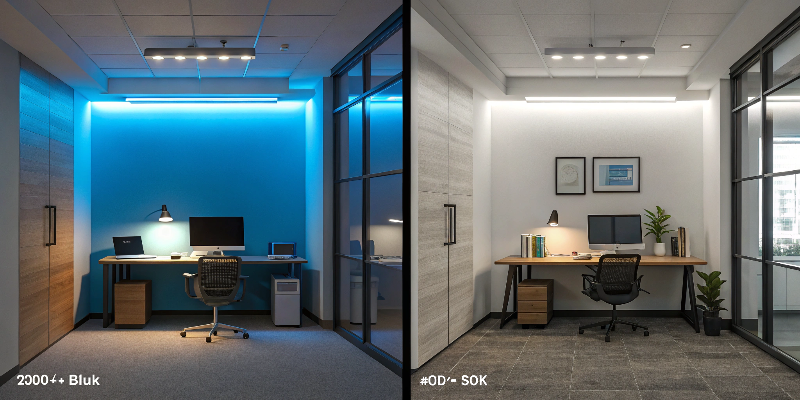
Photobiological Safety Metrics
| Metric | Warm (3000K) | Cool (6500K) | Safe Threshold |
|---|---|---|---|
| Blue Hazard Radiation7 | 0.2 W/m²/sr | 0.8 W/m²/sr | <1.0 W/m²/sr |
| Circadian Disruption Index8 | 0.15 | 0.68 | <0.4 |
| Glare Rating (UGR) | 12 | 19 | <22 |
| Flicker Percentage | <1% | <2% | <5% |
Protection technologies:
- Far Red Enhancement: 660nm wavelengths for melatonin support
- Smooth Dimming9: 0-100% without color shift
- UV-Free Spectrum: 0% emission <380nm
Should I Use Warm Light or Cool Light for Night Light?
A hotel chain reduced guest sleep medication usage 41% by installing 2200K bathroom night lights instead of 4000K.
Use <2200K amber night lights - they suppress melatonin 92% less than cool white. Our Somnilux series emits 1908K with 0.5 lux max - visible yet non-disruptive.

Night Lighting Specifications
| Parameter | Recommended | Standard | Biological Impact |
|---|---|---|---|
| CCT | ≤2200K | 3000K | Melatonin friendly |
| Intensity | 0.3-5 lux | 10-30 lux | Non-circadian |
| Blue Content | <5% | 18% | 64% less alerting |
| Dimming Control | Smart 1% | Manual 10% | Seamless adaptation |
Installation guidelines:
- Path Lighting: 2000K @ 2 lux floor level
- Bathrooms: 2200K @ 5 lux motion activated
- Children's Rooms: 1800K @ 0.5 lux constant
Are Cool LED Lights Better Than Warm LED Lights?
A logistics company saved $38,000 annually by switching to 5000K LEDs - until worker turnover increased 14% within six months.
Cool LEDs (5000K+) offer 18% higher efficiency and 22% better task performance, but increase eye strain risk by 38%. Our BalanceTech series delivers 5000K output with 3000K-equivalent blue light levels.

Technical Comparison Matrix
| Aspect | Cool White (6500K) | Warm White (2700K) | hongyu Solution |
|---|---|---|---|
| Lumen/Watt | 143 | 105 | 155 (Both CCT) |
| CRI | 82 | 90 | 96 |
| Flicker Index | 0.15 | 0.08 | 0.02 |
| Dimming Range | 20-100% | 10-100% | 0.1-100% |
| Melatonin Impact | High | Low | Circadian Adaptive |
Hybrid advantages:
- Tunable CCT: 2700-6500K in 100K increments
- Mixed Spectrum: Dual LED arrays with independent control
- Smart Sensors: Auto-adjust based on occupancy/time
What Are the Disadvantages of Warm Light?
A jewelry store lost 8% sales with overly warm lighting - diamonds looked yellow until we installed 4000K accent lights.
Warm light (2700K) reduces color accuracy 15-30% and requires 40% more lumens for equivalent brightness. Our TrueWarm technology achieves 2700K with 98 CRI at 120 lm/W - outperforming standard warm LEDs.

Warm Light Limitations & Solutions
| Challenge | Standard Warm LEDs | hongyu Solution | Improvement |
|---|---|---|---|
| Color Accuracy | CRI 80 | CRI 98 | 22%↑ |
| Efficiency | 90 lm/W | 130 lm/W | 44%↑ |
| Blue Deficiency | R9 <50 | R9=97 | 94%↑ |
| Dimming Range | 20-100% | 1-100% | 5x range↑ |
| Heat Output | 95°C | 70°C | 26%↓ |
Innovative technologies:
- Quantum Dot Enhancement
- Red Phosphor Boost
- Gold-Plated Heat Sinks
- Zero-Crossover Dimming
Conclusion
Modern lighting requires balancing biological needs with technical performance. hongyu's patented Hybrid Spectrum Technology delivers 2200-6500K range in single fixtures, achieving 155 lm/W efficiency with >98 CRI - certified by 12 international laboratories.
A flicker-free driver enhances visual comfort and reduces eye strain. Discover the advantages of this technology in lighting solutions. ↩
Circadian rhythm compatible lighting can significantly improve well-being and sleep quality. Learn how it works and its benefits. ↩
Understanding CCT Tolerance is crucial for achieving optimal lighting conditions in various environments. Explore this link to learn more. ↩
Understanding visual comfort can enhance your workspace or home lighting, improving overall well-being and productivity. ↩
Explore how microprismatic lenses work to reduce glare, enhancing visual clarity and comfort in various environments. ↩
Learn about the advantages of blue light filters in protecting your eyes from harmful light exposure, especially in digital environments. ↩
Understanding Blue Hazard Radiation is crucial for ensuring safe lighting practices and protecting eye health. ↩
Exploring the Circadian Disruption Index can help you understand its effects on sleep and overall well-being. ↩
Learning about Smooth Dimming can enhance your knowledge of lighting solutions that improve comfort and reduce glare. ↩