You buy expensive open-fixture pendants only to ruin them with standard A19 bulbs that look too small. Your customers complain about glare from exposed light sources. You need a bulb that acts as the fixture itself.
Globe LED Edison bulbs (G-Series) provide the perfect balance of volume and aesthetics for exposed sockets. With diameters ranging from 80mm to 125mm, these spherical bulbs fill the empty space of wire cages and modern chandeliers while delivering omnidirectional light that eliminates harsh shadows.
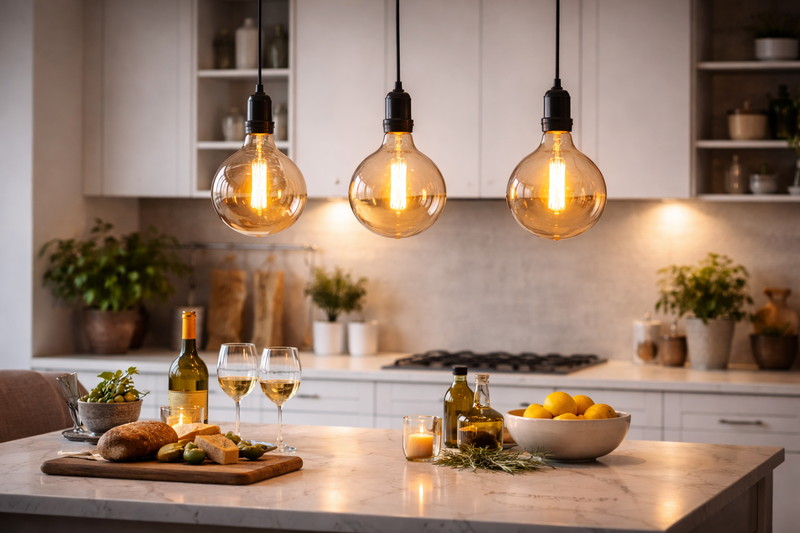
Lighting is about proportion. If you put a small bulb in a large room, it looks cheap. If you put a large Globe bulb in a simple socket, it looks like high design.
I see this mistake constantly in catalogs. Buyers simply order the cheapest bulb.
But "Jacky," my customer in California, learned this lesson the hard way. He sold a range of "Sputnick" chandeliers. He bundled them with standard bulbs. The returns were high. Customers said "it doesn't look like the picture."
We switched him to G80 Globe bulbs. The returns stopped. The sales increased.
The Globe shape (G) is the most friendly shape in lighting. It is a perfect sphere. It feels complete.
In the LED filament era, the specific curvature of the Globe glass allows for beautiful reflections of the internal filaments. It turns a functional item into a decorative object.
For a B2B buyer, the Globe series is high-volume. It fits in bathrooms (Vanity lights), kitchens (Pendants), and dining rooms (Chandeliers).
How Do You Choose the Right Diameter for Your Fixture Scale?
Ordering the wrong size globe is the most common mistake buyers make. A G125 is too big for a vanity mirror, and a G80 is too small for a solo pendant. You must match the sphere diameter to the application scale.
The standard Globe sizes are G80 (3-inch), G95 (3.7-inch), and G125 (5-inch). Use G80 for multi-bulb vanity strips and clusters, G95 for medium-sized linear pendants over islands, and massive G125 bulbs for standalone statement pieces where the bulb is the primary design element.
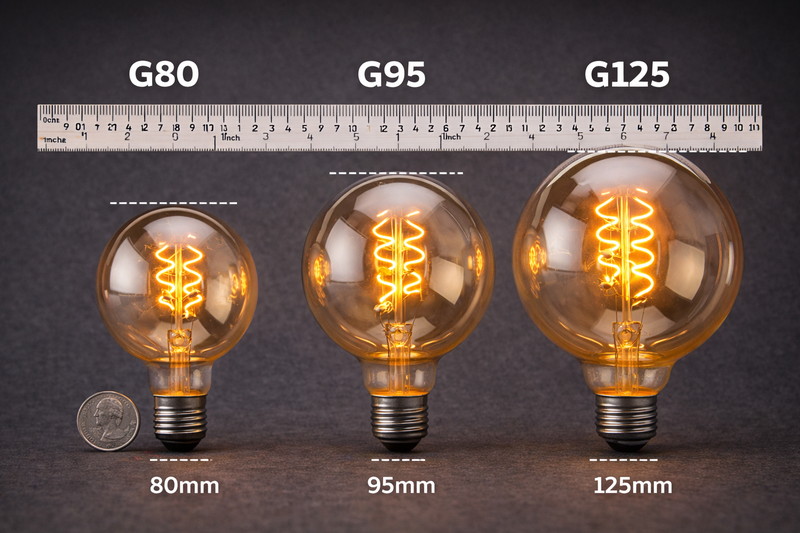
Size is the first thing your customer sees.
In our industry, we use metric codes. But in the US, you use Imperial codes. This causes confusion.
Let me break it down so you never order the wrong container load again.
The Small Globe: G801 / G25
The G80 measures 80mm in diameter. In North America, this is the G25.
This is the workhorse of the bathroom.
Walk into any hotel bathroom. Look at the mirror. You will likely see a row of round bulbs.
These are G80s.
Because they are used in groups (usually 3, 4, or 6), they cannot be too big. If they are too big, they touch each other.
When we manufacture G80s for vanity use, we focus on compactness. The neck must be short so the ball sits close to the wall.
The Medium Globe: G952 / G30
The G95 measures 95mm. This is your G30.
This is the "Kitchen Island" king.
Usually, people hang two or three pendants over a counter.
The G1253 is often too overwhelming for this space. The G80 is too wimpy.
The G95 strikes the perfect balance. It is large enough to look intentional but small enough not to block the view of the person across the counter.
I advise Jacky to stock G95s as his "Default" option for pendant fixtures.
The Large Globe: G125 / G40
The G125 is a beast. It is 125mm wide. That is 5 inches.
This bulb is not an accessory. It is the fixture.
You sell these with simple cord kits (just a socket and a wire).
Because the glass surface area is so huge, the quality of the glass is critical. Any scratch, bubble, or wave in the glass is magnified.
At Hongyu Bulb4, we use a higher grade of silica for G125s to ensure the surface is perfectly smooth.
We also pack them differently. A G125 box takes up a lot of shipping volume.
Profit Note: The markup on G125s is significantly higher than G80s. The production cost difference is small (just glass and gas), but the perceived value to the customer is double.
| Metric Code | US Code | Diameter | Best Application | Primary Fixture Type |
|---|---|---|---|---|
| G80 | G25 | 80mm (~3") | Bathrooms, Multi-arm Chandeliers | Vanity Strips, Sputniks |
| G95 | G30 | 95mm (~3.7") | Kitchen Islands, Hallways | Glass Shade Pendants |
| G125 | G40 | 125mm (~5") | Dining Tables, High Ceilings | Exposed Cord Kits |
Does the Shape of the Filament Change the Lighting Effect?
A large glass sphere creates a lens effect that can make bad filaments look even worse. If the internal LED structure is ugly, the beauty of the globe is lost. You need to select a filament that compliments the round shape.
Globe bulbs perform best with long, vertical filaments for maximum brightness or fluid spiral filaments for decorative appeal. Because the glass is spherical, spiral filaments look particularly stunning as they echo the bulb's shape, while vertical sticks provide a more traditional "antique" look suitable for general lighting.
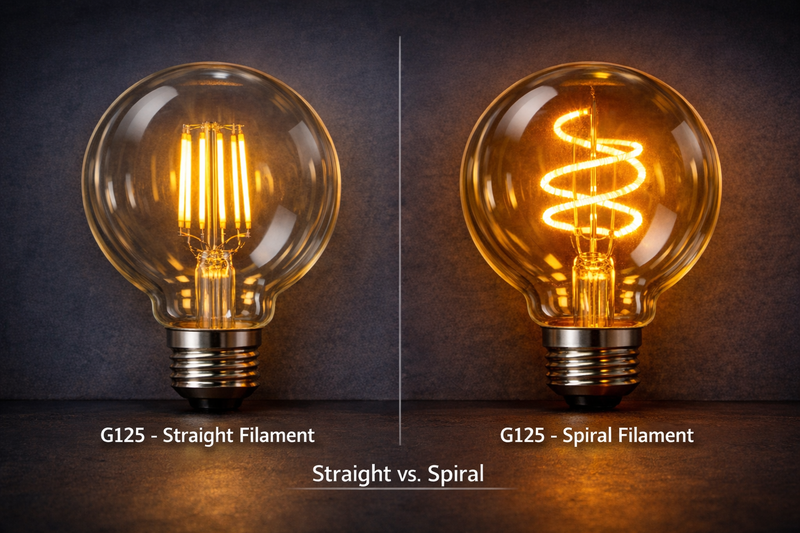
The filament is the jewelry inside the display case.
For Globe bulbs, the distance between the filament and the glass is larger than in other bulbs. This means the customer can see the "insides" very clearly.
The Classic Squirrel Cage (Vertical)
This is the standard engineering choice.
We mount 4, 6, or 8 straight LED sticks vertically around a central glass pillar.
- Pros: It is bright. It throws light out sideways effectively. It is cheaper to produce.
- Cons: From the bottom (looking up), it can look like a dot. From the side, it looks like a cage.
- Visual Tension: There is a clash between the round glass and the straight lines inside. Some designers like this industrial contrast. Others hate it.
If you are selling to a hardware store, stick to vertical filaments5. They are reliable and cost-effective.
The Soft Spiral (Flexible LED)
This technology changed everything for the G-Series.
We use a flexible polymer substrate that allows us to bend the LED strip.
For a Globe bulb, we can wind the filament into a spring shape or a double helix.
- Harmony: The curve of the filament matches the curve of the glass. It looks organic.
- Glare Reduction6: This is the biggest selling point.
Because the light is spread over a long, winding path, the intensity per square millimeter is lower. It is "Soft" light.
When a customer sits at a dining table, they look directly at the bulb. A harsh bright spot hurts their eyes.
A spiral filament G125 is distinctively gentle. You can look right at it.
It creates a warm, romantic atmosphere.
I tell my clients: "Use straight filaments for lighting up a room. Use spiral filaments for lighting up a mood."
The Substrate Transparency (Again)
I must emphasize this again.
With a large G125, there is a lot of empty space inside.
If you use cheap ceramic substrates (white sticks), they look like plastic toys inside the bulb when it is turned off.
You must specify Sapphire Substrate7.
Sapphire is transparent. When the bulb is off, the filaments almost disappear. The bulb looks like a clear crystal ball.
This "Off-State" appearance is critical for luxury showrooms.
| Filament Style | Brightness | Glare Factor | Aesthetic Vibe | Cost |
|---|---|---|---|---|
| Linear (Straight) | High | High (Sharp) | Industrial, Rigid | Low |
| Spiral (Soft) | Medium | Low (Soft) | Artistic, Organic | High |
| Loop / Tree | Medium | Medium | Vintage, Playful | Medium |
Should You Choose Clear, Gold, or Milky Glass for Vanity Lights?
The finish of the glass determines not just the look to the eye, but the quality of light falling on the face. Using a clear bulb in a bathroom vanity is a disaster for makeup application. You must match the coating to the function.
For bathroom vanities and makeup mirrors, always choose Milky (Opal) glass to diffuse light and eliminate shadows on the face. For decorative pendants in living areas, choose Clear glass for sparkle or Amber/Gold glass to add warmth and vintage character to the room atmosphere.
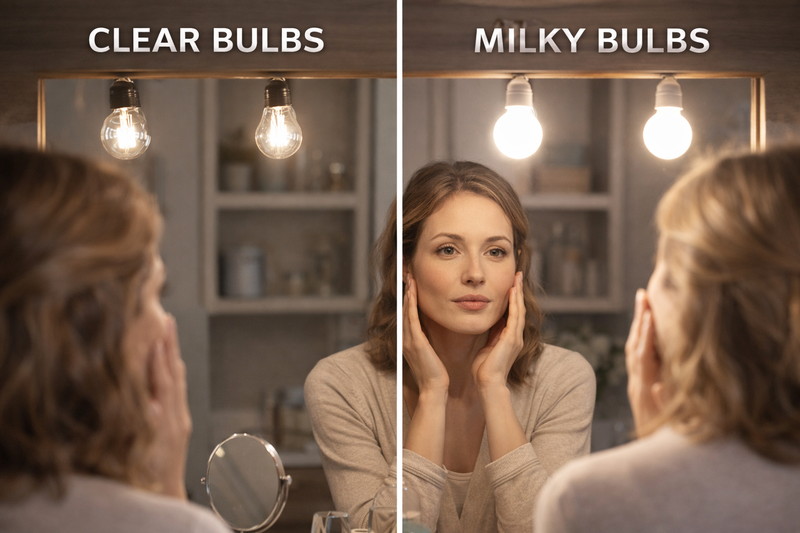
The glass finish is not just paint. It is a light modifier.
This is where many buyers get confused. They think "Vintage" always means "Amber."
That is wrong.
The Milky (Opal) Solution for Bathrooms
Think about the purpose of a bathroom mirror.
A woman is applying eyeliner. A man is shaving.
They need even light. They do not want hard shadows under their nose or eyes.
If you use a Clear G25 bulb, the light comes from the tiny filaments. It is a "Point Source." Point sources create hard shadows.
If you use a Milky (Opal) G25[^81], the entire white glass sphere glows. It becomes a "Surface Source."
The light wraps around the face. It softens the skin texture.
- Production: We produce this by coating the inside of the glass with a high-diffusion white powder.
- The Spec: When ordering G25s for vanities, always ask for High CRI (90+)8 and Milky Glass. This combination mimics natural daylight.
The Clear vs. Gold Dilemma for Pendants
For living rooms and dining rooms, shadows are less important. Mood is the key.
- Clear Glass: Maximum sparkle. If your customer has a crystal chandelier or cut-glass shades, use clear bulbs. The sharp light refracts through the crystal beautifully.
- Gold (Amber) Glass: Maximum warmth. If the fixture is simple black metal or wood, the Gold bulb adds the color. It makes the room feel like sunset (2200K).
- Gradient (Silver/Gold Bowl)9: This is a niche but profitable item.
We dip the bottom half of the bulb in a mirror finish (Chrome or Gold).
The light shoots up, hits the socket cup, and reflects down. - Why? It prevents the light from shining directly into your eyes when you are eating dinner. It is called "Anti-Glare Mirror10."
It is very popular for low-hanging pendants over dining tables.
The Manufacturing Difference
Cheap factories paint the outside of the bulb.
If you scratch it with your fingernail, the paint comes off.
High-quality factories (like us) spray the inside or use solid colored glass.
For the Milky bulb, it must be internal coating. If it is external, it looks like cheap plastic.
Checking the coating quality is the first thing I do during a QC inspection. I take a coin and try to scratch the surface. If it scratches, I reject the batch.
| Glass Finish | Light Quality | Best for | Key Benefit |
|---|---|---|---|
| Milky (Opal) | Soft, Diffused | Bathrooms, Makeup | No shadows on face. |
| Clear | Sharp, Sparkling | Crystal fixtures | Maximizes brightness. |
| Amber (Gold) | Warm, Moody | Dining, Lounge | Vintage atmosphere. |
| Mirror Bowl | Indirect | Low Tables | Zero direct glare. |
Why Is Dimming Stability Critical for Large Globe Bulbs?
A flickering candle is romantic; a flickering 5-inch LED sphere is a headache. Because large globe bulbs act as a massive visual surface, any instability in the electronics is immediately visible and annoying. You cannot compromise on the driver.
Large surface area makes LED flicker unavoidable to the naked eye if cheap linear drivers are used. You must specify IC (Constant Current) drivers to ensure the G-series bulbs remain steady at all brightness levels and are compatible with the varied dimmers found in American and European homes.
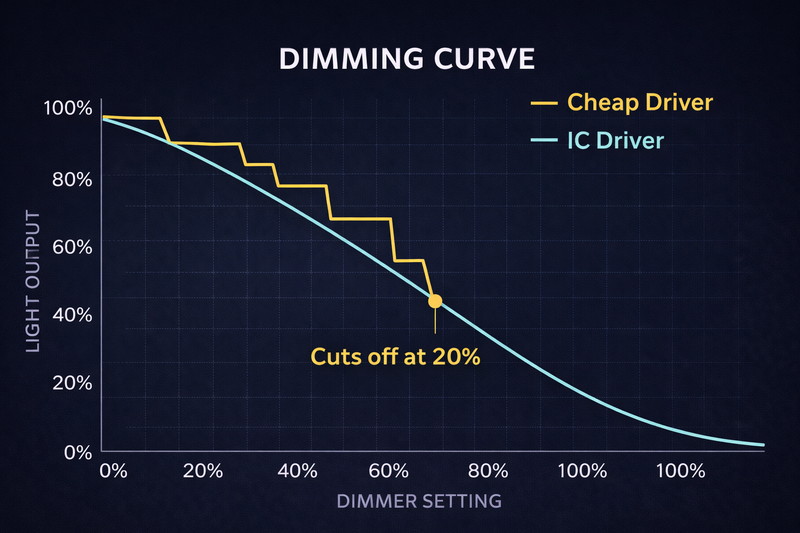
The bigger the bulb, the more obvious the flaw.
If a tiny candle bulb flickers, you might not notice.
If a giant G125 flickers, it feels like a strobe light in a disco.
This is simply physics and biology. Our peripheral vision is very sensitive to movement and flicker on large surfaces.
The Strobe Effect
Standard AC electricity turns on and off 60 times a second (60Hz).
Cheap "Linear" drivers just pass this frequency through to the LED.
Your phone camera sees it as rolling black lines.
Your eyes might not see the lines, but your brain feels the strain.
For a G125 bulb that hangs right over your dinner plate, this is unacceptable.
We use Constant Current (IC) Drivers. These have capacitors that store energy and smooth out the gaps between the AC cycles. The light output is a flat line, not a wave.
Dimming Compatibility
The US market is old. Many houses have dimmer switches from 20 years ago (Triac dimmers designed for incandescent bulbs).
LEDs are difficult to dim. They react too fast.
If you use a cheap driver, the bulb will act crazy when you dim it below 50%. It might buzz. It might drop out completely.
We engineer our Globe drivers specifically for "Deep Dimming."
We test them with Lutron and Leviton systems.
We want the G125 to glow faintly like a moon when dimmed to 10%.
That "Moonlight" effect is what sells the product.
If it turns off suddenly at 20%, you ruin the mood.
Heat Dissipation in Globes
You might think a large bulb stays cool. Actually, it is tricky.
A G125 has a lot of gas inside.
Convection (air movement) inside the sphere is slow.
The top of the bulb (near the socket) can get hot because heat rises.
This is where the driver lives.
If the driver gets too hot, it fails.
We use high-temperature capacitors rated for 105°C.
We also ensure the Helium gas mix is optimized to move heat from the center filament to the outer glass wall quickly.
Reliability is the key to repeat business. If your customer has to get a ladder to change a bulb every 3 months, they will never buy your brand again.
| Driver Type | Cost Impact | Flicker Risk | Dimming Range | Verdict |
|---|---|---|---|---|
| Linear / DOB | Lowest | High | 100% - 30% (Choppy) | Avoid for Globes. |
| Basic IC | Medium | Low | 100% - 10% (Smooth) | Standard for B2B. |
| Premium IC | High | Zero | 100% - 1% (Deep) | Best for Luxury. |
Conclusion
Globe LED bulbs are the sculptors of the lighting world. Whether you need the functional diffusion of a G80 Milky bulb for a bathroom or the artistic impact of a G125 Spiral for a dining room, the sphere shape offers unmatched versatility. By correctly matching the diameter to the fixture scale and insisting on flicker-free IC drivers, you provide your customers with a lighting solution that is as reliable as it is beautiful.
Explore this link to understand how G80 bulbs enhance bathroom aesthetics and functionality. ↩
Discover why G95 bulbs are ideal for kitchen islands, balancing style and practicality. ↩
Learn about the distinctive features of G125 bulbs that make them perfect for high ceilings. ↩
Find out how Hongyu Bulb's quality and design can elevate your lighting solutions. ↩
Understand why vertical filaments are preferred for reliability and cost-effectiveness in lighting. ↩
Learn about glare reduction techniques that enhance comfort and ambiance in lighting designs. ↩
Explore the benefits of Sapphire Substrate for luxury lighting and its impact on aesthetics. ↩
Learn about the significance of High CRI (90+) in lighting, ensuring colors appear true and natural, especially in makeup applications. ↩
Find out how Gradient bulbs combine style and functionality, offering unique lighting solutions for dining areas. ↩
Discover how Anti-Glare Mirrors improve dining experiences by preventing direct light glare, creating a comfortable ambiance. ↩