You spend thousands on patio furniture and landscaping, but at night, your backyard looks like a black hole. You hang cheap Christmas fairy lights, and they burn out in a month. You need a lighting solution that is durable, bright, and stylish.
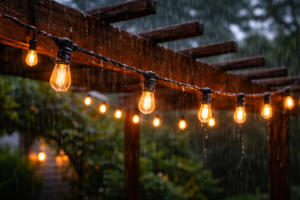
Heavy-duty "Bistros Style" string lights with shatterproof LED Edison bulbs are the ultimate outdoor upgrade. Unlike cheap fairy lights, these feature thick rubberized cords, replaceable screw-in bulbs (usually S14 or G40 shapes), and IP65 waterproofing that withstands rain, sun, and snow for years.
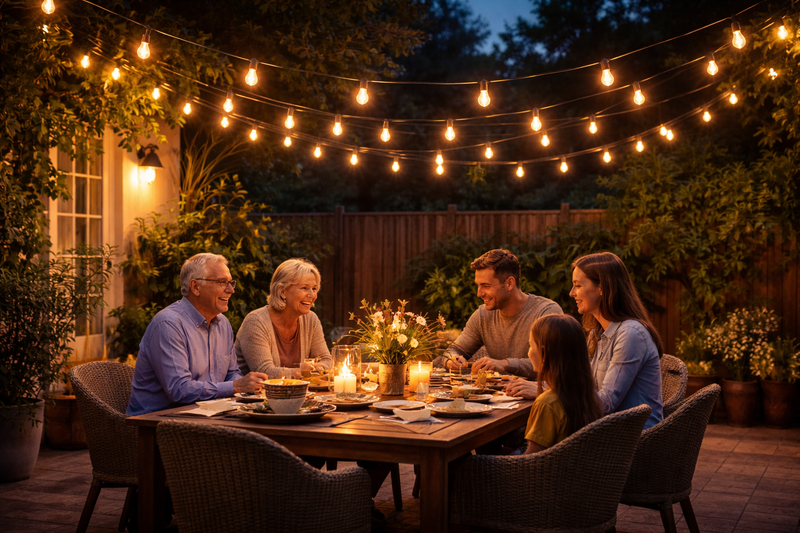
Outdoor lighting used to be complicated.
You needed an electrician. You needed to dig trenches for wires.
Now, you just need a plug and a string set.
I manufacture thousands of kilometers of these lights every year in Dongguan.
Every coffee shop, wedding venue, and smart homeowner wants the "Bistro Look."
It is romantic. It feels like Italy or France.
But there is a big difference in quality.
You might see string lights at the dollar store. Do not buy them.
They use thin wires. The bulbs are glass (they break). The bulbs are fused (you can't change them).
When one bulb dies, the whole string dies.
My Commercial Grade sets are different.
We use thick black rubber wire (SJTW). It is heavy.
We use Shatterproof Plastic Bulbs. You can drop them on concrete, and they bounce.
We use standard E26 or E17 Sockets. If a bulb dies, you unscrew it and put in a new one.
This is a permanent fixture, not a holiday decoration.
To get this look right, you need to understand the Bulb Shape, the Power Source, and the Installation Pattern.
Which Bulb Shape Is Right for You: S14 or G40?
Choosing the right bulb shape changes the entire vibe of your patio. It is not just about light; it is about the silhouette against the sky.
The two main contenders are the S14 (Sign Shape) and the G40 (Globe Shape). The S14 is larger, brighter, and fits standard E26 sockets, making it perfect for main lighting. The G40 is smaller, rounder, often fits E12 or E17 sockets, and creates a more delicate, "fairy-tale" aesthetic.
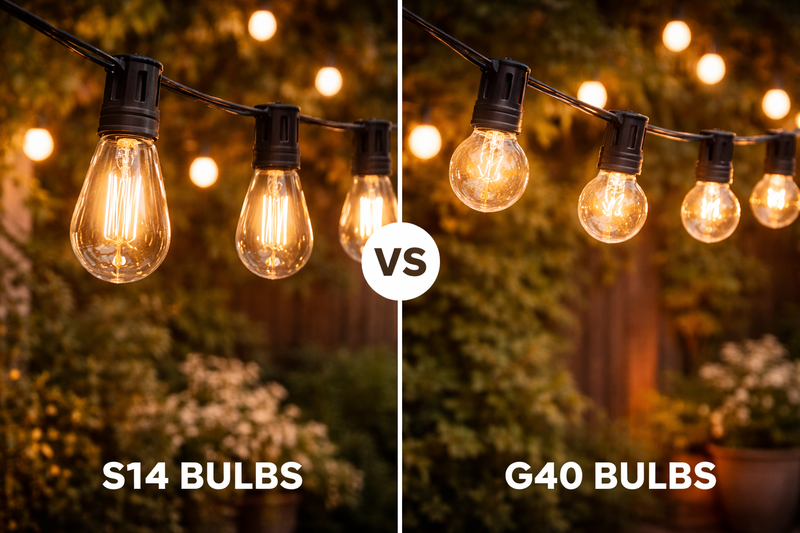
Let's break down the two kings of string lighting.
The S14 Bulb:
This is the big boy.
It looks like a teardrop or a small pear.
It usually has an E26 base (the same size as a normal table lamp).
Because the base is big, the contact is better. It is more waterproof.
The S14 filament is long. It gives off a lot of light (usually 1W or 2W per bulb).
If you want to actually eat dinner and see your food, use S14.
It is robust. It looks industrial.
The G40 Bulb:
This is the cute one.
It is a perfect sphere, about the size of a ping-pong ball (40mm).
It usually has a smaller E12 (candelabra) base.
Because the socket is smaller, it is lighter. The wire is thinner.
This is better for small balconies or camping tents.
The light is softer. It is purely decorative.
If you use G40s for a big party, you might need a secondary light source because they are dim.
The "Filament" Look:
In the past, these bulbs were incandescent. They got hot and used 11 Watts each!
A 50-foot string would use 500 Watts. That is expensive.
My LED versions use 1 Watt each.
But we make the LED chip look exactly like the old tungsten wire.
So you get the vintage look, but your electricity bill is zero.
Plastic1 vs Glass
For string lights, always choose Plastic.
I love glass for indoor lamps. But outdoors? The wind blows.
The strings swing and hit the pole.
If it is glass, it breaks. You get glass shards in your grass.
My plastic S14 bulbs are clear as crystal. You cannot tell the difference until you touch them.
They don't yellow in the sun because we use UV-resistant PET material2.
| Bulb Type | Base Size | Brightness | Visual Style | Best For |
|---|---|---|---|---|
| S14 | E26 (Medium) | High (100-200lm) | Vintage / Retro | Large Patios, Restaurants |
| G40 | E12 (Small) | Low (30-50lm) | Cute / Delicate | Small Balconies, Umbrellas |
| ST38 | E12/E17 | Medium | Modern | Gazebos |
| A15 | E26 | Very High | Bold | Commercial Events |
Now that you picked the bulb, you have to figure out how to power them. Not everyone has an outlet nearby.
Solar vs. Plug-In: Which Power Source Wins?
There is a constant battle between convenience (Solar) and reliability (Plug-In). Your choice depends entirely on your climate and how reliable you need the light to be.
Plug-in string lights offer consistent, bright light indefinitely but require an outlet. Solar string lights are wireless and free to run, but they are generally dimmer, rely on battery health, and will fail to light up after a cloudy day.
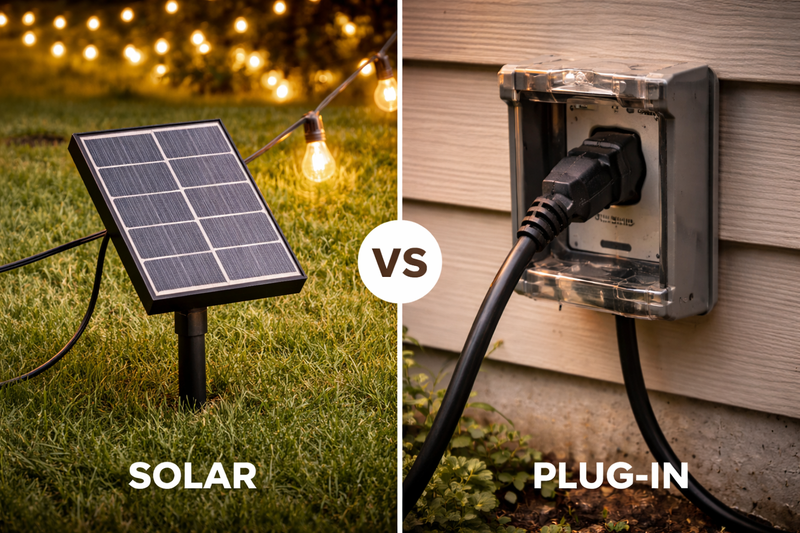
I get this question from Jacky every day: "Wallson, why don't we sell more solar?"
I am honest. Solar is a gamble.
The Case for Plug-In (High Voltage 120V):
This is for the serious user.
You plug it in. It turns on. It is bright.
You can connect 10, 20, even 50 sets together end-to-end.
You can put them on a dimmer switch.
You can use a smart plug to control them with your phone.
The downside? You need an extension cord.
The Case for Solar (Low Voltage 3V):
This is for the "set it and forget it" user.
It charges during the day. It turns on at dusk.
It is very easy to install. No extension cords.
The downside?
Even the best solar panel needs sun.
If it rains for 3 days, you have no light on your patio.
Also, solar bulbs are usually 3V DC. They are much dimmer than 120V bulbs.
You cannot replace the bulbs easily because they are special low-voltage models.
The Hybrid Solution:
We are now developing USB-rechargeable solar panels.
So if it is cloudy, you can take the panel inside, charge it like a phone, and put it back out.
But for a permanent house installation? Always choose Plug-In.
Reliability is key.
Voltage Drop
If you use Plug-In lights, be careful of length.
If you connect 500 feet of lights, the ones at the end might be dimmer.
This is "Voltage Drop3."
My factory uses 18AWG copper wire for short runs (under 50ft) and thicker 16AWG or 14AWG for long commercial runs.
If you have a huge backyard, buy the "Commercial Grade4" sets with the thick wire.
They handle the distance better.
| Feature | Plug-In (120V) | Solar (3V) | Battery (AA) |
|---|---|---|---|
| Brightness | High | Low to Medium | Low |
| Reliability | 100% | Weather Dependent | Battery Dependent |
| Installation | Needs Outlet | Anywhere | Anywhere |
| Connectable? | Yes (many sets) | No (usually single) | No |
| Bulb Base | Standard Screw | Integrated / Special | Integrated |
You have the power. You have the bulbs. Now, how do you hang them so they don't look messy?
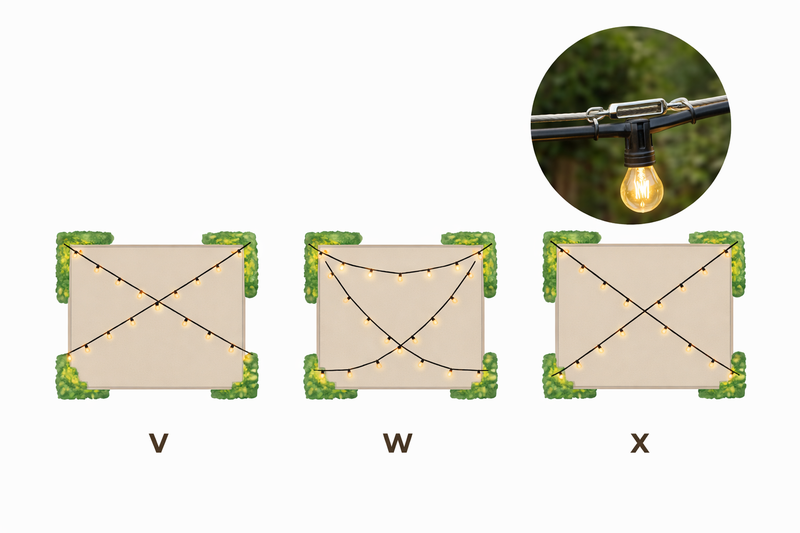
What Are the Best Patterns for Hanging String Lights?
Hanging lights randomly looks like a mistake. You need a geometric plan. The pattern you choose directs the eye and defines the "ceiling" of your outdoor room.
Popular hanging patterns include the "V-Pattern" (simple and effective), the "W-Pattern" or Zig-Zag (covers more area), and the "X-Pattern" (creates a focal point). Using a steel guy wire kit is highly recommended to prevent the string from sagging or snapping under its own weight.
The biggest mistake people make: pulling the wire too tight.
Copper wire stretches.
If you pull it tight like a guitar string, it will snap in the winter (cold makes it shrink).
You need "Swag."
Swag is the gentle curve of the droop.
It looks relaxed. It looks professional.
The Guide Wire Trick:
For spans over 20 feet, do not trust the electrical wire to hold the weight.
Buy a Steel Design Kit (aircraft cable).
- Run the steel cable from point A to point B.
- Pull the steel cable tight.
- Zip-tie your light string to the steel cable.
This way, the steel takes the tension. The electrical wire just hangs there loosely.
This prevents the sockets from tearing.
The Patterns:- The V: Good for small decks. One hook on the house, two hooks on trees.
- The Zig-Zag (W): Best for long dining tables. It covers the whole area evenly.
- The Perimeter: You just trace the edge of the fence. This is boring. Avoid it. Cross the middle to create a "roof."
Height Matters:
Keep the lowest point of the bulb at least 8 feet high.
You don't want tall Uncle Bob hitting his head on a hot bulb (even if it's LED, it's annoying).
If you don't have trees, use Poles.
You can buy simple metal poles that stick into the grass or screw into the deck railing.
They give you the height you need.
Tension and Wind
Wind loves string lights.
It grabs them and swings them.
If you don't use a guide wire, the wind will constantly flex the copper inside the cord.
Eventually, the wire breaks inside the insulation.
The light stops working, but you can't see the cut.
This is the reason for returns.
Support your lights!
Conclusion
String light sets with LED Edison bulbs are the fastest way to add value to your home. By choosing durable S14 plastic bulbs for brightness, opting for plug-in power for reliability, and hanging them in a structured Zig-Zag pattern with steel support cables, you create a permanent "Outdoor Room" that is safe, weatherproof, and beautiful.
Explore the advantages of plastic for outdoor lighting, including durability and safety, to make informed choices for your setup. ↩
Learn about UV-resistant PET material and how it enhances the longevity and performance of outdoor lighting solutions. ↩
Understanding Voltage Drop is crucial for ensuring your lighting setup is efficient and effective, especially over long distances. ↩
Exploring Commercial Grade options can help you choose durable lighting solutions that perform better in large spaces. ↩