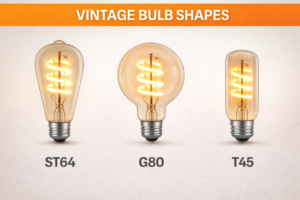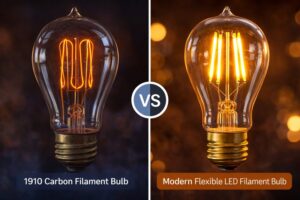
You have just upgraded your home with the latest WiFi-enabled smart dimmers. You spent hours wiring them in. You eagerly screw in your beautiful, vintage-style filament bulbs, expecting a warm, nostalgic glow controlled by your smartphone. Instead, you get a strobe light effect that looks like a disco, a buzzing sound that drives you crazy, or a bulb that refuses to turn off completely.
The incompatibility between LED Edison bulbs and smart switches is a complex interplay of three factors: the dimming curve protocol (Leading Edge vs. Trailing Edge), the minimum load requirement of the switch, and the internal driver architecture of the bulb. Solving this requires matching the specific "electronic language" of your switch with a high-quality IC driver bulb that can handle leakage current.
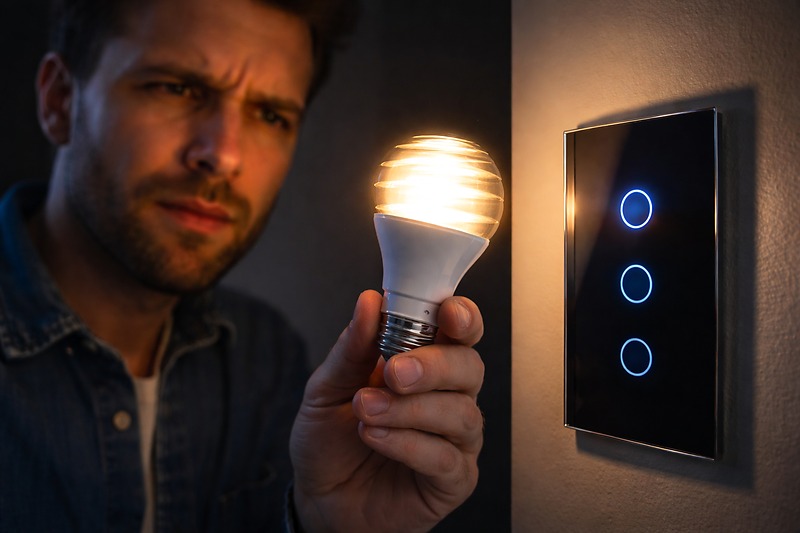
I have a recurring customer named Jacky, a product manager for a lighting distributor in California.
He is a tech guy. He loves Lutron Caséta, Leviton, and Tuya systems.
Last winter, he called me, sounding exhausted.
“Wallson,” he said, “I have 200 returns. My customers are saying your bulbs are broken. They flicker. They buzz. They glow when the switch is off. What is wrong with your production line?”
I told him calmly, “Jacky, send me the model number of the switch they are using.”
It turned out, his customers were using old-style rotary dimmers or cheap "No-Neutral" smart switches with high-efficiency LEDs.
It was not a production failure. It was a mismatch of technology.
You see, an old incandescent bulb is a simple resistor. It is a "dumb" wire.
An LED Edison bulb is a complex electronic device. It has a circuit board inside.
A smart switch is also a computer.
When you put a computer (switch) in charge of another computer (bulb), sometimes they don't speak the same language.
In the 30 years I have been manufacturing lights, the shift to "Smart Home" has been the biggest challenge.
To navigate this, you must understand the physics of how the switch cuts the power, and how the bulb handles that cut.
Leading Edge (TRIAC) vs. Trailing Edge (ELV): Why Does the Dimming Method Matter?
The most common reason for buzzing and flickering is the method the dimmer uses to reduce the voltage. Not all choppy electricity looks the same to an LED bulb.
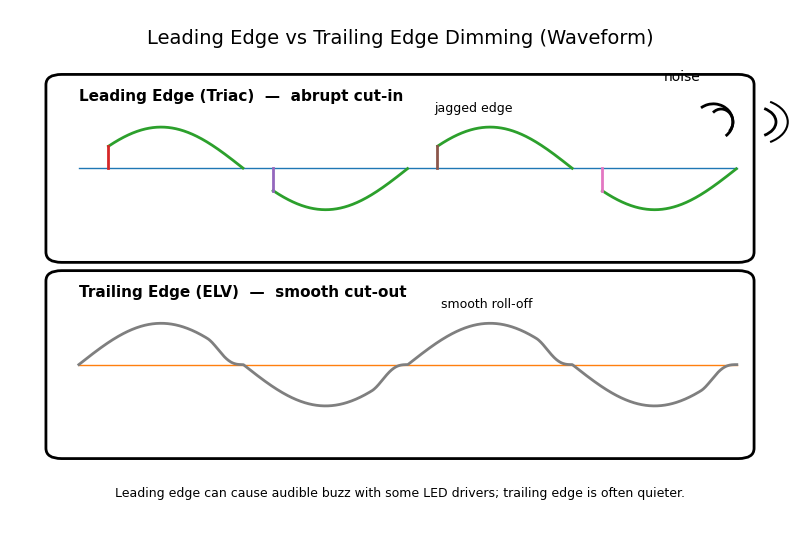
"Leading Edge" (TRIAC) dimmers, designed for old tungsten bulbs, cut the power violently at the beginning of the AC cycle, creating a current spike that shocks sensitive LED electronics. "Trailing Edge" (ELV) dimmers cut the power gently at the end of the cycle, providing a smoother transition that allows LED Edison bulbs to dim seamlessly without noise.
Imagine you are driving a car.
To slow down, you have two choices.
- You can slam on the brakes instantly every few seconds. (Leading Edge).
- You can slowly ease off the gas pedal. (Trailing Edge).
Old-school dimmers (TRIAC) are the car slammers.
They wait for the AC electricity wave to start, and then—BAM—they open the gate.
This sudden rush of voltage creates a "Inrush Current."
The Physical Buzz:
Inside my LED Edison bulb, there are components: a capacitor and a transformer coil.
When that "Leading Edge" spike hits them 120 times a second, they physically vibrate.
The copper wire inside the coil shakes.
This is the "ZZZZZ" sound you hear.
It is not dangerous, but it is annoying.
The Flickering Mess:
Because the spike is so violent, the LED driver (the brain of the bulb) sometimes gets confused.
It loses synchronization with the power wave.
It turns off for a millisecond, then turns back on.
To your eye, this looks like flickering or strobing.
Why "Universal" Dimmers Are a Myth
Many switches on Amazon claim to be "Universal" or "LED Compatible."
In my factory testing lab, I have found this is rarely 100% true.
A "Universal" dimmer usually tries to guess which method to use.
Sometimes it guesses wrong.
Some advanced switches (like high-end Lutron models) have a physical tab or a software setting where you can force it into "ELV" (Trailing Edge1) mode.
If you have flickering, check your switch manual.
Changing from Forward Phase to Reverse Phase often solves the problem instantly.
The Impact on Bulb Lifespan
Using a Leading Edge dimmer on a standard LED bulb doesn't just look bad; it kills the bulb.
That repetitive "hammering" of current spikes generates heat inside the driver components.
Heat is the enemy of LEDs.
An LED bulb rated for 25,000 hours might die in 5,000 hours if driven by a cheap, old-style dimmer.
I always tell Jacky: "Do not blame the bulb for dying young if the switch was beating it to death."
| Dimming Type | Technical Name | Waveform Cut | LED Compatibility2 | Audible Noise |
|---|---|---|---|---|
| Leading Edge | TRIAC / Forward Phase | Start of Cycle | Poor | High (Buzzing) |
| Trailing Edge | ELV / Reverse Phase | End of Cycle | Excellent | Silent |
| Universal | Adaptive Phase | Auto-Detect | Mixed | Medium |
Once you have the right dimming method, you still have to deal with the power wiring itself. This brings us to the "Neutral Wire" debate.
The "No-Neutral" Problem: Why Do My Lights Glow When Switched Off?
This is the spookiest problem in smart lighting. You turn the lights off via Alexa, go to bed, and notice the bulbs are faintly glowing like ghosts.
Smart switches without a neutral wire must constantly trickle a small amount of electricity through the light bulb to power their own WiFi or Zigbee chips. Highly efficient LED Edison bulbs can unintentionally light up from this tiny leakage current, causing "Ghosting" or periodic flashing when the system is supposed to be off.
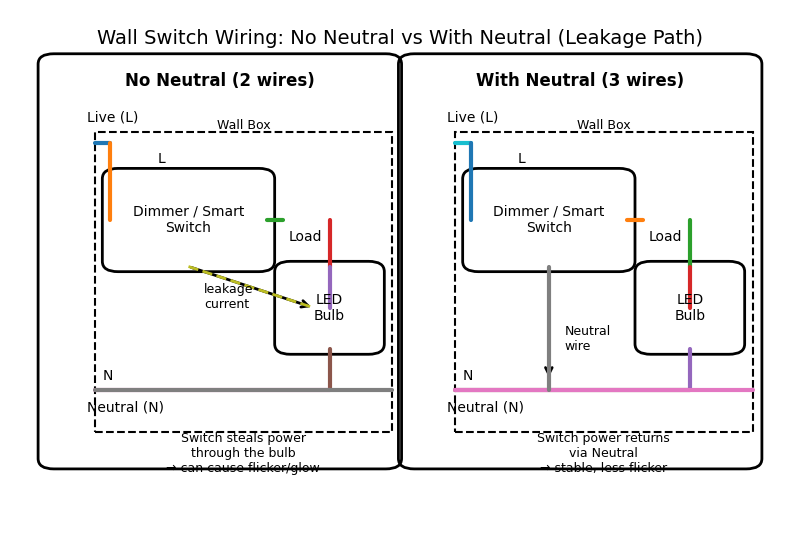
To understand this, you need to understand how a smart switch thinks.
A regular switch is a mechanical disconnect. It cuts the wire.
A smart switch is a device that needs to listen 24/7 for a signal.
It needs power to listen.
The "With Neutral" Scenario:
In a modern house (built after the 1980s usually), the switch box has three bundles of wires: Line (Hot), Load (to the bulb), and Neutral (White).
The smart switch uses the Line and Neutral to power itself. It is a complete circuit.
It controls the Load wire separately.
This is perfect. There is zero leakage to the bulb.
The "No-Neutral" Scenario:
In older houses, switch boxes only have two wires.
The smart switch manufacturers want to sell to these people too.
So they design a switch that "steals" power.
It lets a tiny trickle of electricity flow through the bulb, even when "OFF," to complete the circuit back to the panel.
Old incandescent bulbs were inefficient. They ignored this trickle.
My LED Edison filaments are super-efficient.
They see that trickle and say, "Yay! Power!"
They try to light up.
They might glow dimly (Ghosting).
Or, the internal capacitor charges up, flashes once, drains, and repeats (The "Lighthouse" effect).
The Role of the "Bleeder Resistor3"
To fight this, we have to modify the bulb.
In my high-end filament series, we install a component called a Bleeder Resistor on the driver board.
It acts like a dummy load.
It sits there and says, "Give me that leakage current."
It absorbs the trickle and turns it into a tiny, unnoticeable amount of heat.
It prevents the current from reaching the LED chips.
However, there is a limit.
If you have 10 smart switches leaking power on the same circuit, the bleeder might get overwhelmed.
The Safety Capacitor Solution (LUT-MLC)
If you already bought a No-Neutral switch and your bulbs are ghosting, you don't have to rip open your walls.
You can install a Bypass Capacitor4 (often called a LUT-MLC or Dummy Load).
You wire this small box parallel to the light fixture in the ceiling.
It provides an alternative path for the leakage current.
It steers the electricity around the bulb.
I often send these free of charge to Jacky for his difficult projects. It is a $2 part that saves a $5000 project.
How Does "Minimum Load" Cause Drop-Outs and Instability?
We spent years making LEDs efficient, lowering their wattage from 60W to 4W. Ironically, this efficiency is now a problem for older smart dimmer designs that expect a heavy electrical load to function.
Many smart dimmers have a "Minimum Load" requirement (e.g., 20 Watts) to keep their internal TRIAC or MOSFET stable. If you only connect a single 4-Watt LED Edison bulb, the dimmer may become unstable, causing the light to cut out unexpectedly (Drop-Out) or surge to full brightness because it thinks the circuit is broken.
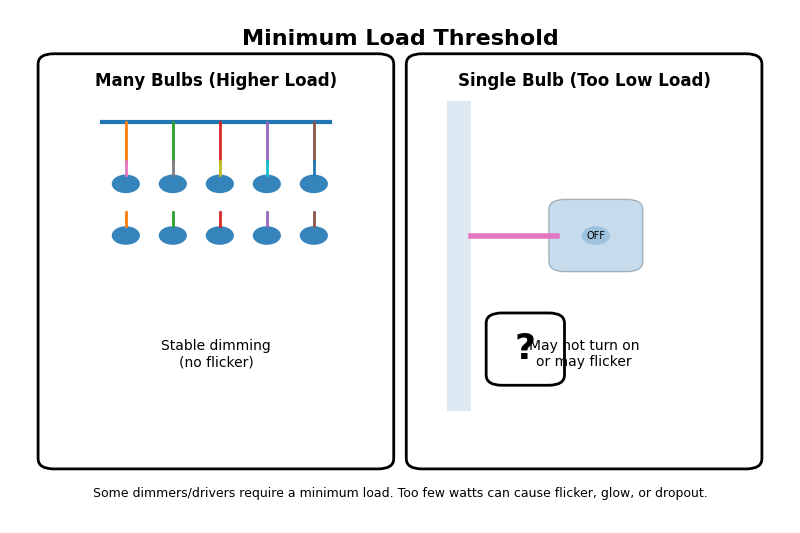
This is a classic case of technology outpacing infrastructure.
I produce a 4W ST64 bulb. It is beautiful.
But the dimmer on the wall expects to feel the resistance of a 60W bulb.
When it sends the signal, it feels... nothing. Or almost nothing.
The dimmer gets confused. "Is there a bulb there? Did the filament break?"
It might panic and shut off voltage completely.
This is called Drop-Out.
You dim the light down. It looks good at 50%. It looks good at 30%.
Then at 20%—POP—it goes dark.
You try to bring it back up, but it won't turn on until you slide it to 80%.
This is "Hysteresis." It is frustrating.
The "Trim" Setting Adjustment
Before you blame the bulb, check your app.
Apps like Lutron, SmartThings, or Tuya usually have a setting called "Low-End Trim5" or "Minimum Brightness."
You can artificially restrict the slider.
You tell the app: "Never go below 10% voltage."
By setting the floor higher, you prevent the bulb from entering that unstable zone where the dimmer loses control.
This doesn't fix the hardware, but it hides the problem from the user.
Why "Resistive" vs. "Capacitive" Load Matters
Incandescent bulbs are "Resistive" loads. Their power draw is linear.
LED bulbs are "Capacitive" loads. Their power draw is complex.
A 100W rating on a smart dimmer usually means 100W of Resistive load.
For LEDs, you continuously need to de-rate the switch.
A common rule of thumb in the industry is divide by 4.
If a dimmer says "Max 600W," do not put 600W of LEDs on it.
Put max 150W of LEDs.
The rush of current (Inrush) from the capacitors in my LED drivers is huge when you turn them on.
If you overload a smart switch with too many capacitive LED bulbs, you will weld the relay shut.
The lights will stay ON forever and you will have to replace the switch.
The Multi-Gang Box Heat Issue
Another hidden factor is heat inside the wall.
If you have 3 or 4 smart switches side-by-side in one box (a multi-gang box), they generate heat.
Smart switches have aluminum fins on the front to dissipate heat.
In a multi-gang box, you often have to break those fins off to make them fit.
This lowers the max load capacity even further.
If your lights are flickering after being on for 2 hours, check the switch.
Is the wall plate hot to the touch?
Overheated electronics become unstable.
The flickering might be the switch gasping for air, not the bulb failing.
What is the Difference Between Linear and IC Constant Current Drivers?
Ultimately, the bulb's ability to handle all these weird power inputs comes down to its internal engine. The driver is the component that converts AC (Alternating Current) to DC (Direct Current).
A "Linear" driver is a cheap, simple circuit that links brightness directly to voltage; it transmits every fluctuation from the wall directly to the LED, causing high flicker. An "IC Constant Current" driver uses a dedicated microchip to regulate the power flow intelligently, smoothing out the "noise" from smart switches for a steady, flicker-free light.
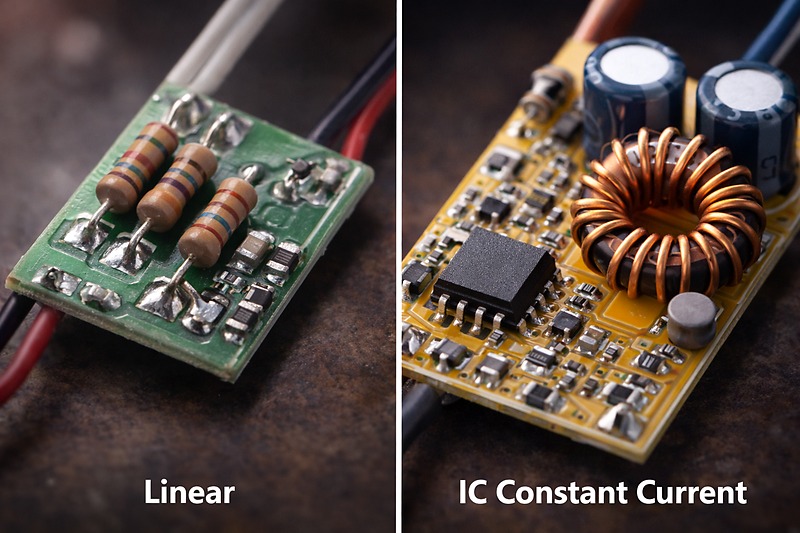
In the competitive B2B market, pennies matter.
A Linear driver costs me about $0.15 to make.
An IC (Integrated Circuit) driver costs me about $0.60 to make.
That is a huge difference when you buy 100,000 bulbs.
The "Linear" Trap:
Linear drivers are essentially just resistors.
They rely on the voltage from the wall being perfect 120V (or 230V).
If the smart switch output wobbles (which it often does), the light wobbles.
If your refrigerator turns on and the house voltage dips? The light dips.
These are the bulbs that give people headaches.
The "IC" Solution:
My factory standard for exports to the USA and Europe is IC Constant Current.
The chip acts like a strict gatekeeper.
It looks at the incoming chaotic power.
It says, "I don't care if you are 110V or 125V. I don't care if you are choppy."
It outputs a perfectly smooth, straight line of DC power to the filament.
This isolates the visible light from the electrical noise.
For smart homes, IC is non-negotiable.
Linear bulbs simply cannot handle the complex waveforms generated by smart dimmers.
The Stroboscopic Effect (SVM)
We measure flicker using a metric called SVM (Stroboscopic Visibility Measure)6.
A perfect light is SVM = 0.
A Linear driver on a bad dimmer can hit SVM = 0.4 or higher.
An IC driver keeps SVM below 0.1.
Why does this matter?
Even if you don't consciously see the flicker, your brain sees it.
It causes eye strain and fatigue.
For a customer like Jacky, selling "Flicker-Free7" is a safety claim, not just cosmetic.
Size Constraints in Edison Bulbs
The hardest part of my job is physics.
In a plastic A19 bulb, the base is wide. I can fit a big, robust IC driver.
In a glass ST64 or G9 Edison bulb, the driver must fit inside the tiny E26/E27 screw cap.
Components for IC drivers (transformers, capacitors) are bulky.
Miniaturizing them without causing overheating is expensive.
This is why a truly "Smart Compatible" vintage bulb is heavier than a cheap one.
If you pick up a bulb and it feels as light as a feather, it probably has a cheap Linear driver.
Put it back. It will hate your smart switch.
Conclusion
Making LED Edison bulbs work with smart switches is not magic; it is engineering. The issues of flickering and ghosting are predictable outcomes of mismatched technology. By ensuring you use Trailing Edge (ELV) protocol, ensuring your switch has a Neutral Wire (or using a bypass capacitor), and investing in bulbs with IC Constant Current drivers, you eliminate the chaos. Lighting should be a source of comfort, not a source of stress. When built correctly, the vintage charm of 1910 works perfectly with the technology of 2024.
Exploring Trailing Edge dimming can help you discover its advantages, such as better compatibility with LEDs and reduced noise. ↩
Understanding LED compatibility is crucial for choosing the right dimmer, ensuring optimal performance and longevity of your LED bulbs. ↩
Understanding the function of a Bleeder Resistor can enhance your knowledge of electrical safety and efficiency in lighting systems. ↩
Exploring Bypass Capacitors will help you solve common lighting issues without extensive rewiring, saving time and money. ↩
Understanding Low-End Trim can help you optimize your smart lighting setup and prevent flickering issues. ↩
Understanding SVM helps you grasp the impact of flicker on eye health and lighting quality, making it essential for informed lighting choices. ↩
Exploring Flicker-Free concepts reveals how they enhance comfort and safety in lighting, crucial for anyone concerned about eye strain. ↩