You're constantly pressured to find lower-cost suppliers, but you know the trap. A "cheap" bulb that fails costs you far more in replacements, labor, and reputation than you ever saved.
The lowest price for a good quality bulb is found by sourcing directly from a manufacturer who has optimized their production for efficiency, not by simply choosing the cheapest listing. This eliminates middlemen and gives you transparent control over the price-to-performance ratio of the components.

I remember talking with a buyer from a large US-based lighting distributor, a new "Jacky" for us. He was tasked with finding a new supplier for their entry-level, high-volume ST64 bulbs. His primary goal was to reduce their cost per unit by 15%. He’d received samples from a half-dozen potential suppliers, all claiming to have the best price. He was lost in a sea of nearly identical-looking bulbs. I asked him to ignore the price for a moment and instead test their dimming performance. The results were stark. One flickered badly below 50% brightness. Another made an audible buzzing sound. A third had a noticeable green tint. He had been so focused on the price quoted on the sheet that he almost missed the massive quality differences that would have led to thousands of angry customers. His experience shows that the quest for the "cheapest" good-quality bulb isn't a simple price comparison; it's an investigation into where and how true value is created.
What's Really Being Sacrificed for That Rock-Bottom Price?
You find a bulb online that’s 30% cheaper than any serious quote. It seems like a huge win, but what critical, unseen parts have been removed or downgraded to reach that magic number?
To achieve a rock-bottom price, suppliers typically sacrifice the most critical and expensive internal components: the driver is downgraded, cheap low-CRI LED chips are used, heat dissipation methods are ignored, and quality control is virtually eliminated. These compromises guarantee poor performance and high failure rates.
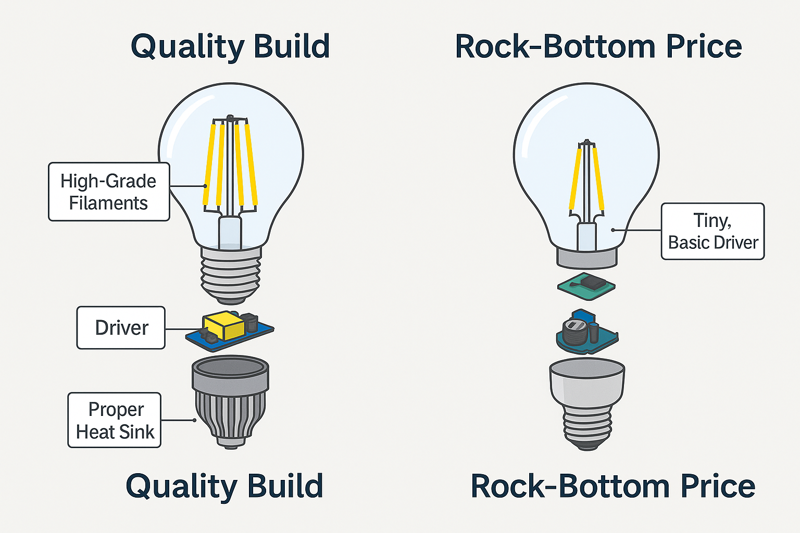
The first place a manufacturer looks to cut costs is the driver. A sophisticated driver that provides smooth, flicker-free dimming down to 5% and handles voltage fluctuations is a complex piece of electronics. A cheap alternative, often a simple "resistor-capacitor" circuit, costs a fraction of the price but offers terrible performance, causing bulbs to flicker, buzz, or fail prematurely when used with dimmers. Next are the LED filaments themselves. High-quality chips from reputable sources provide a high Color Rendering Index (CRI of 90+), making colors look vibrant and natural. To save money, a low-cost producer will use cheap chips with a CRI below 80, resulting in a light that makes everything look washed-out and dull. They also cut corners on assembly, using lower-purity inert gas (or none at all) and inadequate heat sinks. This causes the filaments to overheat and fail quickly. You don't see these compromises in a product photo, but your customers will certainly see them when their lights start failing a few months after installation.
The Anatomy of a Cheap Bulb
Understanding where the cuts are made helps you identify low-quality products.
- The Driver: This is the heart of the bulb. A cheap driver is the number one cause of flicker and incompatibility with dimming systems. It's the most common point of failure.
- The LED Chips: The source of the light. Low-grade chips have poor color accuracy (low CRI) and their light output can degrade much faster over time (lumen depreciation).
- Thermal Management1: The system for removing heat. A lack of proper heat-conducting gas or internal structure means the LED filaments will burn out, drastically shortening the bulb's lifespan from a promised 15,000 hours to just a few thousand.
| Component | Good Quality | "Cheapest" Quality | Consequence of "Cheapest" |
|---|---|---|---|
| Driver | Advanced, stable IC driver | Basic Resistor-Capacitor | Flicker, buzzing, high failure rate |
| LED Chips2 | High CRI (90+), consistent color | Low CRI (<80), color variation | Poor light quality, ugly colors |
| Heat Dissipation | Helium/Inert gas mixture | Low-purity gas or just air | Shortened lifespan, early burnout |
The rock-bottom price is a direct payment for future problems. It’s a liability, not an asset.
What Defines "Good Quality" in a Cost-Effective Bulb?
If the cheapest isn't best, how do you define "good enough"? What are the non-negotiable features a professional-grade, cost-effective bulb must have to satisfy clients without overpaying for features you don't need?
For a cost-effective bulb, "good quality" means a stable driver with smooth dimming to at least 20%, a CRI of 80 or higher for decent color rendering, consistent color temperature batch-to-batch, and a verified lifespan backed by solid factory quality control.
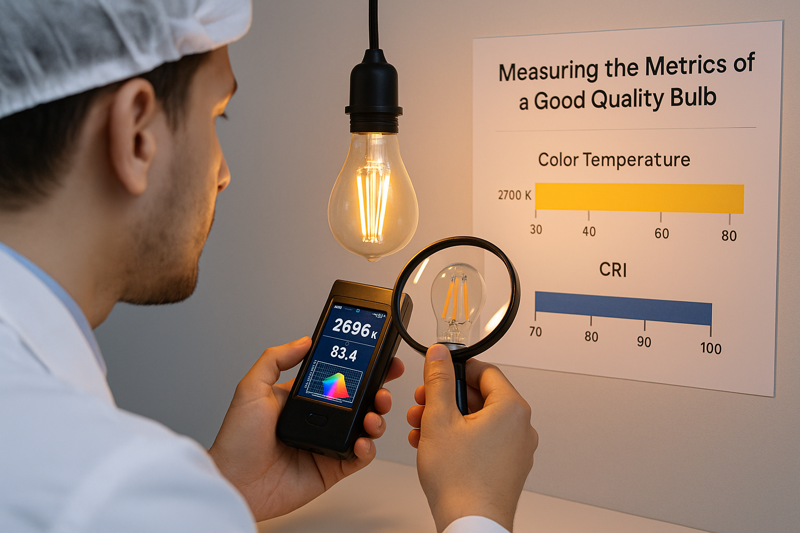
As a buyer for B2B channels, you don't always need the absolute best of everything. You don't need a CRI 98 bulb for a warehouse hallway. The goal is to define a baseline of "good quality" that guarantees performance and reliability for the price point. This is about finding the sweet spot. First and foremost is the driver performance. The bulb must be stable and dim reasonably well with common commercial dimmers. While dimming to 1% is a premium feature, dimming smoothly to 20% without strobing or flickering is a must-have for almost any application. Second is color quality. A CRI of 80 is a widely accepted minimum for commercial spaces. Anything less looks noticeably cheap. Just as important is color consistency—you must be able to trust that the 2700K bulbs you order today will match the ones you order in six months. This only comes from a factory that has tight control over its LED chip supply. Finally, the quality must be backed by the manufacturer's processes. This means they should be able to provide reliability test reports and evidence of their quality control checkpoints.
The "Good Enough" Quality Checklist
Use this as a baseline when evaluating suppliers.
- Driver Performance: Does it offer stable, flicker-free dimming? Ask for a list of compatible dimmers.
- Color Rendering Index (CRI)3: Is it a true 80+? Request a test report (an integrating sphere report) for verification.
- Color Consistency: What is their tolerance for color temperature variance (e.g., within 100K)? This is measured in MacAdam ellipses4. A good factory keeps it within 5 steps.
- Build & Safety: Does the bulb have the necessary certifications for your market (e.g., UL for the US, CE for Europe)? This is a non-negotiable sign of basic quality and safety.
| Feature | Minimum Standard for "Good Quality" | Premium Feature (Higher Cost) |
|---|---|---|
| Dimming | Smooth & stable to 20% | Flicker-free down to 1% or 0% |
| CRI | 80+ | 95+ (for high-end retail/galleries) |
| Color Consistency | Within a 5-step MacAdam ellipse | Within a 3-step MacAdam ellipse |
| Certifications | UL or CE Listed | Additional certifications like Energy Star |
Defining this baseline allows you to compare apples to apples when you get quotes from different suppliers.
How Do Efficient Manufacturers Reduce Costs Without Cutting Corners?
You understand that component quality is key, but some manufacturers are still cheaper than others. How can one factory offer a better price on a good quality bulb than its competitor?
Efficient manufacturers lower costs through production scale, process automation, and supply chain optimization, not by downgrading core components. High-volume purchasing of quality components, automated assembly lines, and lean management reduce overhead, and these savings are passed on to the customer.
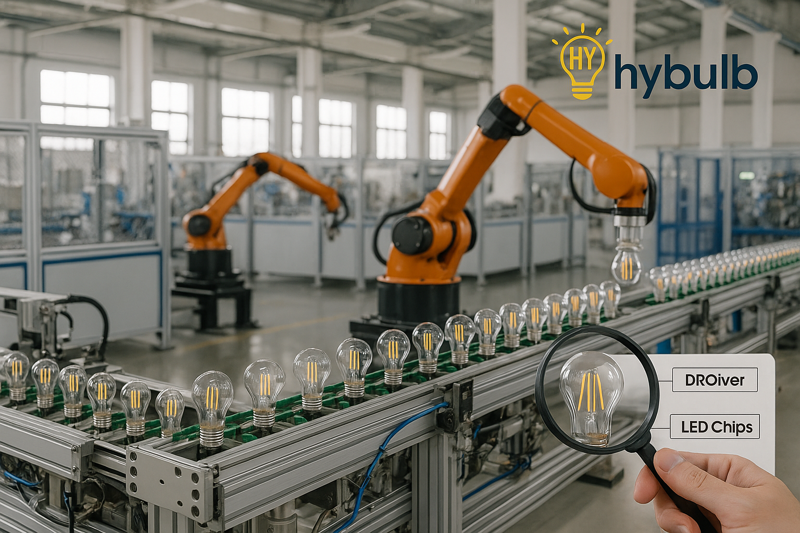
This is where the real "deal" is found. At Hongyu Bulb, we’ve spent 30 years perfecting our production efficiency. The secret to a lower price on a quality bulb isn't magic; it's operational excellence. First, there's the power of scale. Because we produce millions of bulbs, we can purchase high-quality drivers and LED chips in enormous volumes, securing much better prices than a smaller factory could. We extend these savings directly to you. Second is automation. We have invested heavily in automated machinery for critical assembly steps. This not only speeds up production but, more importantly, it drastically improves consistency and reduces the rate of human error, leading to fewer defects and lower overall costs. Third is lean manufacturing. We constantly analyze our entire process, from when raw materials enter the factory to when the finished product ships out. We work to eliminate waste at every step—wasted time, wasted materials, and wasted movement. This lean approach keeps our overhead low. By focusing on these three areas, we can build a bulb with a high-quality driver and 90 CRI chips for a price that other factories can only achieve by using cheap, unreliable components.
The Pillars of Manufacturing Efficiency
These are the operational advantages that create a better price for you.
- Economies of Scale5: Buying better components for less money due to high-volume orders.
- Process Automation6: Using robotics and machinery to increase speed, ensure precision, and reduce defect rates. Every defect prevented is a cost saved.
- Supply Chain Management: Building long-term relationships with component suppliers to guarantee stable pricing and supply.
- Lean Management: A philosophy of continuous improvement focused on eliminating all forms of waste from the production process.
| Efficiency Driver | How It Reduces Cost | How It Protects Quality |
|---|---|---|
| Scale Purchasing | Lowers the unit cost of high-quality components. | Allows us to use superior components without a huge price jump. |
| Automation | Increases throughput and reduces labor cost per unit. | Improves consistency and reduces assembly defects. |
| Lean Process | Minimizes overhead and wasted resources. | Frees up capital to invest in quality control and better machinery. |
A truly low-cost, high-quality bulb isn't made by a "cheap" factory; it's made by a smart and efficient one.
How Can Your Purchasing Strategy Unlock a Better Price on Quality Bulbs?
Even with an efficient manufacturer, your own actions can influence the final price. How can you structure your purchasing to help your supplier give you the best possible deal on a quality product?
Unlock a better price by being a strategic purchasing partner. Provide long-term volume forecasts, place larger blanket orders instead of many small ones, and be flexible on non-essential elements like custom packaging. This reduces the manufacturer's costs, and they can share those savings with you.

As a manufacturer, one of our biggest challenges is unpredictability. It's difficult to plan production and manage inventory without a clear view of future demand. This is where you, the buyer, have significant power to lower your own costs. A buyer who places a small, urgent order every three weeks is more expensive for us to serve than a buyer who provides a six-month forecast and places blanket orders. When you give us a forecast, we can plan our component purchasing and production schedules more efficiently. This stability allows us to offer you a better price. Similarly, ordering 10,000 units at once is far more efficient for us to produce than ten separate orders of 1,000 units. The setup time and administrative costs are lower per unit. Another huge area for collaboration is packaging. A full-color, custom-printed retail box can add significant cost. If your bulbs are going directly to an installation site, could you use a simpler, cheaper bulk-pack carton? Discussing these options shows you're a partner looking for mutual efficiency, not just a customer trying to squeeze margins. This collaborative approach almost always results in a better price for you without touching the quality of the bulb itself.
Actionable Strategies for Lower Pricing
Be a better customer to get a better price.
- Provide Forecasts: Give your supplier a 6-to-12-month estimate of your needs. This is the single most effective way to help them help you.
- Consolidate Orders7: Instead of weekly or monthly small orders, place larger quarterly orders. This consolidation reduces administrative and production setup costs.
- Be Flexible on Packaging: Ask "What is the most cost-effective packaging option?" If you don't need fancy retail boxes, don't pay for them.
- Establish a Long-Term Relationship8: The best pricing is reserved for loyal, long-term partners. Your history with a supplier is a valuable negotiating asset.
| Your Action | How It Helps the Manufacturer | Your Reward |
|---|---|---|
| Give a 6-Month Forecast | Allows for efficient production scheduling & component purchasing. | Better price based on predictability. |
| Place a Single 20k Unit Order | Reduces setup costs and administrative overhead. | Volume discount on the order. |
| Opt for Bulk Packaging | Lowers material and printing costs. | Direct savings on the cost-per-unit. |
| Become a Repeat Customer | Builds trust and reduces risk for the manufacturer. | Access to loyalty pricing and better support. |
Your purchasing strategy is one of the most powerful tools you have for reducing cost without ever sacrificing quality.
Related HongYu product pages
- LED Filament Bulb Product Range → — standard and decorative LED filament bulbs for wholesale and project sourcing.
- Contact HongYu Bulb → — send your target specifications, quantity, market and packaging requirements for quotation.
Conclusion
The cheapest good quality bulb is a myth. The best value comes from partnering with an efficient manufacturer and using smart purchasing strategies to achieve a low total cost of ownership.
Understanding thermal management is crucial for maximizing LED lifespan; this resource provides valuable insights. ↩
Explore this link to discover high-quality LED chips that ensure better light output and longevity. ↩
Understanding CRI is crucial for selecting quality lighting that accurately represents colors, especially in retail and galleries. ↩
Exploring MacAdam ellipses will help you grasp color consistency standards, ensuring better quality in your lighting choices. ↩
Understanding Economies of Scale can help you leverage bulk purchasing for better pricing and quality. ↩
Exploring Process Automation reveals how technology can enhance speed and precision in production. ↩
Exploring this resource will reveal how consolidating orders can lead to significant cost savings and efficiency. ↩
This link will provide insights into how loyalty can unlock better pricing and support from suppliers. ↩