Why Voltage Range Is Not a Minor Footnote in Your Spec Sheet
Here is the mistake we see constantly: an importer fills out the voltage field on their purchase order with "AC 220V" or leaves it blank entirely because it "matches the standard." They receive samples that work fine. They approve production. Three months later, they start getting warranty calls — flickering in the first 500 hours, early failures in enclosed pendants, color shifts nobody asked for.
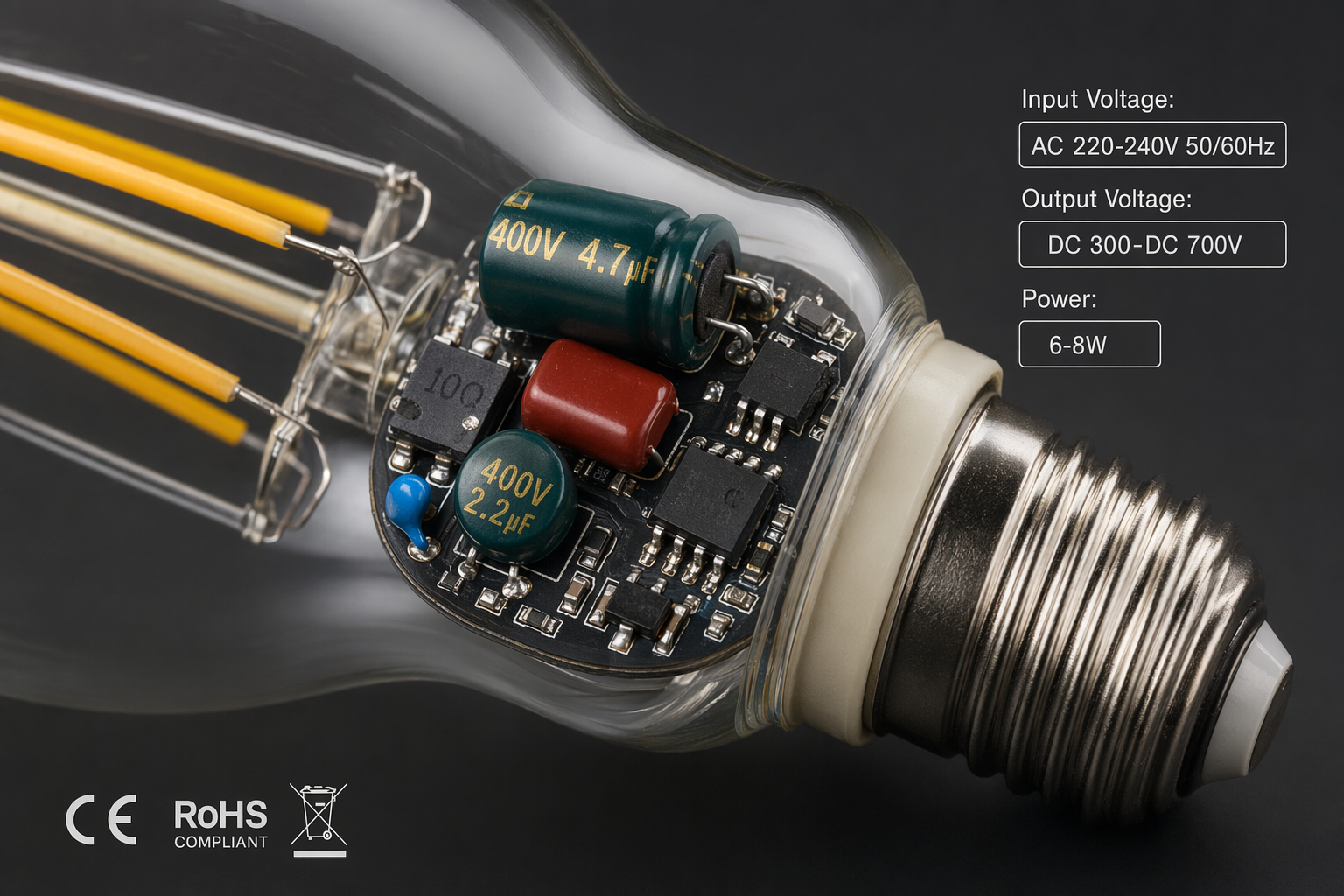
The voltage range on your purchase order is not just a number — it is a design instruction to the driver engineer. It determines the input handling topology, the capacitor selection, and the thermal margin the driver will have in real-world operating conditions. Specify it vaguely, and you get a vaguely engineered driver. That driver will look fine on a test bench and degrade unpredictably in the field.
This guide is written for importers, lighting brands, and wholesalers who specify LED filament bulbs for defined markets. It explains the three voltage ranges, what "universal" actually costs you in thermal performance, and how to write a voltage specification that protects you from complaints that arrive six months after the sale.
The Three Voltage Ranges and What Markets They Serve
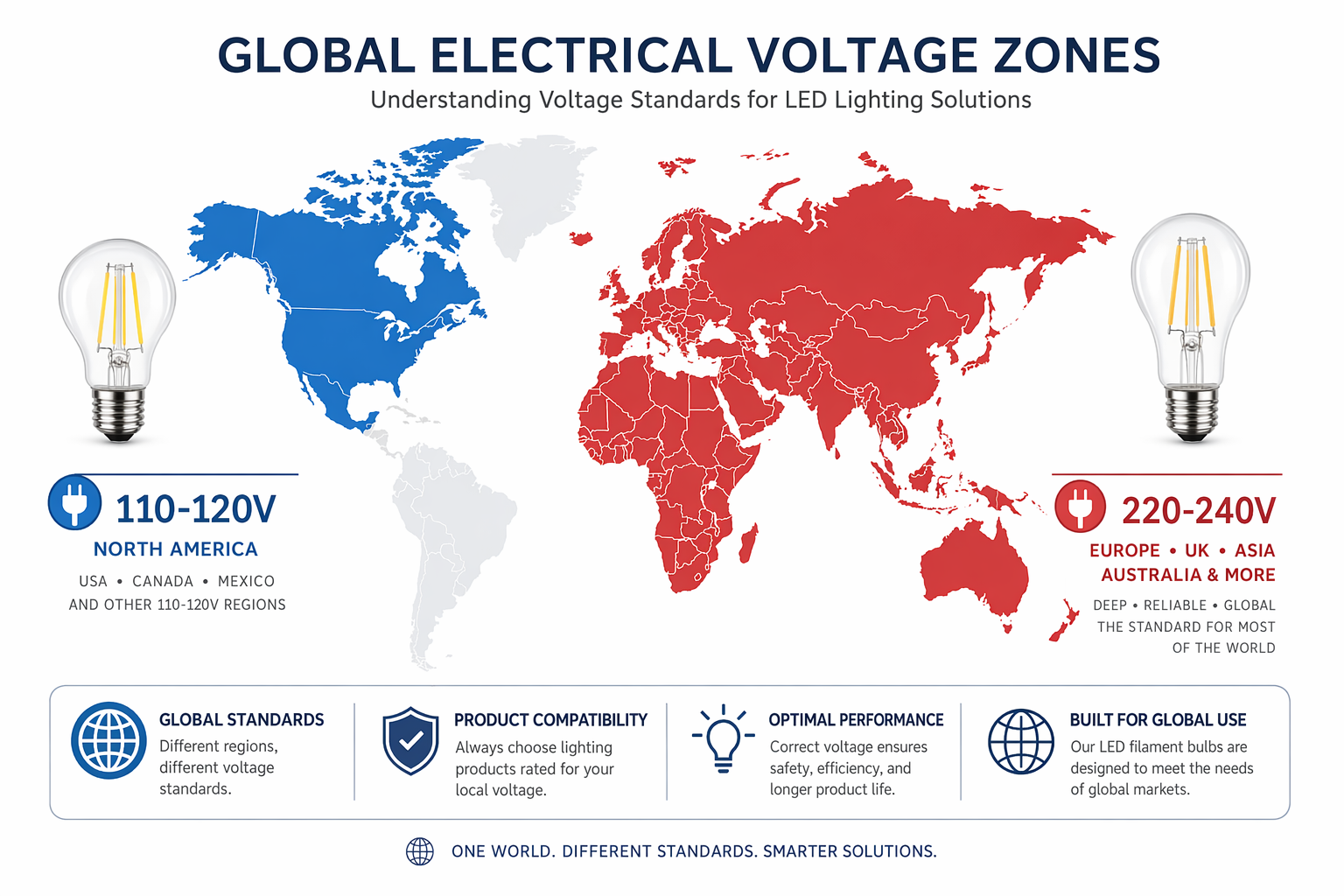
There are three practical voltage ranges you will encounter when sourcing LED filament bulbs:
- 110V / 120V — Standard for North America (US, Canada, Mexico) and parts of Central America. The US nominal is 120V but real-world grid voltage ranges from 110V to 127V depending on location and building wiring. A driver specified only for 120V can be stressed by both extremes.
- 220V–240V — Standard for Europe, UK, Australia, New Zealand, most of the Middle East, and large parts of Asia including China. The EU nominal is 230V with a ±10% tolerance (207V–253V). Drivers must handle this full band reliably under worst-case conditions — not just at the lab test voltage.
- 100–240V (universal) — Designed to operate across both zones. Useful for global SKUs. But "universal" is a marketing label for a genuine design constraint — and buyers who do not understand that constraint pay for it downstream.
The critical buyer mistake: treating these three as interchangeable configurations. They are not. Each is a fundamentally different driver design task. A 220–240V driver is optimized for a narrow, high-voltage input band. A 110V driver is optimized for a lower range. A 100–240V driver must cover both — and that breadth extracts a thermal cost.
According to the U.S. Department of Energy's Solid-State Lighting program, LED driver efficiency is directly linked to input voltage range and power factor correction design. Wider input range requirements typically demand more complex driver architectures to maintain efficiency across the full span.
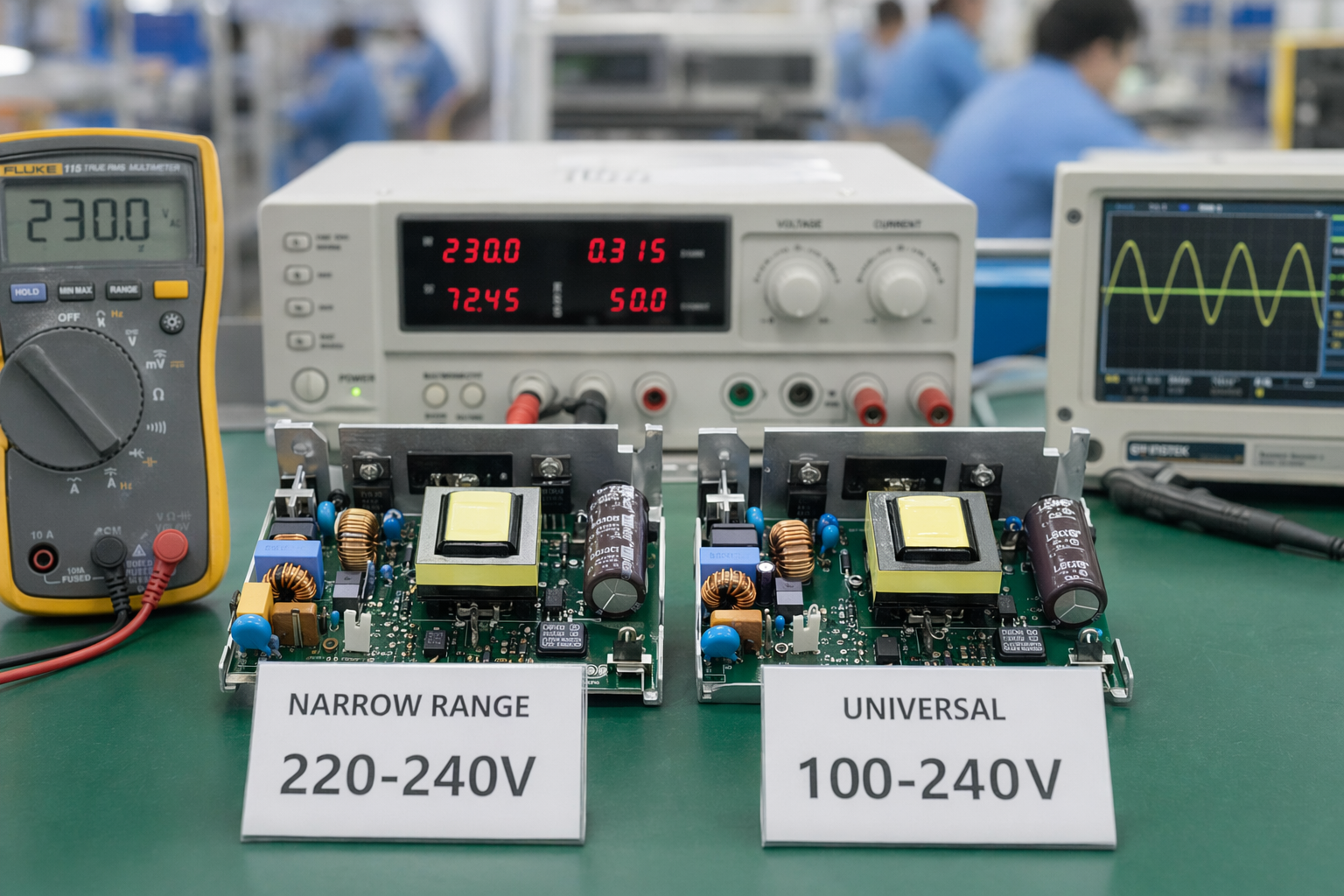
What "Universal Voltage" Actually Means for the Driver — and Where Performance Can Drop
We often see buyers specify "universal voltage" because it sounds like an upgrade — one SKU for all markets, no logistics complexity, no risk of misrouting. In reality, universal voltage is a cost transfer. You avoid the logistics complexity of market-specific SKUs and pay for it in driver thermal performance. The question is whether you understand the trade before you make it.
A driver designed for 100–240V must maintain stable output current across a 2.4:1 input voltage ratio. To achieve this, manufacturers use one of two approaches:
- A wider-range switching topology that adds components, increases circuit complexity, and generates more heat under load
- Derating at voltage extremes — the driver runs at reduced efficiency near 100V and near 240V, converting more input power to heat rather than light output
In a filament bulb with a small glass envelope and minimal thermal mass, that additional heat has nowhere to go. The result is elevated driver operating temperature. The Illuminating Engineering Society (IES) documents the relationship clearly: every 10°C rise in electrolytic capacitor junction temperature roughly halves rated capacitor life. A universal driver running hot in an enclosed fixture is a predictable failure — not a defective product, but a design that was never intended for those conditions.
In our experience, buyers who source universal voltage bulbs for exclusively European markets are paying for driver complexity they do not need and getting reduced thermal margin in return. For decorative and hospitality applications — where enclosed fixtures and high ambient temperatures are common — this matters. We cover how enclosed fixture conditions affect small-base lamps in detail at Why G4 LED Lamps That Look Fine in Samples Fail Early in Enclosed Fixtures →.
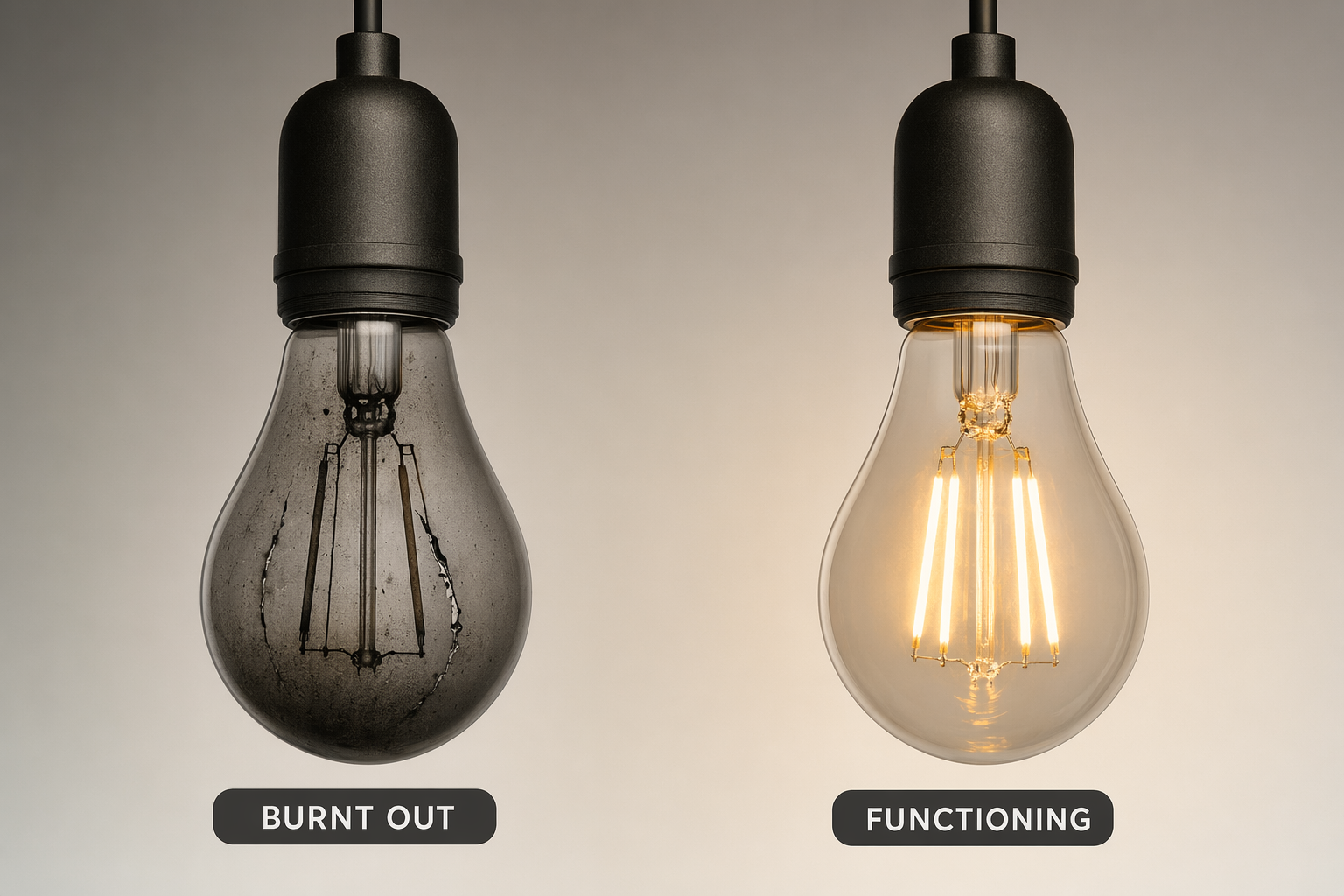
How Voltage Mismatch Causes Real Return Problems
Voltage mismatch failures do not look the same — and the most damaging ones are the hardest to trace. Buyers who understand the three failure patterns are better positioned to catch specification errors before they become warranty crises:
- Immediate failure at installation — A 110V-rated bulb on a 220V circuit fails within hours. This is obvious and usually results in a full batch return. It is also the easiest to prevent with a one-line check on your purchase order.
- Gradual performance degradation — A universal voltage driver operating at the edge of its design range in a thermally tight fixture may perform acceptably for 2,000–3,000 hours before flickering or premature lumen loss begins. By then, the product is distributed across multiple channels. Returns arrive over many months from many sources, and the root cause — a driver that was thermally marginal from day one — is nearly impossible to prove retroactively.
- CCT shift and color inconsistency — Voltage-related thermal stress degrades phosphor performance. Customers see color temperature drift or mismatch between original and replacement lamps. Nobody traces it back to voltage specification — they blame the factory. But the factory built what you specified.
The second and third patterns are the ones that destroy supplier relationships. The first is embarrassing; the others are expensive and slow-burning. As we discuss in Why Getting Color Temperature Wrong Costs More Than Getting the Price Wrong →, downstream color complaints are among the most costly to resolve because they arrive distributed, at scale, long after the specification decision was made.
The ENERGY STAR LED bulb specification requires testing at the rated input voltage specifically because performance at other voltages is not guaranteed to be equivalent. That requirement exists for a reason.
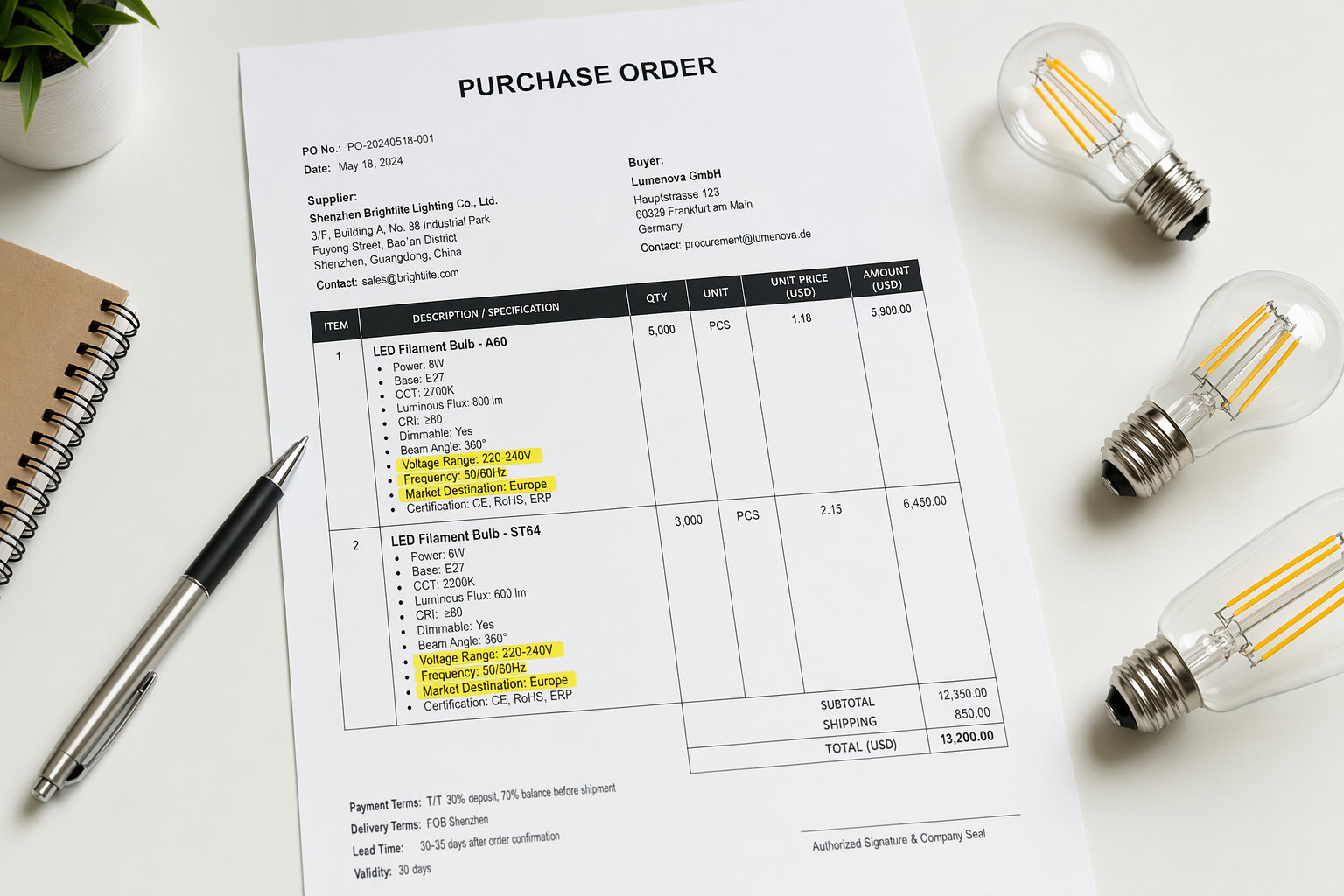
What to Write in Your Purchase Order Spec Sheet
The buyers who avoid voltage-related field failures are not necessarily more technically sophisticated — they just write their spec sheets with more precision. Here is what that looks like in practice:
- Input voltage range: State the exact range: "220–240V AC, 50Hz" for European supply. Do not write "universal" unless you have confirmed that your sales channel genuinely spans both voltage zones. Writing "universal" to avoid a decision means someone else is making the decision for you — and it is the driver engineer at the cheapest factory competing for your order.
- Input frequency: 50Hz for Europe, Australia, UK, China; 60Hz for North America. Some driver designs are frequency-sensitive. Omitting this is a gap.
- Target market declaration: Write "EU/UK market" or "US/Canada market" explicitly on the purchase order. This creates a shared record of intent and reduces ambiguity in dispute resolution.
- Voltage tolerance requirement: For EU supply, specify that the driver must comply with EN 61000-3-2 harmonic limits and EN 55015 EMC requirements at the stated input voltage — not just at 230V nominal.
- Thermal derating documentation for universal orders: Request driver efficiency data at both voltage extremes (100V and 240V). A credible supplier can provide this from their driver manufacturer's datasheets. If they cannot, that is information.
If you are specifying dimmable filament bulbs, voltage range interacts with dimmer compatibility in additional ways. We cover the specification steps for dimmable private label products in How to Specify Dimming Compatibility When Ordering Private Label LED Filament Bulbs →.
The International Electrotechnical Commission (IEC) publishes IEC 61347-2-13 covering control gear for LED modules, and IEC 62560 covers self-ballasted LED lamps — both specify how voltage range performance must be declared and tested. Requiring your supplier to reference these standards is not bureaucratic — it distinguishes suppliers who test to spec from those who claim compliance without evidence.
The European Commission's Low Voltage Directive (LVD) 2014/35/EU requires that products sold in the EU be designed for the declared voltage range with appropriate safety margins. For compact specialty lamps like G4 and G9, voltage specification is even more critical due to the smaller driver footprint — discussed in Why Compact G4 and G9 LED Lamps Expose Weak Supplier Design Faster Than Standard Bulbs →.
Related HongYu Bulb product pages
- LED Filament Bulb Product Range → — standard and decorative LED filament bulbs for wholesale and project sourcing.
- ETL, CE & RoHS Certification Guide → — sourcing guidance for certification and import compliance.
- Big Decorative Bulbs → — oversized decorative filament bulbs for hospitality, retail and statement fixtures.
- Contact HongYu Bulb → — send specifications, target market, quantity and packaging requirements for quotation.
Conclusion
Voltage specification is not a checkbox. It is a driver design instruction — one that determines whether your product runs within its thermal envelope or outside it from day one. Getting it right costs nothing at the purchase order stage. Getting it wrong costs you returns, warranty claims, and supplier relationship damage that arrives months after the sale, at a point where the root cause is effectively impossible to prove.
For importers serving defined geographic markets: specify the actual voltage range for that market. A 220–240V driver for European supply will outperform a universal driver on thermal margin and efficiency in enclosed fixture applications. That difference shows up in lumen maintenance at 3,000 hours — not in a sample inspection.
Write the voltage range explicitly. Require driver performance confirmation at the stated input. Request documentation referencing the applicable IEC standards. These are the steps that separate buyers who get field-reliable products from those who find out about driver compromises at their customer's expense.
External References
- U.S. Department of Energy — Solid-State Lighting Program
- Illuminating Engineering Society (IES) — LED Driver Thermal Management Guidance
- ENERGY STAR — LED Bulb Specification and Testing Requirements
- International Electrotechnical Commission (IEC) — IEC 61347-2-13 and IEC 62560
- European Commission — Low Voltage Directive (LVD) 2014/35/EU