Why do G4 LED lamps look perfect in samples but fail early in real installations? The answer is almost always thermal — and the sample process almost never catches it.

Samples pass. Bulk production passes. The product ships, clears customs, and goes into distribution. Then the complaints start arriving — G4 lamps burning out at three months, four months, six months. Far earlier than the rated lifespan on the packaging.
The importer contacts the supplier. The supplier sends test reports showing 15,000 hours of rated life. The importer sends back the failed units. Nobody can agree on what went wrong. The claim escalates. Replacement stock is sourced. The relationship deteriorates.
In most cases, the G4 lamp itself is not defective. The failure is a thermal problem that begins at the fixture, not the lamp — and the sample evaluation process almost never catches it because samples are rarely tested inside the actual enclosed fixture the product will be installed in.
This is one of the most expensive and most avoidable failure patterns in G4 LED lamp sourcing, and it starts with a gap in the specification process that most importers do not close until after the first large-volume return.
Why Enclosed Fixtures Change Everything About G4 Lamp Performance
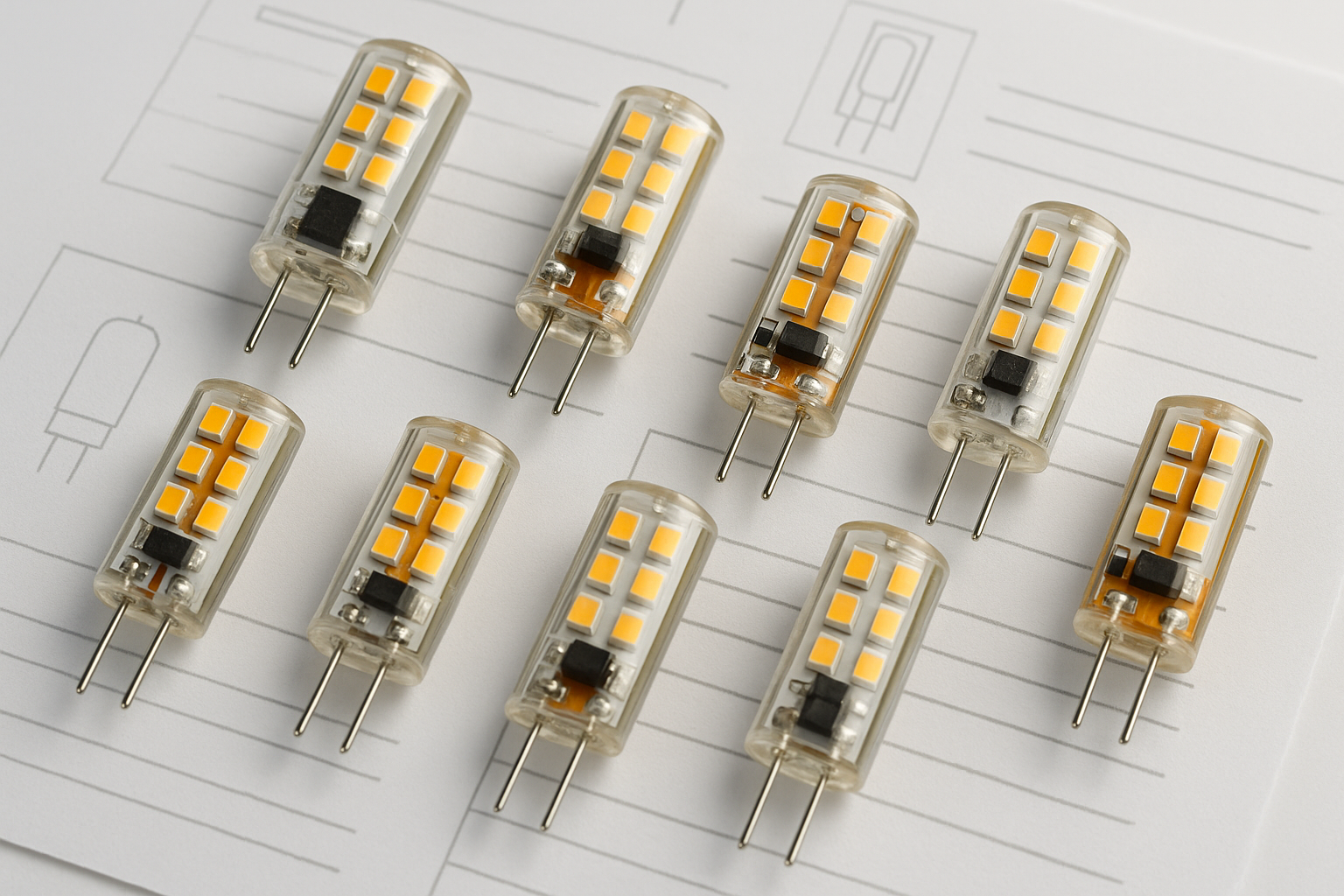
G4 LED lamps were originally designed to replace halogen G4 capsule lamps in a wide range of decorative, accent, and display applications. Many of those applications involve enclosed glass fixtures — globe pendants, lantern fittings, display case lighting, cabinet lighting, and decorative wall sconces where the bulb is sealed inside a glass housing with limited or no ventilation.
Halogen G4 lamps generated enormous heat and were designed to handle it. The tungsten filament operated at incandescent temperatures. The glass envelope was designed for thermal stress. The fixture manufacturers who built enclosed housings around halogen G4 lamps knew they were working with a heat-generating source and designed accordingly — with ventilation gaps, high-temperature rated materials, and large enough internal volumes to manage the heat load.
LED G4 lamps generate far less heat at the light source, which buyers correctly identify as an advantage. What buyers often do not consider is where that heat goes. An LED driver still generates heat. An LED chip array still generates heat. In a standard open fitting, that heat dissipates naturally into the surrounding air. In a sealed enclosed glass fixture, that heat has nowhere to go. The internal temperature of the fitting rises steadily during use, and the G4 lamp is sitting inside that rising heat environment throughout its operating hours.
LED drivers and LED chips are rated for specific maximum operating temperatures. When the fixture's internal temperature consistently exceeds those ratings — which is common in enclosed fittings that were originally designed for halogen — the driver ages faster, the LED chips degrade faster, and the rated lifespan becomes meaningless. The 15,000 hours on the test report was measured in open-air conditions. The installed environment is delivering 45°C or 55°C of ambient heat before the lamp even starts working.
What the Sample Evaluation Process Usually Misses
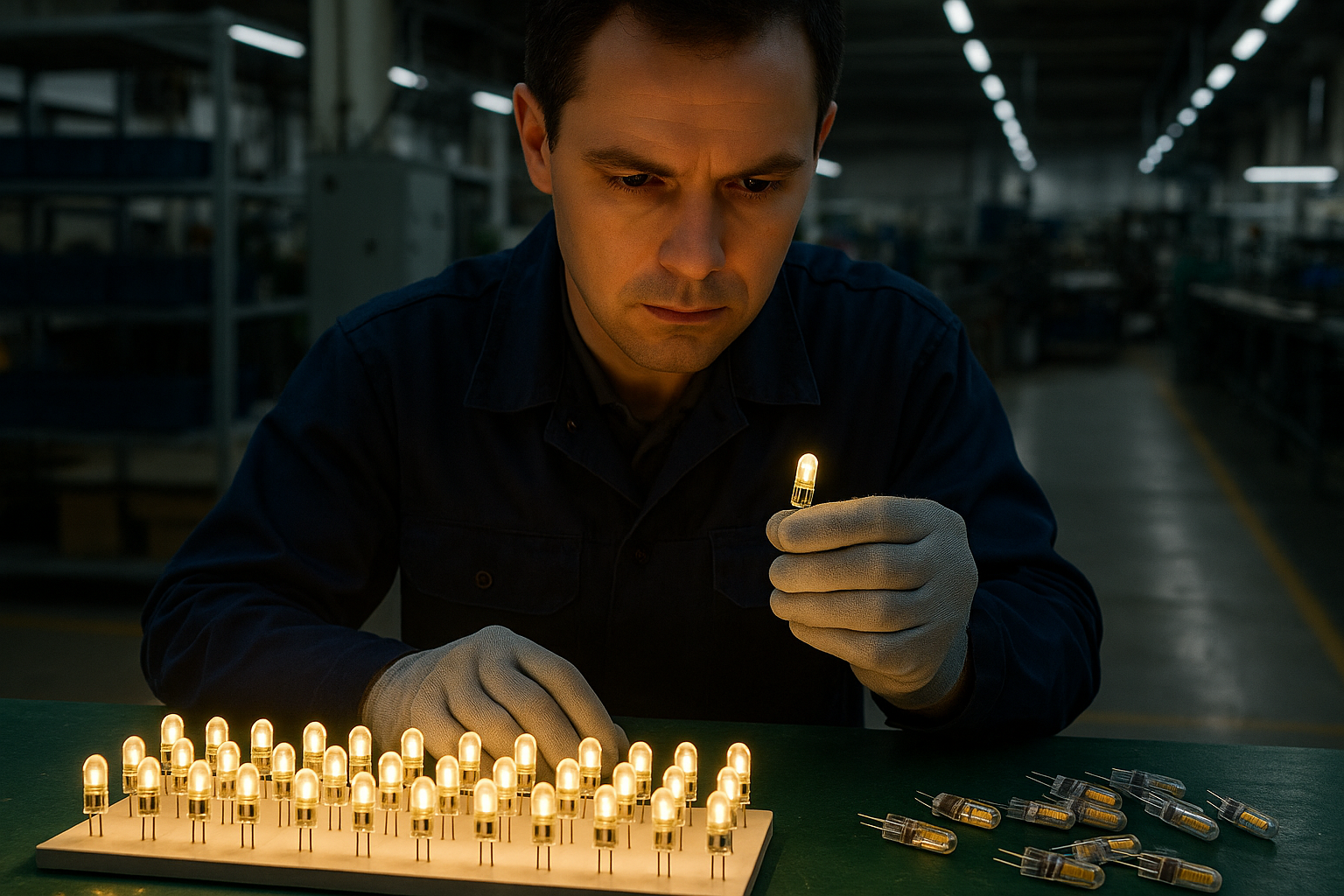
Most importers evaluate G4 LED lamp samples by examining appearance, checking lumen output against spec, confirming base dimensions, verifying color temperature, and powering the lamp on a test bench or in an open socket to confirm it lights correctly.
None of those checks reproduce the thermal conditions of an enclosed fixture installation.
A sample that passes every bench test can still fail in the field when the product is installed in the enclosed housings that the buyer's customers are actually using. This is not a quality control failure. It is a specification failure — the thermal operating environment was never defined as part of the product evaluation, so the lamp was never tested under conditions that reflect actual use.
The check that closes this gap is straightforward: test the sample lamp inside a representative enclosed fixture, running at operating temperature for an extended period, and measure the internal fixture temperature and the lamp's surface temperature under those conditions. A lamp that stays within its rated temperature envelope after two to four hours in an enclosed fixture is meaningfully more reliable than one that was only tested in open air. A lamp that exceeds its driver's rated operating temperature in the same test is going to fail early at scale — and the sample test will never show it.
For importers who are sourcing G4 LED lamps for channels where enclosed decorative fittings are common — hospitality, residential lighting, retail display, cabinet and case lighting — this thermal evaluation should be part of the sample approval process before any bulk order is placed. The cost of running this test is negligible. The cost of discovering the thermal incompatibility after bulk production is not.
How Driver Design Determines Whether a G4 Lamp Survives an Enclosed Fitting
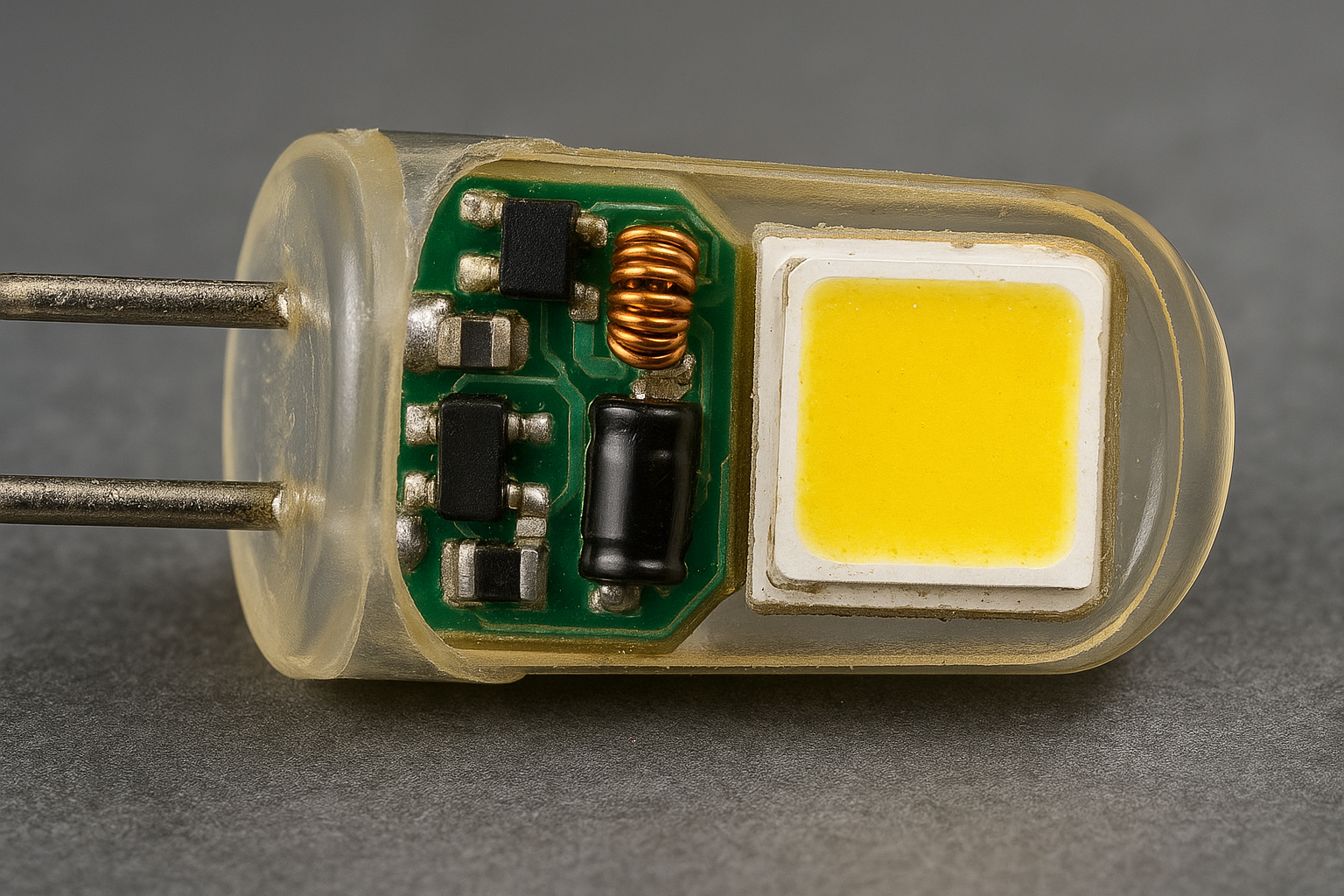
The limiting factor in G4 LED lamp reliability in enclosed fixtures is almost always the driver, not the LED chip itself.
LED chips have become very reliable at normal operating temperatures. Modern LED chip packages are rated for junction temperatures well above what a typical enclosed decorative fixture will produce. The driver circuit — the component that converts incoming AC power to the DC power the LED needs — is a different story. Drivers contain electrolytic capacitors and other components whose rated lifespan drops sharply as operating temperature rises.
The relationship is not linear. A driver capacitor rated for 2,000 hours at 85°C may last 15,000 hours at 65°C. The same capacitor at 95°C might last 800 hours. In an enclosed fixture where the internal temperature runs 20–30°C above ambient, the difference between a driver designed with appropriate temperature derating and one that was not becomes visible very quickly in a large-volume installation.
What this means for importers: the driver specification inside a G4 lamp is not a visible feature, but it is the feature that determines whether the product delivers on its rated lifespan in real installations. Buyers should ask their supplier directly: what is the rated operating temperature of the driver in this G4 lamp? What are the capacitor ratings? Has the driver design been tested inside an enclosed fixture at elevated ambient temperature?
A supplier who can answer these questions with test data is a different kind of supplier from one who can only confirm the rated lifespan on the spec sheet. For a broader look at how compact LED lamp engineering quality varies between suppliers, see why G4 and G9 lamps expose weak supplier design faster than standard bulbs →. The spec sheet number is measured in a controlled open-air environment. The driver operating temperature data tells you whether the product was actually designed for the applications your customers are using it in.
What to Specify Before Placing a G4 Lamp Order for Enclosed Fixture Channels
The enclosed fixture failure pattern is avoidable. It requires adding a small number of thermal-focused questions to the standard G4 lamp specification process.
Maximum rated operating temperature (Tc or Ta). The lamp spec sheet should state the maximum ambient operating temperature the product is rated for. For enclosed fixture applications, this number needs to be higher than for open fittings. A G4 lamp rated for Ta 40°C is unlikely to survive long-term in a small enclosed glass fixture where the internal temperature routinely reaches 50–60°C during use.
Enclosed fixture compatibility statement. Some lamp specifications explicitly state whether the product is suitable for enclosed fixtures. This is a meaningful differentiator. A supplier who can provide an enclosed fixture compatibility rating has done the thermal validation work. A supplier who cannot is not necessarily producing an inferior product — but the buyer is taking on the thermal risk without the supporting data.
Driver component ratings. Ask for the rated temperature of the driver's main capacitors. The answer tells you whether the driver was designed with thermal margin for enclosed applications or whether it was designed to pass open-air tests only.
Sample thermal test. Before approving bulk production, run the sample in your target fixture for two to four hours. Measure the fixture's internal temperature and compare it against the lamp's rated operating temperature. If the fixture temperature consistently exceeds the lamp's rating, either the lamp specification needs to change or the fixture type needs to be reconsidered.
These checks do not require engineering expertise. They require asking the right questions before the order is placed. Most of the G4 enclosed fixture failures we see in returned products were entirely predictable — and entirely avoidable — at the specification stage. Note that G9 lamps carry a different risk profile from G4; if you source both, see our guide on how G4 and G9 differ in failure mode and return risk →.
How This Failure Pattern Affects Importers at Scale
A 3–5% return rate on a 10,000-piece G4 lamp program sounds manageable until the returns start arriving. The cost is not only the replacement units — it is the logistics, the customer service load, the warehouse handling, the credit notes, and the reputational damage in a distribution channel where buyers talk to each other.
The shape of the failure makes it worse than a simple defect claim. A batch of G4 lamps that are visibly wrong on arrival is caught immediately. A batch that fails at three to six months of installation creates a different problem — the product has already been sold through, installed by the end user, and reported as faulty after months of normal use. By the time the return rate becomes visible, the product may already be out of distribution. The importer is absorbing replacement costs on a product that is no longer generating revenue.
The enclosed fixture failure pattern also creates a warranty claim problem. If the product was sold with a 2-year or 3-year warranty — which is standard for LED lamps in many markets — a thermal failure at six months triggers a warranty claim that is difficult to dispute without clear thermal specification data. Without documented enclosed fixture test results showing the lamp's operating temperature limits, the importer has limited grounds to argue that the failure was an installation issue rather than a product defect.
Thermal specification is not a technical detail. It is commercial protection. The data that defines what the product was and was not designed to do is the same data that determines whether a warranty claim is a supplier responsibility or a buyer-side installation issue. Importers who do not collect this data at the order stage are absorbing risk that better specification would have transferred back to the supplier — or eliminated entirely.
FAQ
Why do G4 LED lamps fail faster than their rated lifespan?
In most cases, the cause is thermal — the lamp is installed in an enclosed fixture where the internal temperature exceeds the lamp's rated operating temperature. The rated lifespan is measured in open-air conditions. Enclosed fixtures accumulate heat and reduce effective lifespan significantly when the lamp was not designed for those thermal conditions.
How do I know if a G4 LED lamp is suitable for enclosed fixtures?
Ask the supplier for the lamp's rated maximum ambient operating temperature (Ta) and whether the product has been tested and approved for enclosed fixture use. A lamp with an enclosed fixture compatibility rating has been validated; one without may perform adequately or may not, depending on the fixture.
What temperature should a G4 LED lamp be rated for in enclosed fixture applications?
Enclosed decorative fixtures commonly reach 50–70°C internally during use. A G4 lamp for enclosed applications should ideally be rated for a maximum ambient temperature of at least 50–60°C, with driver components rated accordingly.
Can I test samples myself before placing a bulk order?
Yes. Install the sample lamp in your target fixture, run it for two to four hours, and measure the internal fixture temperature. Compare this against the lamp's rated operating temperature. If the fixture temperature exceeds the lamp's rating during normal operation, the product is not suitable for that application without a change in specification.
Does the enclosed fixture problem affect all G4 LED lamp suppliers equally?
No. Suppliers who have designed their G4 lamps with thermal margin for enclosed applications produce products that perform significantly better in these conditions. The difference is in the driver design and the thermal validation work done during product development, not in the visible lamp specification.
Conclusion: Thermal Specification Is the G4 Check That Most Buyers Skip
The G4 LED lamp category has a well-established failure pattern that produces a predictable volume of returns in any large-scale distribution program where enclosed fixtures are involved. The failure is thermal. The root cause is a specification process that validates performance in open-air conditions and then sends the product into sealed environments where those conditions do not exist.
The solution is not complicated. It is a short list of thermal-focused questions added to the sample approval process, a test run inside a representative enclosed fixture before the production order is placed, and a supplier conversation that goes beyond rated lifespan claims to driver component ratings and enclosed fixture validation data.
Buyers who close this specification gap before placing a G4 lamp order are not doing more work than buyers who don't. They are doing the work at the right point in the process — before the product is in distribution — rather than at the much more expensive point of managing returns, warranty claims, and replacement programs after the failure has already occurred at scale.
If you are sourcing G4 LED lamps and want to discuss enclosed fixture compatibility, driver specifications, or sample thermal testing for your target applications, contact our team → for a practical conversation about your order requirements.
References
- IEC 62560 and related standards define test conditions for self-ballasted LED lamps, including operating temperature specifications. Actual fixture thermal conditions can vary significantly from standard test environments.
- ENERGY STAR specifications for lamps include requirements for enclosed fixture compatibility where applicable. See energystar.gov for current lamp program requirements.
- Capacitor lifetime derating with temperature is well documented in component manufacturer datasheets and LED driver design guides published by organizations such as LED Professional.
- The Zhaga Book specification for LED modules and components provides reference dimensions and thermal interface standards relevant to compact LED lamp design. See zhagastandard.org.
- EU EPREL database requirements for registered lamp products include declared performance parameters that buyers can use to verify product claims. See eprel.ec.europa.eu.
Related HongYu Bulb product pages
- LED Filament Bulb Product Range → — standard and decorative LED filament bulbs for wholesale and project sourcing.
- Contact HongYu Bulb → — send specifications, target market, quantity and packaging requirements for quotation.