The Regulatory Shift Toward Lower CCT — What Is Driving It
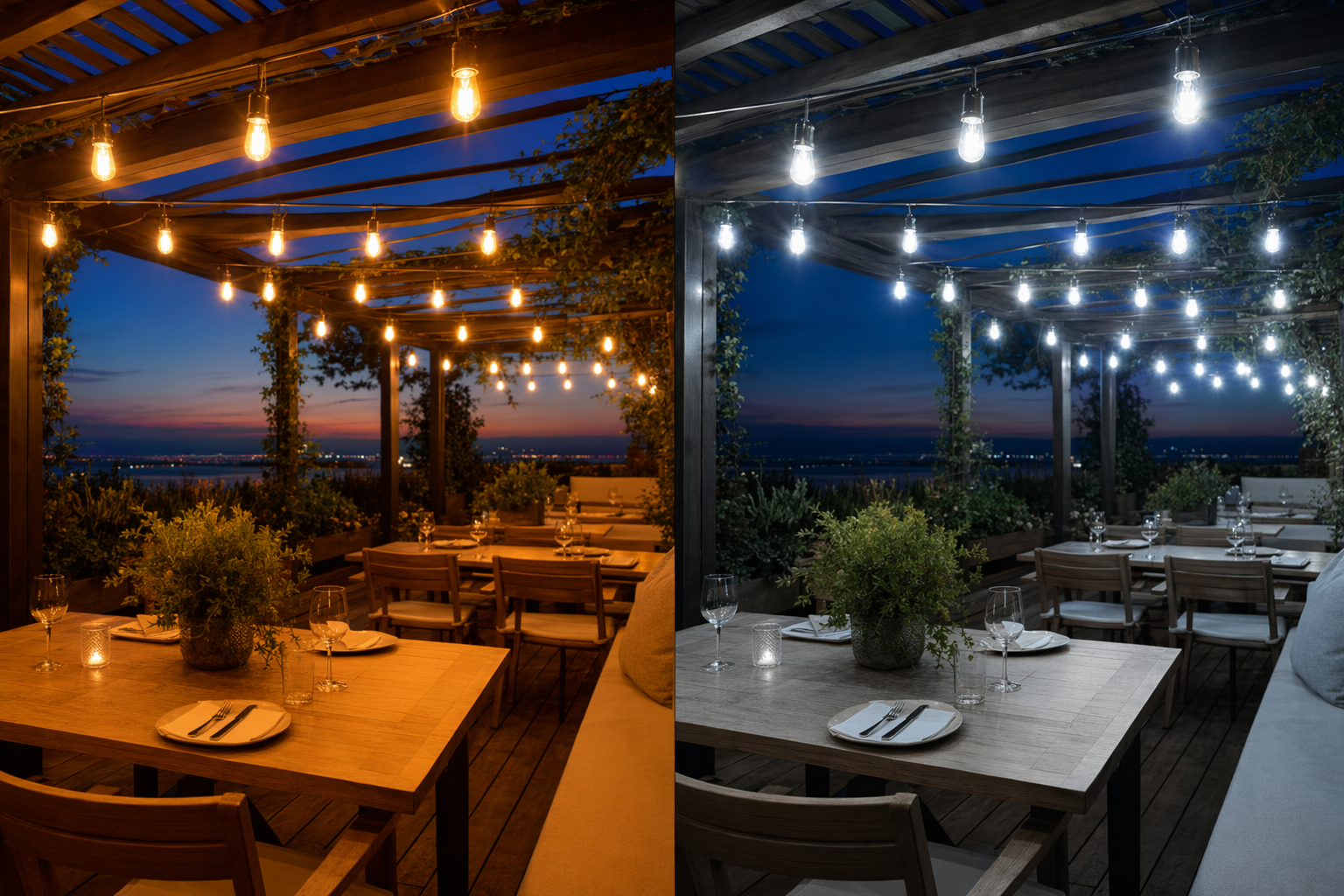
Here is the procurement risk that most buyers have not yet priced in: if you are speccing 3000K or above for outdoor decorative or commercial applications today, you may be building a compliance problem into your next product range — not some theoretical future range, but the one you are sourcing now and expecting to sell over the next two to three years.
For most of the past decade, color temperature choice in decorative LED filament lighting was treated as an aesthetic call. Warm white (2200K–2700K) suited hospitality and residential environments. Cooler temperatures (3000K–4000K) found favour in retail and commercial settings. Neither choice had regulatory consequences.
That assumption is now outdated. In 2026, both US state-level legislation and EU policy frameworks are converging on a ceiling for outdoor luminaire color temperature — and that ceiling is at or below 3000K, with clear directional pressure pushing it lower. For buyers who have been treating 3000K as a safe "neutral" position, the regulatory picture has changed in a way that makes that position look increasingly exposed.
The drivers are distinct but move in the same direction. In the United States, the push comes from the dark sky movement and its documented evidence that blue-shifted outdoor lighting disrupts wildlife, human sleep cycles, and astronomical observation. In Europe, the push comes from energy resilience, environmental sustainability, and photobiological safety policy. Both paths are converging on the 2200K–2700K range as the compliant, future-safe position for outdoor and ambient decorative applications.

What Illinois SB 3037 Means for US Decorative Lighting Buyers
In May 2026, the Illinois General Assembly introduced Senate Bill 3037, the Dark Sky Act. The bill proposes to cap outdoor luminaire color temperature at 3000K for lighting installed at state-funded facilities, with provisions encouraging equivalent standards for commercial outdoor lighting statewide.
Read that again: the proposed maximum is 3000K. Not 4000K, not 3500K — 3000K is the ceiling. Buyers who have been speccing 3000K as a compliant "warm" option are sitting at the regulatory boundary, not comfortably inside it. When Illinois tightens this standard in a future legislative cycle — which the IDA and environmental groups are actively pushing for — 3000K becomes the new non-compliant position. At that point, only 2700K and below clears the bar.
Illinois is not operating in isolation. The International Dark-Sky Association (IDA) has been advocating for outdoor lighting CCT limits below 3000K for years, and its Fixture Seal of Approval program already requires 3000K or below — with the programme explicitly favouring 2700K and below for dark-sky-sensitive zones. Tucson, Arizona and multiple Hawaii communities have enacted 2700K-or-lower ordinances. These are not fringe jurisdictions. They are leading indicators of where mainstream commercial specification is heading.
For importers sourcing decorative LED filament bulbs for US outdoor applications — string lights, café lighting, hospitality terraces, event venues — the practical implication is this: a 3000K outdoor decorative SKU you spec and stock today could be facing a retail or project specification barrier within your next one or two buying cycles. A 2700K spec navigates that risk entirely. The U.S. Department of Energy's Solid-State Lighting program has similarly flagged blue-light content in outdoor LED applications as a growing regulatory concern, noting that 2700K represents a practical ceiling for dark-sky-sensitive environments.
This is not a fringe concern. It is a procurement decision with a horizon measured in buying cycles, not decades.

The EU Energy Resilience Push and Its Connection to Lighting CCT Limits
In the European Union, the regulatory pressure toward lower CCT arrives from a different direction — not dark sky conservation, but energy resilience, environmental sustainability, and photobiological safety — and it has been building steadily within the Ecodesign and Energy Labelling framework.
The EU's Ecodesign Regulation and its predecessor directives already impose minimum efficiency requirements on LED lamps placed on the EU market. What is less widely understood by importers is the direction of travel within the framework's evolving technical annexes: the environmental impact of blue-light content in consumer and outdoor lighting is increasingly part of the regulatory conversation, not an afterthought. The European Commission's EUR-Lex portal hosts a growing body of legislative guidance on photobiological safety for lighting products, and the trajectory points toward tighter constraints on short-wavelength (blue-shifted) light in consumer-facing applications.
LightingEurope, the industry association for major European lighting manufacturers, has acknowledged in its position papers that the 2200K–2700K segment is increasingly aligned with both regulatory direction and sustainability positioning. Their guidance is written for manufacturers with long product development cycles — but the same logic applies to importers: the SKUs you bring to market now will be on shelf or in project specifications for three to five years. Products designed around the 2200K–2700K range will be better positioned for future regulatory tightening than those built around 3000K–4000K.
For buyers placing LED filament products on the EU market, the structural message is the same as in the US: the warm white range that defines the LED filament category is the range that regulation is moving toward. This is a structural advantage that requires no product redesign to exploit — it is already baked in.
For a deeper treatment of the cost implications when CCT is mis-specified at the purchase order stage, see our earlier analysis: Why Getting Color Temperature Wrong Costs More Than Getting the Price Wrong →.

Why 2200K–2700K LED Filament Bulbs Are Structurally Well-Positioned
The LED filament bulb category was built around the 2200K–2700K range by design — not for regulatory reasons, but because the product's entire aesthetic identity is built on mimicking the warm amber glow of traditional incandescent lamps. That heritage turns out to be a compliance asset.
Unlike standard LED bulbs, which can be manufactured across a wide CCT range with equal technical ease, LED filament bulbs are category-defined by their warm amber appearance. A 4000K LED filament bulb is a technical oddity; the market does not ask for it, and manufacturers do not optimise for it. The visual and commercial core of the category sits firmly in the 2200K–2700K band — which is exactly where regulators are directing outdoor and ambient decorative applications.
This means buyers and brands who have built their product range around LED filament bulbs are already positioned in the CCT segment that regulation is moving toward. They did not engineer this for compliance reasons. It is a consequence of the product's heritage. But it is a real commercial advantage as CCT restrictions expand, because it means their existing inventory is not at risk of becoming a stranded asset in compliance-sensitive markets.
The advantage applies across the full filament format range. A60 standard, T45 tubular, G40 globe, ST64 vintage Edison, and compact formats like G4 and G9 all operate naturally in the 2200K–2700K band. Buyers offering these formats to hospitality, outdoor, and commercial decorative customers are offering products that are already regulation-ready in an expanding number of jurisdictions — and that story is worth telling explicitly in customer-facing materials and tender documentation.
For form-factor-specific specification guidance, see: A60 LED Filament Bulbs: Why the Most Common SKU Is Also the Most Commonly Misspecified →, T45 Tubular LED Filament Bulbs: What B2B Buyers Need to Know →, and G40 Globe LED Filament Bulbs: How to Spec and Source for Commercial Outdoor Applications →.

What Importers and Brands Should Document About CCT in Their Purchase Specs
Given the regulatory trajectory, CCT documentation in purchase specifications deserves more precision than it typically receives. Here is what a well-structured CCT specification for LED filament bulbs should include — both to protect against color consistency failures and to create a documented compliance record for customers in CCT-restricted markets.
- Nominal CCT with explicit value: State the target CCT as a number, e.g., "2700K nominal" or "2200K nominal." Do not accept supplier shorthand like "warm white" without a CCT number attached. "Warm white" has been used to describe everything from 2200K to 3500K depending on the supplier.
- CCT tolerance and ANSI bin: Specify the acceptable tolerance around the nominal CCT. The Illuminating Engineering Society (IES) and ANSI C78.377 define standard CCT bins for LED lighting. Requiring compliance with a specific ANSI bin limits the CCT variation that is acceptable within a production batch and creates a documented standard your supplier is contractually bound to.
- Initial CCT test certificate: Require that each production batch is tested for initial CCT by an accredited laboratory, with test certificates provided before shipment. For buyers in CCT-restricted markets, this documentation is not just quality assurance — it is the evidence chain you need if a customer or project specifier asks you to demonstrate regulatory compliance.
- Color maintenance over rated life: For hospitality and long-term installation applications where CCT consistency matters across replacement cycles, require LM-80 test data on the LED chip and a stated maximum CCT shift at the rated lumen maintenance threshold.
- Application-specific dark-sky labeling: For outdoor applications where dark-sky compliance is already required or likely, consider adding "2700K CCT — dark-sky compatible" to product labeling and documentation. This is a low-cost positioning move that adds tangible value to customers in jurisdictions with CCT restrictions, and it differentiates your offering from suppliers who have not thought ahead.
Getting CCT specification right at the purchase order stage is the most cost-effective point of control in the supply chain. Rejecting a batch over CCT deviation after manufacture costs orders of magnitude more than preventing the deviation through clear specification upfront. The ENERGY STAR LED lamp specification provides a useful external reference for what "acceptable CCT maintenance" means in practice for the US market.
Related HongYu Bulb product pages
- LED Filament Bulb Product Range → — standard and decorative LED filament bulbs for wholesale and project sourcing.
- EU Dim-to-Warm Bulbs → — warm dimming filament bulbs for hospitality and mood lighting.
- LED Dimming Guide → — technical guidance for TRIAC dimming, flicker and compatibility.
- CRI Guide for LED Bulbs → — guidance on CRI 80, CRI 90 and CRI 95 project decisions.
- ETL, CE & RoHS Certification Guide → — sourcing guidance for certification and import compliance.
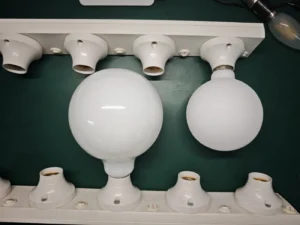
- Big Decorative Bulbs → — oversized decorative filament bulbs for hospitality, retail and statement fixtures.
Conclusion
The core point is worth stating plainly: a buyer who specs 3000K for outdoor decorative applications today is sitting at the regulatory boundary, not inside it. As Illinois SB 3037, IDA model ordinances, municipal lighting codes, and EU sustainability policy all push in the same direction, 3000K is not a future-safe position — it is the position most likely to face a compliance barrier within the next buying cycle or two.
The 2200K–2700K range that defines the LED filament category is not just aesthetically appealing and market-proven. It is structurally aligned with where outdoor lighting regulation is heading in both the US and EU. Buyers who have built their product range around LED filament bulbs already hold this advantage. The practical question is whether you are documenting and communicating it — to your own customers, in tender submissions, and in the CCT specifications you write into purchase orders.
Treat CCT as a formal procurement specification: state the nominal value, require an ANSI bin tolerance, and require batch test certificates before shipment. This protects you from color consistency complaints and creates the compliance documentation trail that customers in CCT-restricted markets will increasingly ask for. The products you are already sourcing are the products the market is moving toward. Make sure your specs and documentation reflect that.
External References
- IDA Fixture Seal of Approval Program (3000K CCT requirement) — International Dark-Sky Association
- Solid-State Lighting Program (blue-light content and outdoor LED guidance) — U.S. Department of Energy
- ANSI C78.377 CCT Bin Standards — Illuminating Engineering Society
- Ecodesign Regulation and photobiological safety guidance — European Commission EUR-Lex
- Warm CCT market positioning guidance — LightingEurope
- LED Lamp CCT Maintenance Specification — ENERGY STAR