The Counterfeit Component Problem in Decorative LED Bulb Supply Chains

In May 2026, ams OSRAM — one of the world's leading LED chip manufacturers — confirmed it had filed patent infringement proceedings against manufacturers actively using counterfeit versions of its LED chip technology. The company stated it is monitoring global supply chains, including markets where decorative LED filament products are manufactured at volume. This is not a new problem, but the enforcement posture has hardened.
For importers and private label buyers sourcing decorative LED filament bulbs from Chinese factories, this development is a signal worth taking seriously. The counterfeit component issue in decorative LED supply chains is real, persistent, and almost impossible to catch through the methods most buyers currently use.
The core problem is deceptively simple: counterfeit or substandard LED chips, driver ICs, and phosphor blends look identical to legitimate components during a finished product inspection. They are installed in the same bulb housing, run at the same wattage, and produce light that appears similar to spec. The divergence — in lifespan, color consistency, and thermal stability — only becomes visible after thousands of operating hours, by which time the product is in your customer's hands.
This guide is written for private label buyers who want to understand where the risk lives and what they can verify before committing to a mass production order.

Why Finished Sample Inspection Does Not Catch Component-Level Risk
The standard buyer workflow goes something like this: request samples, evaluate appearance and initial performance, approve, place order. For many product categories, this is adequate. For LED filament bulbs with a counterfeit component risk, it is not.
Finished sample inspection will tell you:
- Whether the bulb lights up at the stated wattage
- Whether the color temperature appears roughly correct to the eye
- Whether the glass shape and base type match your specification
- Whether the visible filament style is what you ordered
Finished sample inspection will not tell you:
- Whether the LED chip inside is a genuine branded component or a counterfeit/grey-market equivalent
- Whether the driver IC is from the supplier you were told, or a substituted clone
- Whether the phosphor blend is consistent with the CCT you specified, or a close approximation that will shift over time
- Whether the components will perform to spec at 3,000 hours, 6,000 hours, or 10,000 hours
The U.S. Department of Energy's SSL program has documented in multiple gateway and CALiPER studies that LED products with apparently identical initial performance can diverge significantly in lumen maintenance, color shift, and reliability over time — driven entirely by component quality differences that are invisible at the point of sale.
The same principle applies to compact specialty products. As we discuss in Why Compact G4 and G9 LED Lamps Expose Weak Supplier Design Faster Than Standard Bulbs →, the smaller form factors in the G4 and G9 category amplify the consequences of substandard component choices — there is less thermal mass to absorb the heat that a marginal driver generates.
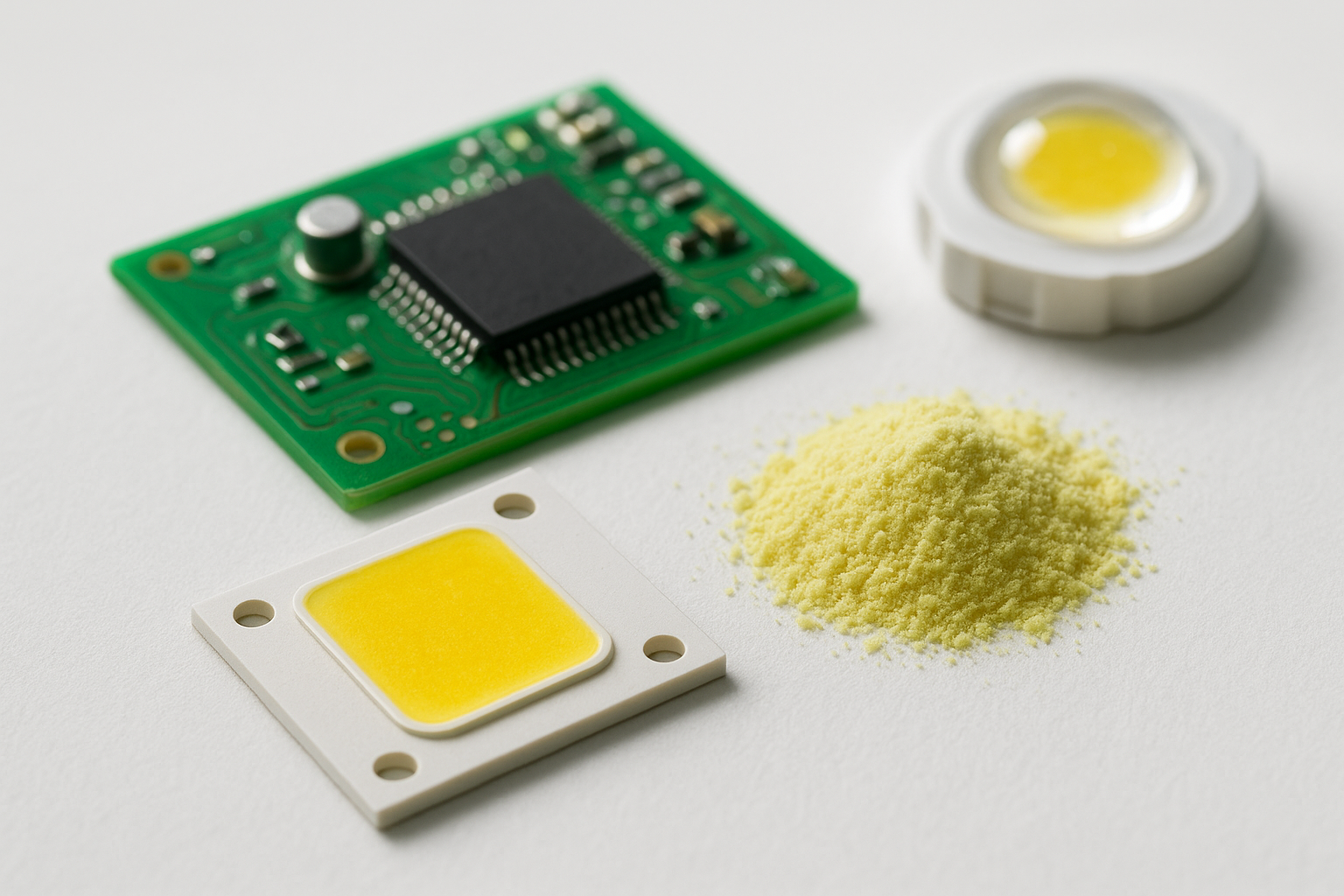
The Three Components Most Commonly Substituted: LED Chip, Driver IC, and Phosphor Blend
Component substitution in LED bulb supply chains concentrates in three areas:

1. The LED Chip
Genuine LED chips from manufacturers like ams OSRAM, Nichia, Cree, or Samsung carry traceable specifications: forward voltage range, lumen output per watt, color rendering index, and expected lumen maintenance curves (L70/L80 at stated junction temperatures). Counterfeit chips carry the same labels but are manufactured to different standards, often with higher defect rates and lower lumen maintenance than the genuine product.
The ams OSRAM IP enforcement action in May 2026 targets manufacturers selling products that incorporate chips marketed as genuine OSRAM technology but manufactured without authorization. Buyers sourcing private label products cannot know whether this applies to their supplier without active verification.
2. The Driver IC
The driver integrated circuit controls how power is delivered to the LED chip. Genuine driver ICs from suppliers like ROHM, Macroblock, or ON Semiconductor are manufactured to tight specifications for input voltage range, output current regulation, and thermal shutdown behavior. Counterfeit driver ICs may appear identical but lack proper thermal protection, leading to overcurrent conditions and premature failure — particularly in enclosed fixtures.
The connection between driver quality and enclosed fixture performance is significant. We cover this in detail for the G4 category at Why G4 LED Lamps That Look Fine in Samples Fail Early in Enclosed Fixtures →.
3. The Phosphor Blend
In LED filament bulbs, the warm amber color of the "filament" effect is produced by a phosphor coating on the LED substrate. The phosphor blend determines color temperature, color rendering index (CRI), and how the color shifts over time. Substituted or lower-grade phosphor blends may produce acceptable initial readings on a spectrometer but show significantly higher color shift at 3,000+ hours, resulting in customer complaints about inconsistent color across a batch or between replacement lamps.
This is directly related to the specification and sourcing issues we discuss in Why Getting Color Temperature Wrong Costs More Than Getting the Price Wrong →.
The Illuminating Engineering Society (IES) LM-80 and TM-21 test protocols are specifically designed to characterize LED component lumen maintenance — but these tests must be conducted on the actual chip component, not just on the finished bulb. A supplier who can provide LM-80 data for their LED chip is providing traceable evidence of component quality; a supplier who cannot or will not provide this data creates a verification gap.
What to Ask Your Supplier Before Placing a Mass Production Order
Before placing a mass production order for private label LED filament bulbs, the following questions should be standard parts of your supplier qualification process:
- What is the brand and part number of the LED chip used in this product? A credible supplier should be able to provide this without hesitation. If the answer is vague ("tier 1 chip," "well-known brand"), treat it as a flag.
- Can you provide the LED chip manufacturer's datasheet for this specific component? Genuine datasheets carry forward voltage specifications, lumen output curves, and operating temperature ranges. Compare the datasheet specs against the bulb's claimed performance.
- Can you provide LM-80 test data for the LED chip? LM-80 data is a standard industry requirement for any LED component sold into regulated markets. If the supplier cannot produce it, either the chip is not from a credible manufacturer, or the supplier does not have documentation of what is actually inside their product.
- What driver IC is used, and who is the manufacturer? Request the driver IC manufacturer's name and part number.
- Are you authorized to use the LED chip brand you have specified? This question matters specifically in the post-OSRAM enforcement context. An authorized supplier can provide evidence of a supply relationship with the chip manufacturer.
It is also worth checking whether the supplier has current certifications for the target market — CE marking for Europe, UL listing for the US. ENERGY STAR certification, while voluntary, also requires component-level documentation. The ENERGY STAR certified light bulbs database is publicly searchable and provides a reference for what documentation standards look like for verified products.
How to Build Component Traceability Into Your Private Label Contract
Asking the right questions before order placement is necessary but not sufficient. Component traceability needs to be contractualized to be enforceable. Here is how to structure that protection:
- Bill of Materials (BOM) lock: Require the supplier to submit a full BOM listing the LED chip brand, driver IC brand, and key passive components before production confirmation. Include a contractual clause stating that any substitution without your written approval constitutes a breach of contract and triggers right of return.
- Pre-production sample inspection (PPSI): Before mass production begins, request a pre-production sample and have it independently tested for initial lumen output, CCT, CRI, and power factor. This creates a documented baseline against which production units can be compared.
- Third-party factory audit: For significant orders, a third-party factory audit that includes component stock verification — checking that actual chip inventory on the production floor matches the BOM — provides a layer of assurance that cannot be faked in documents alone.
- Post-production batch testing: Specify that 1–3% of each production batch must be tested by an independent lab (or at minimum by the factory's own accredited lab) before shipment, with test reports provided as a condition of payment release.
These steps mirror best practices recommended by LightingEurope, the industry association representing European lighting manufacturers, which has published guidance on quality assurance in LED supply chains and the risks of unverified component sourcing.
For buyers who also source dimmable products, component substitution in the driver circuit has additional consequences for dimmer compatibility. We cover this in Why Ordering Dimmable G4 or G9 Lamps Without Compatibility Spec Creates Complaints → and in our guide on How to Specify Dimming Compatibility When Ordering Private Label LED Filament Bulbs →.
The IEC publishes standards (including IEC 62612 for self-ballasted LED lamps and IEC 62560 for LED light bulbs) that specify test methods and minimum performance requirements. Requiring your supplier's products to be tested against these standards by an accredited third-party lab gives you documented evidence of performance that is independent of the supplier's own claims.
Related HongYu Bulb product pages
- LED Filament Bulb Product Range → — standard and decorative LED filament bulbs for wholesale and project sourcing.
- Custom Color Bulbs → — custom glass color, coating and printed finish options for private-label collections.
- Custom Logo Bulbs → — printed branding and private-label decorative bulb options.
- Big Decorative Bulbs → — oversized decorative filament bulbs for hospitality, retail and statement fixtures.
- Contact HongYu Bulb → — send specifications, target market, quantity and packaging requirements for quotation.
Conclusion
The ams OSRAM IP enforcement action in May 2026 is a useful reminder that counterfeit component risk in the LED filament bulb supply chain is active, not theoretical. For private label buyers, the risk is not primarily legal — it is commercial. Counterfeit or substandard components produce failures that arrive months or years after purchase, in distributed form across your retail or hospitality customer base, with no easy path to root cause analysis or resolution.
Protecting yourself requires moving beyond finished sample inspection. It requires asking for component-level documentation, building BOM controls into your purchase contracts, and establishing a pre-production verification step that creates a documented baseline before mass production begins.
Suppliers who resist these requests — who cannot or will not provide chip datasheets, LM-80 data, or driver IC specifications — are telling you something important. A manufacturer with nothing to hide has no reason to withhold component documentation. Build that expectation into your sourcing process, and you substantially reduce your exposure to the quality failures that drive returns, chargebacks, and reputational damage.