Most importers of decorative LED filament bulbs spend more time negotiating unit price than specifying color temperature. That is understandable — price is a visible number that appears on every quotation, and a one-cent-per-unit difference across a 10,000-piece order is easy to calculate.
The cost of the wrong color temperature is harder to calculate before it happens and much larger after it does.
An order placed at a slightly higher unit price with the correct color temperature for the target market will sell. An order placed at the lowest possible unit price with the wrong color temperature will sit in a warehouse, get marked down, or get returned. In most cases, the markdown and warehousing cost of unsellable inventory at the wrong color temperature exceeds the total savings from months of price negotiation.
Color temperature is not a neutral specification. It is a market preference that varies significantly by country, channel, application, and end customer expectation — and getting it wrong is one of the most expensive and least recoverable mistakes in decorative LED filament bulb sourcing.
This article covers what importers and lighting brands need to know about color temperature preferences by market, why the decorative filament bulb category has specific dynamics that differ from standard LED lamps, and how to specify color temperature correctly for the markets you are actually selling into.
Decorative Filament Bulbs Have a Different Color Temperature Logic Than Standard LED Lamps
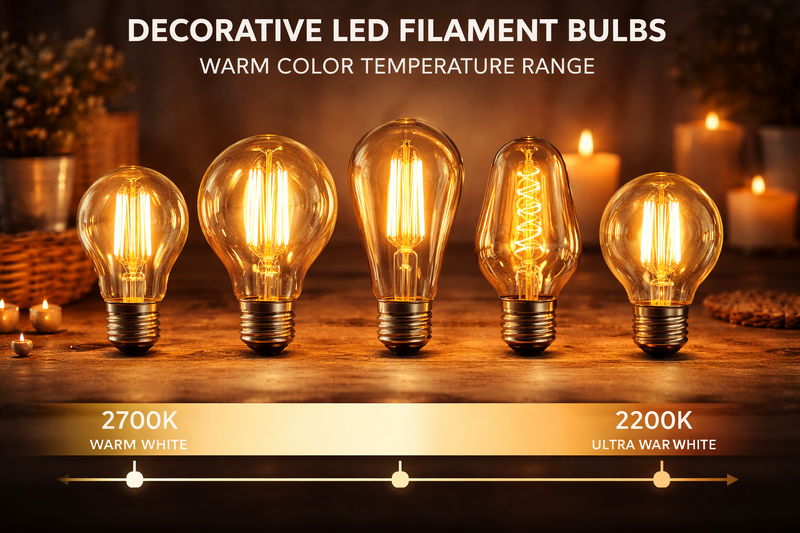
Standard LED lamps are sold across a wide color temperature range — from 2700K residential warm white through to 6500K daylight — and the choice depends heavily on application. Office lighting skews cooler. Residential bedroom lighting skews warmer. The commercial rationale for different color temperatures across the standard LED range is well established.
Decorative LED filament bulbs operate in a narrower band, and the logic is different.
The commercial value of decorative filament bulbs is almost entirely based on their visual resemblance to vintage incandescent and Edison bulbs. That aesthetic depends on the warm, amber-tinted glow that incandescent lamps produce — a color temperature typically between 2200K and 2700K. A decorative filament bulb at 4000K or 5000K is a technical product that has lost its primary reason for existing. It no longer looks like the warm, nostalgic object that drives consumer purchase decisions and supports the premium retail price positioning that makes the category commercially interesting.
This means that for most markets and most channels where decorative filament bulbs are sold, the color temperature question is not "warm, neutral, or cool" — it is "how warm, exactly?" The difference between 2200K, 2400K, 2700K, and 3000K within the warm white range matters commercially, and the preference differs by market.1
European Markets Are the Most Demanding on Warm Accuracy — and the Most Unforgiving When It Is Wrong
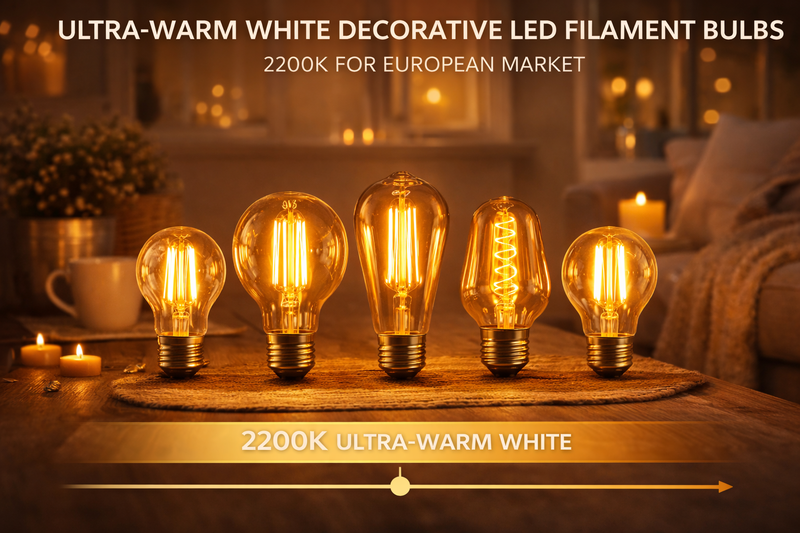
European buyers of decorative LED filament bulbs have a strong, consistent preference for ultra-warm color temperatures — typically 2200K to 2400K — that closely match the warmth of traditional incandescent lamps. This preference is reinforced by decades of residential lighting culture built around incandescent bulbs, and by the fact that EU regulations phased out standard incandescent lamps, making LED filament bulbs the primary way to preserve that aesthetic.
The German, Dutch, Scandinavian, and UK markets in particular are sensitive to color temperature accuracy. A bulb specified as 2700K but actually producing 2800K or appearing visually cooler than expected will draw complaints from professional buyers and retail customers who are comparing the product against their existing warm incandescent references or against a competitor's correctly specified product.
The most common color temperature mistake for the European market is ordering 2700K when the target application needs 2200K or 2400K. The 2700K specification is correct for standard LED lamps in Europe. For decorative filament bulbs in residential and hospitality applications, it is often not warm enough to satisfy the product expectation of buyers who want the maximum visual similarity to the incandescent bulbs they are replacing.
For importers serving the premium European residential or hospitality segment, 2200K is the safer specification. For mid-market retail, 2400K is a reasonable mid-point. 2700K works for buyers who are more price-sensitive or less focused on incandescent matching as a value proposition.2
The US Market Is More Segmented, but the Default Mistake Is Still Ordering Too Cool
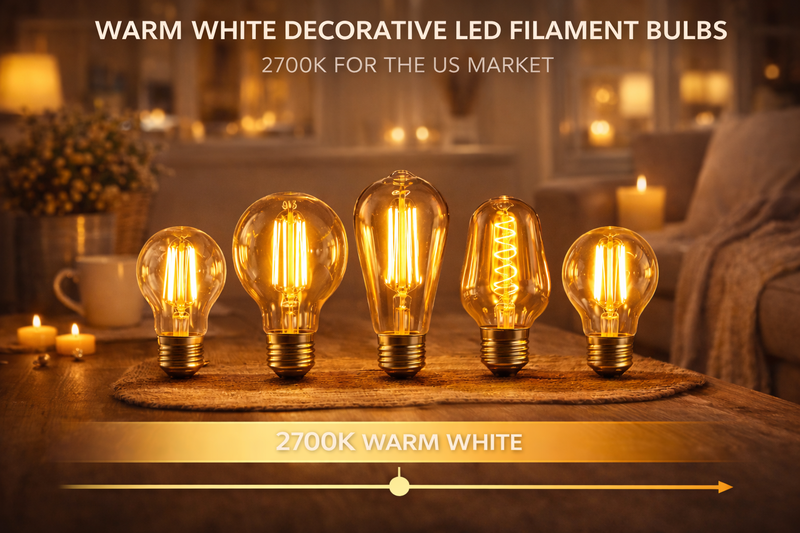
The US market for decorative LED filament bulbs is more segmented by channel than the European market, and the right color temperature specification depends significantly on where the product will be sold.
Mainstream residential retail — home improvement chains, general merchandise retailers — is primarily a 2700K market for decorative filament bulbs. This matches the standard residential warm white expectation that has become the US LED lighting norm, and it is the safest specification for importers who do not have detailed information about their end channel.
Premium residential and renovation channels — specialty lighting showrooms, online premium lighting retailers, design-oriented home goods brands — increasingly specify 2200K to 2400K to differentiate their product from standard LED lamps and to appeal to buyers seeking maximum incandescent resemblance.
Hospitality and restaurant supply is the most demanding US channel for color temperature accuracy, with most foodservice and hotel design specifications landing at 2200K to 2400K. Restaurants using decorative filament bulbs are doing so primarily for the warm, flattering ambient light they create, and 2700K is often considered too white for serious hospitality applications.
The common importer mistake in the US market is treating 2700K as universal and missing the premium channel opportunity that 2200K enables, or ordering a mixed SKU range without understanding that the volume and margin in each channel differ significantly.3
The Japanese Market Has the Strictest Appearance Consistency Standards of Any Major Market
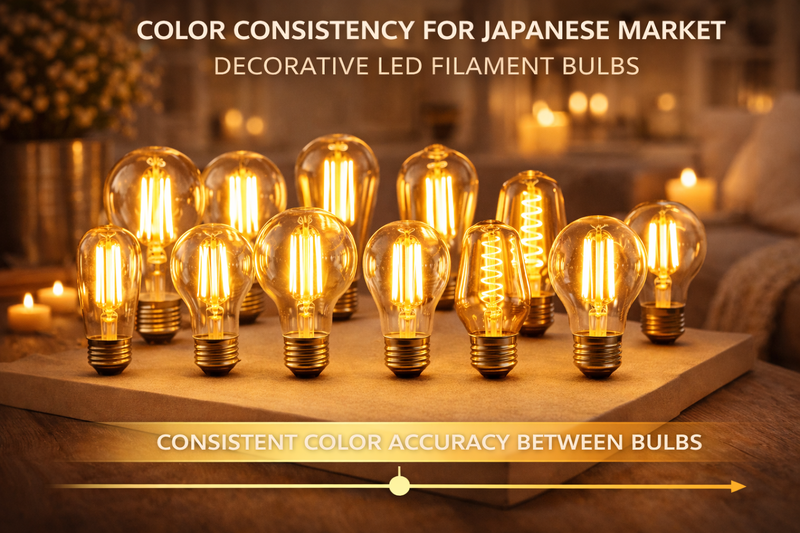
Japan is the market where color temperature specification errors become most visible and most costly, because Japanese buyers expect a level of unit-to-unit color consistency that is significantly more demanding than most other markets.
In the Japanese residential and retail channel, decorative filament bulbs are typically sold at a 電球色 (incandescent color) standard, which corresponds to approximately 2700K to 2800K. The hospitality and specialty lighting channel prefers warmer options, often 2200K to 2500K.
The specification challenge for importers targeting Japan is not only choosing the correct color temperature — it is also ensuring that the production batch delivers that color temperature consistently, with minimal variation between individual units. Japanese retail buyers frequently reject shipments where multiple units lit simultaneously show visible color variation, even if every unit technically measures within a stated tolerance. The visual test, rather than the instrumental test, is often the commercial reality for products displayed in Japanese retail environments.
This means that for Japan, importers should specify color temperature tolerance explicitly — typically ±100K or tighter for premium applications — and request that the factory confirm its production consistency data for the specified model before order confirmation. A supplier who cannot provide consistency data for a Japanese-market order is a supplier whose production QC may not be suited to that channel's expectations.4
Australia and New Zealand Follow the European Preference Pattern, Not the US Pattern
Importers who source for both US and Australian markets sometimes assume the two markets have similar color temperature preferences. They are meaningfully different for decorative filament bulbs.
The Australian residential and hospitality market follows a preference pattern closer to the European market than the US market. Ultra-warm white — 2200K to 2400K — is the dominant preference in the café, restaurant, and premium residential sectors where decorative filament bulbs are most actively purchased. The 2700K specification that works as a safe default in US mainstream retail tends to read as too cool in Australian hospitality-focused retail environments.
This distinction matters for importers who try to rationalize their SKU range across multiple markets. A 2700K product that performs well in US mainstream retail may need a separate 2200K SKU for the Australian market rather than assuming the same product works in both channels.
How to Specify Color Temperature Correctly for Your Target Market and Channel
Before finalizing any decorative LED filament bulb order, importers and lighting brands should confirm the following specifications in writing:
Color Temperature Specification Checklist
- target color temperature confirmed in Kelvin (not just "warm white")
- color temperature tolerance specified (e.g., ±150K for standard, ±100K for premium, ±50K for Japan)
- target market and primary sales channel confirmed (residential retail / hospitality / specialty lighting)
- sample review under controlled lighting conditions completed before production approval
- production batch consistency standard confirmed with the factory
- mixed SKU color temperature strategy reviewed against channel volume expectations
- CRI requirement specified alongside color temperature (minimum CRI 80 for standard, CRI 90+ for premium and hospitality applications)
| Market | Mainstream residential | Premium / hospitality | Key consideration |
|---|---|---|---|
| Europe (DE/NL/UK/Scandinavia) | 2400K | 2200K | Ultra-warm preference; 2700K often too cool |
| United States | 2700K | 2200K–2400K | Segmented by channel; hospitality demands warmer |
| Japan | 2700K–2800K | 2200K–2500K | Strict consistency requirement; visual unit match |
| Australia / New Zealand | 2400K | 2200K | Follows European pattern, not US |
| Middle East / hospitality | 2200K–2400K | 2200K | Hospitality-driven; warm preference universal |
FAQ
Is 2700K always safe as a universal specification for decorative filament bulbs?
No. 2700K is a reasonable mid-point for many markets, but it is too cool for premium European and Australian hospitality applications, and not warm enough to differentiate from standard LED lamps in markets where maximum incandescent resemblance is a purchase driver. It is a safe default only if the importer has limited information about the end channel.
How much does getting the color temperature wrong actually cost?
The cost depends on order size, markdown depth, and warehousing duration. In practice, unsellable inventory at the wrong color temperature is typically marked down 30–50% to clear, and slow-moving stock may carry warehousing costs for 6–18 months before clearance. On a 10,000-unit order, that outcome is almost always more expensive than any price savings from the sourcing process. The calculation is not symmetrical — the downside of wrong color temperature is much larger than the upside of a small unit price reduction.
Can I get the same bulb model in multiple color temperatures?
For standard product models, yes — most OEM manufacturers can produce the same bulb shape in 2200K, 2400K, 2700K, and 3000K by adjusting the LED filament specification. MOQ requirements apply per color temperature, so a split SKU order will need to meet minimums across each variation. This is worth planning at the ordering stage rather than trying to add a color temperature variant after production has begun.
How do I evaluate color temperature accuracy from a sample?
Review samples under a consistent neutral ambient light — ideally daylight balanced (5000K–6500K) — which makes warm tints more visible than evaluating samples against a warm incandescent background. Compare multiple units simultaneously to check consistency. If you have a colorimeter, measure actual CCT against the stated specification. If you are relying on visual assessment only, compare against a reference product at a known color temperature to establish a baseline.
Final Thoughts
Color temperature is the specification that most determines whether a decorative LED filament bulb looks right in its final application. It is also the specification that importers most often leave to default, assume is standard, or get wrong once before learning an expensive lesson.
The cost of a conversation about color temperature at the ordering stage is zero. The cost of discovering the wrong color temperature after the container has arrived is measured in markdowns, returns, customer complaints, and months of tied-up capital in unsellable stock.
If you are sourcing decorative LED filament bulbs for a specific market or sales channel, send us the target market, channel type, and any reference products your buyers are currently using. We can confirm the color temperature specification that is most likely to perform in your market — and back it up with samples you can evaluate before placing a production order.
Related HongYu Bulb product pages
- LED Filament Bulb Product Range → — standard and decorative LED filament bulbs for wholesale and project sourcing.
- CRI Guide for LED Bulbs → — guidance on CRI 80, CRI 90 and CRI 95 project decisions.
- Custom Color Bulbs → — custom glass color, coating and printed finish options for private-label collections.
- Custom Logo Bulbs → — printed branding and private-label decorative bulb options.
- ETL, CE & RoHS Certification Guide → — sourcing guidance for certification and import compliance.
- Contact HongYu Bulb → — send specifications, target market, quantity and packaging requirements for quotation.
References
SEO Title
Why Getting Color Temperature Wrong Costs More Than Getting the Price Wrong
Meta Description
Color temperature is one of the most expensive specification mistakes in decorative LED filament bulb sourcing. Learn what each major market expects and how to avoid unsellable inventory.
Primary Keyword
decorative LED filament bulb color temperature market
Secondary Keywords
- LED filament bulb 2200K 2700K market preference
- decorative LED bulb color temperature specification
- warm white LED filament bulb import
- LED filament bulb color temperature Europe US Japan
- private label LED bulb color temperature selection
Energy Star program specification requirements for decorative LED lamps including color temperature and CRI standards: https://www.energystar.gov/products/lighting_fans/light_bulbs ↩
EU regulation on ecodesign requirements for light sources and the transition from incandescent to LED in European residential markets: https://ec.europa.eu/info/energy-climate-change-environment/standards-tools-and-labels/products-labelling-rules-and-requirements/energy-label-and-ecodesign/energy-efficient-products/light-sources_en ↩
Illuminating Engineering Society (IES) guidance on color temperature selection for residential and hospitality lighting applications: https://www.ies.org/ ↩
Japanese Industrial Standards (JIS) for LED lamps and color quality requirements in the Japanese market: https://www.jisc.go.jp/eng/ ↩