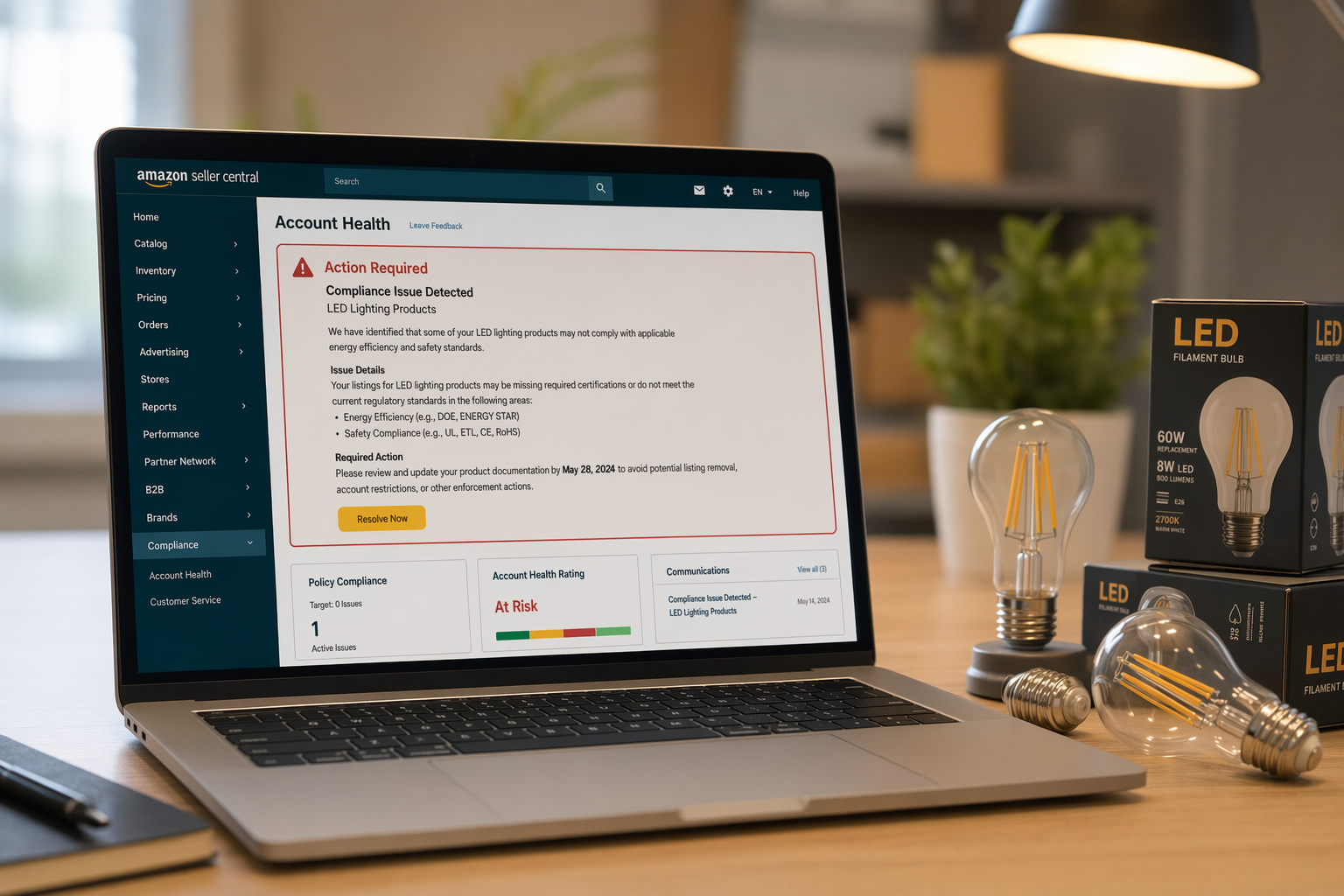
Most Amazon EU sellers sourcing LED filament bulbs from Chinese factories have no idea they are the deemed importer — until the morning they open Seller Central and find an “Action Required” notice. The message asks for a CE Declaration of Conformity, the name and EU address of a responsible person, and supporting test documentation. Sellers who cannot produce these within 14 days get delisted. Many never get relisted at all.
This is not a future risk. Amazon has been issuing these notices across EU lighting categories since late 2024, when the EU’s General Product Safety Regulation (GPSR) came into full force. If you are selling Chinese-manufactured LED filament bulbs on Amazon EU without these three things in place — a CE DoC from your factory, an EU responsible person, and correct product labeling — you are exposed right now.
This article explains exactly what the rules require, why marketplace sellers bear the liability, and what to do before your listing becomes the next casualty.
What “Deemed Importer” Means Under EU Product Safety Law
The EU’s General Product Safety Regulation (GPSR), Regulation (EU) 2023/988, which came into full application in December 2024, codified a concept that catches most marketplace sellers off guard: when a product is sold online by a seller whose manufacturer has no EU legal presence, the seller becomes the importer in law. Not the factory. Not a middleman. You.
This is the deemed importer rule. Under Article 4, the full weight of EU importer obligations transfers to whoever places the product on the EU market. For sellers sourcing directly from Chinese LED bulb factories — which is the majority of private-label and white-label sellers on Amazon EU — that entity is almost certainly you or your business.
Being the deemed importer means you are legally responsible for:
- Verifying that the manufacturer has performed the required conformity assessment
- Holding and being able to produce the technical documentation on request
- Ensuring CE marking is correctly applied to the product and packaging
- Registering as a responsible economic operator in the EU
- Cooperating with market surveillance authorities if a safety concern arises
- Reporting safety incidents and participating in corrective action
The Low Voltage Directive 2014/35/EU and the Electromagnetic Compatibility Directive 2014/30/EU have always applied to importers. The GPSR closed the loophole that let marketplace sellers disclaim responsibility by pointing at their Chinese supplier. That exit route no longer exists.
Why Online Marketplace Sellers of Chinese LED Products Are Most Exposed
The deemed importer rule has always existed in some form. What changed is enforcement — and who gets caught.
Traditional importers knew their obligations. They checked the documentation, verified the CE mark, kept records. But the rise of direct-to-consumer and private-label selling through Amazon EU created a generation of sellers who operate more like brand managers than importers. Many of them signed up for an Amazon seller account, found a factory on Alibaba, applied their logo, and started shipping. They assumed the factory’s CE certificate covered their obligations. It almost certainly did not.
Here is the problem: when your Chinese LED filament bulb factory has no EU legal presence, there is no EU importer in the conventional sense. The GPSR’s deemed importer mechanism assigns that identity to you — automatically, without your knowledge or consent. The first time many sellers discover this is when they receive the Amazon compliance notice.
LED filament bulbs are particularly high-risk in this context:
- High volume, low unit value: SKU proliferation across wattage, base type, and colour temperature means documentation gaps multiply quickly across your catalogue
- Active market surveillance: The EU Safety Gate (RAPEX) database lists LED lighting among the most frequently notified product categories, with recurring issues around overheating, flammable components, and incorrect labelling
- Shared factory documentation: Many Chinese factories produce for multiple brands simultaneously, using shared or transferred test reports that may not accurately represent your specific production run
- Ecodesign overlap: EU Regulation 2019/2015 on energy labelling and Regulation 2019/2020 on ecodesign create additional enforcement triggers that run parallel to safety requirements
The problem is not that Chinese LED factories are inherently non-compliant. Many produce excellent products. The problem is the compliance chain — from factory test report to EU shelf — has gaps that you are now legally responsible for bridging. As we’ve covered in our analysis of how base type selection affects return risk →, even minor specification oversights cascade into commercial problems. Regulatory exposure makes those problems orders of magnitude worse.
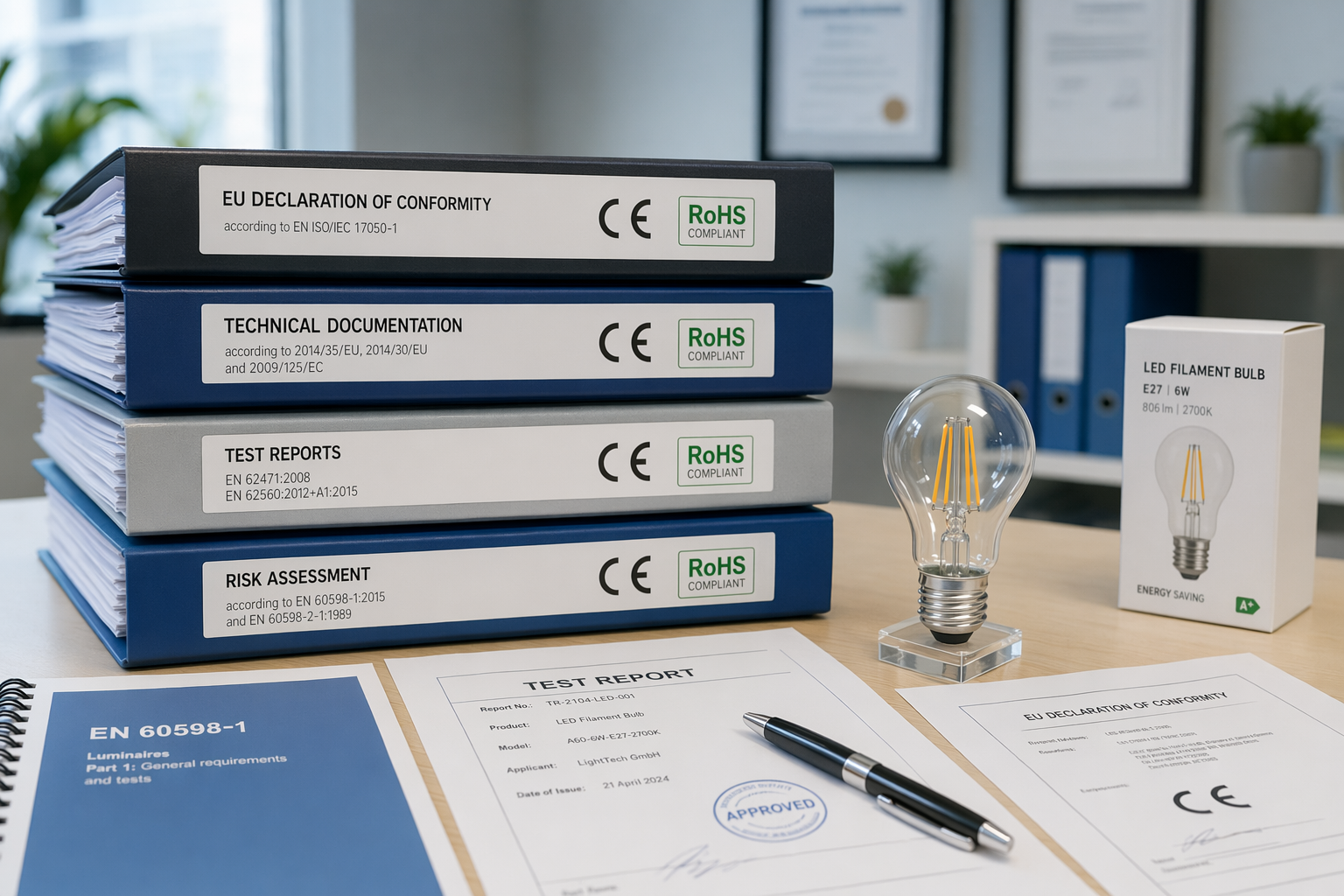
What Compliance Documentation You Are Now Responsible For
As deemed importer, you are not a passive label owner passing along a supplier’s paperwork. You are an economic operator with independent legal obligations. For LED filament bulbs sold on the EU market, here is what you are responsible for — and what Amazon will ask you to produce:
Declaration of Conformity (DoC)
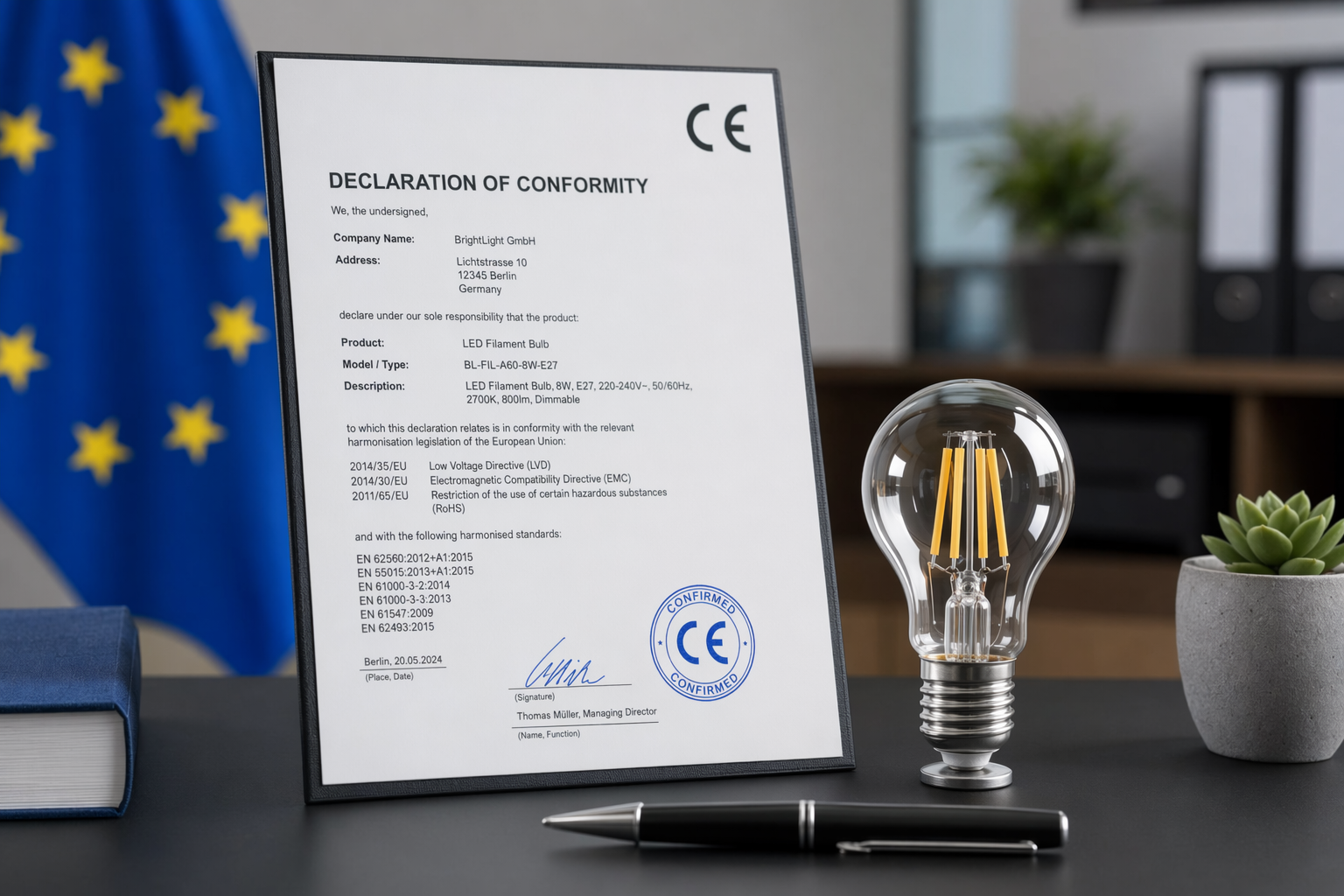
The DoC must be issued by the manufacturer, their EU-authorised representative, or — in the absence of either — you, as the deemed importer. It must list all applicable directives (LVD, EMC, RoHS, Ecodesign) and the harmonised standards used (typically EN 62560, EN 55015, EN 61547). A generic DoC from your Chinese supplier naming a Chinese address is almost certainly insufficient for EU market purposes. Get your factory to issue a proper DoC before you list, not after you’re suspended.
Technical File
This is the full documentation behind the DoC — circuit diagrams, component lists, test reports from accredited laboratories, risk assessment, and product samples used in testing. You are entitled to request this from your supplier. If they refuse or provide only summary-level documents, treat that as a compliance risk signal, not a negotiation tactic. If the documentation doesn’t exist or can’t be produced, neither can your listing.
EU Representative Registration
Under GPSR Article 16, products sold on online marketplaces must be associated with a responsible economic operator established in the EU who can be contacted by market surveillance authorities. If your factory has not appointed an EU authorised representative, you are that person. Amazon is now requiring this at the listing level — which means no EU representative, no listing.
Product Labelling
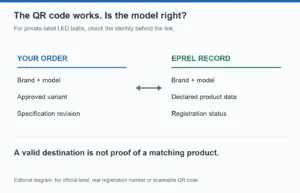
EU energy labelling under Regulation 2021/340 requires specific label formats, rescaled ratings, and QR codes linking to the European Product Database for Energy Labelling (EPREL). Amazon has been actively enforcing EPREL registration as a listing condition. Incorrect or missing labels are an independent enforcement trigger — you can be in full CE compliance and still get delisted for a labelling failure.
What Platforms Like Amazon Are Already Requiring From Sellers
Amazon EU has aligned its compliance requirements directly with the GPSR framework. The notices sellers are receiving are not hypothetical future enforcement — they are live, and they result in delisting.
In practice, here is what Amazon can require at any time:
- CE documentation requests: Amazon can ask for CE certificates, test reports, and Declarations of Conformity with a 14-day response window. Missing the deadline means your listing goes down. Providing inadequate documentation means it stays down.
- EPREL registration enforcement: All EU energy-labelled products — every LED lamp — must have a valid EPREL registration number. Amazon requires this for new listings and has been auditing existing catalogues.
- Responsible person identification: Amazon requires sellers to identify an EU-based responsible person for products sold to EU customers, consistent with GPSR Article 16. This cannot be your Chinese factory’s address.
- Safety incident reporting: Amazon expects sellers to report product safety incidents and cooperate with corrective action. This obligation sits with the deemed importer — you.
LightingEurope, which represents major European lighting manufacturers, stated explicitly in March 2026 that the deemed importer mechanism is an enforcement priority for national market surveillance authorities — particularly in Germany, France, and the Netherlands. Sellers who have historically relied on supplier-provided CE marks without independent verification are advised to audit their documentation now, not when the notice arrives.
This is especially relevant for brands selling A60 LED filament bulbs, where specification errors are already a recurring commercial problem — as we’ve detailed in our piece on why the most common SKU is also the most commonly misspecified →.
How to Structure Your Supplier Relationship to Manage Deemed Importer Risk
The three things you need before listing any LED product on Amazon EU are: a CE Declaration of Conformity from your factory, an EU responsible person appointment, and correct product labeling including EPREL registration. Everything else is detail around those three requirements. Here is how to build the structure that keeps you compliant at scale:
Step 1: Get CE DoC From Your Factory Before Listing
This is the non-negotiable starting point. Before a single unit ships for EU sale, you need a Declaration of Conformity that names your product, lists the applicable EU directives and harmonised standards, and is signed by someone who can legally issue it. If your supplier cannot provide a proper DoC, do not list the product. The supply agreement should contractually obligate the factory to maintain the technical file, issue the DoC, and notify you of any production changes that could affect compliance. Factories that resist these clauses are telling you something important.
Step 2: Appoint an EU Responsible Person
Your Chinese manufacturer needs to appoint an EU-based authorised representative (AR), or you need to act as one yourself. Many compliance service providers offer AR services for a few hundred euros per year — this is not a significant cost relative to the risk of a delisting. If you have a registered business in an EU member state, you can act as the responsible person directly. Either way, this entity must be named on the product or its packaging, and the details must match what Amazon has on file.
Step 3: Add Required Product Labeling
EU energy labelling is mandatory for every LED lamp, and incorrect labeling is an independent enforcement trigger. Register your products on EPREL before they go live. Ensure the physical label on the product and packaging matches the EPREL entry. Include the QR code. Verify that the rescaled energy class is accurate. This is not optional and it is not the factory’s problem — it is yours, because you are the deemed importer.
Independent Laboratory Verification
Requesting test reports is necessary but not sufficient. Reports can be outdated, cover different production batches, or be issued for a different market. For high-volume SKUs, commission independent pre-shipment testing from an EU-recognised accredited laboratory. Factory-level issues like thermal management failures in enclosed fixtures are a known risk with LED filament bulbs — our technical analysis of why G4 LED lamps that look fine in samples fail early in enclosed fixtures → illustrates how performance diverges between test conditions and real-world deployment, divergence that can trigger safety notifications post-sale.
EPREL Registration Management
EPREL registrations must be maintained and updated. Ensure you have access to all registration records and that they reflect your branded product, not a generic factory variant. Mismatches between the EPREL entry and the physical product label are an enforcement risk independently of the underlying product’s safety.
Documentation Retention
EU product safety law requires technical files to be retained for 10 years after the last product is placed on the market. Build this into your document management system now. A compliance enforcement inquiry three years after a product line is discontinued is a realistic scenario. The absence of documentation at that point is treated as evidence of non-compliance.
Ongoing Market Surveillance Monitoring
Subscribe to the EU Safety Gate notification system for LED lighting. When a competitor’s similar product is flagged, it tells you something about the compliance risks in your own supply chain. If the same Chinese factory supplies both of you, the risk is not theoretical. Compliance also connects to specification discipline — brands that invest in documentation tend to specify more carefully, including colour temperature accuracy → and dimming compatibility → — which reduces both regulatory and commercial risk simultaneously.
Related HongYu Bulb product pages
- LED Filament Bulb Product Range → — standard and decorative LED filament bulbs for wholesale and project sourcing.
- ETL, CE & RoHS Certification Guide → — sourcing guidance for certification and import compliance.
- Big Decorative Bulbs → — oversized decorative filament bulbs for hospitality, retail and statement fixtures.
- Contact HongYu Bulb → — send specifications, target market, quantity and packaging requirements for quotation.
Conclusion
If you are selling Chinese LED filament bulbs on Amazon EU right now, you need to answer three questions: Do I have a CE Declaration of Conformity from my factory that covers my actual product? Do I have an EU responsible person appointed and named on the product? Are my products correctly labeled and registered on EPREL?
If the answer to any of these is “I’m not sure” or “my supplier handles that,” you are at risk of a listing suspension. Amazon is issuing “Action Required” notices. Market surveillance authorities in Germany, France, and the Netherlands are actively pursuing deemed importer enforcement. LightingEurope has identified this as a 2026 priority.
The good news is the path forward is clear and manageable: get the DoC before you list, appoint an EU responsible person, and ensure your labeling is correct. These are not complex tasks. They do require intentional action, supplier conversations, and a modest investment in compliance infrastructure. That investment is orders of magnitude smaller than the cost of a delisting, a shipment detention, or a product recall.
Treat compliance as part of your procurement process — not a cost centre to defer. The brands that do this well tend to have fewer surprises, better supplier relationships, and more defensible positions in a market that is only getting more regulated.
External References
- General Product Safety Regulation (GPSR) — European Commission
- CE Marking — European Commission Single Market
- EU Market Surveillance Regulation (2019/1020) — EUR-Lex
- LightingEurope Position on Deemed Importer Obligations
- Amazon EU Responsible Person Requirements — Amazon Seller Central
- EPREL — European Product Registry for Energy Labelling (European Commission)