Most buyers who stock both G4 and G9 LED lamps treat the difference as a simple dimensional fact: different base, different pin spacing, different fixture fit. That assumption works until the returns start arriving — and when they do, G4 and G9 failures tend to look different, come from different channels, and require different conversations with suppliers and customers.
G4 and G9 LED lamps are not just the same product with a different base. They go into different fixtures, serve different applications, have different thermal environments, and carry different risk profiles for importers. Treating them identically at the specification stage is one of the more consistent sources of avoidable quality problems in compact LED lamp sourcing.
The Base Difference Is the Least Important Difference
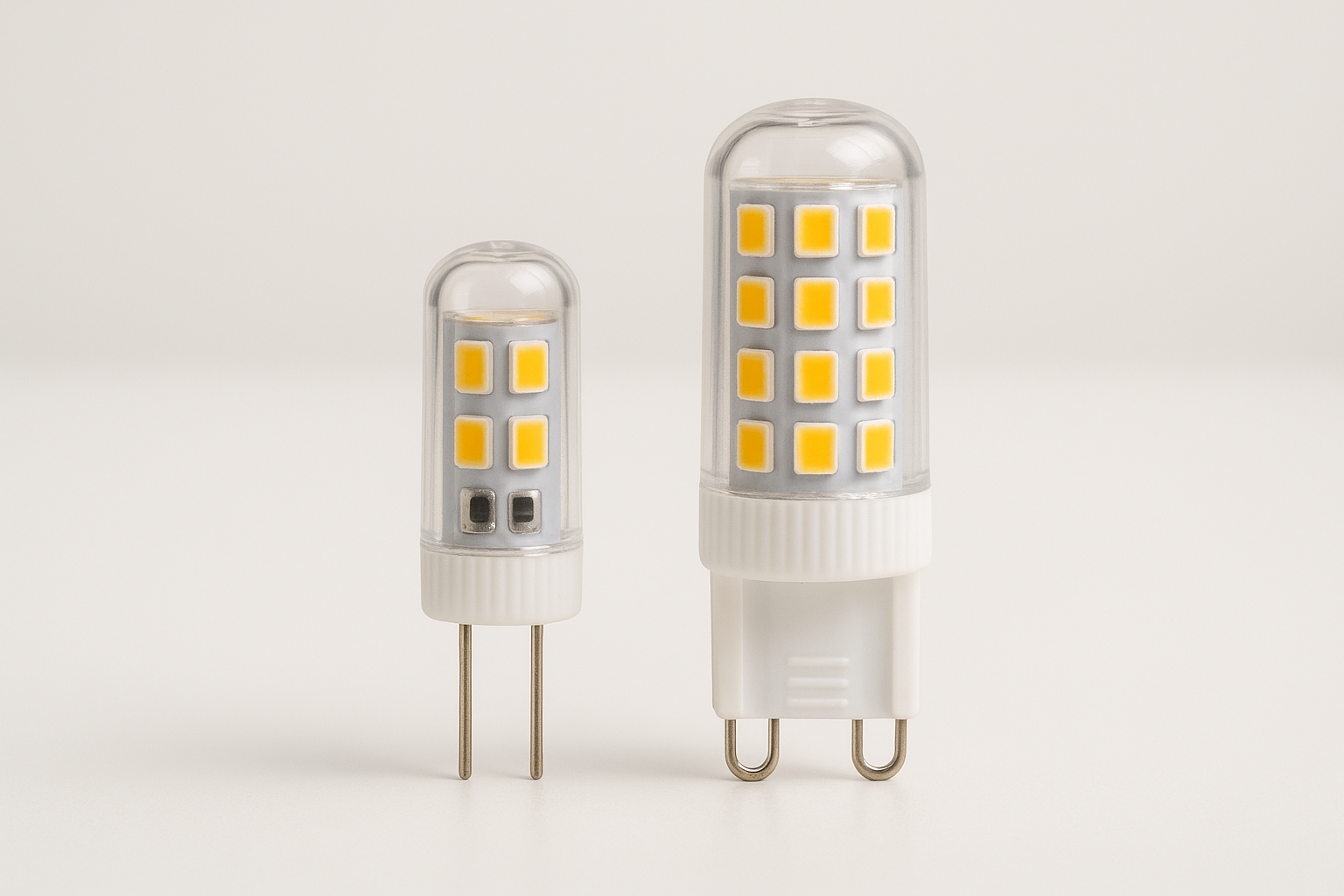
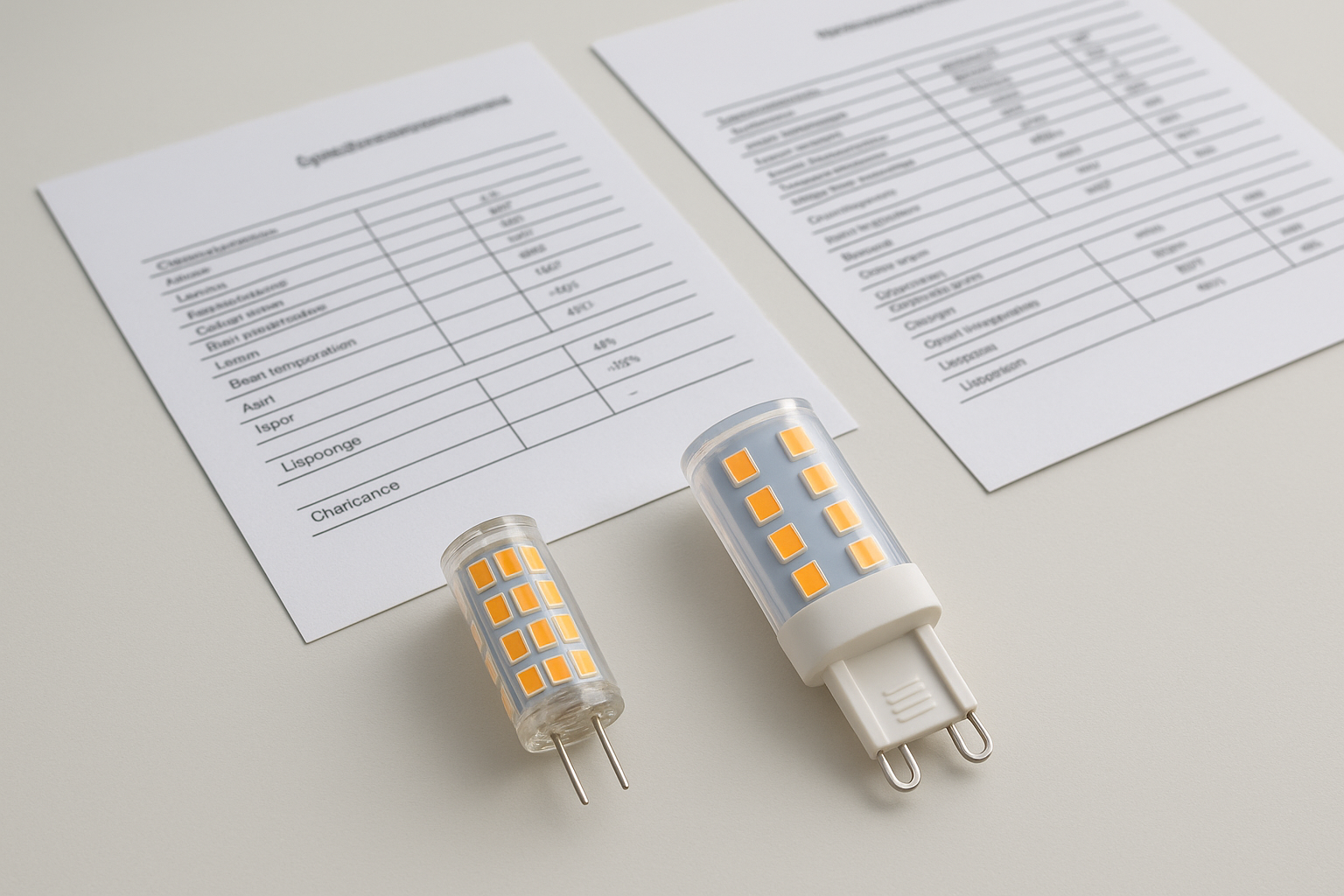
G4 lamps have a bi-pin base with 4mm pin spacing. G9 lamps have a bi-pin base with 9mm pin spacing — and critically, the pins themselves are looped rather than straight. These dimensional differences make the two products physically incompatible with each other's sockets.
But the base is not where the commercial differences lie.
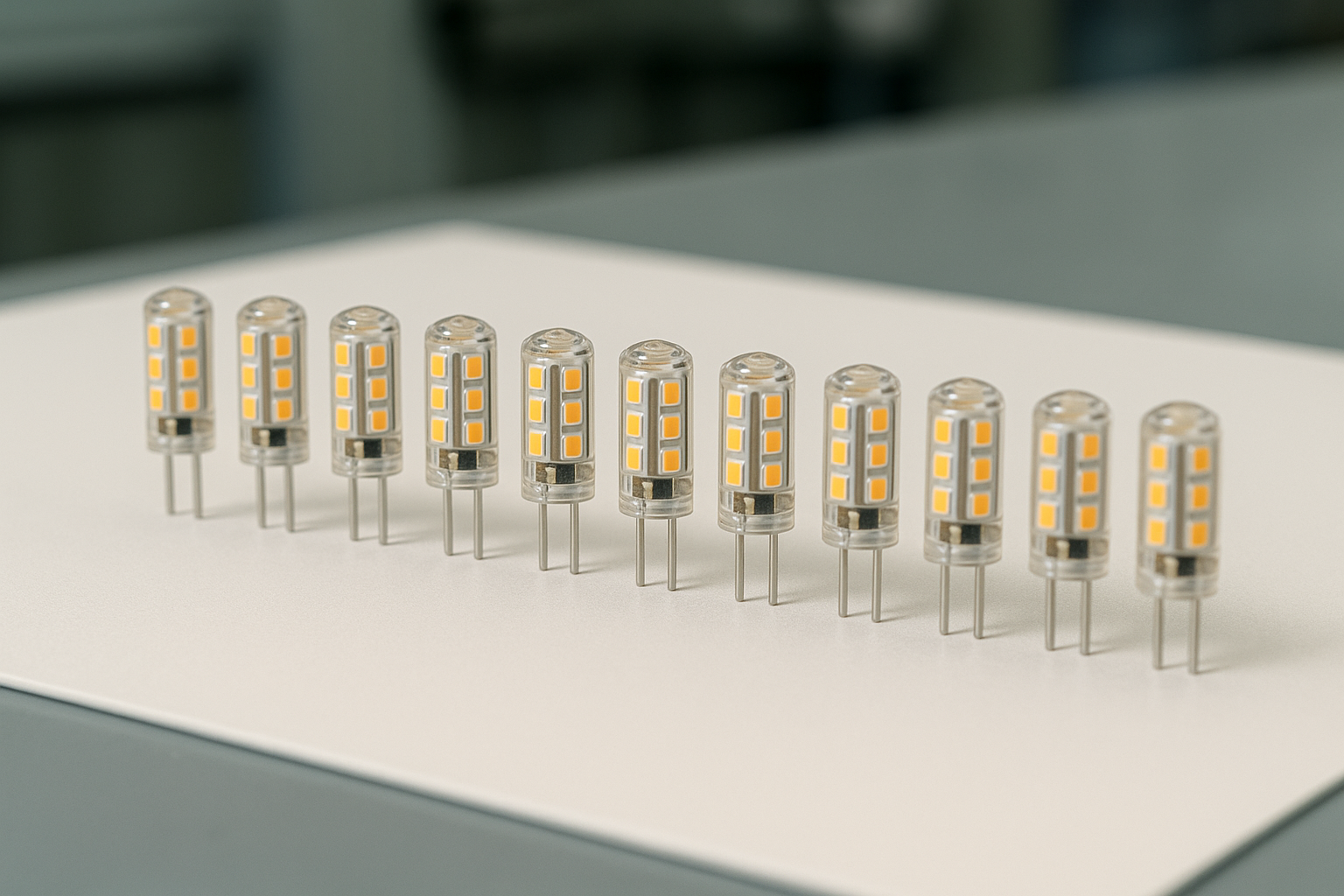
G4 lamps are small. Very small. The capsule body of a G4 lamp is typically 12–15mm in diameter and 30–40mm long. That body contains the LED chip array, the driver circuit, and any thermal management the manufacturer has included. There is very little room for any of it. Driver design in a G4 lamp is a tight engineering exercise where component selection, layout, and thermal pathway all have to work within a volume that is considerably smaller than most buyers realize when they look at the spec sheet.
G9 lamps are larger — typically 15–25mm in diameter and 45–65mm long — and that additional volume creates more room for the driver, more surface area for heat dissipation, and marginally more tolerance for component sizing. A supplier who can produce a reliable G9 lamp is not automatically producing a reliable G4 lamp. The two products require different levels of engineering discipline — and the reasons why become clear when you look at what compact lamp engineering actually involves. See why compact G4 and G9 lamps expose weak supplier design faster than standard bulbs → for a detailed breakdown.
The practical consequence: when evaluating a supplier for both products, do not assume that G9 performance predicts G4 performance. Evaluate them separately.

G4 and G9 Go Into Different Fixtures — Which Means Different Failure Modes
G4 LED lamps are predominantly used in low-voltage applications. Traditional halogen G4 lamps ran on 12V DC or AC, and a large share of the fixtures in the installed base were designed for 12V supply. This creates an important sourcing complication that does not apply to G9.
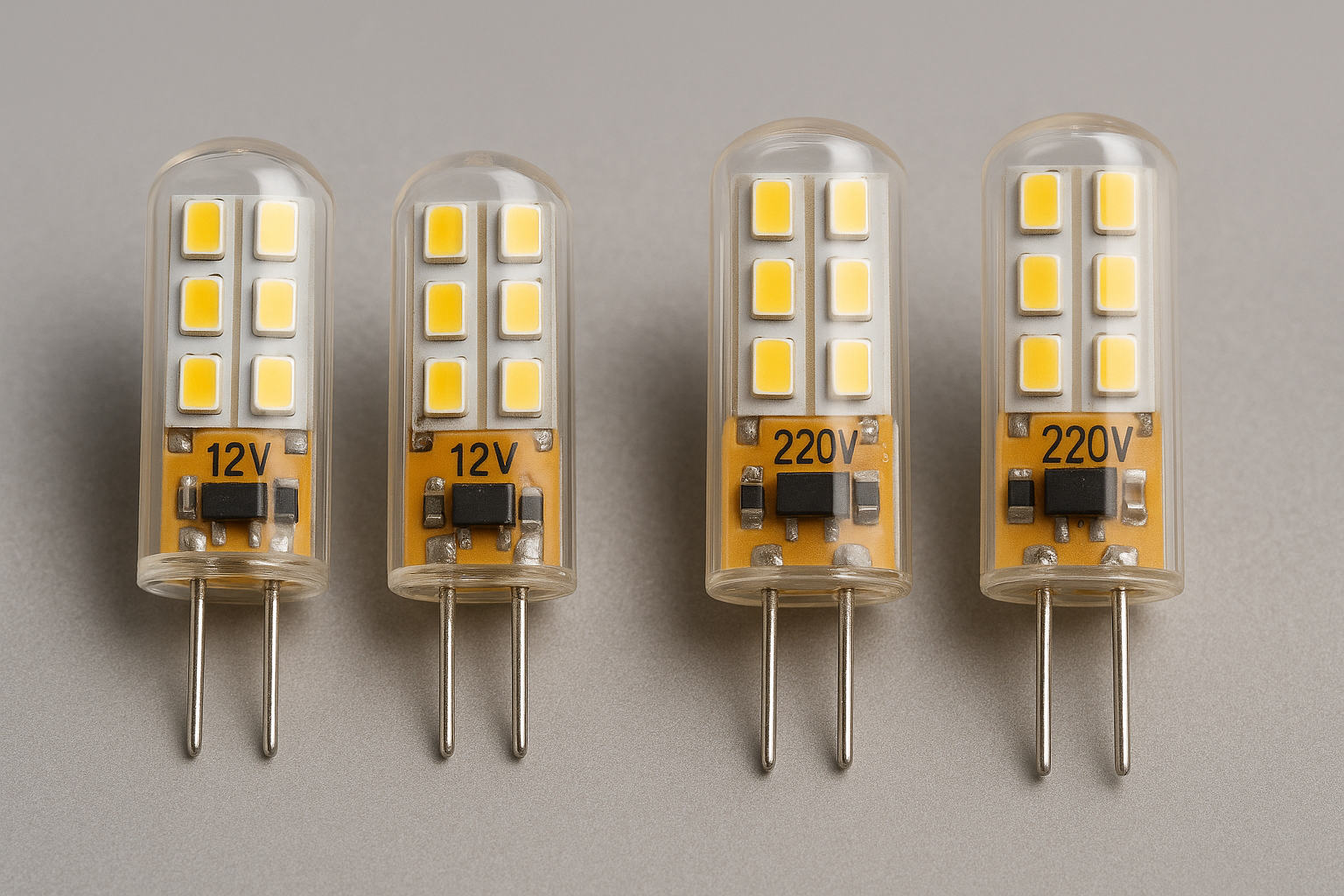
G4 lamps come in both 12V and 220V versions, and the two are not interchangeable in the same fixture. A 12V G4 lamp installed in a 220V direct-wire fixture will fail immediately. A 220V G4 lamp installed in a 12V fixture powered by a transformer will also not function correctly. When importers receive G4 complaints about lamps that "don't light" or "fail instantly," voltage mismatch is one of the first things to check — and it is a specification failure that happens more often than it should because the voltage is not clearly communicated in the ordering process.
G9 lamps are almost universally mains voltage — 220V in Europe, 110V in North America. The voltage decision is simpler and less likely to produce this category of error.
The fixture environments also differ meaningfully. G4 fixtures tend to be smaller, more enclosed, used in display cabinets, accent fittings, showcase lighting, and decorative pendants with very small glass bodies — environments where thermal accumulation is a significant risk. G9 fixtures tend to be larger decorative table lamps, wall sconces, and pendant lights where the lamp has more surrounding airspace and thermal risk is typically less extreme.
G9 Returns Come From Compatibility; G4 Returns Come From Heat
This is the most commercially useful distinction for importers, because it changes what you need to specify and test before placing a bulk order.
G9 returns are most commonly driven by:
- Incompatible dimmer performance — G9 fixtures are frequently on dimmer circuits in residential and hospitality settings, and a G9 lamp not validated against your target market's dimmer types will generate flickering, buzzing, and narrow dimming range complaints
- Inconsistent color between units — G9 lamps in visible, grouped applications like bathroom vanity bars or chandelier arrays make any unit-to-unit color variation immediately obvious
- Lumen output below expectation — LED G9 replacements that underdeliver on brightness versus the halogen they replaced are a consistent source of dissatisfaction
G4 returns are most commonly driven by:
- Early failure from enclosed fixture heat — the lamp works fine in open air but fails early in the sealed glass capsule fittings where G4 lamps are frequently installed. See our guide on why G4 lamps fail early in enclosed fixtures → for a full breakdown of this failure pattern.
- Voltage specification mismatch — 12V vs 220V errors that create immediate failures and look like product defects but are actually specification communication failures
- Flickering in 12V transformer circuits — 12V G4 lamps installed on older magnetic transformers may flicker or not function correctly because the lamp's driver is not compatible with the transformer's output waveform
What this means for specification: G9 lamps need a dimming compatibility evaluation → — and for G4 and G9 specifically, the compact driver size makes this even more critical. See why ordering dimmable G4 or G9 lamps without a compatibility spec creates complaints later → and a color consistency check. G4 lamps need a thermal evaluation and a clear voltage specification on every order. Applying the same checklist to both products will catch some problems and miss others.
How Voltage Specification Errors in G4 Orders Create Expensive Problems
The voltage issue in G4 sourcing deserves its own section because it is a problem that experienced G9 importers do not expect and first-time G4 importers consistently underestimate.
When a G9 importer places an order for G9 LED lamps for the European market, the voltage is 220V. There is no ambiguity, no alternative version. The specification is single and obvious.
When a G4 importer places an order for G4 LED lamps, the question is not automatically resolved. The installed base in Europe for G4 fixtures includes a large number of 12V installations — kitchen cabinet lights, display case lighting, boat interiors, picture lights, and decorative accent fittings that were designed for 12V halogen G4 lamps and have never been rewired to mains voltage.
Importers who source G4 lamps without explicitly specifying voltage — or who source from suppliers who produce 220V G4 by default without flagging the issue — risk distributing product that is incompatible with the fixtures their customers own. The end customer installs the lamp and it either fails immediately or fails to light at all. The complaint looks like a defective lamp. The actual cause is a voltage specification failure at the sourcing stage.
The preventable step: confirm voltage explicitly on every G4 order. If you are serving a market with a significant 12V fixture installed base, consider stocking both 12V and 220V G4 variants. Make sure packaging clearly states the voltage.
What to Specify Differently for G4 vs G9 Before Placing an Order
The practical output of understanding G4 and G9 as different products with different risk profiles is a different specification approach for each.
For G4 LED lamp orders, confirm and document:
- Voltage: 12V DC, 12V AC, or 220V — do not assume
- Maximum rated ambient operating temperature (Ta): is the product rated for enclosed fixture use?
- Driver thermal rating: what are the driver capacitor ratings?
- Transformer compatibility (for 12V): is the lamp compatible with both electronic and magnetic 12V transformers?
- Enclosed fixture test: has the supplier tested this product inside an enclosed fixture at elevated ambient temperature?
For G9 LED lamp orders, confirm and document:
- Dimmer compatibility: which dimmer types and brands has the product been tested against in the target market?
- Minimum brightness floor and usable dimming range
- Unit-to-unit color consistency: what is the binning specification and how many MacAdam steps of variation are accepted?
- Lumen output relative to halogen replacement claim: verified lamp output, not just LED chip rating
- Flicker performance at low dimming levels
These are not identical checklists because the products are not identical risks. Importers who build separate specification protocols for G4 and G9 will catch more problems at the sample stage and generate fewer returns in distribution.
FAQ
Can I use the same supplier specification checklist for both G4 and G9 lamp orders?
Not reliably. G4 and G9 have different dominant failure modes — G4 returns are most often thermal or voltage-related, while G9 returns are most often dimmer compatibility or color consistency issues. Using the same checklist will leave gaps in both evaluations.
Why does G4 have two voltage options but G9 does not?
G4 lamps originated in 12V low-voltage halogen applications and remain dominant in that segment. G9 lamps were always mains voltage products. The 12V G4 installed base is large enough in Europe and other markets that it cannot be ignored when sourcing G4 LED replacements.
How do I know if my target market uses 12V or 220V G4 fixtures?
Distribution channel information is the most reliable guide. Buyers serving marine, caravan, cabinet lighting, and traditional accent lighting channels often need 12V G4. Buyers serving modern residential and commercial channels are more likely to need 220V G4. If uncertain, ask your downstream buyers which transformer or wiring system their fixtures use.
Why are G4 LED lamps harder to engineer reliably than G9?
The physical constraints are the primary reason. A G4 body is smaller than a G9 body, leaving less space for driver components, thermal management, and design margin. The consequences of marginal design choices become visible faster in field conditions.
Is a supplier who makes good G9 lamps automatically capable of making good G4 lamps?
Not necessarily. The engineering constraints of G4 are meaningfully more demanding than G9. Evaluate G4 and G9 performance separately when qualifying a supplier.
Conclusion: Treat G4 and G9 as Different Products Because They Are
The importer who manages G4 and G9 lamps as interchangeable products — same supplier conversations, same sample checks, same purchase order format — is running a specification gap that produces different kinds of returns from different parts of the distribution channel, often without connecting them to a common cause.
The fix is straightforward. G4 needs a voltage specification and a thermal evaluation. G9 needs a dimmer compatibility evaluation and a color consistency check. Neither of these is technically demanding. Both require asking the right questions before the order is placed rather than discovering the answers through warranty claims after distribution.
If you are sourcing G4 or G9 LED lamps and want to discuss voltage specifications, thermal ratings, or dimmer compatibility for your target market, contact our team → for a practical conversation about your requirements.
References
- IEC 62031 covers LED modules for general lighting and provides context for component performance standards applicable to compact LED lamp design.
- LightingEurope publishes market and application guidance relevant to European lighting product categories. See lightingeurope.org.
- ENERGY STAR Lamps Specification includes requirements for dimming performance, flicker, and lumen maintenance relevant to both G4 and G9 LED products. See energystar.gov.
- EU Ecodesign regulations for light sources (EU) 2019/2020 define voltage and performance requirements for lamps on the European market. See the EUR-Lex database.
- The Illuminating Engineering Society (IES) publishes technical memoranda on LED product testing. See ies.org.
Related HongYu Bulb product pages
- LED Filament Bulb Product Range → — standard and decorative LED filament bulbs for wholesale and project sourcing.
- ETL, CE & RoHS Certification Guide → — sourcing guidance for certification and import compliance.
- Contact HongYu Bulb → — send specifications, target market, quantity and packaging requirements for quotation.