The complaint usually arrives after the product has already shipped. A customer calls to say the bulbs flicker at low settings. Or they buzz when dimmed past 50%. Or they simply shut off below a certain brightness level instead of dimming smoothly. The importer contacts the supplier. The supplier confirms the bulbs are dimmable. Both statements are true. The product is still failing in the field.
This is the most common and most avoidable problem in decorative LED filament bulb sourcing: ordering a bulb that is dimmable without specifying what it needs to dim on. By the time the complaint reaches the importer, the product is in distribution, the customer is frustrated, and the cost of correction — replacement stock, returns, brand credibility damage — is many times higher than the cost of getting the specification right before the production order was placed.
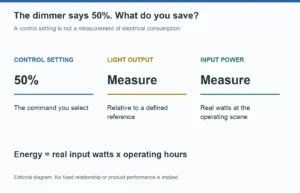
Dimming compatibility is not a simple yes/no feature. It is a relationship between the bulb's driver design and the specific dimmer technology installed in the customer's wall. A driver that performs flawlessly on one dimmer brand can flicker, buzz, or refuse to dim below 30% on another — not because the bulb is defective, but because the two components were never tested together.
This article covers what importers and private label buyers should specify, ask, and verify before finalizing a decorative LED filament bulb order where dimming performance matters to their end customer.
Why LED Filament Bulb Dimming Is More Complex Than It Looks
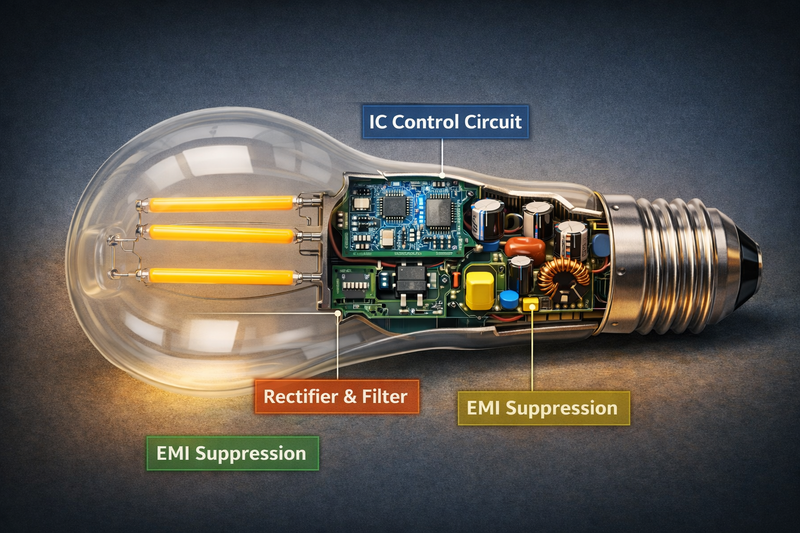
The warm, glowing appearance of LED filament bulbs is achieved by running LED filament strips at relatively low current density — a design choice that creates the visual similarity to incandescent bulbs that makes them commercially valuable. That same design creates a more complex dimming challenge than most buyers anticipate.
Incandescent bulbs dim by simple voltage reduction. Reduce the voltage, reduce the filament temperature, reduce the light output. The relationship is smooth and predictable across essentially any dimmer.
LED filament bulbs use a driver circuit that converts mains AC power into the DC power the LED filaments need. When a dimmer reduces the incoming voltage or chops the AC signal, the driver must interpret that signal and adjust output accordingly. Whether it does so smoothly, across a wide range, without flickering or buzzing, depends on three things working together: the dimmer type, the driver design, and the interaction between the two.
That interaction is where most dimming complaints originate. A driver design that works flawlessly with one dimmer brand may produce visible flicker or a high minimum brightness floor with another. This is not a quality failure. It is a specification failure — the buyer ordered a dimmable bulb without specifying which dimmer ecosystem it needed to perform in.1
The Three Dimmer Technologies Your Importer Needs to Understand
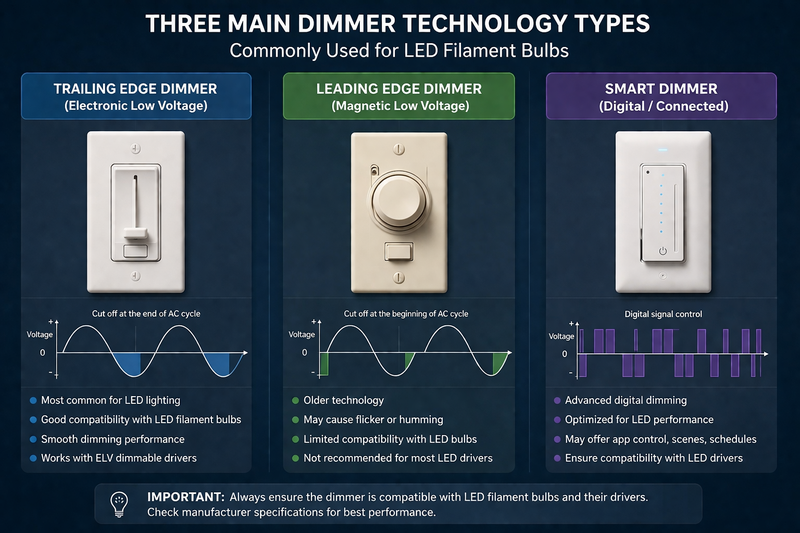
Not all dimmers work the same way. The most relevant categories for decorative LED filament bulb importers are:
Leading edge (TRIAC) dimmers are the oldest and most widely installed type in most markets. They cut the leading edge of each AC half-cycle. They were designed for resistive loads like incandescent bulbs and halogen lamps. Many LED drivers are not optimized for leading edge dimmers, producing flickering, buzzing, or a narrow usable dimming range on these units. They are very common in existing residential installations, particularly in older homes, which makes compatibility with this dimmer type commercially important in many markets.
Trailing edge (ELV) dimmers cut the trailing edge of the AC cycle and are generally considered more compatible with LED drivers. They are less common in installed base but increasingly specified in new residential and hospitality construction. LED filament bulb drivers designed for trailing edge performance typically offer smoother dimming curves and lower minimum brightness thresholds.
Smart and phase-adaptive dimmers from brands like Lutron, Legrand, and various regional manufacturers use adaptive algorithms that can work with a wider range of LED drivers. They often include specific LED compatibility modes. In the US market particularly, Lutron compatibility is a premium specification requirement for many lighting brands serving the residential renovation and hospitality sectors.
What this means for your order specification: if your target market has a significant installed base of a particular dimmer type, you need to specify that the bulb driver must be tested and validated against that dimmer type — not simply confirmed as "dimmable." Dimmable means the driver has dimming capability. Compatible means it has been tested against the dimmers your customers actually own.2
Minimum Brightness and Dimming Range Are Separate from Flicker Performance
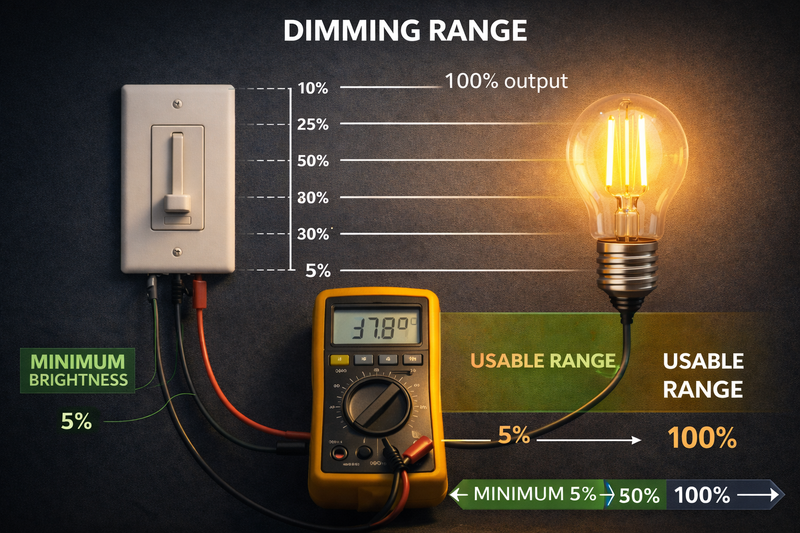
When buyers ask whether a bulb is dimmable, they typically mean: can the brightness be reduced? The more useful questions for B2B specification are:
What is the minimum brightness floor? Some LED drivers can only dim to 20–30% of full brightness before they shut off, flicker, or become unstable. For hospitality applications where low ambient lighting is a design requirement, a 20% minimum floor is commercially problematic. Buyers serving restaurants, hotels, or premium residential markets typically need a minimum brightness at or below 10%, and preferably closer to 5%.
What is the usable dimming range? A driver that theoretically dims from 100% to 20% but shows significant brightness stepping across that range — visible jumps rather than smooth transitions — is not delivering a premium dimming experience. Smooth dimming across the usable range is a separate performance metric from the minimum floor.
Does flicker increase at lower brightness levels? Some drivers that perform acceptably at moderate dimming levels show measurable flicker below certain brightness thresholds. For human comfort, flicker frequency below 100Hz can be visible and fatiguing. Buyers sourcing for sensitive environments — healthcare, office, children's spaces — may need specific flicker metrics confirmed in the specification.
These are all specifiable parameters. A competent OEM manufacturer should be able to confirm the expected dimming range, minimum brightness floor, and flicker performance for a given driver design — and provide test data on specific dimmer models if requested.3
Market-Specific Dimmer Compatibility Lists Matter More Than Generic "Dimmable" Claims
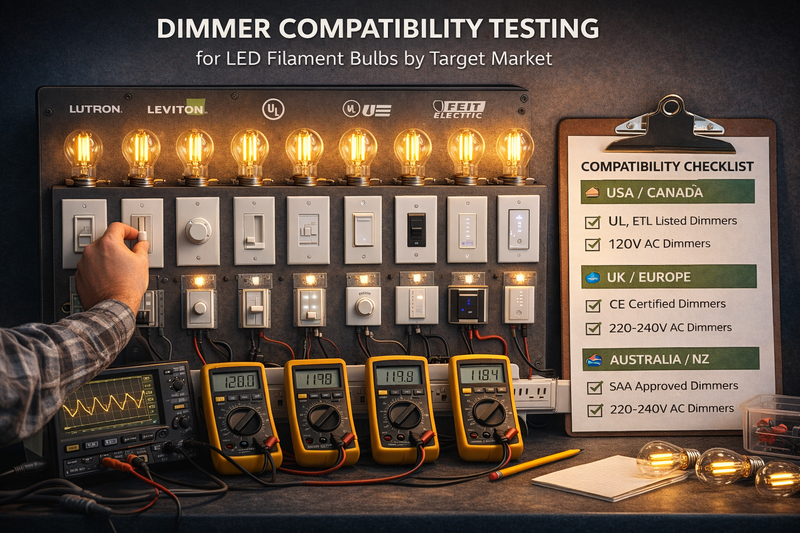
One of the most commercially useful things an importer can request from an OEM bulb supplier is a market-specific dimmer compatibility list — a tested list of dimmer models confirmed to work acceptably with the specified driver design.
This is not the same as a generic "compatible with most leading and trailing edge dimmers" statement. It is a documented test result that says: this bulb, with this driver, was tested on these specific dimmer models and achieved these specific minimum brightness levels and flicker measurements.
For different target markets, the relevant dimmer brands vary:
| Market | Common dimmer brands to test |
|---|---|
| United States | Lutron, Leviton, Legrand, GE, Insteon |
| United Kingdom | Varilight, Crabtree, MK Electric, Legrand |
| Germany / DACH | Busch-Jaeger, Gira, Jung, Schneider |
| Australia | HPM, Clipsal, Legrand |
| Japan | Panasonic, Koizumi, Toshiba |
If you are importing into a specific market and your buyers — retailers, contractors, or end installers — are asking about dimmer compatibility with named brands, the answer "it is dimmable" is not sufficient. The answer "it was tested and confirmed on Lutron Caseta and Leviton Decora" is.
Requesting this documentation before finalizing an order is a reasonable quality specification request that any serious OEM supplier should be able to accommodate for standard or high-volume SKUs.4
How to Write Dimming Specifications Into Your Purchase Order
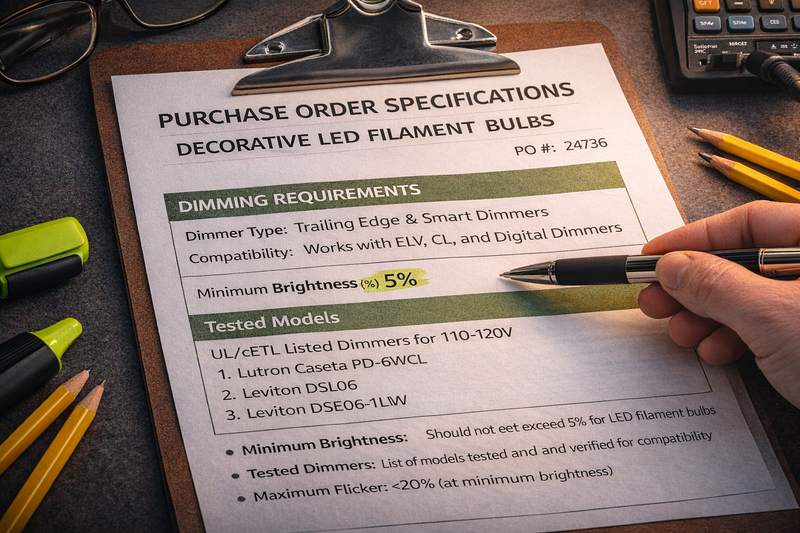
Generic "dimmable" language in a purchase order does not protect the importer if the product fails in the field. The following specification elements should be included explicitly when dimming performance is a commercial requirement:
Dimming Specification Checklist for Private Label Orders
- dimmer technology type required (leading edge / trailing edge / both / smart)
- minimum brightness floor required (e.g., ≤10% of full output)
- usable dimming range required (e.g., 100% to 10% without stepping)
- flicker frequency threshold at minimum brightness (e.g., <100Hz at all dim levels)
- specific dimmer models to be included in compatibility testing
- documentation required (test report, compatibility list, or third-party flicker measurement)
- sample verification process before bulk production approval
These specifications do not make the ordering process significantly more complex. They create a clear shared understanding between the buyer and the manufacturer about what performance is expected — and they provide recourse if the delivered product does not meet that standard.
Without these specifications, disagreements about dimming performance after delivery become disputes about whose interpretation of "dimmable" was correct. With these specifications, the expectation is documented before production begins.5
What to Ask Your OEM Supplier Before Placing a Dimmable Bulb Order
Before finalizing any private label LED filament bulb order where dimming is a product claim or a buyer expectation, importers and lighting brands should confirm the following with their supplier:
Driver design questions:
- Is the driver a phase-cut compatible design, and has it been tested on both leading and trailing edge dimmers?
- What is the confirmed minimum brightness floor on a standard trailing edge dimmer?
- What is the confirmed minimum brightness floor on a standard leading edge dimmer?
- Does flicker increase at lower brightness levels, and is there measurement data to confirm performance?
Compatibility documentation questions:
- Does the factory have an existing dimmer compatibility list for this driver design?
- Which dimmer models has this driver been tested on, and what were the results?
- Can the factory perform additional dimmer testing on models specific to the target market?
Production consistency questions:
- Is the driver design fixed across production batches, or does component substitution occur?
- If driver components change, is notification provided before production?
- How is dimming performance verified during mass production quality control?
Suppliers who cannot answer these questions, or who resist providing test documentation, are not necessarily selling poor product — but they are not equipped to support a buyer who needs to make specific performance claims to their own customers.
FAQ
Does a higher price mean better dimming compatibility?
Not necessarily. Dimming compatibility is determined by driver design and testing, not by bulb price tier. Some competitively priced decorative filament bulbs from well-organized OEM manufacturers deliver excellent dimming performance because they have invested in driver design and compatibility documentation. Price is not a reliable proxy for dimming quality — specification and documentation are.
Why do some LED filament bulbs flicker on dimmers that work fine with other brands?
Because the interaction between a dimmer and an LED driver is specific to the two components involved. A dimmer that works well with one driver design may not be electrically compatible with another, even at the same power level and wattage. Compatibility testing on specific dimmer models is the only reliable way to confirm performance.
Can the same bulb order be certified for both the US and EU markets?
Electrical certification (CE vs ETL vs UL) differs by market, but the underlying driver design can sometimes be tested and documented for both market dimmer ecosystems. Whether this is commercially practical depends on the volume and value of the order. For high-volume private label programs, it is worth requesting multi-market dimmer testing at the development stage.
What is the minimum order quantity for a custom driver specification?
This varies by manufacturer. For standard decorative filament bulb models, most OEM suppliers can accommodate driver specification adjustments within standard MOQ ranges (typically 500–2,000 pieces depending on the model). Custom driver development for a fully new design typically requires higher volumes and longer lead times. The right approach depends on whether the buyer needs a modified standard driver or a fully new design.
Final Thoughts
Dimming compatibility is not a technical footnote in a decorative LED filament bulb order. It is a commercial specification that directly affects whether your customers can actually use the product the way they expect to, in the lighting environment they already have.
Buyers who treat "dimmable" as a binary feature get complaints. Buyers who specify dimmer technology, minimum brightness floor, target dimmer models, and required documentation get a product that performs consistently in the field — and a supplier relationship where expectations are clearly defined on both sides.
If you are planning a private label LED filament bulb program and need to confirm dimming specifications, testing scope, or compatibility documentation for your target market, send us your product model, target wattage, and the dimmer brands most relevant to your market. We can confirm what our current driver designs can support and what testing documentation we can provide before you commit to production.
Related HongYu Bulb product pages
- LED Filament Bulb Product Range → — standard and decorative LED filament bulbs for wholesale and project sourcing.
- EU Dim-to-Warm Bulbs → — warm dimming filament bulbs for hospitality and mood lighting.
- LED Dimming Guide → — technical guidance for TRIAC dimming, flicker and compatibility.
- Custom Color Bulbs → — custom glass color, coating and printed finish options for private-label collections.
- Custom Logo Bulbs → — printed branding and private-label decorative bulb options.
- Big Decorative Bulbs → — oversized decorative filament bulbs for hospitality, retail and statement fixtures.
References
Energy Star program technical requirements for luminaires and lamps, including LED driver performance standards: https://www.energystar.gov/products/lighting_fans/light_bulbs ↩
Lutron technical resources on LED dimming compatibility and dimmer-driver interaction: https://www.lutron.com/en-US/Products/Pages/Components/LEDCompatibility.aspx ↩
IEC 61000-3-2 and related standards for harmonic current emissions and flicker performance in LED lighting products: https://www.iec.ch/ ↩
DesignLights Consortium qualified products list and LED performance verification resources: https://www.designlights.org/ ↩
EU ErP Directive and related LED product regulatory requirements for the European market: https://ec.europa.eu/info/energy-climate-change-environment/standards-tools-and-labels/products-labelling-rules-and-requirements/energy-label-and-ecodesign/energy-efficient-products/light-sources_en ↩