Most importers of decorative LED filament bulbs spend time specifying wattage, color temperature, base type, and certification. Very few specify glass type. The supplier uses whatever glass is standard for the model. The product arrives, passes visual inspection, and goes to market.
Then the complaints start. Cracking during installation. A slight yellow tint that appears after months of use. A cloudiness that was not visible in the product photos but becomes obvious next to a competitor's bulb on a retail shelf. Or a globe bulb that developed a hairline crack after a moderate temperature change in a climate-controlled warehouse.
None of these failures look like a glass specification problem. They look like random defects, shipping damage, or quality inconsistency. In most cases, they are a specification problem — specifically, the wrong glass type was used for the application, the bulb shape, or the market expectation, and nobody specified otherwise at the order stage.
Glass is the largest single visible component of a decorative LED filament bulb. It determines thermal durability, optical clarity, long-term appearance, and the premium or budget feel that a buyer's end customer experiences when they hold the product. It is also one of the specifications that is most consistently left off the purchase order — until a complaint makes it impossible to ignore.
Borosilicate Glass and Soda-Lime Glass Are Not Interchangeable
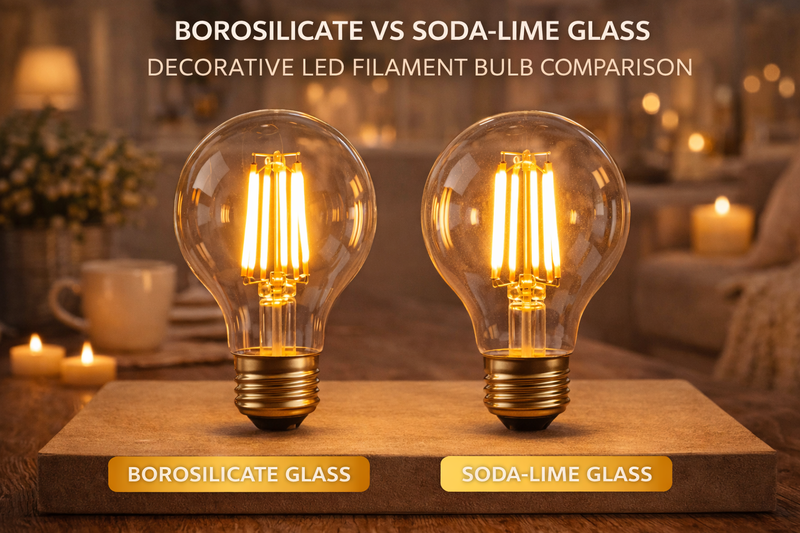
The two glass types used in decorative LED filament bulb manufacturing serve different purposes and have meaningfully different performance characteristics. Treating them as interchangeable is the sourcing decision that produces most glass-related product complaints.
Soda-lime glass is the most widely produced glass in the world. It is the material in most household windows, standard glass containers, and the majority of lower-price-tier LED bulbs. It is less expensive to produce, easier to blow into complex shapes at lower temperatures, and entirely adequate for many applications. Its limitations become relevant in decorative LED filament bulbs when thermal cycling, optical clarity, or long-term color stability are performance requirements.
Borosilicate glass contains boron trioxide, which significantly improves thermal shock resistance, reduces the coefficient of thermal expansion, and produces a cleaner, more transparent optical quality. It is the material in laboratory glassware, high-end cookware, and premium decorative lighting products. It costs more to produce and requires higher processing temperatures, but it delivers performance that soda-lime glass cannot match in thermally demanding or visually critical applications.1
For decorative LED filament bulbs specifically, the practical differences between the two glass types matter most in four areas: thermal durability, optical clarity, color stability over time, and structural integrity in large-format globe shapes.
Thermal Cycling Cracks Soda-Lime Glass in Ways That Look Like Random Defects
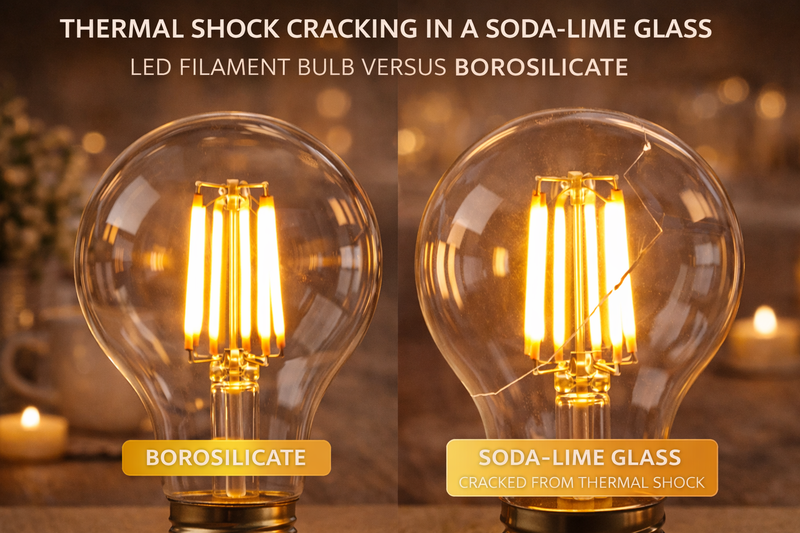
Decorative LED filament bulbs are not thermally neutral products. The filament-style LED strips run warmer than standard LED chips to produce the warm, glowing appearance that makes them commercially valuable. The glass envelope heats during operation and cools when the light is switched off. Over thousands of on/off cycles, this thermal cycling creates stress in the glass.
Soda-lime glass has a relatively high coefficient of thermal expansion — it expands and contracts more per degree of temperature change than borosilicate glass. In a large globe bulb or a long tubular shape, this means more dimensional movement per cycle and more accumulated stress at the areas of greatest thermal gradient, typically the base seal and the thicker parts of the glass profile.
The result is hairline cracking that appears after weeks or months of normal use. The cracks are often small and appear during cooling after a use cycle. They look like shipping damage, handling damage, or random manufacturing defect. Without a glass specification on the purchase order and a thermal cycling test in the quality protocol, there is no way for the importer to know whether this is a manufacturing problem or a predictable consequence of using the wrong glass type for the application.2
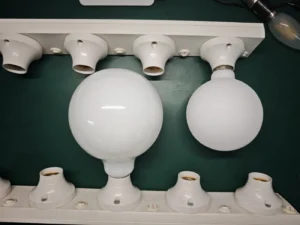
This is one of the most common sources of quality complaints in large-format decorative filament bulbs — G80, G95, and G125 globe models — where the larger glass surface area amplifies the thermal expansion effect. If you are importing large globe styles and you have not specified borosilicate glass, your return rate on this failure mode is a specification outcome, not a random quality event.
Optical Clarity Determines Whether Your Bulb Looks Premium or Budget on a Shelf
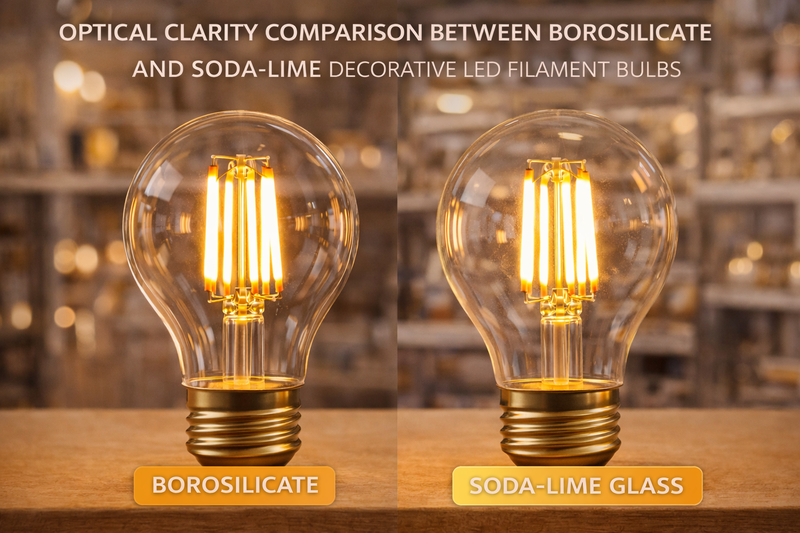
In a product category where visual aesthetics are the primary purchase driver, glass clarity is a commercial specification, not just a technical one.
Borosilicate glass has a lower refractive index variation and fewer impurities than soda-lime glass, which produces a cleaner, more consistently transparent appearance. When a filament LED bulb is illuminated, the glass envelope is what the customer sees around and through. A cleaner glass makes the filament pattern crisper, the glow warmer, and the overall appearance more premium.
Soda-lime glass, particularly in lower-grade formulations, can show subtle greenish or bluish tints caused by iron oxide content in the raw materials. Under warm-white LED filament lighting, this tint is often not visible in catalog photography or in isolation. It becomes visible when the product is displayed next to a borosilicate glass competitor, or when multiple units are grouped in a retail display under neutral or cooler ambient lighting.
For importers building a premium or mid-premium private label brand, this visual difference is commercially significant. A buyer who positions their product at a price point above the basic tier but sources the same soda-lime glass as the basic tier products is competing on packaging and marketing while giving up a product-level differentiator that customers can see and feel.3
Large Globe Shapes Have a Higher Structural Requirement That Only Borosilicate Reliably Meets
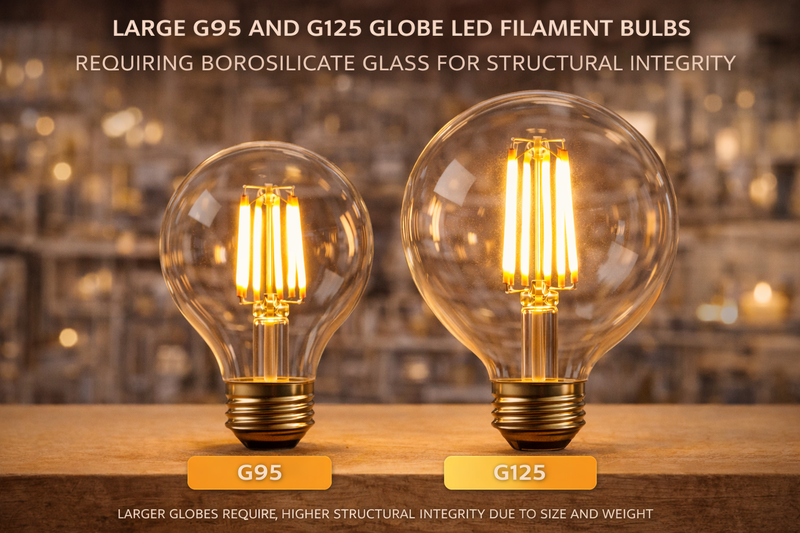
Not all decorative filament bulb shapes carry the same glass risk profile. Smaller A-shape and candle bulbs in standard soda-lime glass typically perform adequately in normal use conditions. Larger format globe bulbs — G80, G95, and G125 — have a structural requirement that soda-lime glass is not always able to meet reliably across the product lifecycle.
The reason is geometric. A larger glass envelope has more surface area, more internal volume, and a longer distance from the thermal source at the base to the cooling glass surface at the top. This creates a more pronounced thermal gradient during operation and a higher total glass expansion per cycle. It also means the glass must be thin enough to be blown into the large shape but thick enough to remain structurally stable.
In well-manufactured borosilicate large globe bulbs, this balance is achievable. In soda-lime glass large globe bulbs, the combination of lower thermal shock resistance and the dimensional demands of the large format creates a failure mode that surfaces statistically across a large-volume import program — not on every unit, but on enough units to generate a measurable return rate and a customer satisfaction problem.
For any importer handling G95 or G125 globe styles at meaningful volume, glass type specification for these SKUs is not optional. It is the difference between a product that works reliably in the field and one that generates a return rate your margins cannot absorb.
Glass Finish and Color Customization Is Where Specification Gaps Create the Most Visible Surprises
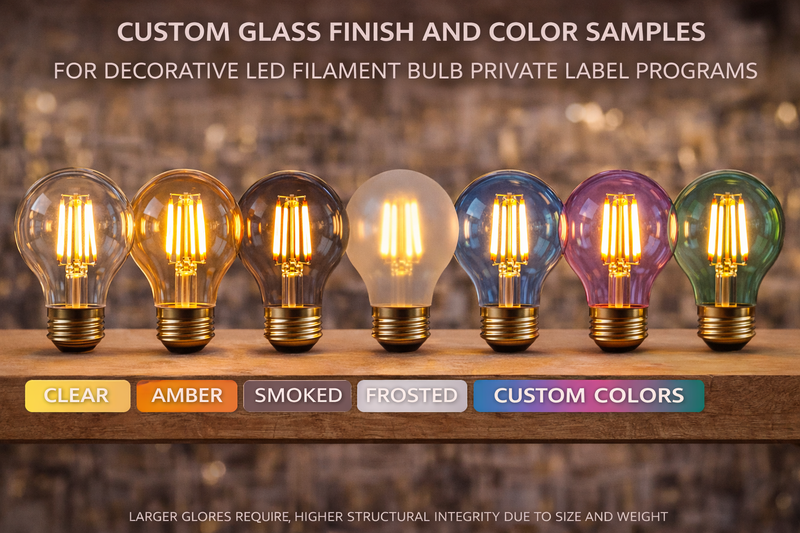
Beyond clear glass, decorative filament bulbs are available in a wide range of finishes: amber tint, smoked, frosted, gold lustre, matte white, and fully custom colors. These finishes are applied differently depending on the glass type and the finish method, and the specification details that are obvious to a manufacturer are rarely obvious to an importer looking at a product photo.
The most common specification gap in custom finish orders is the difference between a glass tint baked into the material during manufacturing and a surface coating applied after forming. A material tint is permanent, UV-stable, and consistent throughout the glass wall. A surface coating can chip, scratch, or fade under repeated thermal cycling. The visual result at the time of ordering may look identical. The performance result over a product's market life is not.
For amber or smoked finishes specifically — the most commercially popular custom glass colors in the decorative filament bulb category — importers should confirm whether the tint is a body color or a coating, and what thermal cycling and UV stability data supports the finish. For private label programs where the finish is part of the brand's product identity, this is a specification that belongs in writing, not in an assumption.4
What to Put in Writing Before Your Next Glass Specification Order
Most glass specification failures happen because the right questions were never asked before the order was placed. The following checklist covers the minimum specification elements that importers should confirm in writing for any decorative LED filament bulb order where glass performance matters:
Glass Specification Checklist for Private Label Orders
- glass type confirmed: borosilicate or soda-lime (specified per SKU, especially for G80/G95/G125)
- thermal cycling test standard confirmed if borosilicate is specified
- optical clarity grade or iron content specification included for clear glass SKUs
- finish type confirmed: body color tint or surface coating
- UV stability data requested for any colored or coated finish
- wall thickness specification or tolerance included for large globe formats
- sample pre-production approval includes glass quality review, not only LED and driver review
- mass production QC protocol includes glass visual inspection and spot thermal check
For standard A-shape and candle models in clear glass, the specification requirements are less demanding. For large globe formats, amber or smoked custom finishes, and any SKU positioned at mid-premium or premium price points, these specifications protect both the product and the brand.5
FAQ
Is borosilicate glass always worth the extra cost for decorative LED filament bulbs?
For smaller standard shapes like A60 and C35 in clear glass at mid-market price points, soda-lime glass is often adequate if thermal management in the base is well designed. For G80 and larger globe formats, long tubular shapes, and any SKU where premium optical appearance or thermal durability is a brand requirement, borosilicate is the more reliable specification. The cost difference per unit is typically small relative to the risk of a return rate driven by thermal cracking or appearance mismatch.
Can I tell which glass type a supplier used by looking at the product photos?
Usually not in clear glass samples without side-by-side comparison. Subtle tint from iron content in lower-grade soda-lime glass is more visible in person and under specific lighting than in product photography. The most reliable way to confirm glass type is to request a material specification from the supplier and, for high-value or high-volume programs, to request third-party material verification.
Do different target markets have different glass quality expectations?
Yes, meaningfully so. The Japanese market has particularly strict appearance and consistency standards for decorative lighting products. The premium European residential and hospitality market similarly expects consistent optical quality. The US market is more segmented — high-end retail and hospitality applications demand borosilicate quality; value retail is less sensitive. Understanding where your product will be positioned and sold is the first step in deciding how detailed your glass specification needs to be.
What is the standard lead time impact of specifying borosilicate versus soda-lime glass?
For standard product models already in production with borosilicate glass, there is typically no lead time impact. For custom shapes or finishes being developed on borosilicate, the higher processing temperature may add slight complexity to the tooling and development timeline. Your OEM supplier can confirm whether the specific model is already produced in borosilicate or requires a development step.
Final Thoughts
Glass is not a background detail in a decorative LED filament bulb. It is the product. The filament is inside it. The light passes through it. The customer holds it, installs it, and judges your brand partly by how it looks and how long it lasts.
An importer who specifies color temperature, wattage, base type, certification, and packaging — but leaves glass type as a supplier default — is leaving one of the most commercially significant decisions to whoever happened to quote the lowest price for the glass contract that month.
For most standard SKUs at standard price points, that may work out fine. For large globe formats, premium finishes, or any product where the glass is part of a brand identity, it is a specification gap that eventually shows up as a complaint, a return, or a competitor whose product simply looks better on the same shelf.
If you are planning a private label program and want to confirm which glass specification is appropriate for your product mix and target market, send us the SKU list and the markets you are selling into. We can advise on glass type, finish options, and what quality documentation we can provide before production begins.
Related HongYu Bulb product pages
- LED Filament Bulb Product Range → — standard and decorative LED filament bulbs for wholesale and project sourcing.
- Custom Color Bulbs → — custom glass color, coating and printed finish options for private-label collections.
- Custom Logo Bulbs → — printed branding and private-label decorative bulb options.
- Big Decorative Bulbs → — oversized decorative filament bulbs for hospitality, retail and statement fixtures.
- Contact HongYu Bulb → — send specifications, target market, quantity and packaging requirements for quotation.
References
Schott technical resources on borosilicate glass properties and applications in lighting: https://www.schott.com/en-us/products/borosilicate-glass ↩
IEC 60968 and related standards for lamp performance and thermal shock testing: https://www.iec.ch/ ↩
EU regulation on hazardous substances in glass and lighting products (RoHS): https://ec.europa.eu/environment/topics/waste-and-recycling/rohs-directive_en ↩
Energy Star program requirements for decorative LED lamps including product lifetime and performance standards: https://www.energystar.gov/products/lighting_fans/light_bulbs ↩
DesignLights Consortium qualified product performance verification and testing resources: https://www.designlights.org/ ↩