Featured image: AI-generated editorial factory-QC image. It is not a HongYu test record, certification sample or measured result.
A buyer approves a clean packaging PDF. The CE symbol is correctly shaped, the wattage is visible, the model number looks right, and the supplier confirms that production can begin.
Then the bulk shipment arrives.
The model printed on the bulb does not match the declaration. The voltage line is hard to read on curved glass. A North American certification mark was copied from a sample but is not linked to the ordered construction. Several cartons carry one batch code, while the lamps inside carry none. The artwork was approved; the product was not.
That distinction is the central insight of this guide:
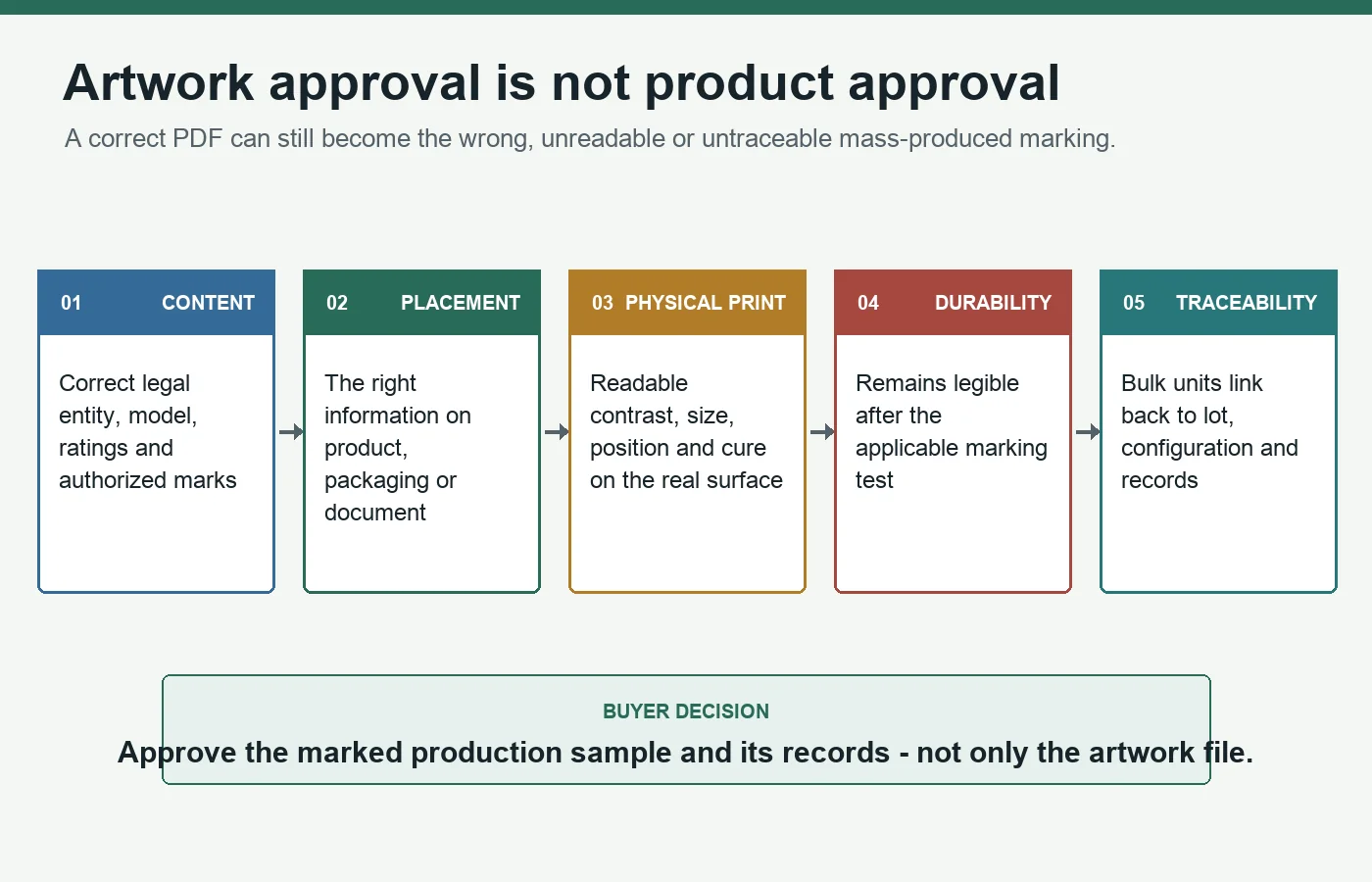
LED bulb marking approval is a five-part control problem: content, placement, physical print quality, durability, and traceability. A correct graphic file proves only the first draft of the first part.
For an importer, private-label brand, or project buyer, the purpose of marking is not decoration. It connects a physical lamp to its ratings, responsible economic operator, compliance evidence, production lot, and corrective-action path. When that connection breaks, a technically good bulb can still become a market-access, inventory, or recall problem.
The CE Symbol Is a Declaration, Not a Decorative Asset
The European Commission states that CE marking is affixed after the manufacturer has completed the relevant conformity assessment, assembled the technical file, and issued the EU declaration of conformity. It is the manufacturer's declaration that the product meets applicable legal requirements; it is not an EU authority's safety approval or a mark of origin.[1]
That immediately changes the buyer's review question.
Do not ask only, "Is the CE logo on the artwork?" Ask:
- Which legal manufacturer is taking responsibility for this exact model?
- Which directives and standards are listed in the declaration?
- Does the model identifier on the bulb, package, declaration, test report, quotation, and production record describe the same configuration?
- Has series production been controlled so that the shipped product remains the declared product?
- Is the CE marking applied where and how the applicable legislation requires?
For mains-voltage electrical equipment within its scope, the EU Low Voltage Directive requires manufacturers to establish technical documentation and conformity assessment, draw up the EU declaration, affix CE marking, and maintain procedures so series production remains in conformity. It also requires product identification through a type, batch, serial number, or another identifying element, with limited alternatives where the equipment's size or nature does not allow the information to be placed on the product.[2]
The practical judgment is simple:
A valid-looking symbol is not evidence that the ordered lamp is inside the scope of the supporting file.
This is why a buyer evaluating EU standard filament bulbs should define the exact voltage, wattage, cap, dimming function, glass finish, model code, and destination market before approving any marking. A range page or catalogue family is a starting point; the production marking must identify the configuration actually being supplied.
Product, Package, and Compliance File Have Different Jobs
A common artwork mistake is to treat every required item as interchangeable: if it does not fit on the bulb, move it to the box; if it does not fit on the box, place it in a manual. That is not a defensible rule.
The correct location depends on the applicable legislation, product standard, certification program, product size, and market. Some requirements allow information to move to packaging or an accompanying document under defined conditions. Others are intended to remain on the product. Retail information may belong specifically on the individual package.
The EU light-source energy-label regulation gives a clear example of location-specific information: for a light source marketed through a point of sale, the prescribed energy label is printed on the individual packaging. The label includes the supplier name or trademark, model identifier, A-to-G scale, energy consumption, QR code, and efficiency class.[5]
That package label does not replace every identification or safety marking obligation on the lamp itself.
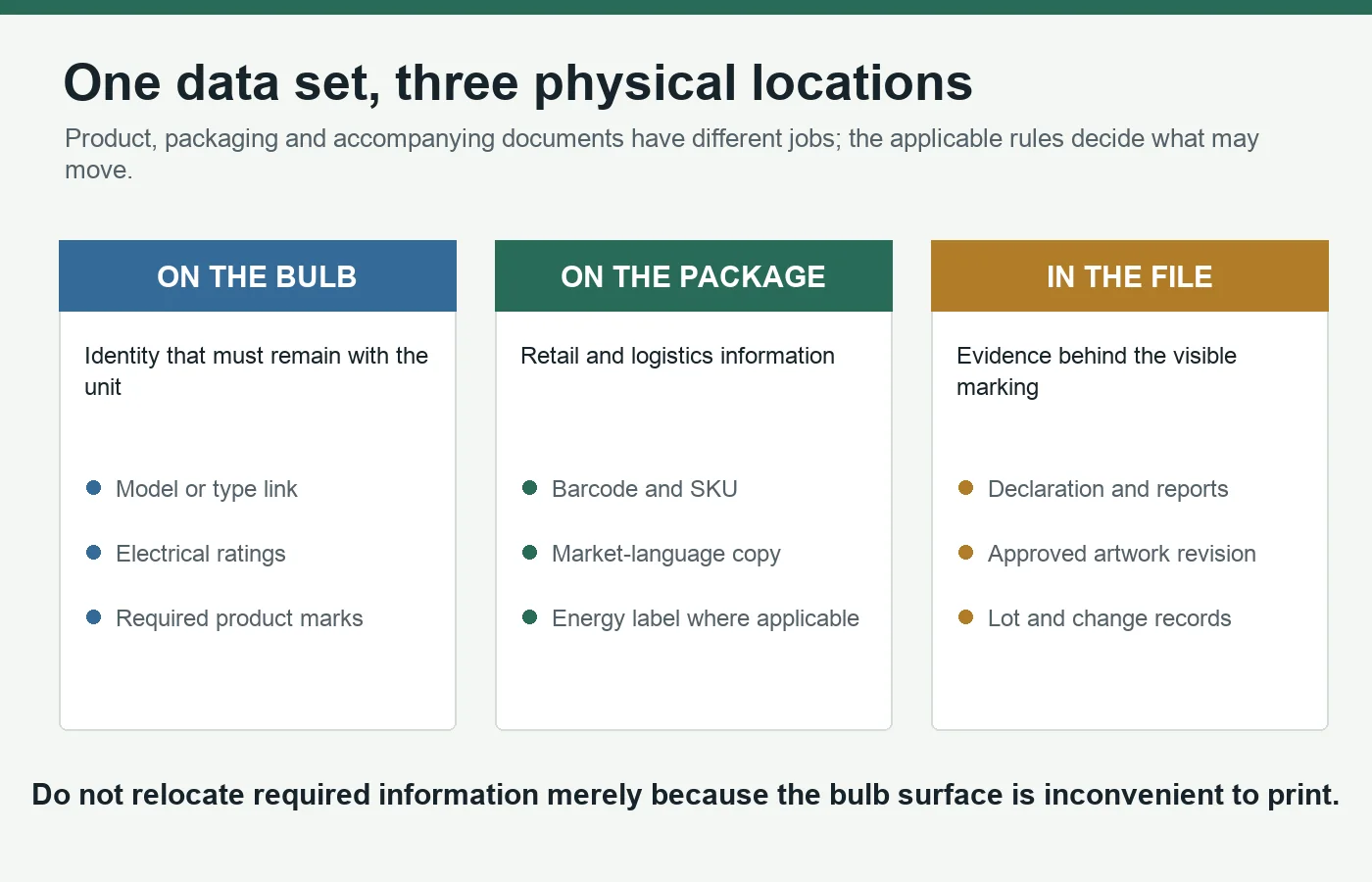
Build a market-specific marking matrix before artwork begins:
| Data field | Exact source of truth | Required location | Owner | Approval evidence |
|---|---|---|---|---|
| Model or type identifier | Controlled product specification | Product, package, or document as applicable | Product/compliance | Marked sample plus file cross-check |
| Rated voltage and frequency | Electrical specification and test file | As required by applicable standard/rules | Engineering | Marked sample and test report |
| Rated power or other declared ratings | Approved performance specification | As required | Engineering/product | Measurement record and artwork revision |
| Manufacturer/importer identity | Legal market-responsibility decision | Product or permitted alternative | Compliance/legal | Entity details and final artwork |
| CE or certification mark | Applicable legal or certification route | Required approved location | Compliance | Declaration, certificate/file, and mark authorization |
| Energy information | Applicable light-source rules | Individual packaging or online display as applicable | Compliance/packaging | EPREL/technical data and final package proof |
| Lot or date code | Factory traceability plan | Product and/or package according to plan | Quality | Lot traveller, inspection record, retained sample |
| Barcode/SKU | Customer inventory system | Package/carton | Customer/logistics | Scan test and order master data |
The table should identify a controlled source for every claim. Typing "4 W" independently into the bulb print, box artwork, catalogue, and declaration creates four opportunities for drift. Pulling all four from one approved product master makes discrepancies easier to detect.
Certification Marks Need Authorization and Scope
CE marking and an ETL Listed Mark are not the same kind of system. Buyers should not review them as if they were interchangeable logos.
For ETL, Intertek describes an Authorization to Mark process, follow-up service at the manufacturing and labelling locations, and specific elements around the certification mark. Its current North American guide explains that the mark is tied to an applicant, manufacturing location, control number, product descriptor, and applicable standard. Direct-imprint artwork requires approval; copying a graphic from another product is not authorization.[4]
When sourcing US ETL clear filament bulbs, verify at least four connections:
- the certification listing covers the relevant product category and model family;
- the applicant and manufacturing site match the authorized arrangement;
- the direct-imprint or label artwork is the approved version;
- the ordered lamp construction remains within the certification report and follow-up-service controls.
Do not infer these connections from the appearance of the mark. Also do not place a certification mark on a mockup, sample, package, or website merely because certification is "in progress." The approval status and permitted use must be confirmed with the certification body and the responsible applicant.
Concrete judgment 1: A certification logo in an editable artwork file has no independent compliance value. Request the file number or declaration, verify model scope, and retain the approved mark artwork revision.
Curved Glass Turns a Clean PDF into a Production Variable
Graphic approval happens on a flat, backlit display. Production printing happens on curved glass, metal, plastic, coating, or a pressure-sensitive label. These surfaces have different contrast, adhesion, heat exposure, available area, and visual distortion.
The print process also changes the result:
| Method | Useful when | Variables to control | Buyer evidence |
|---|---|---|---|
| Pad or screen printing | Repeating text or graphics on glass or cap surfaces | Ink system, surface preparation, curvature, fixture, print pressure, cure | Physical sample, cure record, legibility and durability result |
| Laser marking | Material and finish can produce stable contrast | Material response, power, speed, focus, heat effect, mark position | Approved marked part and contrast check |
| Printed label or rating plate | The certification program and product design permit a label | Approved stock, adhesive, temperature exposure, wrinkles, edge lift, placement | Authorized label, adhesion check, installed sample |
| Inkjet or variable-code printing | Lot/date data changes by production run | Code format, position, resolution, ink/cure, database link | Scan/read check and lot-record reconciliation |
These are process categories, not automatic quality rankings. Laser marking is not universally better than printing. A durable black print on one glass finish may be low-contrast on amber or smoky glass. An adhesive label that behaves well on a cool enclosure may not be suitable near a warm lamp cap. The selected method must be validated on the actual production surface and construction.
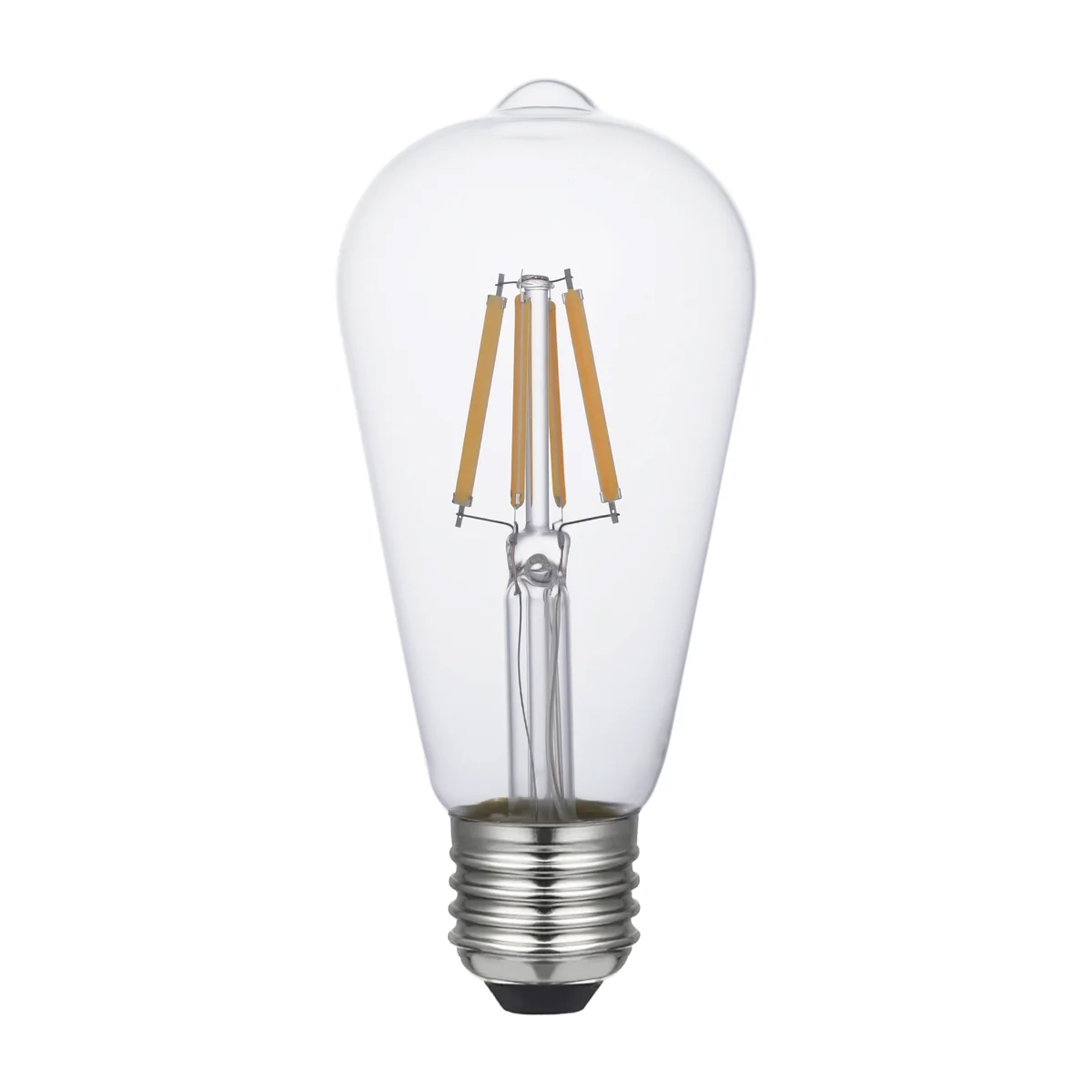
Clear decorative lamps make the tradeoff especially visible. Buyers want an uncluttered bulb, but the product still needs the information required for its market and design. The answer is not to shrink text until it becomes meaningless. It is to choose a controlled location, contrast, orientation, and method that preserve both compliance and product appearance.
This matters for elongated EU vintage straight-filament bulbs because glass shape, visible filament, and cap proportions are part of the design. Marking should be reviewed on the unlit lamp from normal viewing angles as well as under inspection lighting. A placement that looks acceptable in an isolated close-up may be visually intrusive in an exposed-socket installation.
Concrete judgment 2: Approve the real marked sample at 1:1 scale. A magnified artwork proof cannot demonstrate normal-distance legibility, curved-surface distortion, or visual balance.
A Marking Can Be Wrong, Unreadable, or Untraceable
These three failure modes look similar during a rushed inspection but require different corrective actions.
Wrong content
The print is sharp, permanent, and attractive, but it identifies the wrong model, voltage, legal entity, certification control number, or rating. This is a document-control failure. Improving print quality will not fix it.
Unreadable or physically unstable
The artwork content is correct, but the physical result is too small, distorted, low-contrast, smeared, incomplete, easily removed, or hidden after installation. This is a process, material, or placement failure.
Untraceable
The marking looks correct, but no controlled record links that physical lamp to the ordered lot, production date, BOM or driver revision, inspection result, and retained sample. This is a traceability-system failure.
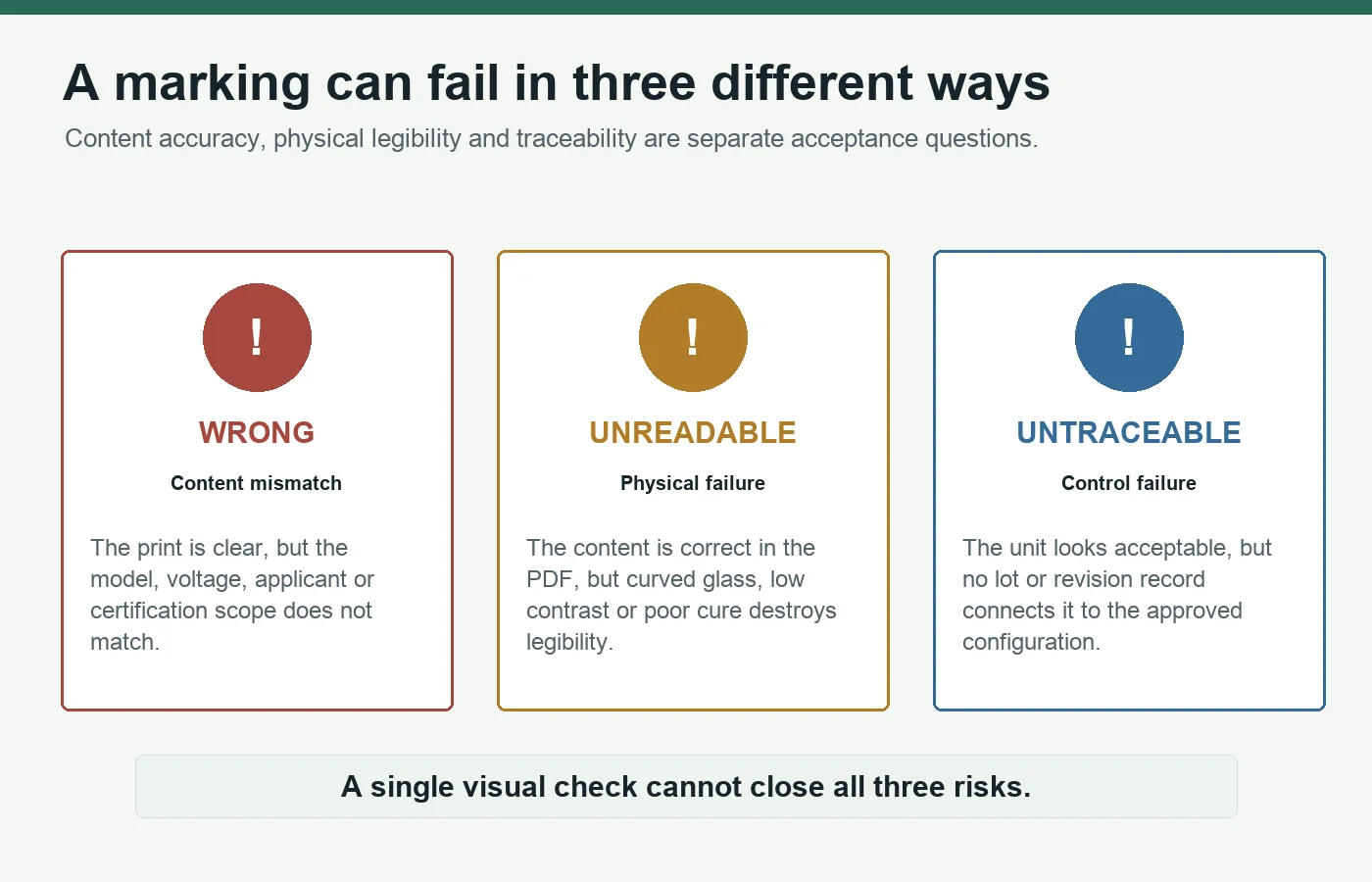
Concrete judgment 3: Separate the marking inspection into three signoffs: compliance-content review, physical-print acceptance, and traceability reconciliation.
Durability Testing Needs a Named Method
The phrase "rub tested" is as incomplete as "quality tested."
IEC 62560 covers safety and interchangeability requirements, test methods, and compliance conditions for self-ballasted LED lamps within its stated voltage, wattage, and cap scope.[3] The exact marking requirements and durability method for a product must come from the applicable standard edition, national adoption, certification program, and test laboratory interpretation. This article does not replace those documents.
If a supplier reports a marking test, the record should identify:
- the exact product and marking surface;
- print or label method and material revision;
- curing or conditioning time before the test;
- applicable standard, edition, clause, and laboratory procedure;
- wiping or rubbing medium, apparatus, force, duration, and number of strokes where relevant;
- environmental conditioning before or after the test where required;
- acceptance criterion, such as continued legibility and label security;
- before-and-after photographs under consistent lighting;
- sample quantity and individual result;
- test date, operator or laboratory, and equipment where relevant.
Do not invent a universal solvent, force, or cycle count and call it an IEC test. A buyer may add a project-specific abrasion, handling, or heat-exposure check for commercial risk control, but it should be labelled as a buyer requirement, not misrepresented as a mandatory certification clause.
For a private-label program, useful production checks can include normal handling after full cure, visual inspection after agreed thermal conditioning, barcode or code readability, and comparison to a retained golden sample. These checks supplement applicable compliance testing; they do not replace it.
Concrete judgment 4: "Pass" is valid only when the sample, method, conditioning, acceptance criterion, and result are all recorded.
Traceability Is What Makes Corrective Action Narrow
The EU Blue Guide explains that product identification and economic-operator traceability support market surveillance. It also notes that more detailed item or batch identification can help reduce the scope of a recall when manufacturers maintain an advanced traceability system.[6]
This is not an argument that every decorative bulb needs a unique serial number. It is an argument that the chosen identification level should support the promised quality system.
A useful lot code should answer practical questions:
- Which production period or line produced the lamp?
- Which ordered model and artwork revision applied?
- Which driver, filament, glass, cap, and critical material revisions were authorized?
- Which incoming and final inspection records cover the lot?
- Which cartons and customer shipment contain it?
- Is there a retained sample for comparison?
- If a complaint arrives, can the factory distinguish an isolated lot from all units carrying the same retail SKU?
Printing the same generic code on every shipment creates the appearance of traceability without the function. A code format is useful only when records can decode it and the code on the bulb or package is reconciled during inspection.
Concrete judgment 5: Ask the supplier to select one sample code and show the complete record path behind it. A code that cannot be decoded during approval will not become more useful during a recall.
Five Buyer Judgments Before Order Approval
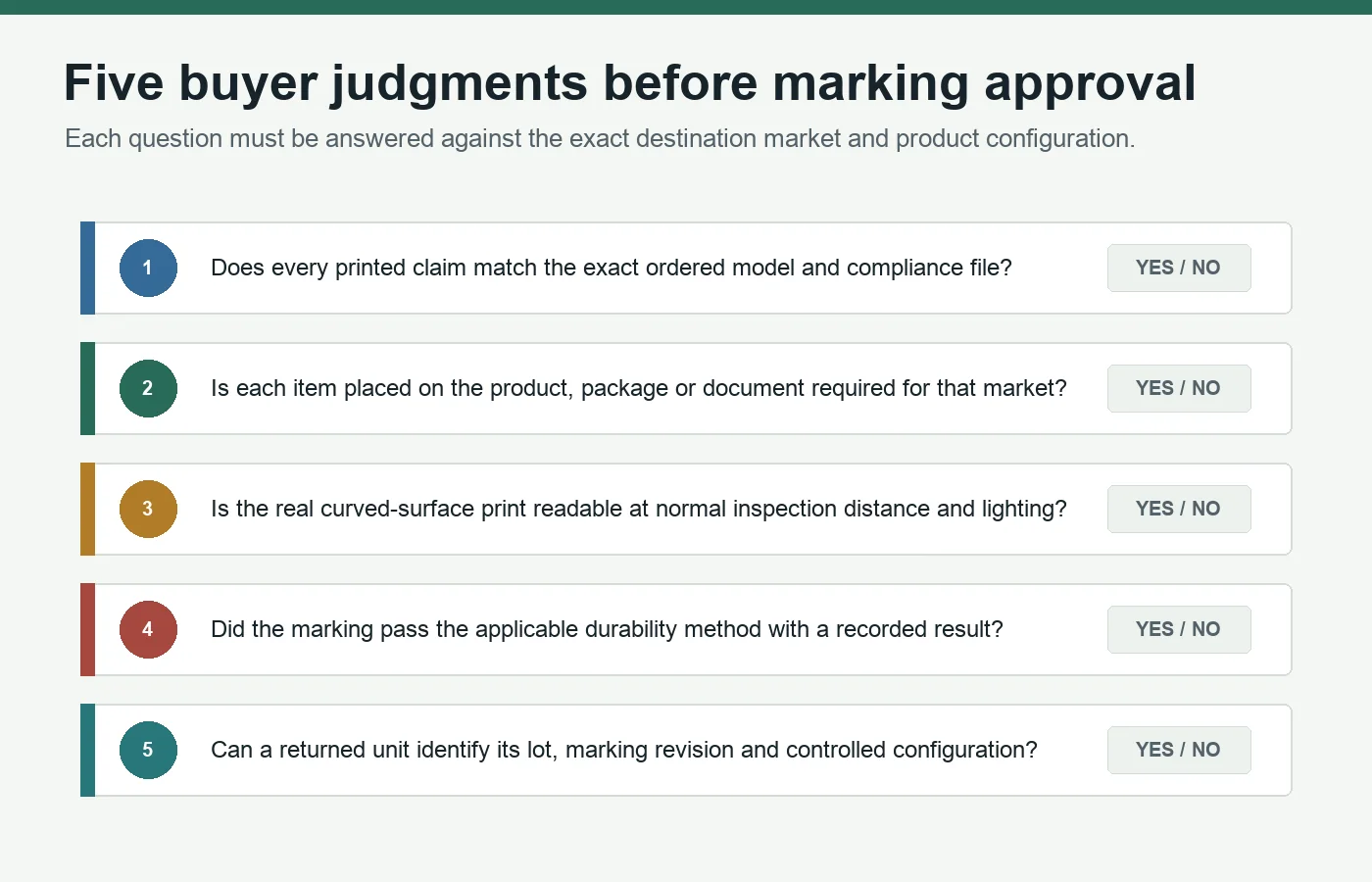
1. Does every claim match the exact ordered model?
Cross-check the quotation, product specification, marked sample, package, declaration, report, certification listing, and online data. Highlight even small naming differences. Some differences are harmless internal codes; others indicate that evidence belongs to another configuration.
2. Is every item in the correct physical location?
Use a destination-market matrix. Do not assume that a carton label can replace a lamp marking, or that a bulb marking replaces required retail-package information.
3. Is the marking readable on the production surface?
Inspect actual curved glass, cap, coating, or label material after the production cure process. Record text height or artwork dimensions where appropriate, contrast, orientation, position tolerance, and defects that cause rejection.
4. Did it pass the applicable durability method?
Retain the method and result, not only a photo showing someone rubbing a lamp. The acceptance criterion should be agreed before testing.
5. Can the code lead back to the controlled product?
Select units from the pilot or bulk lot and trace them back to the artwork revision, product configuration, inspection record, and shipment. Traceability should work in both directions.
From Marking Matrix to Bulk Shipment
Marking approval should be integrated into product-change control, not left with packaging design at the end of development.
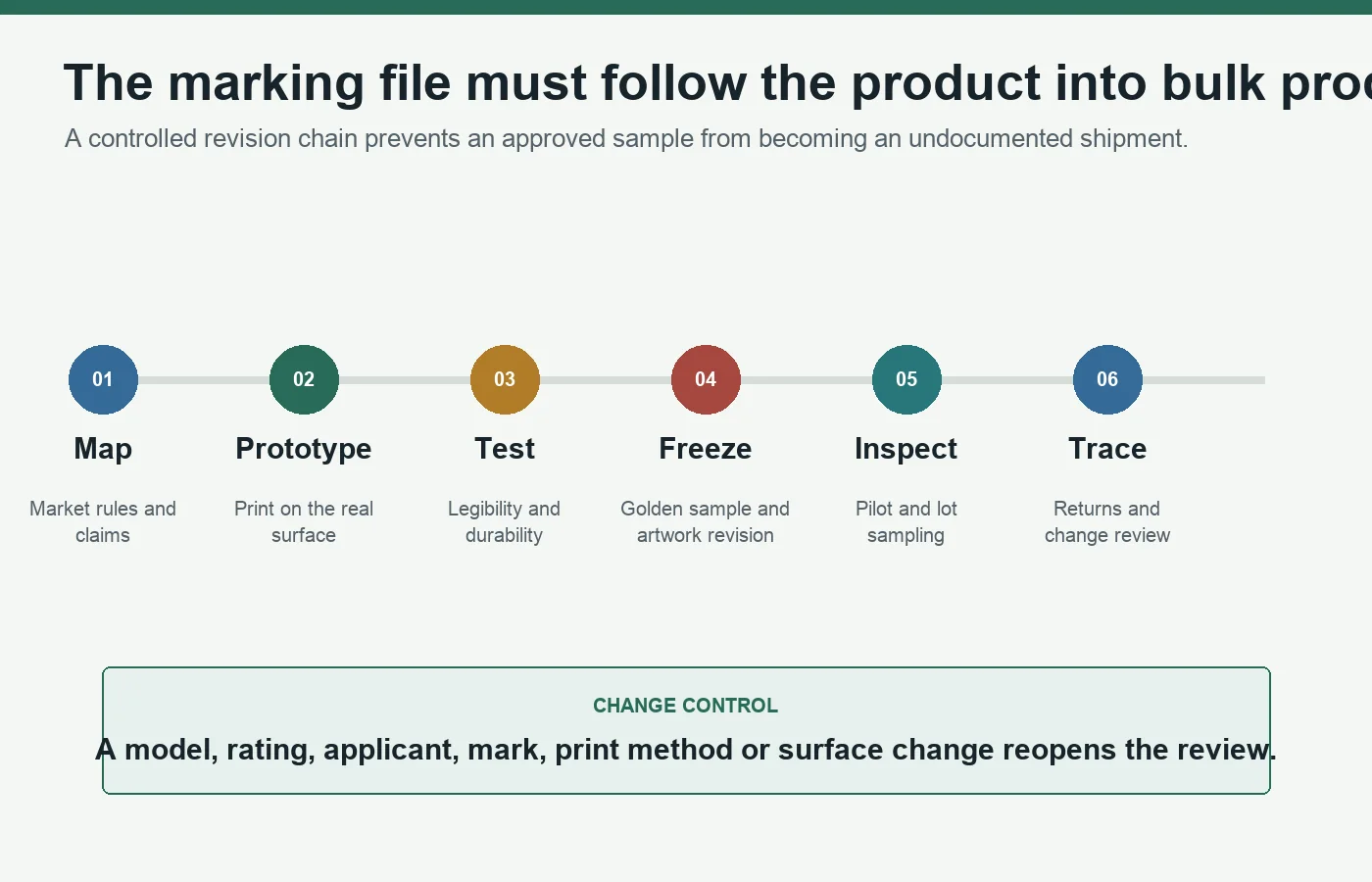
| Stage | Required evidence | Release decision |
|---|---|---|
| Market mapping | Destination, responsible entities, applicable rules, certification route, language | Confirm which fields and marks are required and where |
| Artwork control | Product master, source files, revision, approvers, certification artwork | Approve content for prototype only |
| Marked prototype | Real bulb, package, label, normal and close-up photos | Approve placement and visual legibility |
| Compliance/durability check | Named method, samples, conditioning, acceptance criteria, results | Approve or correct the marking system |
| Golden sample | Signed physical sample, artwork hash/revision, print specification | Freeze the reference configuration |
| Pilot run | Production-built units, code reconciliation, defect inspection | Confirm normal equipment can reproduce the result |
| Bulk inspection | Lot sampling, markings, packaging, carton and record match | Release the shipment or contain the lot |
| Change request | Description, affected models/lots, risk review, revalidation plan | Approve before implementation, not after shipment |
Key changes include more than edited text. A new glass coating can reduce contrast. A different ink or curing process can alter adhesion. A new importer changes responsible-party information. A certification-file update can change approved wording. A new voltage or driver can require a different model identity. A packaging resize can make the energy label noncompliant.
What to Put in the RFQ and Approval Sheet
Add a marking schedule to the request for quotation instead of writing only "custom logo and CE required."
| RFQ field | What to specify or request |
|---|---|
| Destination market | Country or region, sales channel, and responsible importer/private-label owner |
| Exact product identity | Shape, cap, voltage/frequency, wattage, CCT, dimming state, finish, model and revision |
| Compliance route | Applicable declarations, certificates, reports, listing/file numbers and responsible entity |
| Product marking | Required text/marks, position, orientation, artwork size, contrast and tolerance |
| Package information | Ratings, barcode, model, language, energy label and market warnings as applicable |
| Variable code | Lot/date format, physical location, database meaning and retention period |
| Process | Print/laser/label method, material, cure or conditioning, and controlled supplier |
| Verification | Applicable standard method plus any clearly labelled buyer-specific check |
| Approval evidence | Marked sample, photographs, test record, golden sample and artwork revision |
| Change control | Events that require notification, review, new samples, or retesting |
| Bulk inspection | Sampling plan, defect classes, reconciliation checks and release authority |
Three red flags deserve immediate clarification:
- "We use the same CE/ETL artwork for all bulbs." A graphic may be reused only when the underlying responsibility and scope remain valid for the exact products. Verify rather than assume.
- "The batch code is on the carton, so every lamp is traceable." Ask whether inner boxes or individual lamps can become separated from that carton in distribution.
- "The sample print is permanent." Request the named test method and result, then confirm that mass production uses the same surface, ink or label, cure, and process settings.
Conclusion
A polished PDF is not a marked product. A symbol is not a compliance file. A batch code is not traceability unless it opens a real record.
A defensible LED bulb marking approval connects five things: correct content, correct location, readable physical execution, applicable durability evidence, and a lot-level route back to the controlled product configuration. The buyer should freeze those connections in a golden sample and revision-controlled file, then verify that pilot and bulk production reproduce them.
The sharper purchasing question is not "Can you print our logo and the required marks?"
It is:
"Show me the marked production sample, the evidence authorizing every claim, the durability result, and the record that links this physical lamp to my exact order."
References
- European Commission. CE marking - responsibilities, meaning and official guidance. Back
- European Parliament and Council. Directive 2014/35/EU on electrical equipment designed for use within certain voltage limits. Back
- International Electrotechnical Commission. IEC 62560:2011, Self-ballasted LED-lamps for general lighting services - Safety specifications. Back
- Intertek. 2026 Guide to North American Product Testing and Certification. Back
- European Commission. Commission Delegated Regulation (EU) 2019/2015 on energy labelling of light sources. Back
- European Commission. The Blue Guide on the implementation of EU product rules 2022. Back