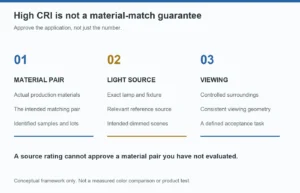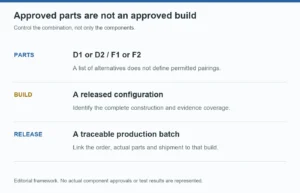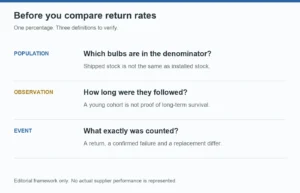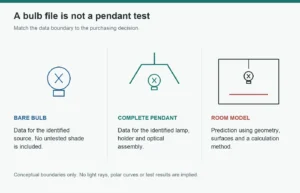
Featured image: Original editorial diagram. Definitions and hypothetical calculations are not HongYu test results.
Two suppliers quote a decorative LED bulb. One highlights a power factor of 0.9. The other offers a lower price and a lower power factor. A purchasing spreadsheet awards the first bulb a higher "efficiency" score before anyone compares its measured light output or input watts.
That score is built on the wrong quantity.
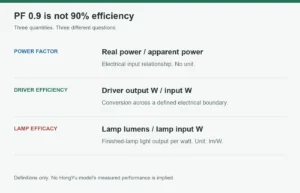
Power factor describes the relationship between real and apparent electrical power. It does not tell you what percentage of electricity becomes light, how efficiently the driver converts power, or how many lumens the finished bulb produces per watt.
High power factor can be a valuable requirement. The mistake is treating it as a shortcut for every other requirement.
Four Numbers, Four Different Questions
Schneider Electric defines power factor as real power divided by apparent power. Its meter documentation also distinguishes true power factor, which includes harmonic content, from displacement power factor, which considers the fundamental frequency.[1]
For a single-phase lamp at one operating point:
True PF = P / (V RMS x I RMS)
The quantities in that equation must refer to the same measurement boundary and operating condition. A label saying only "PF" should not leave the buyer guessing which definition was used.
| Quantity | Meaning | What it does not prove |
|---|---|---|
| True power factor | Real input power divided by apparent input power; dimensionless | Driver conversion efficiency or optical efficiency |
| Driver efficiency | Electrical power delivered at the defined driver output divided by electrical input power | Finished-lamp lumens per watt |
| Lamp luminous efficacy | Light output in lumens divided by the complete lamp's real input watts | Light distribution, visual comfort or application suitability |
| Energy use | Real input power integrated over operating time, commonly expressed in kWh | Whether the light is useful in the intended installation |
DOE's guidance uses luminous efficacy, measured in lumens per watt, to describe LED lighting energy performance and distinguishes component, lamp and luminaire boundaries.[2] Its historical market-performance figures are not needed here; the important point is the definition.
A PF of 0.9 is therefore not a claim of 90% driver efficiency. Nor does PF 0.5 mean half the electricity entering the bulb disappears as wasted energy.
Buyer judgment 1: Give PF, driver efficiency and lamp efficacy separate fields. Never turn PF into an efficiency percentage on a comparison sheet.
Same Watts, Different Current: A Worked Example
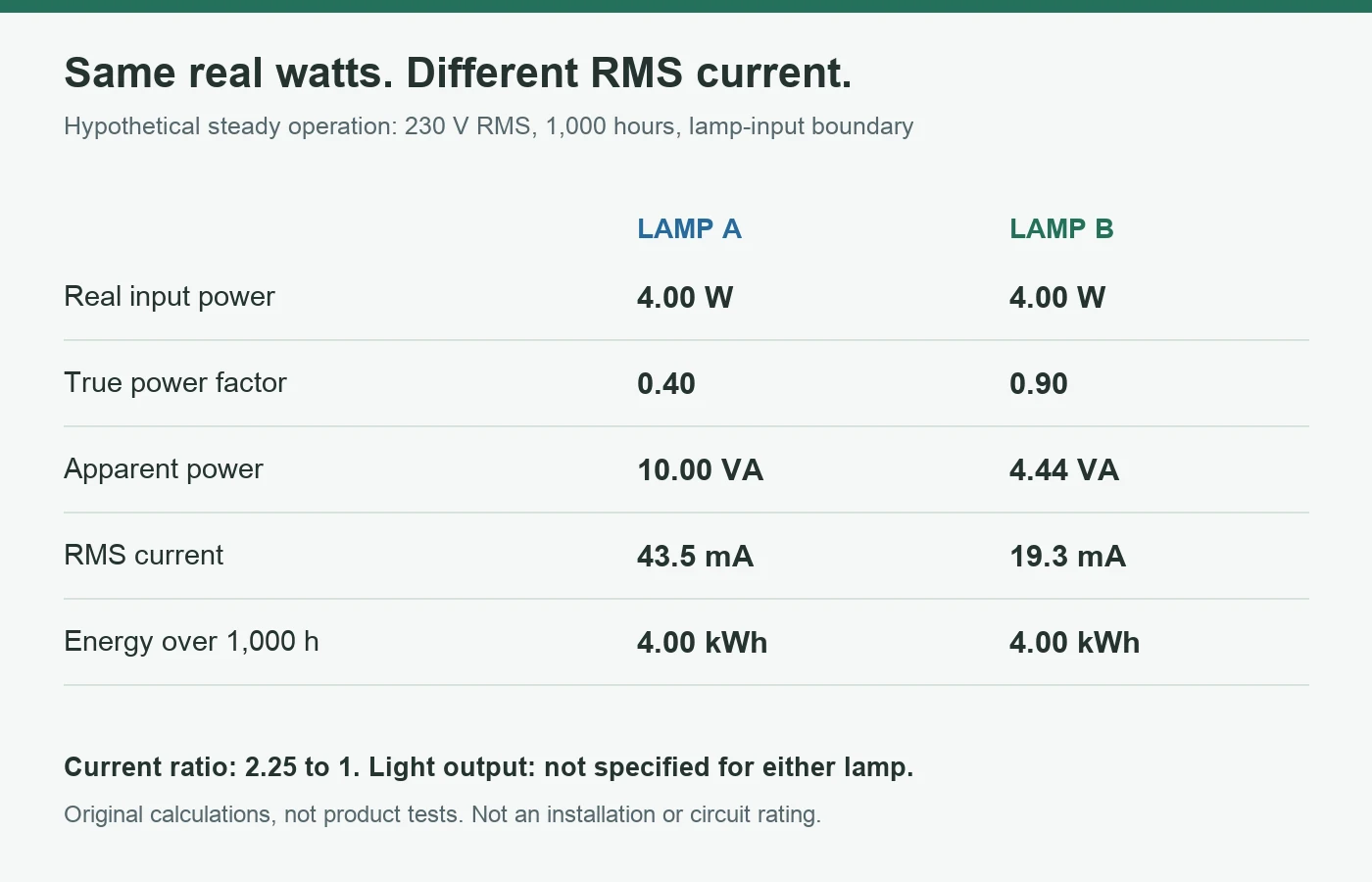
Assume two hypothetical lamps both draw 4.00 W of measured real power from a 230 V RMS supply at steady full output. Lamp A has true PF 0.40; Lamp B has true PF 0.90.
| Calculated quantity | Lamp A | Lamp B |
|---|---|---|
| Real input power | 4.00 W | 4.00 W |
| True PF | 0.40 | 0.90 |
Apparent power, P / PF | 10.00 VA | 4.44 VA |
RMS current, P / (V x PF) | 43.5 mA | 19.3 mA |
| Lamp-input energy over 1,000 hours | 4.00 kWh | 4.00 kWh |
| Light output and lamp efficacy | Not specified | Not specified |
Lamp A draws 2.25 times the RMS current, but both consume the same real energy at their lamp terminals under these assumptions. Neither can yet be called the more efficient light source: the example contains no lumen measurements.
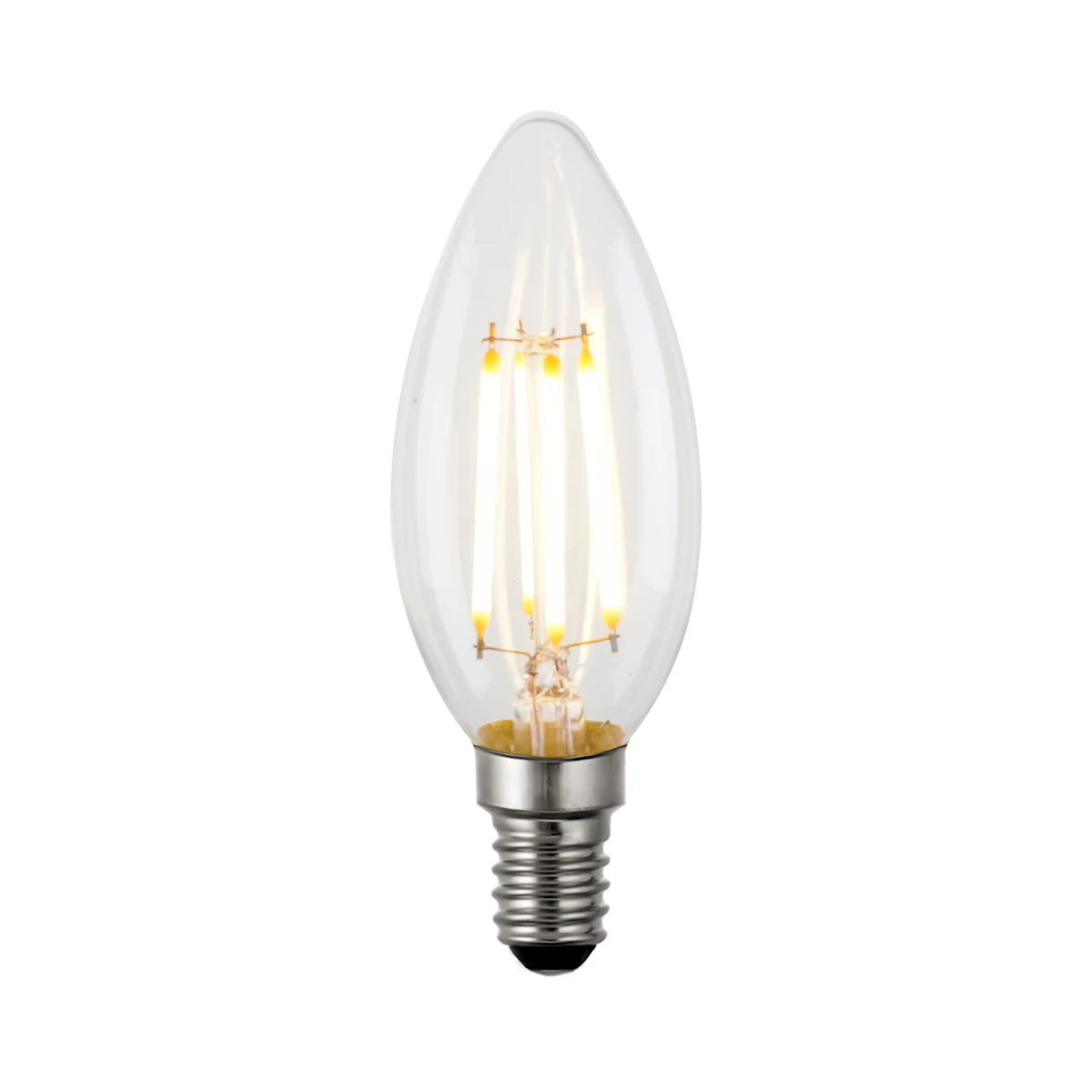
For products in the EU standard filament bulb range, request the actual input measurements for the quoted model and revision. A nominal "4W" name is not a substitute for a measured 4.00 W result, and the shape of the glass does not reveal the driver characteristics.
Buyer judgment 2: Compare measured watts and delivered light before claiming an energy-efficiency advantage. A lower current reading alone is not that evidence.
Do Not Divide the Energy Bill by Power Factor
For constant real input power, the basic calculation is:
Energy (kWh) = real input power (W) x hours / 1,000
Australian government guidance similarly bases an appliance's energy-related running-cost estimate on input kilowatts, operating time and the applicable price per kWh.[3]
Using 4 W / 0.40 = 10 W as Lamp A's billable real power would be wrong. The result is 10 VA of apparent power, not a revised 10 W consumption figure.
The measurement boundary matters, however. The table describes energy entering the lamps, not every loss in a building. Higher current can increase resistive losses upstream; Schneider identifies higher distribution losses as one consequence of poor power factor.[4] The magnitude depends on the actual installation and cannot be calculated from a bulb's PF alone.
Commercial electricity contracts may also include demand, reactive-energy or power-factor-related provisions. Check the customer's actual tariff and metering basis instead of promising a fixed bill reduction from a lamp-level PF change. Do not assume every customer is charged the same way.
For a dimmed operating schedule, calculate energy from measured real power at each relevant state and its duration. The knob position is not necessarily the percentage of watts consumed.
Buyer judgment 3: State whether a saving concerns lamp-input kWh, installation losses or a specific tariff charge. Do not merge them into one unsupported percentage.
High PF Does Not Settle the Lighting Decision
A separate hypothetical comparison makes the distinction clear. Suppose Lamp C produces 400 lm at 4 W with PF 0.60, while Lamp D produces 300 lm at 4 W with PF 0.90. Their lamp efficacies are 100 lm/W and 75 lm/W respectively. The higher-PF lamp has the lower luminous efficacy in this example.
That does not automatically make Lamp C the correct purchase. It may fail a required PF criterion, distribute light poorly for the application, or have the wrong appearance, color or control behavior. The point is to compare independent requirements rather than declare one universal winner.
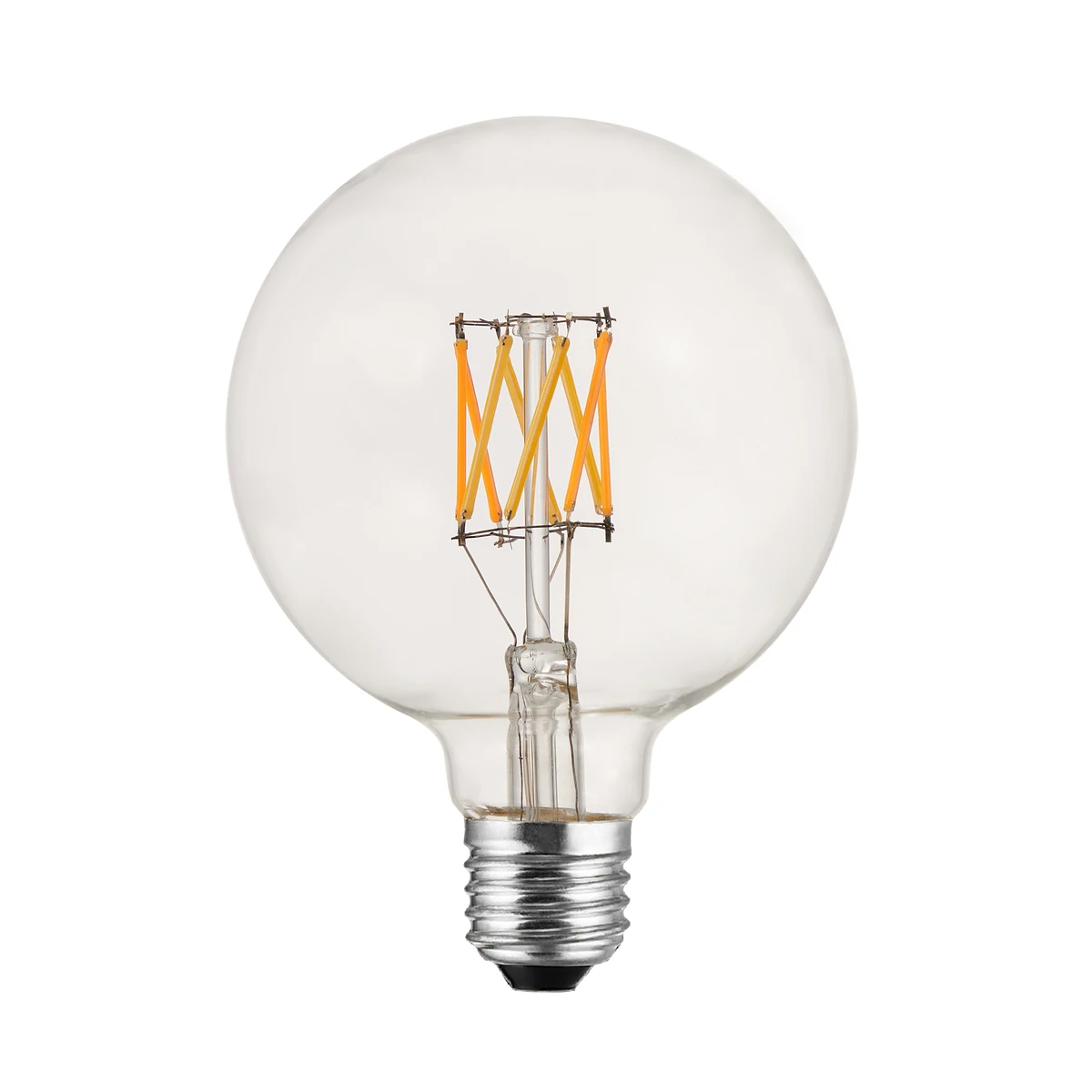
For top-mirror decorative bulbs, for example, the reflected light distribution and reduction of direct view of part of the emitting area may be central to the design intent. Compare the required lighting effect as well as total lumens and watts. A desirable mirror finish is not an electrical-efficiency claim, and a high lm/W number is not proof of the right visual result.
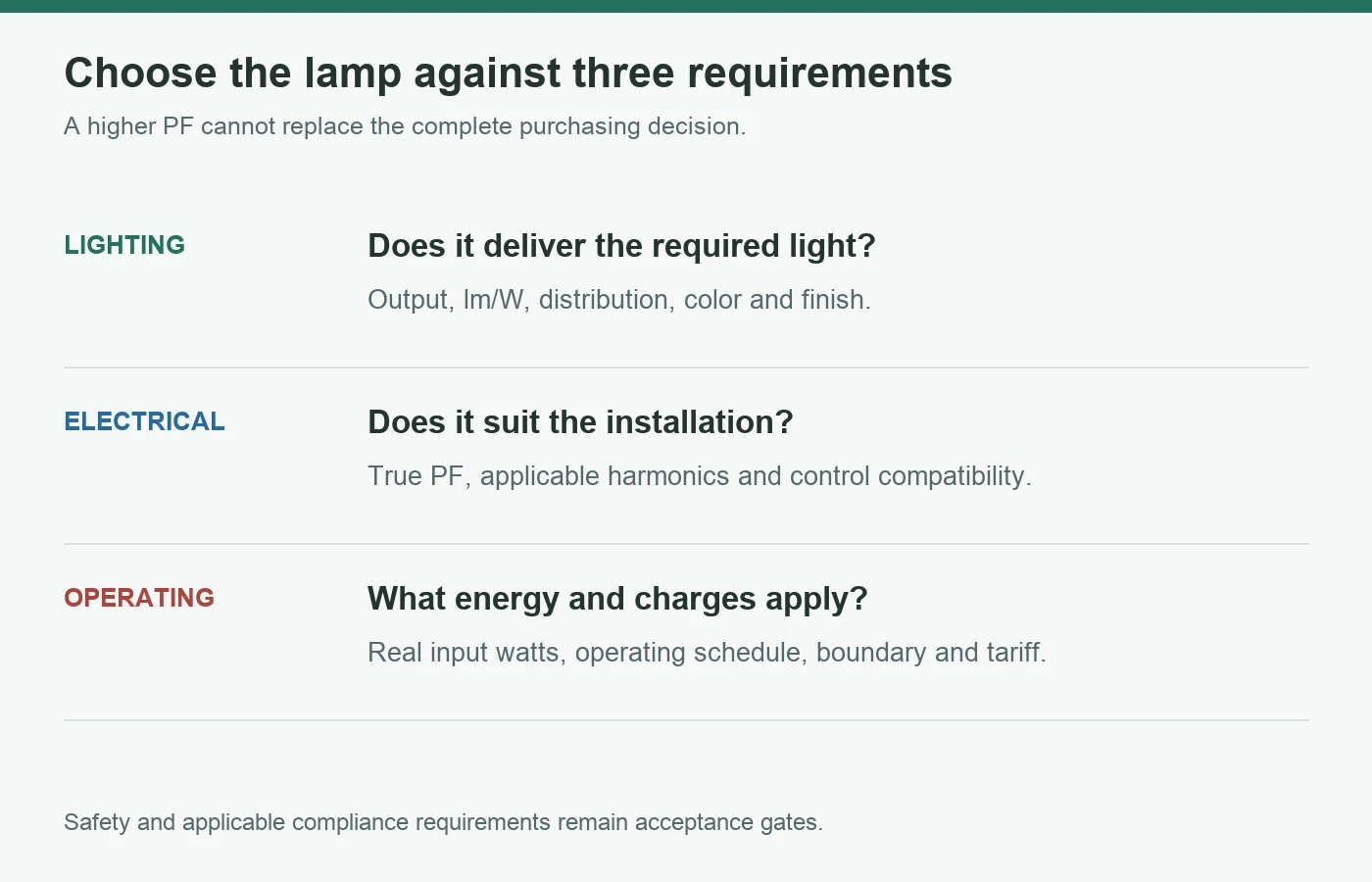
Keep safety and applicable compliance requirements as acceptance gates. Among products that meet them, evaluate the lighting result, electrical loading, operating behavior and total cost for the actual project.
Ask Which PF, at Which Operating Point
True PF and displacement PF are not interchangeable for a load with distorted current. A good displacement value can coexist with distortion that reduces true PF. Likewise, one PF number cannot describe the full harmonic spectrum or establish that individual harmonic limits have been met.
IEC 61000-3-2 addresses harmonic-current emissions under specified test conditions. Its published scope and lighting provisions are more specific than a generic request for "high PF."[5] Have the test provider identify the applicable edition, equipment category, power range and requirements for the target market. Do not infer compliance or noncompliance from the hypothetical 4 W examples above.
| Question for the supplier | Useful evidence |
|---|---|
| Is the number true PF or displacement PF? | Clearly identified instrument field and definition |
| At what supply and control setting? | Voltage, frequency, supply waveform and operating state |
| Where was power measured? | Lamp input or complete lamp-plus-controller input, explicitly identified |
| Are watts, current and PF from the same run? | Simultaneous or consistently recorded data at a stable operating point |
| What harmonic evidence is needed? | Applicable test report, not a PF value used as a substitute |
| Does the result apply across the intended use? | Results for the relevant configurations and operating points |
A lamp specified only at full output may not behave the same way when dimmed. PNNL's historical CALiPER research examined dimming, flicker and power quality separately and found that desirable behavior in one characteristic did not guarantee it in another.[6] That study is useful methodological context, not a claim about today's HongYu products.
When evaluating dim-to-warm LED bulbs, record real power, light output, color response and relevant electrical characteristics at agreed operating points with the intended controller. Do not turn a full-output PF requirement into an unstated promise covering every dimmer setting.
Buyer judgment 4: Attach every PF claim to a definition, measurement boundary and operating point. Keep harmonic compliance and dimming behavior as separate checks.
Turn "High Efficiency" into a Usable RFQ
An inquiry saying "high-efficiency, high-PF decorative bulbs" leaves several different decisions unresolved. Replace those adjectives with a short, configuration-specific schedule.
| RFQ field | What to specify or request |
|---|---|
| Lighting duty | Required output, distribution, color quality, finish and intended application |
| Real input power and efficacy | Measured watts and complete-lamp lm/W under identified conditions |
| Power factor | True PF requirement, test voltage/frequency and applicable control states |
| Driver efficiency, if needed | Defined input/output boundary, operating point and measurement method |
| Electrical evidence | Applicable harmonic requirements and separately agreed compatibility checks |
| Changes and acceptance | Approved product revision, tolerances, verification method and change-notification conditions |
If a driver-efficiency number is commercially important, obtain an engineering report for that boundary. Do not infer it from PF, and do not ask warehouse staff to open mains-powered lamps to take improvised measurements.
From a manufacturing-control perspective, the approved driver revision belongs with the performance record. A component or circuit change may require reassessment of more than PF: repeat the affected electrical, optical, thermal and control checks as justified by the change. This is a recommended approval practice, not a claim about an audited factory procedure.
Buyer judgment 5: Approve a set of independently verified requirements, not a "premium driver" label or one impressive number.
Conclusion
PF 0.9 means that real power is 90% of apparent power at the defined operating point. It does not mean the bulb has 90% conversion efficiency, produces more light per watt, or automatically costs less to operate.
For better purchasing decisions, separate three questions: Does the lamp deliver the required light? Does its electrical behavior suit the installation? What real energy and other applicable charges will the operating schedule produce?
Power factor belongs in that assessment. It should not replace it.
References
- Schneider Electric. Power Factor: True PF and Displacement PF, PM5500 Documentation. Back
- U.S. Department of Energy. Energy Efficiency of LEDs. Used for definitions and measurement boundaries, not current market benchmarks. Back
- Australian Government. Energy Ratings: Estimating Running Costs. Back
- Schneider Electric. Power Factor and Power Quality. Back
- IEC. IEC 61000-3-2:2018+AMD1:2020+AMD2:2024, Consolidated Version. Public scope summary; no compliance assessment of a specific lamp is made here. Back
- Pacific Northwest National Laboratory. Retail Lamps Study 3.1: Dimming, Flicker, and Power Quality Characteristics of LED A Lamps, 2014. Back