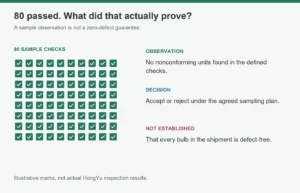
Featured image: Composite made from a real HongYu product photograph and an original editorial procurement graphic; it is not a laboratory scene or an 806 lm test record.
A buyer approves an LED bulb report showing 806 lm. The purchase order repeats "806 lm," production starts, and a third-party inspector later measures several lamps below that number. The buyer calls the lot defective. The supplier replies that 806 lm is nominal and sends a different report with a higher average.
Both parties have numbers. Neither party has a complete acceptance rule.
This is not mainly a photometry problem. It is a procurement-control problem created when five different things are compressed into one line on a specification:
- the declared value;
- the allowed product variation;
- the measurement method and conditions;
- the sampling plan;
- the rule that converts test results into a pass, fail, or retest decision.
The central buyer insight is this: a lumen value describes a product only under defined conditions; a purchase order must separately define how a production lot will be accepted. "806 lm" alone does neither job completely.
First Separate the Three Lumen Decisions
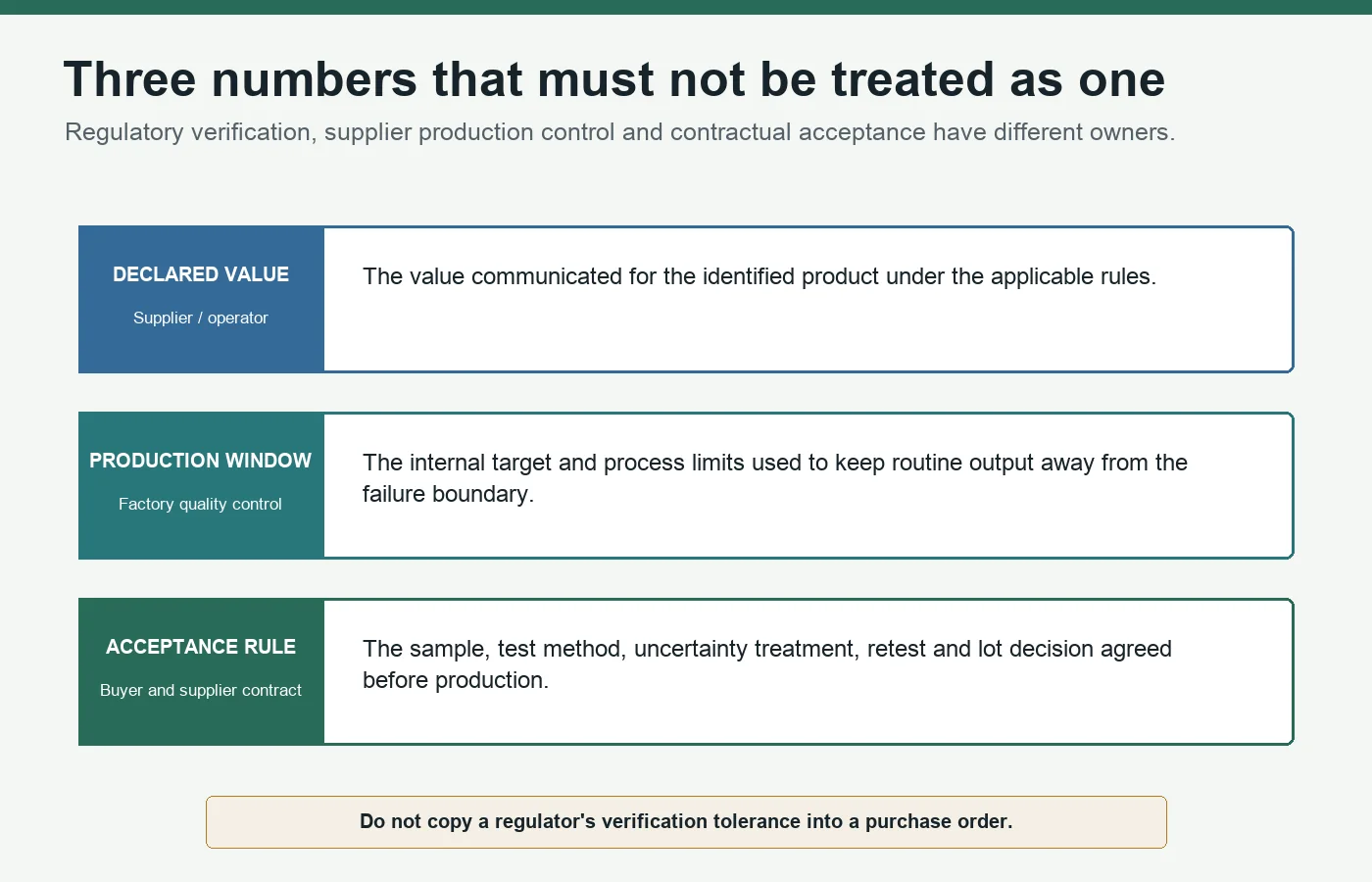
1. Declared value
The declared luminous flux belongs to the identified product and the applicable declaration or regulatory framework. IEC 62612 specifies performance requirements, test methods and conditions for self-ballasted LED lamps within its scope.[1] That does not mean every purchase contract should copy one value from the standard and stop there.
2. Factory production window
The factory needs an internal target and process-control window that keep normal production away from the buyer's rejection boundary. This is where LED selection, filament configuration, driver output, glass transmission, coating, assembly variation and thermal behavior are controlled.
An internal factory limit is not automatically the product declaration, and it is not automatically the buyer's legal remedy. It is a manufacturing control used to make compliant deliveries repeatable.
3. Contractual acceptance rule
The purchase order must define which units are sampled, how they are conditioned and measured, which result is compared with which limit, how measurement uncertainty is handled, and what happens after a borderline or failed result.
Concrete judgment 1: Put the declared value, the factory control window and the contractual acceptance rule in separate rows. If all three are written as "806 lm ± X%," ask who owns each number and what decision it controls.
"Lumens" Is Still Not a Complete Measurand
For a normal omnidirectional bulb, buyers often intend total luminous flux. In other product and regulatory contexts, useful luminous flux may refer to flux within a defined sphere or cone. The current EU ecodesign regulation defines luminous flux under conditions specified in applicable standards and separately defines useful luminous flux for energy-efficiency calculations.[2]
That distinction matters for decorative bulbs. A clear ST64 lamp, a mirror-top lamp, a directional reflector, and a coated globe can use the same word "lumens" while distributing light differently. A report and specification should identify the quantity actually measured rather than relying on a familiar unit alone.
At minimum, state:
- total or useful luminous flux;
- the relevant geometry where useful flux is specified;
- rated voltage and frequency;
- dimming or control state;
- lamp orientation if the applicable method or product behavior makes it relevant;
- ambient and stabilization conditions;
- the exact model, finish, CCT, wattage and production revision.
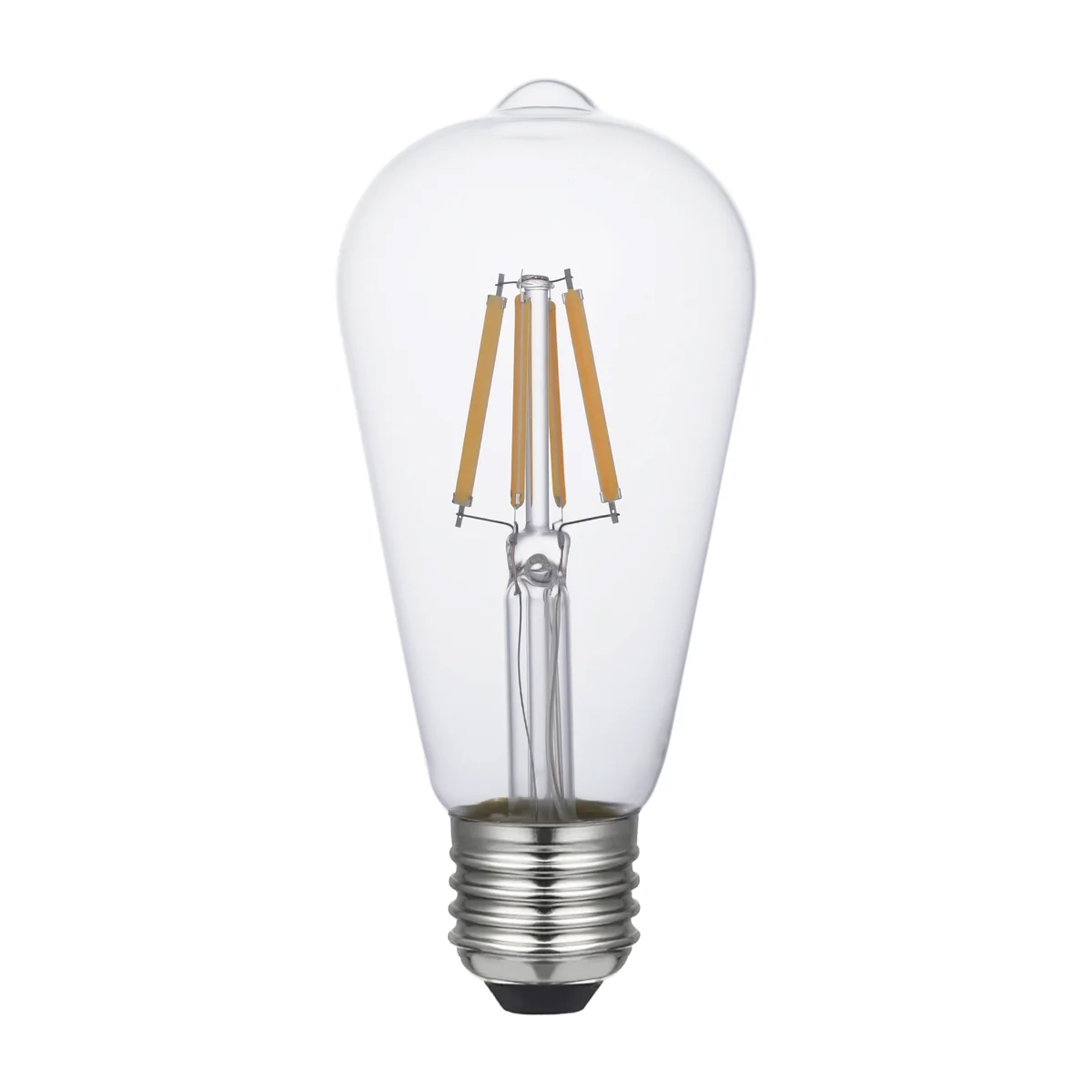
HongYu's EU standard filament bulb range is a practical starting point for defining common mains-voltage product families. The approval document should still identify the exact shape, cap, wattage, finish and CCT being ordered. A report for one configuration should not silently approve every configuration on the range page.
Concrete judgment 2: Never approve a line item that says only "lumens." Approve a measured quantity for one identified configuration under one identified method.
Why Two Laboratories Can Measure the Same Lamp Differently
CIE S 025 was created to support reproducible photometric and colorimetric measurement of LED lamps, modules and luminaires under normalized conditions, while recognizing the limits of declared measurement uncertainty.[3] ANSI/IES LM-79-24 likewise covers physical and environmental conditions, electrical conditions, test preparation, total luminous flux measurement, uncertainty and reporting for solid-state lighting products.[4]
The method matters because the lamp is not an inert object. Its output can change while the driver and LEDs warm up. The measured result can also be affected by the supply, ambient conditions, stabilization criterion, sphere system, calibration, spectral mismatch correction, self-absorption treatment, geometry and sample history.
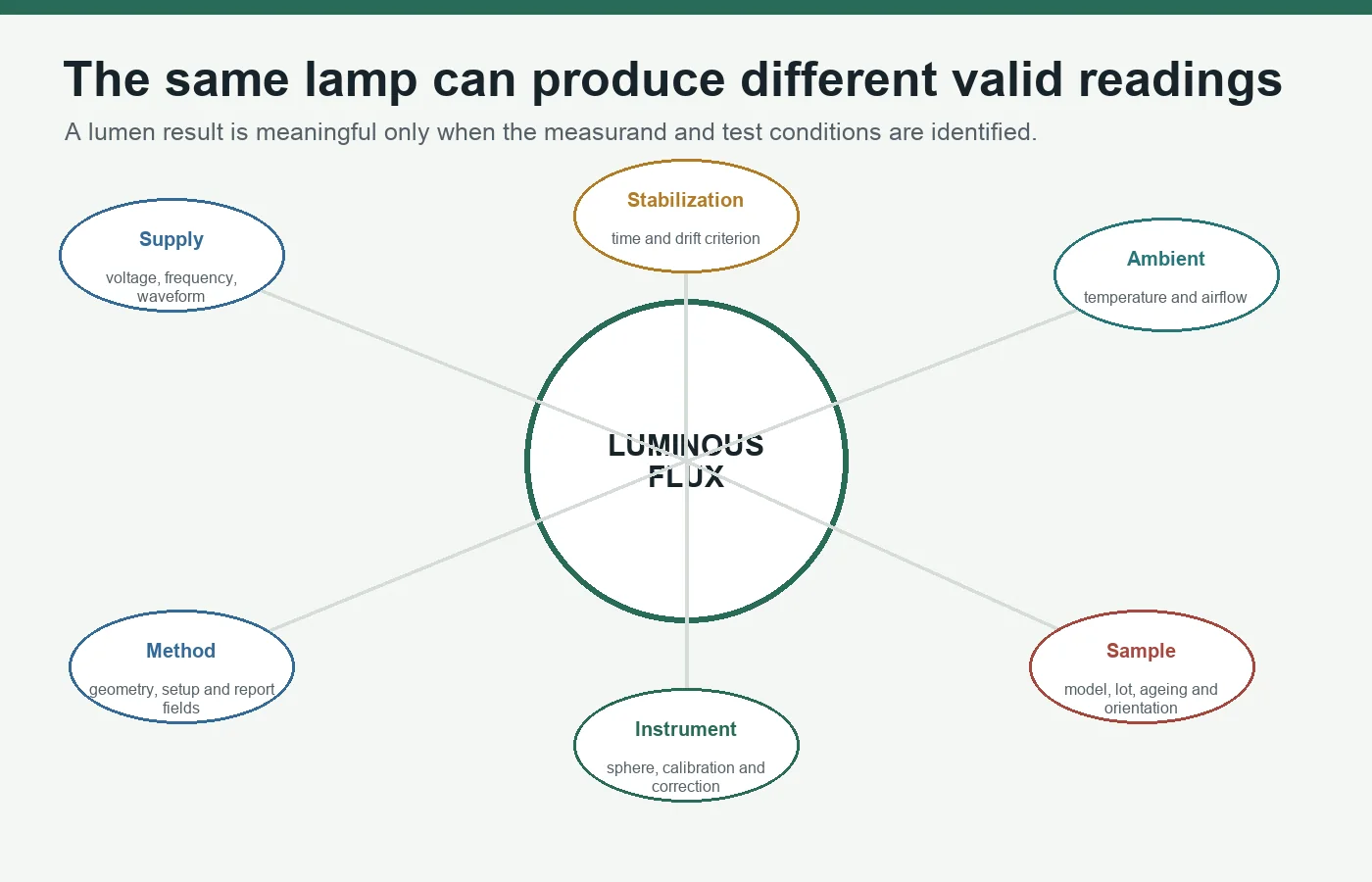
When results disagree, compare the test setup before comparing the final numbers:
| Control item | Questions for both reports | Procurement risk if omitted |
|---|---|---|
| Sample identity | Same model, finish, CCT, wattage, driver/BOM revision and lot? | Different products are treated as repeat measurements |
| Sample history | New, aged, previously heated, transported or repeatedly tested? | Drift is blamed on the laboratory or supplier |
| Electrical input | Same voltage, frequency, waveform and control state? | Driver operating point changes |
| Stabilization | Same criterion and observation interval? | One lab records an early peak and another a stable value |
| Ambient/setup | Same temperature, airflow, orientation and mounting assumptions? | Thermal conditions change optical output |
| Instrument | Appropriate sphere/system, current calibration and applicable corrections? | System bias becomes a product dispute |
| Report scope | Raw value, rounded value, uncertainty and conformity statement all identified? | A measurement is mistaken for a pass/fail rule |
The goal is not to force two competent laboratories to produce identical last digits. It is to make their results comparable enough for the agreed decision.
A Real Report Is Evidence, But Not Yet a Lot Certificate
The report excerpt below is a real HongYu-supplied spectrum-analysis result for an amber-glass sample. It records CCT, luminous flux, electrical input, efficacy and other optical values. Its flux entry is 237.62 lm for that specific tested sample.
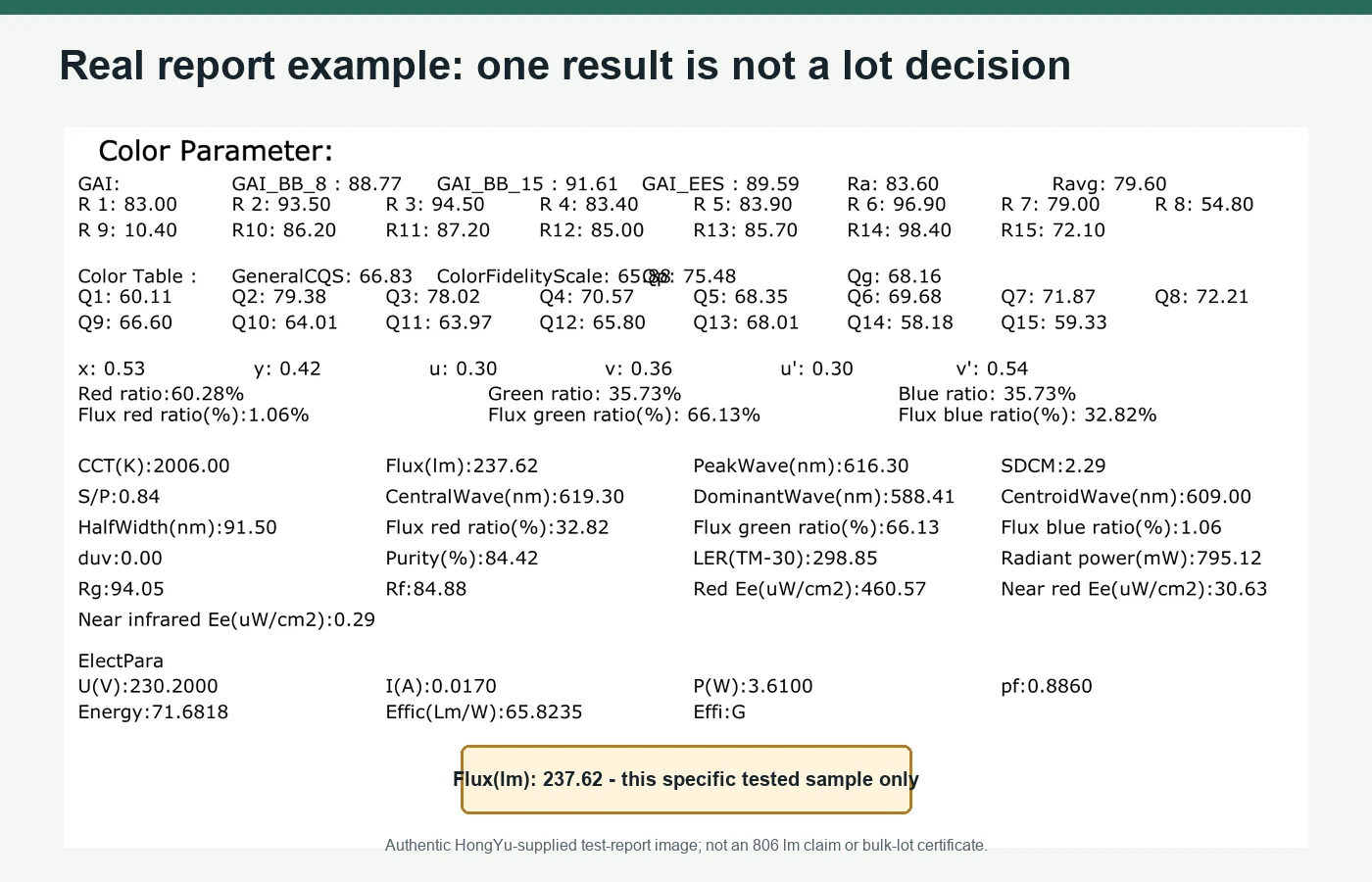
This is useful product evidence because it shows the measured result and related test fields. It still does not answer four commercial questions by itself:
- Was the tested unit selected randomly from the production lot?
- Which purchase-order limit applied to that exact configuration?
- What measurement uncertainty and decision rule applied?
- Does the result represent one sample, the lot mean, every tested unit, or another statistic?
For customized glass or coating, the transmission loss belongs to the finished configuration. A clear-glass report should not be reused to approve an amber, smoky, frosted or porcelain version merely because the internal filament and driver are similar. Buyers discussing such variants can start with HongYu's custom color bulb options, then require configuration-specific photometric evidence before freezing the specification.
Concrete judgment 3: A test report is evidence about the items actually tested. It becomes lot-release evidence only when sample selection, acceptance limits and the decision rule connect it to the lot.
Measurement Uncertainty Must Be Connected to the Decision
ISO/IEC 17025 is the international competence standard for testing and calibration laboratories and covers consistent operation and reliable results.[5] ILAC G8 provides guidance on decision rules and statements of conformity, including how measurement uncertainty is considered when a laboratory states that a result conforms to a specification.[6]
This matters near a limit. Suppose a contract has a lower acceptance boundary and a laboratory reports a result close to it. The measured value alone does not explain the risk of accepting a nonconforming unit or rejecting a conforming one. A decision rule states how the uncertainty is used to create the acceptance zone.
There is no honest universal answer that every bulb order should use the same guard band. NIST notes that evaluating uncertainty is a technical activity, while selecting a conformity decision rule is also a business decision involving the economic consequences of false acceptance and false rejection.[7]
The purchase order should therefore state one of the following before testing:
- the named standard or program already defines the conformity rule and will be followed;
- the laboratory will report measured values and uncertainty, while the buyer applies a separately agreed commercial rule;
- the parties agree to a specific decision rule or guard band for the contractual limit;
- borderline results trigger a defined retest rather than an improvised negotiation.
Do not add the laboratory's uncertainty to the supplier's product tolerance after the result is known. That changes the contract retrospectively.
Concrete judgment 4: Agree on the decision rule before samples enter the sphere. A tolerance without an uncertainty rule is unfinished; an uncertainty statement without a commercial consequence is not an acceptance plan.
Do Not Copy a Regulator's Verification Tolerance Into the PO
One of the most expensive specification errors is copying a market-surveillance tolerance and presenting it as the manufacturer's allowed production shortfall.
The verification procedure in the consolidated EU ecodesign regulation is explicit: its verification tolerances relate to checks by Member State authorities and must not be used by a manufacturer, importer or authorized representative as an allowed tolerance for technical documentation, compliance interpretation or better-performance communication.[8]
That language gives buyers a useful principle even outside that specific regulatory context:
- regulatory declaration rules establish regulatory obligations;
- authority verification rules govern an authority's verification process;
- factory process limits govern manufacturing control;
- purchase-order limits govern the commercial acceptance agreed by the parties.
These layers can reference one another, but they are not interchangeable.
Sample Size Does Not Define What "Pass" Means
An inspection plan that says "test 10 pieces" is incomplete. Ten randomly selected units may be enough for one agreed purpose and inadequate for another. The purchase order must define the lot, sampling method, statistic and failure action.
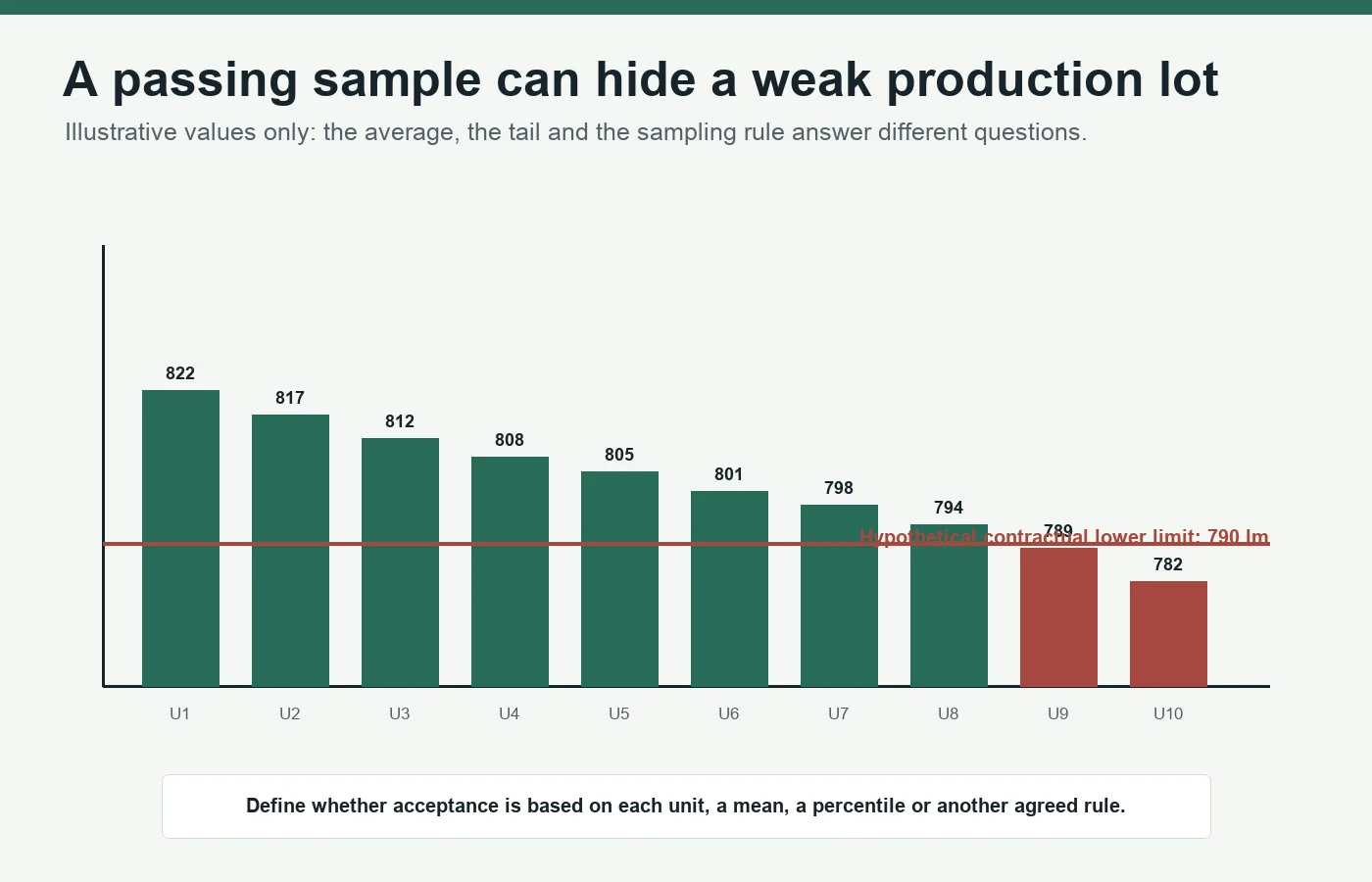
Consider the illustrative chart. Eight units are above a hypothetical 790 lm boundary and two are below. The average may still look comfortable. Does the lot pass?
The correct answer is not hidden in the chart. It is in the contract:
- If every tested unit must meet the lower limit, the sample fails.
- If only the arithmetic mean is controlled, the sample may pass while weak tail units remain.
- If an acceptance number is defined, apply that number to the specified defect classification.
- If the limit includes a decision rule, apply that rule before assigning conformity.
- If none of these were agreed, the parties have discovered a specification gap, not a mathematical solution.
For oversized or unusual geometries, sample representation and test setup deserve extra attention. HongYu's big decorative bulb range includes shapes whose geometry, glass finish and visual application differ from a standard A60. Do not treat one conveniently measured reference lamp as proof for every large decorative configuration.
Factory Controls That Make Bulk Output Defensible
Photometric consistency is built before final inspection. A factory control plan should connect incoming materials, assembly settings, in-process measurements and final records to the approved product revision.
| Production stage | Control evidence | Why the buyer should care |
|---|---|---|
| LED/filament selection | Approved source, bin or defined performance window, incoming record | Optical input variation begins before assembly |
| Driver configuration | Controlled BOM/revision and electrical check | Drive current changes output, efficacy and thermal behavior |
| Glass/finish | Approved glass, coating recipe or supplier lot | Transmission can change the finished-lamp flux |
| Assembly | Filament position, thermal path and process parameters | Geometry and heat affect measured performance |
| In-process optical check | Defined equipment, reference sample and frequency | Detects process drift before the final lot exists |
| Final test | Random sample, identified method and raw results | Connects production to the shipment decision |
| Traceability | Lot codes for critical optical and electrical inputs | Makes a failed result diagnosable rather than anecdotal |
| Change control | Revalidation trigger for driver, LED, glass, coating or process change | Prevents an old report approving a new configuration |
A golden sample can support visual and comparative control, but it should not replace a calibrated quantitative measurement when the PO contains a numeric lumen requirement. Likewise, a fast production-line photometer can be useful for trend control without being treated as interchangeable with a formal integrating-sphere report.
Concrete judgment 5: Freeze a product-and-method pair, not only a physical sample. If the driver, filament, glass finish, test equipment or calculation method changes, review whether the approval evidence still applies.
Put These Fields in the Purchase Order
| PO or quality-agreement field | Minimum content |
|---|---|
| Product identity | Model, shape, cap, finish, CCT, rated voltage/frequency, wattage, dimming state and revision |
| Photometric quantity | Total or useful luminous flux and applicable geometry |
| Declared value | Value used for product declaration, packaging and required documentation |
| Contract limit | Lower/upper limit or other agreed production requirement; define whether it applies per unit or statistically |
| Test method | Applicable IEC/CIE/IES or agreed laboratory method and edition |
| Test conditions | Supply, ambient, orientation, stabilization and sample preparation |
| Laboratory | Factory, buyer, third party or named referee; required accreditation scope where applicable |
| Measurement result | Raw result, rounding, units and required uncertainty statement |
| Sampling | Lot definition, random-selection responsibility, sample size and acceptance number/statistic |
| Decision rule | Treatment of uncertainty, guard band where agreed and borderline-result handling |
| Retest | Who selects samples, quantity, laboratory, method and whether the original result remains part of the decision |
| Lot disposition | Release, sort, rework, replacement, price remedy or rejection |
| Change control | Components and process changes that require notification or revalidation |
| Records | Report, raw data, sample IDs, calibration status, lot code and retained samples |
Three RFQ answers should trigger immediate clarification:
- "The standard allows minus 10%, so our 806 lm bulb only needs 725 lm." Ask which standard, which clause, who the tolerance is legally intended for, and whether it is being misused as a production allowance.
- "Our laboratory measured 810 lm, so the shipment passes." Ask how the sample was selected, which lot it represents, and which contractual decision rule converts the measurement into acceptance.
- "Your inspector measured lower, so their sphere is wrong." Compare the complete methods, calibration status, uncertainty, corrections, conditions and sample identities before assigning blame.
Define the Dispute Route Before There Is a Dispute
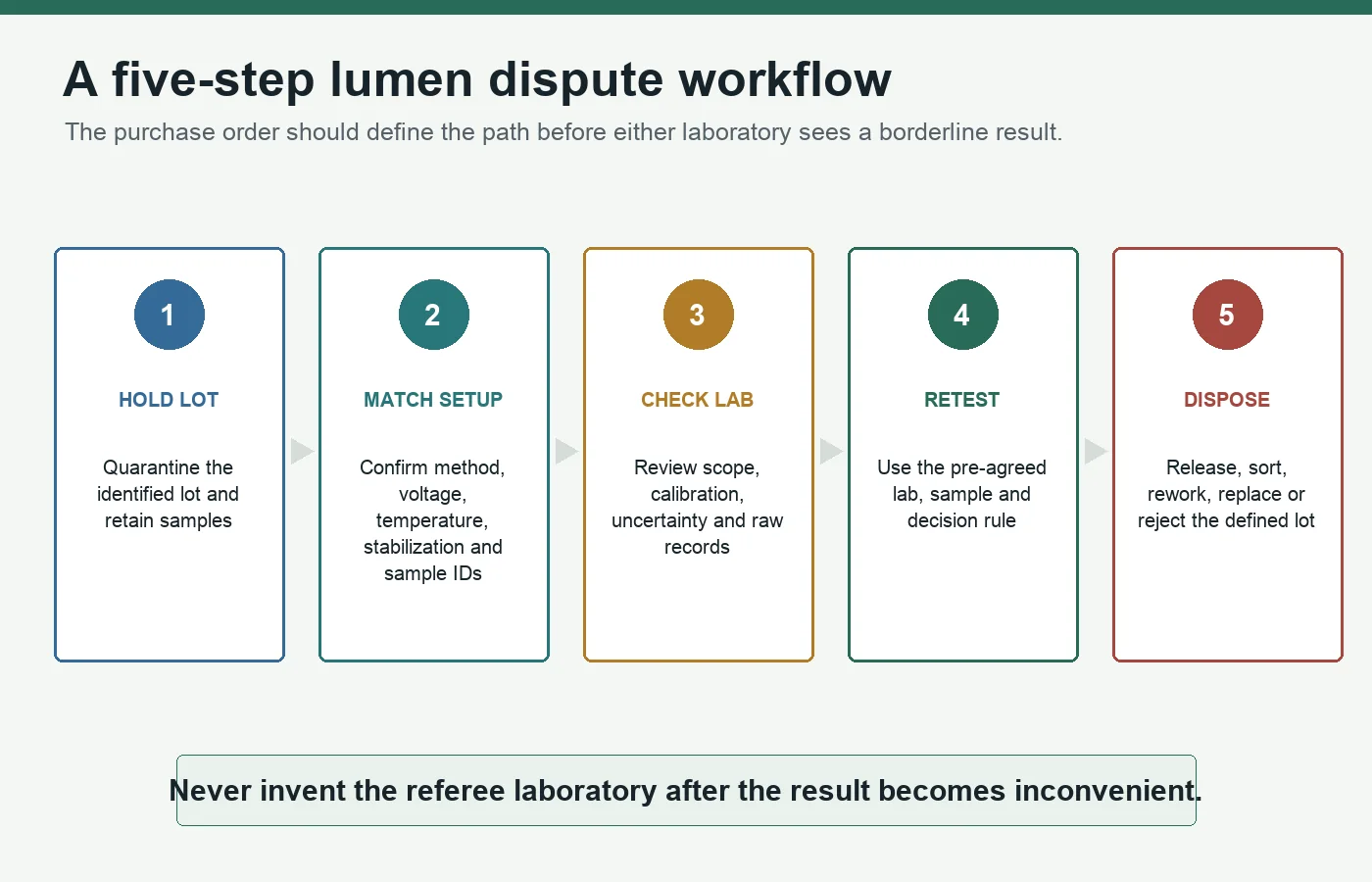
When results conflict:
- Hold the identified shipment lot and secure retained samples.
- Confirm that both reports concern the same model, revision, lot and sample condition.
- Compare method, test setup, calibration, uncertainty, raw data and reporting.
- Use the referee laboratory and retest rule named in the purchase agreement.
- Apply the pre-agreed lot disposition without silently changing the specification.
The referee laboratory should not be selected only after one party dislikes the first result. That creates an incentive to keep testing until a preferred number appears.
Conclusion
An 806 lm declaration can be accurate while a shipment still fails a well-written inspection rule. A shipment can also be commercially acceptable even when two laboratories do not report identical values. The outcome depends on what was measured, how it was measured, which units represented the lot and how uncertainty was converted into a conformity decision.
For procurement, the defensible sequence is:
- define the exact product configuration and photometric quantity;
- separate declared values from factory process limits and contract limits;
- specify the method, conditions and required report fields;
- define random sampling and the statistic or acceptance number;
- agree on the uncertainty decision rule, referee laboratory and retest path;
- control product and method changes through production.
The better buyer question is not "Can you guarantee 806 lumens?"
It is:
"Which value is being declared, which production lot is being accepted, under which measurement conditions, using which sampling and decision rule, and what happens when a result is close to the limit?"
References
- International Electrotechnical Commission. IEC 62612:2013, Self-ballasted LED lamps for general lighting services - Performance requirements. Back
- European Union. Commission Regulation (EU) 2019/2020 laying down ecodesign requirements for light sources and separate control gears. Back
- International Commission on Illumination. CIE S 025/E:2015, Test Method for LED Lamps, LED Luminaires and LED Modules. Back
- Illuminating Engineering Society. ANSI/IES LM-79-24, Optical and Electrical Measurements of Solid State Lighting Products. Back
- International Organization for Standardization. ISO/IEC 17025:2017, General requirements for the competence of testing and calibration laboratories. Back
- International Laboratory Accreditation Cooperation. ILAC G8:09/2019, Guidelines on Decision Rules and Statements of Conformity. Back
- National Institute of Standards and Technology. Assessment of Conformity, Decision Rules and Risk Analysis. Back
- European Union. Consolidated Commission Regulation (EU) 2019/2020 - Annex IV verification procedure. Back