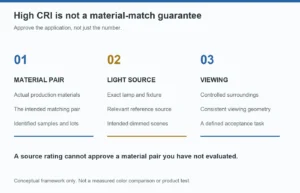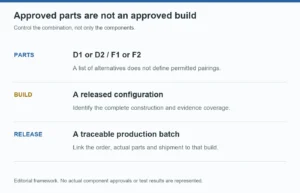
Featured image: Original editorial diagram. It does not represent actual component approvals, certification or HongYu test results.
A supplier has two acceptable drivers and two acceptable filament assemblies. All four parts appear on an approved alternatives list. When one driver runs short, production selects the other.
Is the finished bulb still the product you approved?
Not necessarily. A driver may have been evaluated with one filament assembly, while the alternate filament was evaluated with a different driver. Listing the parts separately does not establish that every possible pairing is acceptable.
This is an illustrative purchasing scenario, not a report of a HongYu production incident. The distinction matters because it exposes a weakness that even a genuine, traceable bill of materials can miss:
An approved parts list identifies candidates. An approved build identifies which parts may be used together, under which conditions, with which supporting evidence.
For importers and private-label lighting brands, the answer is not to ban alternative components. It is to approve usable configurations before a shortage turns an unreviewed combination into a shipment.
The Missing Cell in Your Approval Table
Consider a simplified product with driver options D1 and D2, and filament-assembly options F1 and F2. Keep the glass, cap, wiring arrangement, voltage, process and other construction details fixed for this example.
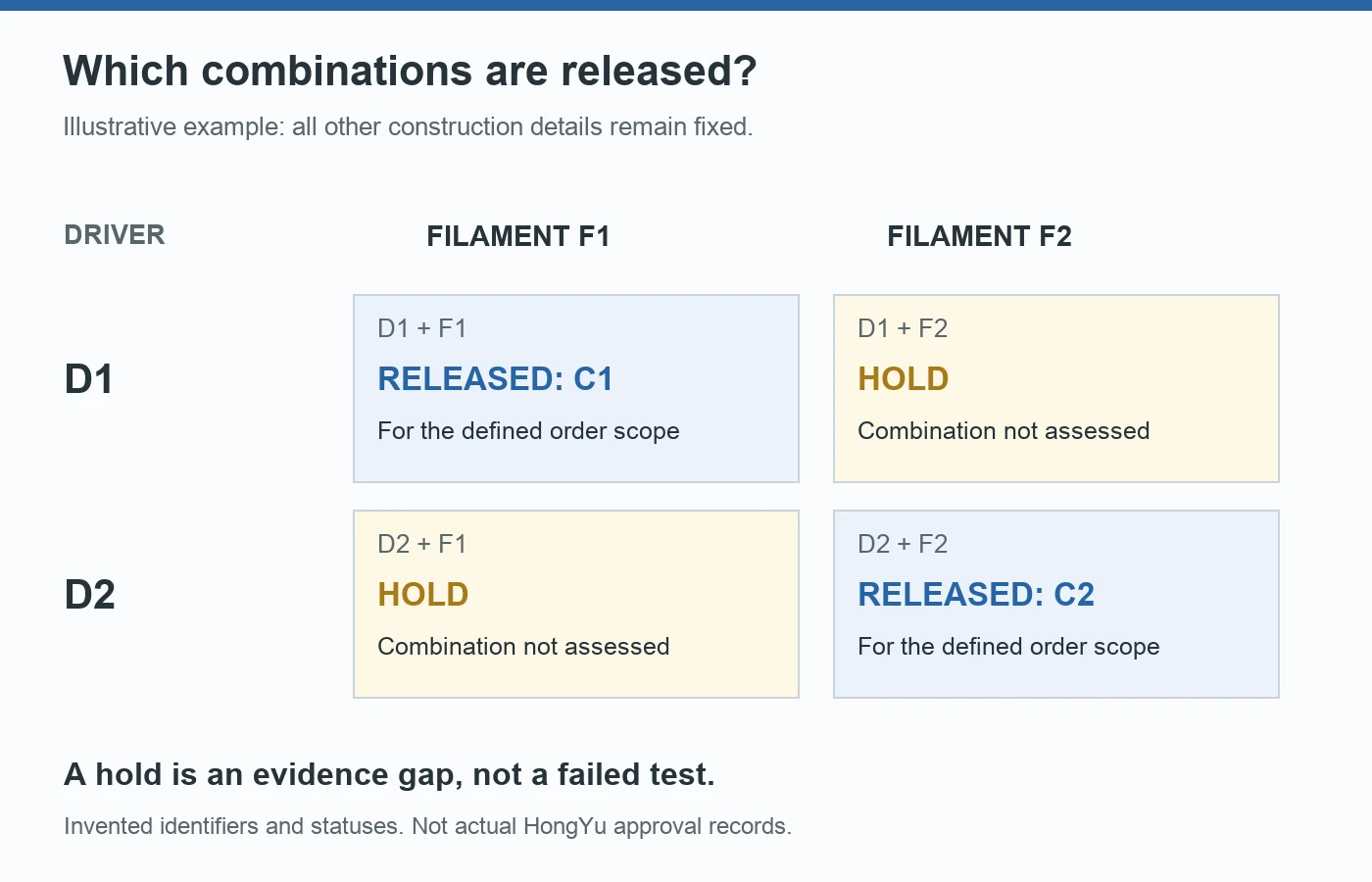
Assume the responsible teams have released D1 + F1 and D2 + F2 for the intended order, after completing the necessary engineering, customer and applicable compliance reviews. They have not assessed the crossed pairings.
| Driver / filament assembly | F1 | F2 |
|---|---|---|
| D1 | Released: configuration C1 | Hold: combination not assessed |
| D2 | Hold: combination not assessed | Released: configuration C2 |
There are four possible pairings, but only two released configurations. The other two are not proven defective. They are simply outside the documented release decision.
That difference is operationally important. A purchasing system that says "D1 or D2" and "F1 or F2" can unintentionally permit all four combinations. A configuration-controlled system permits C1 or C2 and stops the other pairings until review is complete.
Buyer judgment 1: Ask which complete combinations are released. A list of individually acceptable alternatives is not enough.
Why Matching Watts and Lumens Does Not Close the Question
A replacement part can match a headline specification while changing an interface inside the lamp. "Equivalent" needs an object: equivalent in dimensions, full-output brightness, dimming behavior, thermal operation, or certification coverage?
These are different questions. The following is an engineering review framework, not a universal test schedule or a claim that every change causes every listed problem.
| Changed interface | What may need review | Why a simple comparison is incomplete |
|---|---|---|
| Driver and filament assembly | Output-current behavior, LED operating-voltage range, startup and dimming states | Equal rated input wattage does not define the electrical load seen by the driver |
| Light engine and glass finish | Delivered flux, color appearance and distribution | Matching the bare light source does not establish the finished lamp's optical result |
| Driver, cap and internal layout | Component temperatures, insulation arrangements, clearances and assembly fit | A component rating is not a measurement of its installed conditions |
| Cap, glass and joining process | Material compatibility, retention and process controls | The same external dimensions do not establish the same joint |
| Dim-to-warm channels and controls | Brightness/color relationship, transition behavior and selected dimmer combinations | Matching the two endpoint CCT values does not describe the path between them |
DOE's research on multi-source LED products emphasizes interactions among light sources, optics and electronics, and reports architecture-dependent changes in light output, chromaticity and tuning range. That work supports a system-level review; it is not a test result for a particular decorative filament bulb.[1]
For the EU standard filament bulb range, start with the exact ordered model and revision. A family name such as "C35" or a description such as "4 W clear" is useful for browsing, but does not identify every internal construction choice.
Buyer judgment 2: Require an interface-based explanation of equivalence. "Same wattage" is one comparison, not a complete substitution decision.
Do Not Turn Every Change into a Full Retest
Configuration control does not mean testing every conceivable combination or repeating an entire qualification program after every administrative change.
First, decide which configurations the business actually needs. If the supply plan only requires C1 and C2, there is no automatic benefit in qualifying the other two pairings. Keeping unnecessary variants out of production reduces the number of combinations that must be maintained, inspected and traced.
Next, document what changed and what evidence can reasonably carry over. A competent reviewer should identify the affected characteristics, relevant operating conditions, applicable compliance constraints and the evidence needed to close the gap. Some conclusions may be supported by existing records and a justified engineering assessment. Others require new measurements, production samples or certification-body review.
If a family assessment relies on representative or worst-case samples, record why those samples bound the variants. A build that is worst-case for temperature is not automatically worst-case for dimmer interaction or optical appearance. Do not treat "representative model tested" as permission for combinations the assessment never considered.
For dim-to-warm bulbs, a useful change review can include the brightness/color relationship at agreed intermediate states, not only at full output and the warmest endpoint. Retain controller model, lamp count, supply conditions and the actual tested configuration so a later comparison answers the same question.
Buyer judgment 3: Approve the combinations you need, then justify the evidence coverage. Neither "test everything" nor "the old report covers everything" is a sound default.
Separate Customer Acceptance from Certification Coverage
The word "approved" can conceal several different decisions. A buyer may approve appearance, an engineer may release a construction, and a certification body may authorize a defined product under its own scheme. Those decisions are related, but not interchangeable.
| Decision | What the record should establish | What it does not establish by itself |
|---|---|---|
| Customer acceptance | The specified appearance and commercial performance requirements were accepted for an identified configuration | Permission to use a certification mark |
| Engineering release | The construction and supporting evidence are adequate for the stated requirements and conditions | Automatic coverage under every market or certification file |
| Certification review, where applicable | The exact construction or permitted alternatives remain within the relevant authorization and conditions | Acceptance of every customer-specific visual or dimming requirement |
| Production release | The order will be built using a permitted configuration and controlled process | That later substitutions are also permitted |
UL Solutions describes Recognized components as evaluated for use within a larger end product, subject to defined conditions of acceptability. Component recognition is therefore not blanket approval of every finished lamp containing that component.[2]
Its Follow-Up Services guidance also connects the manufactured product, component traceability and construction details to the applicable certification procedure. Changes need to be handled through the relevant revision process rather than inferred from a familiar part number.[3]
Intertek's published certification agreement similarly addresses changes affecting compliance or listing eligibility, including product and production-method modifications. The responsible applicant/manufacturer must follow the applicable approval and mark-use requirements. The agreement and listing documents governing the actual product control the decision.[4]
When reviewing US ETL clear filament bulbs, ask how the ordered construction and alternatives map to the relevant listing documentation. A catalogue page, a component certificate or a customer's approval email cannot independently answer that question.
These are examples of specific certification schemes, not a claim that every LED lamp needs UL or ETL certification, or that their processes define every other market's requirements.
Buyer judgment 4: Name the approval authority and scope. Customer approval cannot waive certification conditions, and certification coverage does not settle every purchasing requirement.
Make the Released Configuration Visible to Production
An approval matrix is useful only if the order, material issue and production records follow it. The practical factory-facing question is: what prevents two individually allowed parts from being issued together when their combination is not allowed?
An ERP rule can provide that control, but a smaller operation can use an approved build sheet and checked material-issue record. The format matters less than a clear release rule and reliable execution.
For each permitted configuration, retain a stable identifier linked to:
- the product specification, BOM and drawing revisions;
- exact component identifiers and restrictions on alternatives;
- relevant assembly/process revisions and production location;
- review evidence, limitations and responsible approvers;
- the orders, batches and effective change point that may use it.
The buyer does not necessarily need unrestricted access to proprietary schematics or every supplier price. Agree on sufficient traceable configuration information, with confidential technical details available to authorized reviewers where needed. Confidentiality should not become an excuse for an unidentifiable build.
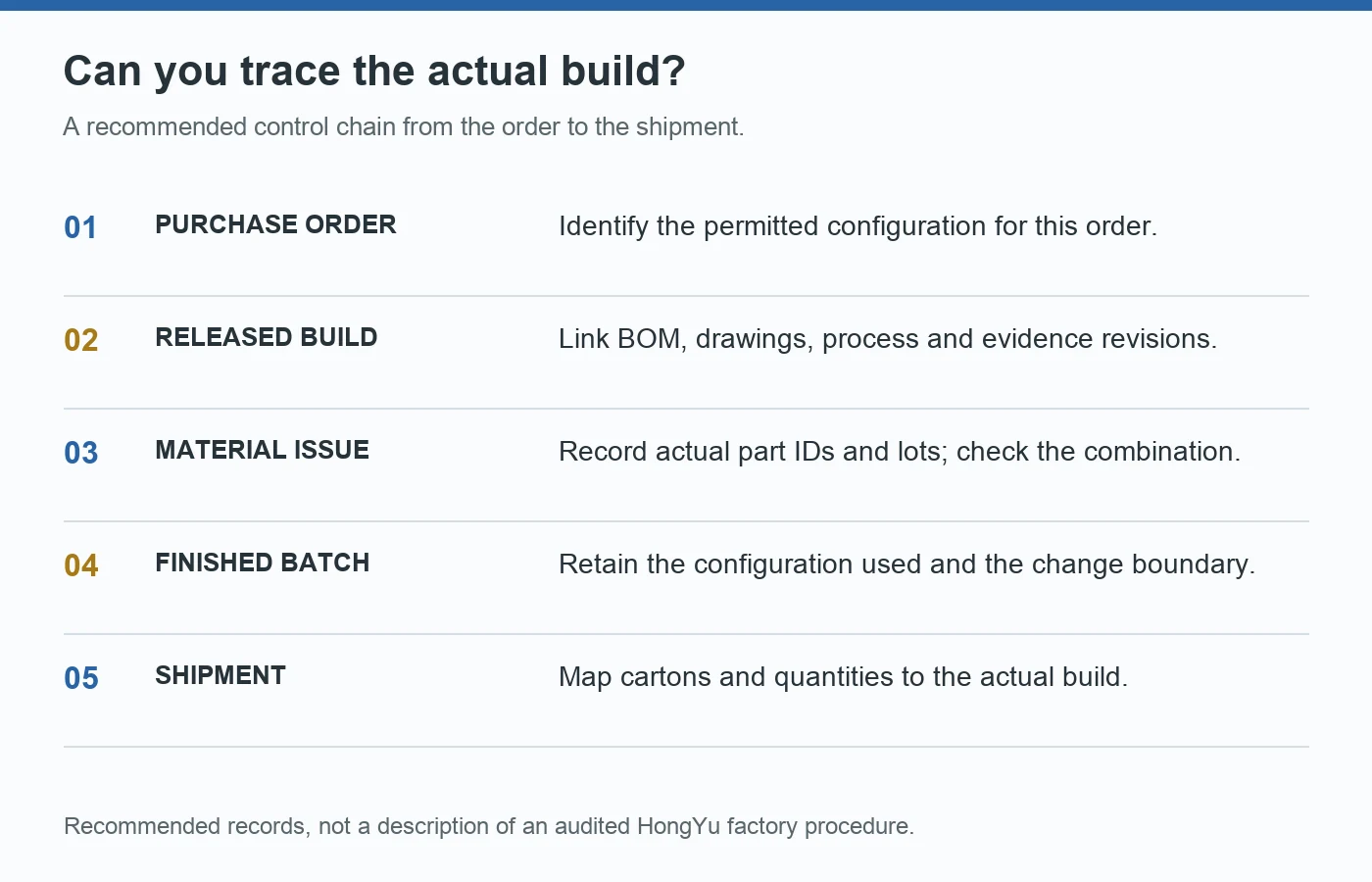
A retained sample is helpful, but it is not the whole release package. A sealed lamp does not expose all component identities, and one sample cannot document which configuration went into every carton. Link physical references to the controlled records.
A Shortage Is a Scheduling Problem Before It Is an Approval
If D1 becomes unavailable while F1 remains in stock, the matrix above does not authorize D2 + F1. The immediate choices are to obtain the released parts, use the complete released C2 build if permitted for the order, or hold the proposed combination for review.
Use a short release checklist before the next shipment:
| Checkpoint | Required answer |
|---|---|
| Proposed build | Which exact configuration and revisions will this order receive? |
| Evidence gap | What changed from a released build, and what remains to be assessed? |
| Authority | Who can approve engineering, customer and applicable certification decisions? |
| Transition | What is the last old-build lot and first new-build lot, and how is work in progress handled? |
| Shipment identity | Can cartons and records be traced to the actual configuration, including authorized mixed shipments? |
A temporary deviation should have a defined scope, quantity or period, affected orders, evidence and closure owner. It must not override safety requirements or required certification authorization. Where those conditions cannot be satisfied, holding shipment is the appropriate outcome.
If more than one released configuration can ship under the same commercial SKU, agree on that explicitly and preserve the distinction in production and shipment records. Otherwise, a later complaint may be impossible to isolate to the relevant build.
Buyer judgment 5: Release the transition, not just the replacement part. Approval needs an effective batch boundary and a record of the configuration actually shipped.
Conclusion
A well-managed alternative-component program can protect supply continuity. Its value comes from having usable, documented builds ready before a shortage, not from creating the longest possible list of interchangeable-looking parts.
For your next LED bulb reorder, replace "Are all the parts approved?" with a more useful request:
Show us the released configuration for this order, the evidence that covers it, and how the shipment will be traced back to that build.
That is the difference between knowing what parts a factory may buy and knowing what product your business will receive.
References
- U.S. Department of Energy. An Update on Stress Testing Results for Multi-Source LED Lighting. System-level context; not testing of HongYu filament bulbs. Back
- UL Solutions. Component Testing and Certification Services. Conditions of acceptability for Recognized components. Back
- UL Solutions. Follow-Up Services. Construction consistency and component traceability. Back
- Intertek. Certification Agreement for Applicants and Manufacturers, sections 2.2 and 3.1, revision 16 July 2024. Verify the agreement and authorization applicable to the actual product. Back