You see the growing trend for spiral filaments but hesitate. Is this just a style, or is there a real performance reason? Stocking up based on a fad is a risky investment.
Spiral filaments are in high demand because their continuous line of light creates a softer, more authentic vintage glow with less glare than straight filaments. This superior atmospheric quality is a key feature that commands a higher perceived value and profit margin.
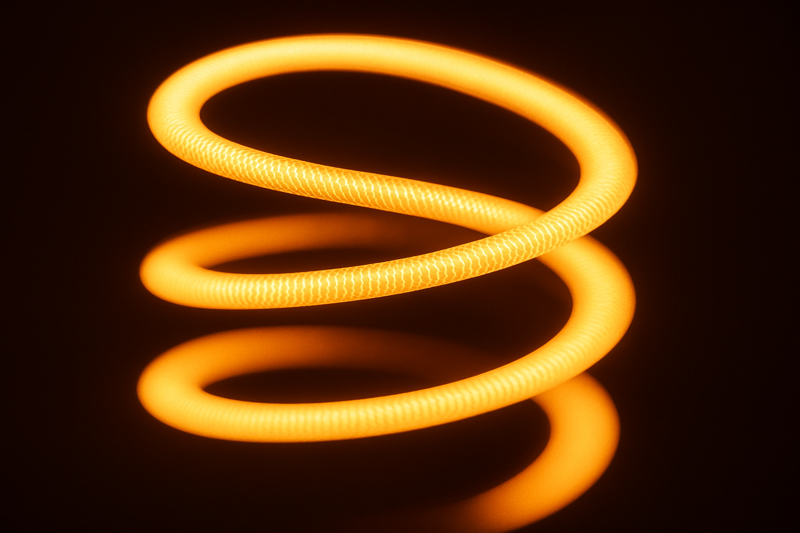
I remember working with a product manager for a large North American lighting distributor a couple of years ago. Let's call him Jacky. His company was selling huge volumes of the standard, straight-filament "Edison bulbs." But he noticed his boutique competitors were getting specified on high-end hospitality projects. He asked me, "Wallson, a spiral filament costs more to produce. Why would a hotel chain pay extra for a 'squiqqly' light?" I sent him a sample case with both types. He installed them side-by-side in his showroom. He called me back a week later and said, "I get it now. The straight filament bulb is a light source. The spiral filament bulb is a piece of decor." He understood that his customers weren't just buying light; they were buying an atmosphere, and that atmosphere had a much higher value.
How Does a Spiral Filament Create a Better Atmosphere?
You see that the spiral looks "warmer," but you don't know why. How can a simple change in filament shape have such a dramatic impact on the feel of a room?
A spiral filament creates a single, continuous line of light. This is softer and less jarring to the human eye than the multiple, sharp points of light from a straight filament array, reducing glare and creating a more organic, uniform glow.

The secret lies in how our eyes perceive light sources. A traditional straight-filament bulb is really an array of several individual, intensely bright light sources. When you look at it, your eye sees multiple "dots" of light. This can create harsh reflections and a subtle, almost subconscious glare that feels less relaxing. A spiral filament, however, is engineered as a single, long, continuous light-emitting element. Your eye follows this uninterrupted line of soft light. The effect is more diffused and uniform, much closer to the way the filament in an original Edison carbon bulb would have glowed. It doesn't have the sharp "peaks" of brightness that a multi-filament bulb does. This fundamental difference is what transforms the bulb from being merely a functional object into a captivating decorative one. It’s why spiral filaments are so effective at creating an atmosphere of warmth and intimacy in restaurants, bars, and homes—the light itself is simply more comfortable to be around.
Light Source and Visual Perception
Understanding the difference between a point source and a line source is key to explaining the value of a spiral filament.
- Straight Filaments (Point Array Source): These act as a collection of individual, high-intensity points of light. This can lead to a "starburst" effect or slight glare, which can feel harsh in an intimate setting. The overall effect is bright and functional.
- Spiral Filaments (Line Source)1: The light is emitted along a continuous path. This spreads the light source out, reducing the intensity at any single point. This diffusion results in a softer glow that is much more pleasant for direct viewing. The goal is visual comfort.
- Authenticity: The very first commercial light bulbs by Edison used a single, glowing filament of carbonized bamboo. The single, continuous glow of a spiral LED filament is a much more historically accurate recreation of this original, iconic look than the rigid, cage-like structure of straight filaments.
| Feature | Straight Filament Array | Spiral Filament | Impact on Atmosphere |
|---|---|---|---|
| Light Source | Multiple bright "points" | A single "line" of light | Spiral is softer, less glary. |
| Visual Comfort2 | Can be harsh for direct viewing | Comfortable for direct viewing | Spiral creates a more relaxing mood. |
| Authenticity | Mimics tungsten cages | Mimics original carbon filaments | Spiral feels more genuinely vintage. |
| Primary Feel | Industrial, Bright, Technical | Organic, Warm, Decorative | Spiral is the choice for ambiance. |
For a customer trying to create a specific mood, this difference isn't a small detail—it's everything.
Are Spiral Filaments as Bright and Efficient as Straight Filaments?
You're a practical buyer. You see the aesthetic appeal, but you're worried that the beautiful spiral design comes at the cost of performance, specifically brightness and energy efficiency.
There is a slight trade-off. Spiral filaments are typically 10-15% less efficient in raw lumens-per-watt than the most advanced straight filaments. However, the goal of a spiral bulb is atmospheric quality, not maximum brightness, making this a deliberate and worthwhile design choice.
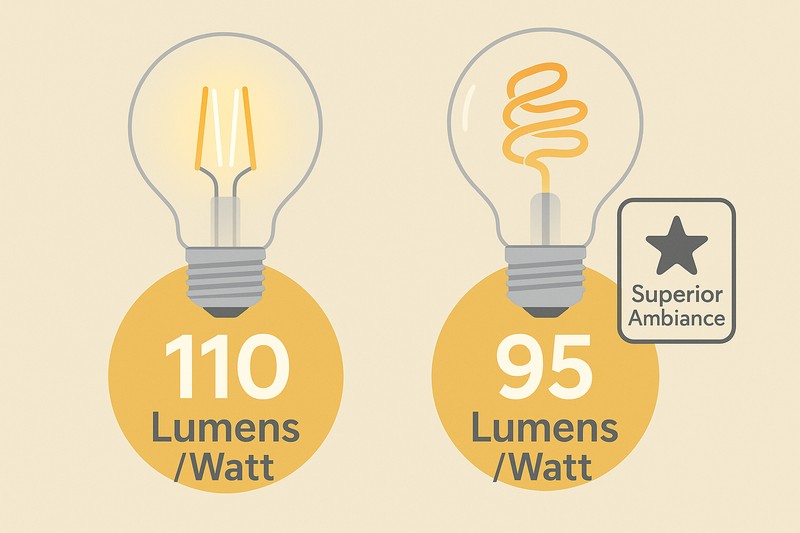
This is a critical question for any professional who needs to justify their purchasing decisions with data. And the honest answer is that a straight filament, being a simpler and more direct structure for emitting light, can be engineered for slightly higher efficacy (lumens per watt). The most efficient straight filaments might reach 110-120 lm/W. A comparable spiral filament, due to its complex shape and the way light reflects upon itself within the coil, will typically operate in the 90-100 lm/W range. However, framing this as a simple loss of performance is a mistake. It is an intentional engineering trade-off. We are trading a small amount of raw, measurable brightness for a massive improvement in the quality and feel of the light. For the intended applications—decorative pendants, restaurant lighting, living room lamps—maximum lumen output is not the goal. In fact, it's often undesirable. The goal is to create a comfortable, glare-free, and inviting atmosphere. The spiral filament achieves this perfectly, and the minor reduction in efficacy is an insignificant price to pay for the enormous aesthetic benefit that customers are actively seeking and willing to pay a premium for.
The Value of "Useful" Light
It’s important to distinguish between raw measurement and real-world application.
- Lumens as a Metric: Lumens measure the total amount of light a bulb produces in all directions. It's a raw quantity.
- Useful Light3: For decorative applications, "useful light" is light that contributes to the desired atmosphere without creating discomfort. The less-glary light from a spiral is arguably more "useful" in these settings than the harsher, higher-lumen light from a straight filament.
- Energy Consumption: A 4W straight filament bulb and a 4W spiral filament bulb consume the exact same amount of energy. The difference is in how efficiently that energy is converted into visible light. For a low-wattage decorative bulb, the difference in annual energy cost is pennies, while the difference in visual impact is immense.
| Metric | High-Efficacy Straight Filament | High-Quality Spiral Filament4 | B2B Buyer Insight |
|---|---|---|---|
| Typical Wattage | 4W | 4W | Energy consumption is identical. |
| Typical Lumens | ~450 lm | ~380 lm | The brightness difference is noticeable but not dramatic. |
| Efficacy (lm/W) | ~110 lm/W | ~95 lm/W | The trade-off is small for a large aesthetic gain. |
| Primary Goal | Efficiency & Brightness | Atmosphere & Visual Comfort | Sell the feature, not just the spec. |
The customer for a spiral bulb is not buying lumens; they are buying a look and a feeling.
Do Spiral Filaments Require Special Drivers or Dimmers?
As a conservative buyer, you rightly worry about new technology. Does this complex filament shape require special electronics that could lead to compatibility issues, flickering, or installation problems for your clients?
No. The filament's shape is purely physical. A high-quality spiral bulb uses the same advanced IC driver technology as a high-quality straight filament bulb. The dimming performance depends entirely on the driver, not the filament's coil.
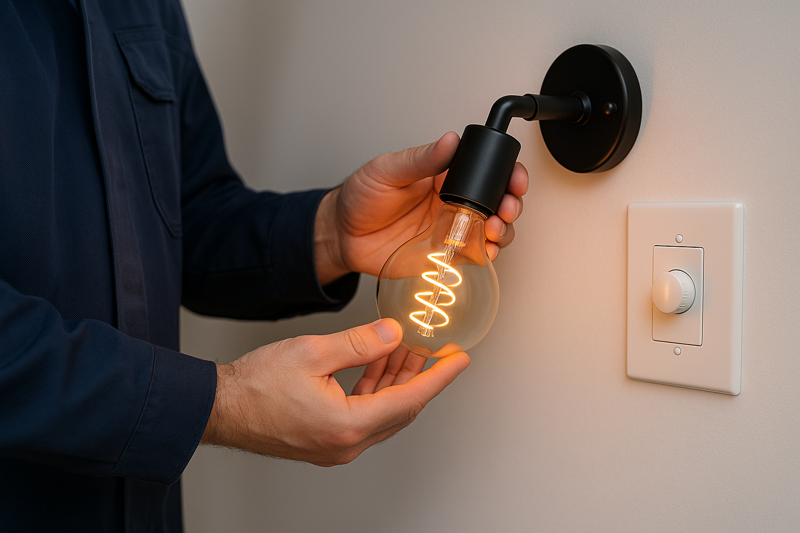
This is an excellent and prudent question, and it's one we get from many new buyers. The fear of stocking a product that causes headaches for electricians and end-users is very real. The good news is that the 'spiral' aspect of the filament is entirely a matter of its physical form factor. The underlying technology that powers it and controls its dimming is identical to that of any other professional-grade LED filament bulb. The crucial component is, and always has been, the driver. A cheap bulb, whether straight or spiral, will use a low-cost linear driver that will flicker, buzz, and have poor compatibility with dimmers. A professional-grade bulb from a manufacturer like Hongyu Bulb, regardless of filament shape, will use a high-quality IC (Integrated Circuit) driver. This sophisticated electronic component ensures a clean, stable power supply to the filament. This is what provides the smooth, flicker-free dimming from 100% down to 10% and ensures broad compatibility with the majority of Lutron, Leviton, and other major dimmer brands found in the US and Europe. So, you can reassure your customers with confidence: if they are choosing a well-made, certified spiral filament bulb, it will perform just as reliably as its straight-filament counterpart.
The Driver is the Key to Performance
The focus should always be on the quality of the internal electronics, not the shape of the light source.
- IC Driver (The Professional's Choice)5: An Integrated Circuit driver is a small, smart component that manages power, smooths out electrical fluctuations, and communicates effectively with dimmer switches. This is what prevents flickering and buzzing. Both our straight and spiral bulbs use these.
- Linear Driver (The Low-Cost Alternative): This is a much simpler, cheaper way to power an LED. It's highly susceptible to power fluctuations and is the primary cause of flickering and poor dimming performance. We avoid these in our premium products.
- Compatibility Testing6: As a responsible manufacturer, we invest time and money into testing our IC drivers with a wide range of common dimmer switches from our key markets (like the US, UK, and Netherlands). We can provide these compatibility reports to give you and your customers peace of mind.
| Driver Type | Dimming Performance | Filament Compatibility | Our Standard at Hongyu Bulb |
|---|---|---|---|
| Low-Cost Linear Driver | Poor (Flicker, Buzz) | Works with any filament shape | We avoid this for professional products. |
| High-Quality IC Driver | Excellent (Smooth, Silent) | Works with any filament shape | This is our standard for all premium bulbs. |
When you buy from us, you're buying the assurance of a high-quality driver, whether the filament inside is straight, curved, or coiled.
How Does the Spiral Design Impact Bulb Longevity?
You know that heat is the enemy of all LED products. Does coiling the filament into a tight spiral trap heat and cause the bulb to fail sooner than a straight filament design?
No, when manufactured correctly. A well-designed spiral bulb uses an inert gas fill like helium to effectively transfer heat from the compact filament to the entire glass surface for dissipation. This ensures a long, stable lifespan of 15,000+ hours, equal to its straight-filament equivalent.
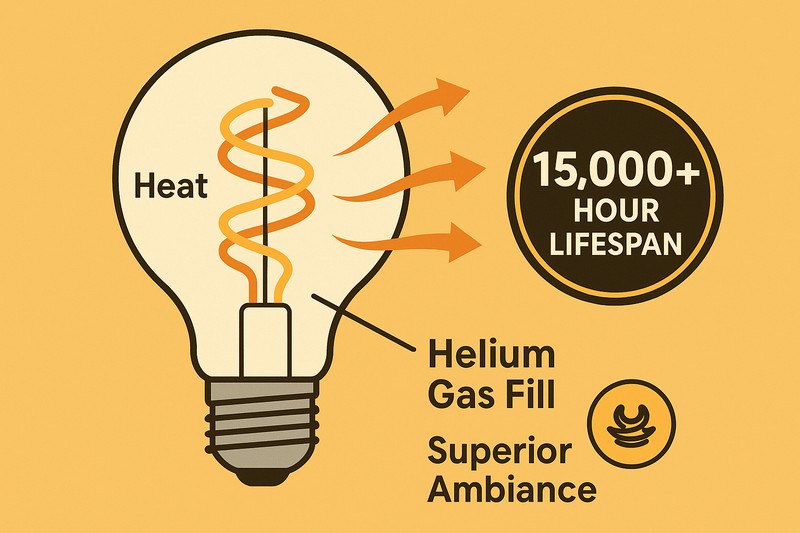
This is a very insightful technical question that shows a deep understanding of LED technology. It's true that concentrating the light source into a coil could potentially create a hot spot that might degrade the LED chips and shorten the bulb's life. This is a real problem for low-cost manufacturers who simply coil the filament and seal the bulb with a standard gas mixture. However, a high-quality manufacturer like Hongyu Bulb solves this problem with advanced thermal management. The key is in the gas we use to fill the glass envelope. Instead of a simple nitrogen mix, we use a carefully formulated blend that includes helium. Helium has exceptionally high thermal conductivity. It acts as a super-highway for heat, actively pulling the thermal energy away from the delicate LED filament and transferring it efficiently to the inner surface of the entire glass bulb. The glass bulb then becomes the heat sink, dissipating the warmth safely into the surrounding air. This process keeps the LED chips operating within their optimal temperature range, ensuring a long and reliable lifespan of 15,000 hours or more, which is identical to our straight filament bulbs.
The Science of Heat Dissipation
Proper thermal management is a hallmark of a high-quality LED product.
- The Challenge: LED filaments generate heat. Concentrating that filament into a spiral concentrates the heat source. If this heat is not removed, the LEDs will degrade and fail prematurely.
- The Solution: High-Conductivity Gas7: Using a gas like helium creates an efficient thermal bridge. Heat naturally moves from a hot area (the filament) to a cooler area (the glass), and helium makes this process much faster and more effective.
- The Result: Stable Lifespan8: By keeping the core temperature of the LEDs low, we can confidently rate our spiral filament bulbs for the same long lifespans and warranty periods as our other professional-grade products. This is a critical, invisible feature that protects your investment and your reputation.
| Manufacturing Quality | Thermal Management | Resulting Lifespan | Key Indicator of Quality |
|---|---|---|---|
| Low-Cost | Standard gas, poor heat transfer | Short, unpredictable, prone to early failure | Unusually low price, no mention of gas fill. |
| Professional Grade | Helium-enhanced gas fill | Long and reliable (15,000+ hours) | Manufacturer discusses thermal design. |
You can trust our spiral filament bulbs because we have engineered them not just to look good, but to last.
Related HongYu product pages
- LED Filament Bulb Product Range → — standard and decorative LED filament bulbs for wholesale and project sourcing.
- Contact HongYu Bulb → — send your target specifications, quantity, market and packaging requirements for quotation.
Conclusion
Spiral filament bulbs are not just a trend; they are a superior choice for atmospheric lighting, offering a softer, more authentic glow. Their value lies in the premium ambiance they create for any space.
Explore the advantages of Spiral Filaments for creating a warm and inviting atmosphere in your space. ↩
Learn how Visual Comfort influences lighting design and enhances the ambiance of your environment. ↩
Understanding 'useful light' can enhance your lighting design, creating the perfect atmosphere while minimizing discomfort. ↩
Explore the advantages of high-quality spiral filament bulbs for energy efficiency and aesthetic appeal in your lighting solutions. ↩
Explore this link to understand how IC drivers enhance LED performance and prevent flickering. ↩
Learn about the significance of compatibility testing to ensure optimal performance and customer satisfaction. ↩
Explore this link to understand how High-Conductivity Gas enhances thermal management, ensuring longer-lasting LED products. ↩
Discover why a Stable Lifespan is crucial for LED products, protecting your investment and ensuring reliability. ↩
Browse from HongYu Bulb: EU Vintage Flexible Filament Bulbs → · EU Standard LED Filament Bulbs →
Sourcing LED filament bulbs at wholesale? HongYu Bulb is a China-based LED manufacturer supplying wholesalers, importers, and hospitality brands worldwide. Request a quote → or browse our full LED filament bulb range →.