A buyer sends a clean vector logo. The factory bends a flexible LED filament into the shape. The first sample lights, everyone approves the photo, and production begins.
Then the bulk order reveals four different problems: one letter closes up when illuminated, a tight curve looks brighter than the straight section, support wires interrupt the logo, and the design sits at a different angle from bulb to bulb.
The drawing was approved. The product was not.
That distinction is the central insight of this article:
A custom filament shape must pass three separate approvals: artwork fidelity, optical readability and production repeatability.
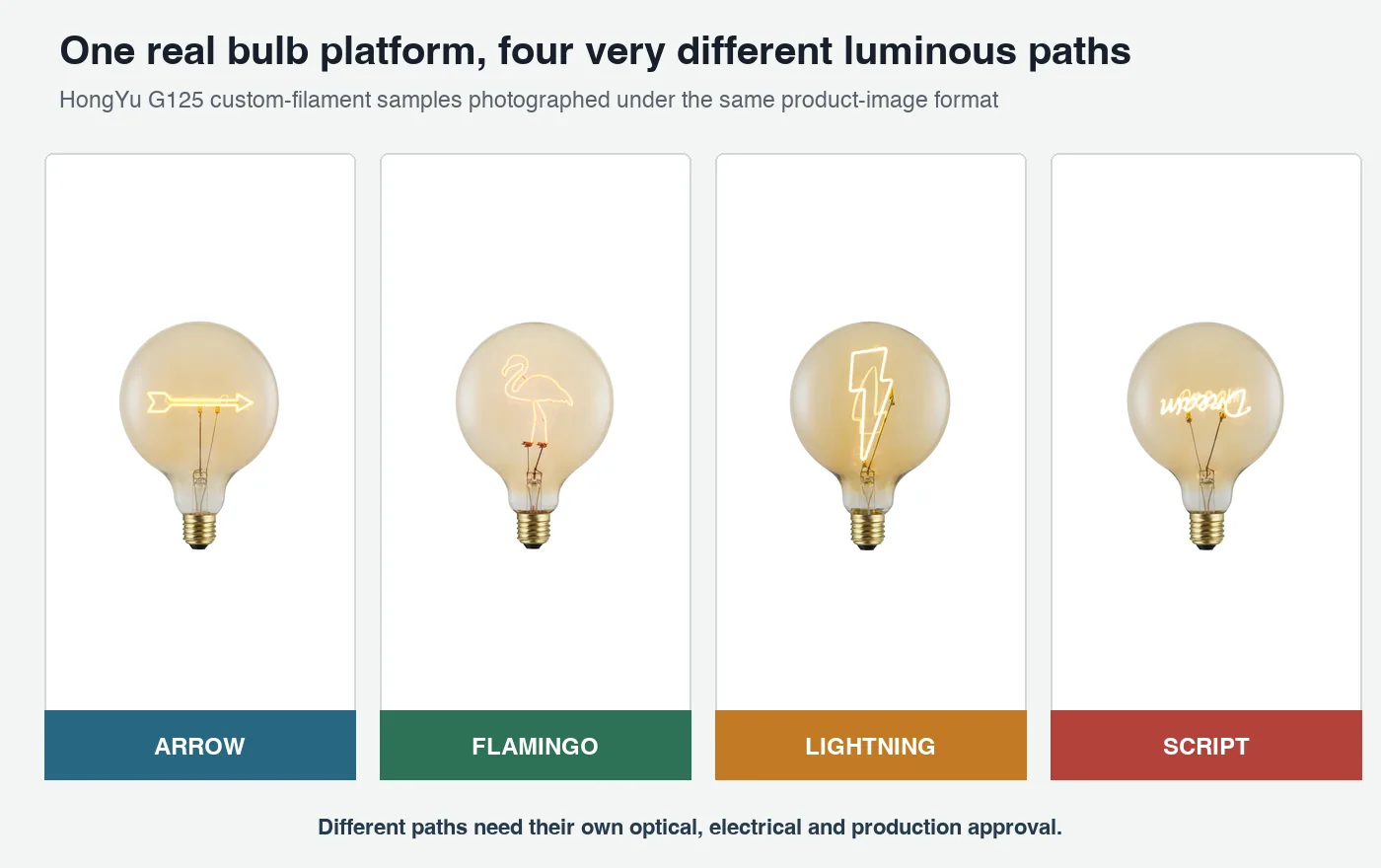
The models in HongYu's custom logo bulb range show how a filament can become an arrow, flamingo, lightning bolt, word or other recognizable symbol. But a recognizable prototype is only the beginning. The path must also operate within an electrical design, fit inside a real glass envelope, remain supported during transport and repeat consistently across production.
This guide explains how importers, lighting brands and project buyers can approve that complete system rather than approving one attractive sample photograph.
One Shape, Three Different Specifications
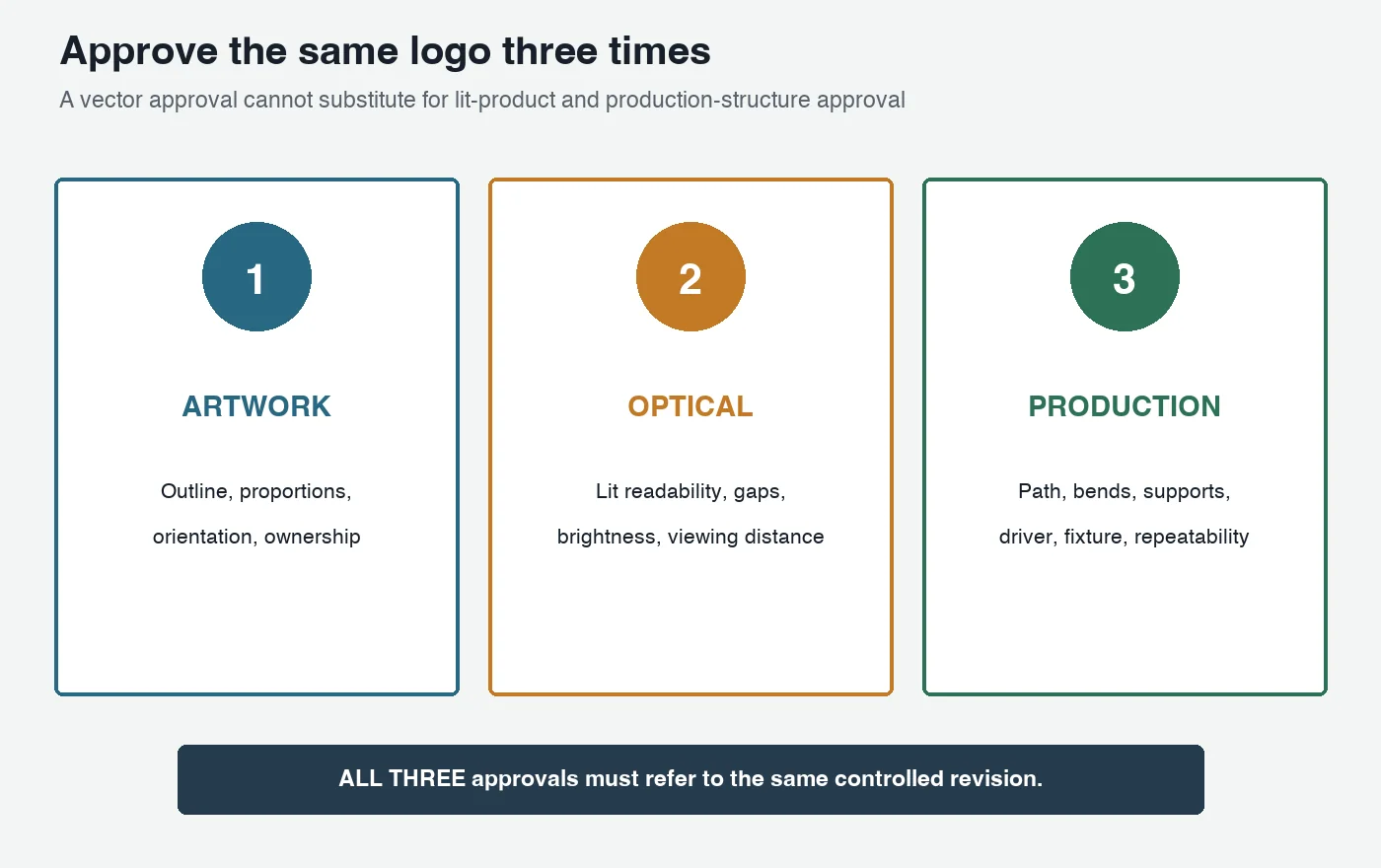
The same logo exists in three forms, and each answers a different question.
1. The artwork file
This defines the intended outline, proportions, orientation and protected brand features. It is usually a vector file or dimensioned drawing.
2. The illuminated appearance
This is what a viewer actually sees after the filament emits light through clear, amber, smoky or diffused glass. Light bloom makes lines appear thicker. Close gaps can disappear. Small internal details can merge into one bright patch.
3. The production structure
This defines filament path length, bend geometry, terminals, support points, driver, glass shape, base orientation and assembly fixture. It determines whether the design can be repeated safely and consistently.
IEC 62560 covers safety, interchangeability, test methods and compliance conditions for self-ballasted LED lamps within its scope.[1] A custom symbol does not remove those product obligations. The logo is being placed inside an electrical lamp, not printed on a poster.
Concrete judgment 1
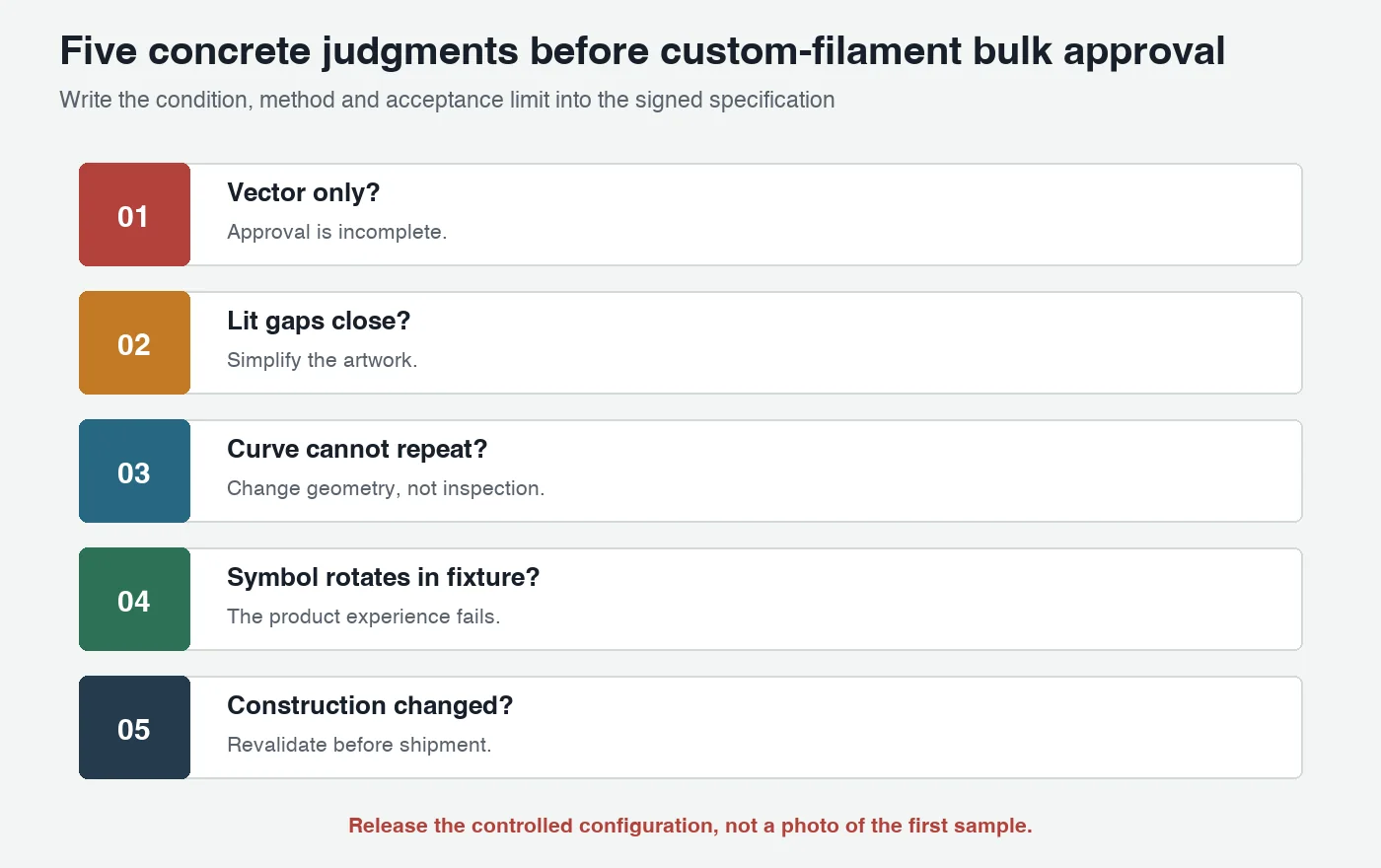
Never approve a custom filament from the vector file alone. Require approval of the unlit prototype, the lit prototype and the dimensioned production structure.
A Good Vector Can Become a Bad Lighted Logo
Design software shows a sharp, uniformly colored line. A lit filament does not behave that way.
Its apparent thickness depends on luminance, exposure, viewing distance, glass finish and the surrounding environment. A phone camera can make the problem worse by clipping bright areas into white. A logo that looks precise in a factory close-up may become unreadable across a restaurant or shop window.
In factory sample review, we separate four questions:
- Can a viewer identify the symbol when the lamp is switched off?
- Can a viewer identify it immediately when switched on?
- Do the negative spaces remain open instead of filling with glare?
- Does the image still read from the intended fixture distance and angle?
The test condition must be written down. "Looks good" is not a repeatable method. Record the glass finish, supply voltage, dimming level, ambient light, camera exposure if photographs are part of approval, and approximate viewing distance.
DOE explains that an LED lamp is a complete system in which the LEDs, driver, optics and thermal management work together.[2] The practical implication for a logo bulb is that the visual result cannot be separated from the electrical and optical conditions used to create it.
Concrete judgment 2
If the smallest gap or letter counter closes when the bulb is lit at the approved condition, simplify the artwork before approving the sample. Do not ask production inspection to solve an unreadable design.
Filament Path Length Is an Electrical Variable
A longer word or symbol usually needs a longer luminous path than a simple lightning bolt. That affects more than material consumption.
The filament and driver have to be engineered as a pair. Path length, LED arrangement, operating current and power design influence brightness, heat and electrical behavior. The exact construction varies by filament technology, so buyers should not invent a universal watts-per-centimeter rule.
Instead, request model-specific evidence:
| Approval item | What to record | Why it matters |
|---|---|---|
| Illuminated path | Final routed length and revision | Confirms which artwork was engineered |
| Driver | Approved circuit or driver revision | Prevents an unapproved bulk substitution |
| Rated input | Voltage and frequency | Defines the test condition |
| Electrical result | Wattage, current and power factor where applicable | Detects production drift |
| Optical result | Lumen output and visual uniformity | Separates total output from logo readability |
| Thermal condition | Orientation, ambient and stabilization state | Makes comparisons meaningful |
The DOE's solid-state lighting research identifies reliability as a system-level issue: drivers, interconnects, thermal conditions and other components can create catastrophic failure before LED lumen depreciation becomes the limiting factor.[3]
For a custom filament, the buyer should therefore freeze the driver and filament revision together. A new driver that still produces "1W" on a label is not automatically equivalent if it changes brightness distribution, startup or thermal behavior.
Tight Curves Need Engineering, Not Optimism
Every logo has visually important corners. Those corners can also be the hardest places to manufacture.
A tight turn can create several practical risks:
- the luminous line may kink or flatten;
- the spacing between adjacent sections may become too small;
- the curve may not sit in the same plane as the rest of the symbol;
- local stress may increase during forming, handling or shipment;
- a support wire may have to be placed in a visually sensitive area.
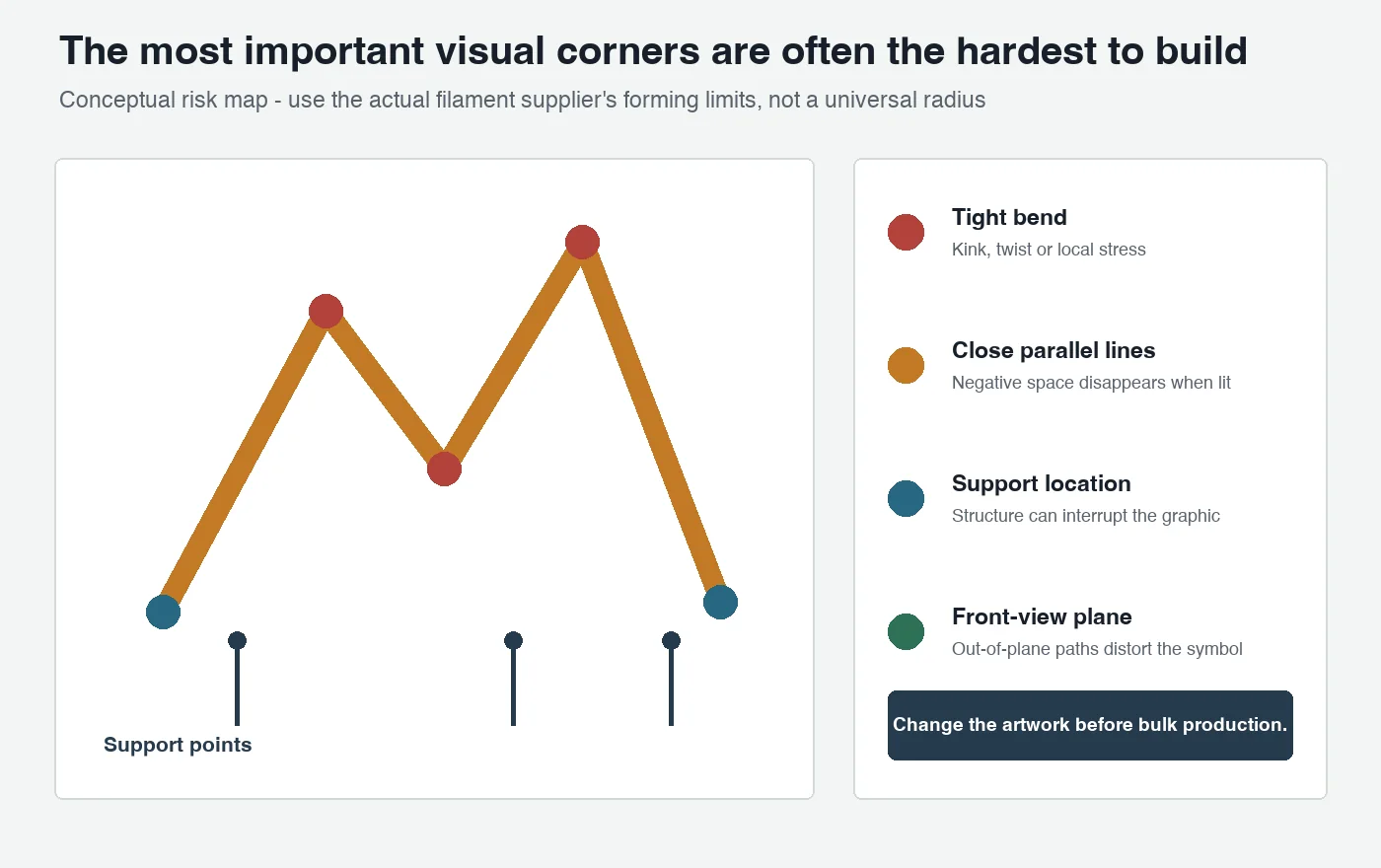
There is no responsible universal minimum bend radius that applies to every flexible filament construction. The acceptable geometry depends on the actual filament, encapsulation, internal conductors, forming method and supplier process.
That is why the approval drawing should show more than the outer logo. It should identify terminals, high-risk bends, support locations and the expected front-view plane.
Concrete judgment 3
If a critical curve cannot be reproduced without kinking, twisting or adding an objectionable support, change the logo geometry. Do not classify the resulting variation as workmanship after mass production starts.
The Glass Envelope Is Part of the Logo
The same filament can look very different inside A60, G95, G125 or an oversized decorative bulb.
Glass diameter changes the available visual field. Neck shape affects how low the symbol can sit. Amber or smoky glass changes contrast and output. A globe can make a wide word feel balanced, while a narrow envelope may force the artwork to become too small or too crowded.
HongYu's custom shape bulb range is useful when the glass silhouette is intended to reinforce the symbol. For very wide or highly visible graphics, the big decorative bulb range provides more visual area, but the larger envelope also makes centering and transport support more important.
The orientation relative to the base must also be defined. If the bulb is installed in a fixed socket, a word that rotates 30 degrees becomes a different product experience even when the filament itself is perfect.
For production approval, define:
- front-view direction relative to the cap or base feature;
- horizontal and vertical position inside the envelope;
- allowable tilt and rotation;
- clearance from the glass, stem and internal conductors;
- viewing side if the design is not symmetrical.
Concrete judgment 4
A dimensionally correct filament is still a reject if its position or rotation makes the symbol read incorrectly in the intended fixture.
Why the Prototype Can Be Better Than the Bulk Order
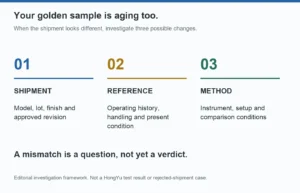
A prototype may be formed slowly by an experienced technician. Production introduces fixtures, multiple operators, material lots, forming tools, assembly stations and time pressure.
The gap between sample and bulk usually appears in repeatability, not in basic feasibility.
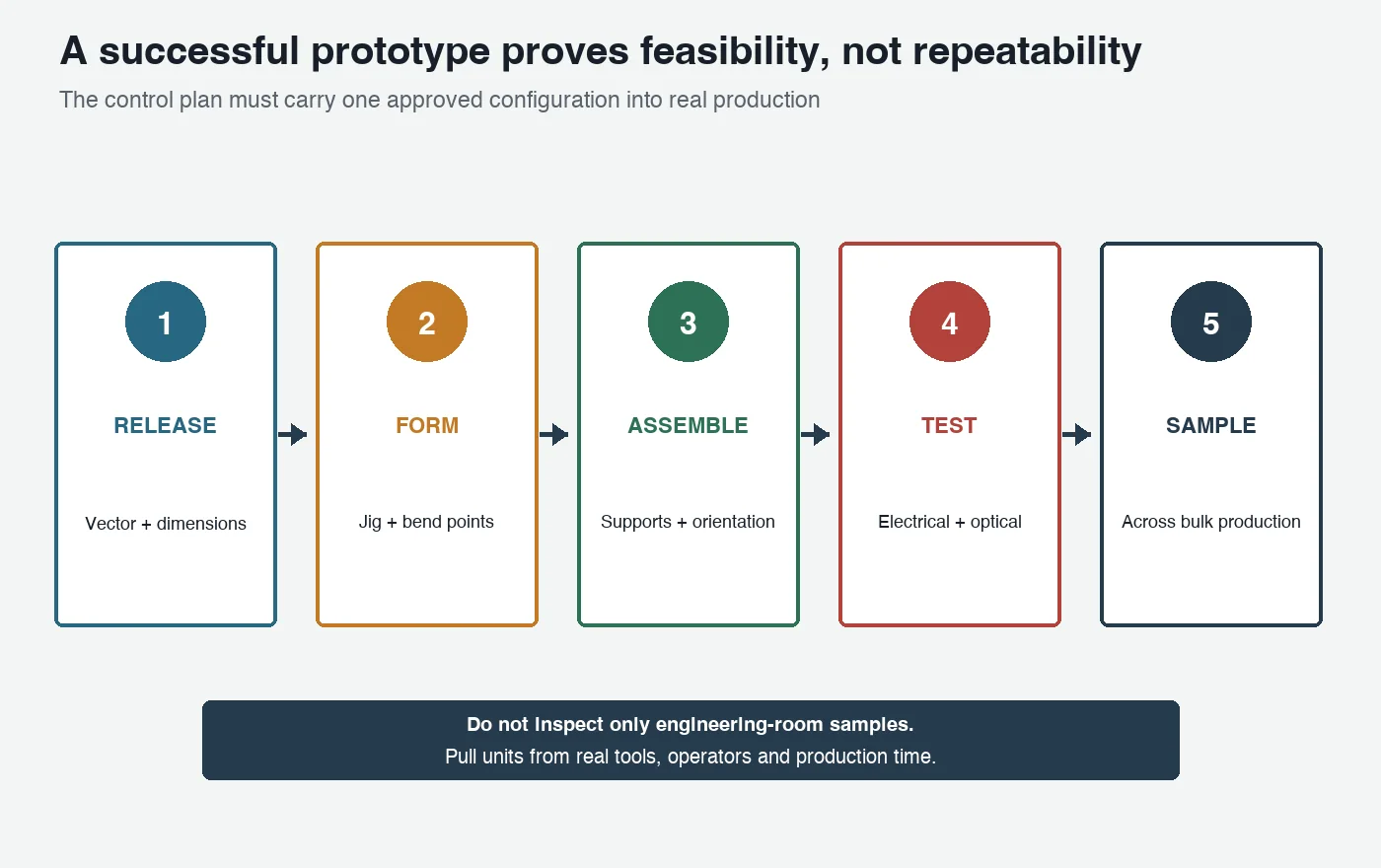
A practical control plan connects the approved sample to five production controls:
- Artwork revision control: one released vector and dimensioned drawing.
- Forming control: approved jig, path, bend points and orientation.
- Assembly control: defined stem, support-wire and base relationship.
- Electrical control: locked filament and driver revisions with recorded tests.
- Visual control: group comparison under a fixed lit and unlit condition.
Do not let the engineering room build every inspection sample. Pull units across production time, forming tools and operators. A defect that appears in 3% of a shipment can be invisible in one specially selected lamp.
Five Approval Decisions Before Bulk Production
1. Freeze the artwork revision
The purchase specification should identify the final file, revision and date. Verbal changes and chat screenshots are not controlled artwork.
WIPO explains that industrial design protection concerns the ornamental or aesthetic aspects of a product and that registration practices differ by jurisdiction.[4] Buyers should confirm that they have the right to use the logo or design they supply, while the manufacturing agreement should define confidentiality, ownership and authorized production quantity.
2. Approve lit and unlit masters
Keep a signed physical sample or clearly identified retained sample at both buyer and factory. Record the electrical and viewing conditions used for the lit approval.
3. Lock the construction behind the appearance
The approved shape, filament revision, driver, supports, glass and base orientation belong to one product configuration. A hidden change can alter a visible result.
4. Define measurable visual limits
Use dimensions for height, width, tilt, rotation and location. Use reference images for legibility and visual balance. State which features are critical to brand recognition.
5. Revalidate after relevant changes
A change to artwork, filament, driver, forming jig, support layout, glass envelope or assembly method should trigger the appropriate level of retesting.
Concrete judgment 5
A bulk shipment should be released against the controlled product configuration, not against a photo of the first sample.
A Factory Inspection Matrix That Answers the Right Questions
| Inspection stage | Samples | Main question | Evidence |
|---|---|---|---|
| Artwork review | Digital file | Is the intended design unambiguous? | Released vector and dimensioned drawing |
| Engineering prototype | Initial units | Can the shape operate and remain readable? | Lit/unlit photos and electrical results |
| Pilot production | Units from real tooling | Can the process repeat the shape? | Dimension, rotation and group-comparison data |
| Conditioned check | Defined operating or environmental condition | Does the structure remain stable? | Before/after visual and electrical comparison |
| Pre-shipment inspection | Random bulk samples | Does production match the controlled configuration? | Inspection report and retained samples |
Photobiological safety assessment may also be relevant depending on the finished product and market. IEC 62471-7 addresses assessment of light sources and luminaires that primarily emit visible radiation.[5] Do not infer compliance from low wattage or from the decorative purpose of the lamp; use the applicable requirements for the actual product and market.
What a Useful Custom-Filament RFQ Should Include
A useful request for quotation should contain:
- vector artwork with dimensions and revision;
- target bulb shape, diameter and glass finish;
- base type, voltage, frequency and dimming requirement;
- required front-view orientation;
- intended fixture and viewing distance;
- target wattage or brightness objective;
- market and applicable certification requirements;
- order quantity, packaging and labeling requirements;
- ownership and confidentiality expectations;
- prototype, pilot and bulk approval stages.
The most efficient RFQ does not demand an instant unit price from an ambiguous logo. It gives the factory enough information to identify where the design must change before tooling, samples and testing consume time.
Conclusion
A custom logo filament bulb is not ordinary artwork placed inside glass. The luminous path is simultaneously a brand graphic, an optical source, an electrical load and a formed assembly.
That is why one attractive prototype cannot approve a bulk order.
Approve the design three times: as artwork, as illuminated appearance and as production structure. Freeze the revision. Record the viewing and electrical conditions. Define bend, support, position and rotation limits. Pull pilot and bulk samples from real production. Revalidate when the construction changes.
The right question is not only, "Can you bend our logo?"
It is:
"Can you reproduce the same readable, electrically approved logo across the entire order?"
References
- IEC 62560:2011+A1:2015, Self-ballasted LED-lamps for general lighting services - Safety specifications. ↩
- U.S. Department of Energy, LED Basics. ↩
- U.S. Department of Energy, 2019 Solid-State Lighting R&D Opportunities. ↩
- World Intellectual Property Organization, Industrial Designs. ↩
- IEC 62471-7:2023, Photobiological safety of lamps and lamp systems - Light sources and luminaires primarily emitting visible radiation. ↩