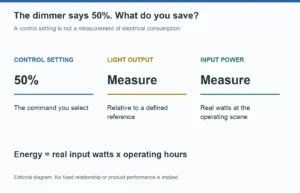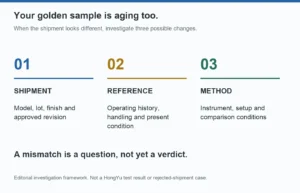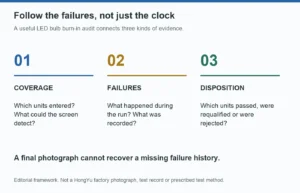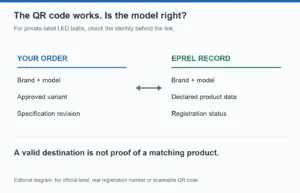
Featured image: Original editorial diagram. No official energy label, real registration number or scannable QR code is reproduced.
A packaging proof arrives with a crisp energy label. The QR code opens a page. The supplier has provided an EPREL number. It is tempting to mark the compliance task complete and release the boxes for printing.
But a successful scan answers only one question: where does this code lead? It does not establish that the destination describes the bulb in your purchase order, under the brand you will sell, with the specification you approved.
For private-label buyers, the expensive mistake is not always a missing record. It can be a real record attached to the wrong commercial product.
This guide addresses standalone, packaged LED light sources within EU energy-labelling scope. It is a procurement review method, not a complete legal compliance assessment. Have the responsible compliance party confirm scope, exemptions and economic-operator roles for the actual product and transaction.
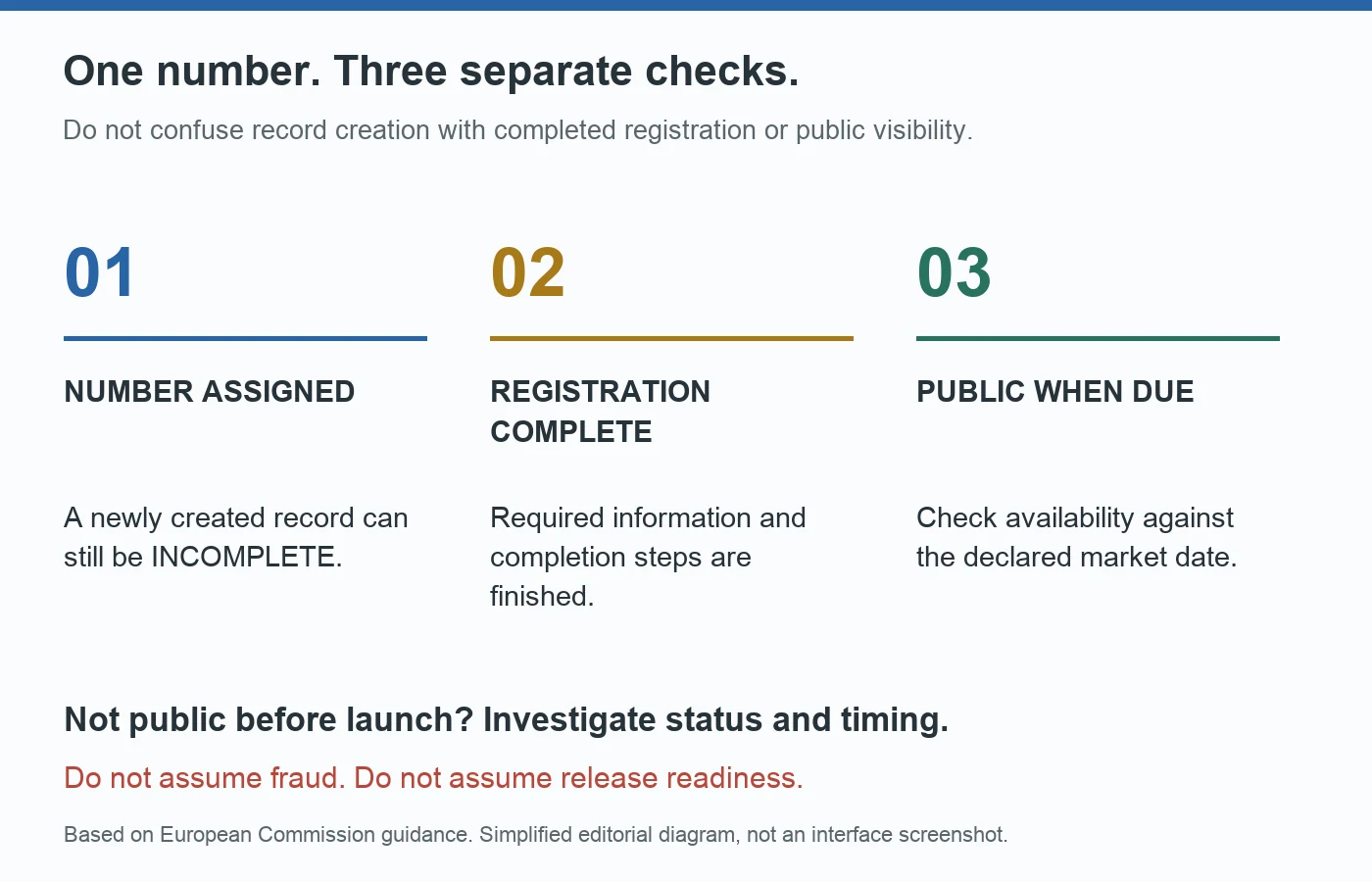
1. An EPREL Number Is Not a Completion Certificate
The European Commission's registration guide makes an important distinction: creating a model assigns a registration number, while the new entry initially has an INCOMPLETE status. The remaining information and registration steps still need to be completed. The brand/trademark and model identifier are part of the record's identity.[1]
The procurement implication is straightforward: a number in an email is not evidence that the work behind it is finished.
Ask the responsible supplier to identify the record, its current status and the planned market date. Keep those answers against the specific purchase-order line, rather than in a general supplier-approval folder.
Buyer judgment 1: Treat an assigned number as a reference to investigate, not permission to launch. A spreadsheet cell containing digits cannot substitute for a completed model review.
There is an equally important caution in the other direction. Commission guidance says a completed registration can precede market placement, with public visibility starting on the declared placing-on-market date. Scheduled publication depends on mandatory fields being filled and registration being marked complete.[2]
A prelaunch QR destination that is not yet public therefore does not, by itself, prove deception. Request an explanation and status evidence. Record the expected public date and assign someone to recheck it. Do not let a reasonable prelaunch explanation become an indefinite excuse once the product is being released to market.
2. Build a Crosswalk Between the Order and the Record
An OEM transaction may contain several identifiers: the factory's item code, the buyer's stock-keeping unit, the model identifier on the consumer-facing documentation, and the EPREL registration number.
These do not have to be the same string. They do need a controlled relationship.
For example, a buyer evaluating EU standard filament bulbs may start with a catalogue code, then assign a private-label SKU. The useful handover is a row connecting both to the agreed brand, model and record. An email saying "the whole series is covered" is too imprecise to approve individual packaging files.
Use this comparison before artwork release. It is a purchasing checklist, not a substitute for checking every applicable mandatory field.
| Check | Compare these items | What should stop approval? |
|---|---|---|
| Commercial identity | Order line, agreed brand/model and EPREL identity | Another brand or unexplained model suffix |
| Physical variant | Approved sample, cap, shape and finish against the specification | A similar-looking photograph used as the only identification |
| Declared performance | Approved specification, product information sheet and model data | Unexplained differences in power, useful luminous flux, CCT or dimming information |
| Energy information | Label artwork, current model data and product information sheet | A label copied from a neighboring SKU or an older revision |
| Digital destination | Actual QR destination and the recorded EPREL number | A catalogue homepage, unrelated model or unexplained redirect |
| Registration readiness | Status evidence, declared market date and public availability when due | An incomplete entry presented as a completed launch deliverable |
The Commission's light-source overview explains that the energy label and EPREL information serve different levels of detail: the label includes the efficiency class and energy consumption, while the model information gives additional characteristics such as light output, colour temperature and cap type.[3] Do not limit the review to whether the large class letter matches.
Also distinguish a specification discrepancy from a measurement comparison. A bench result, a declared value and a rounded display field are not automatically interchangeable. An unexplained difference should trigger technical review, not an improvised pass/fail tolerance.
Buyer judgment 2: Approve the model mapping, not just the QR image. The relevant question is whether this order line has a defensible path to this record.
3. Private Label: A Different Company Name Is Not Automatically Wrong
Avoid a crude rule such as "every name must be identical everywhere."
The Commission distinguishes the legal supplier from the product brand. Its guidance explains that EPREL-generated labels use the Brand/Trademark field; the registering supplier may market products under different brands. The supplier role can be held by an EU-established manufacturer, an authorised representative of a non-EU manufacturer, or an importer, depending on the arrangement.[4]
Consequently, a legal entity whose name differs from the retail brand is not automatically a mismatch. What matters for your review is an explained and documented relationship, the correct brand/model identity and an accountable party handling the registration.
Before buying printed packaging, ask:
- Who is responsible for this model's EPREL registration and ongoing corrections?
- Which brand and model identifier will the consumer see?
- How do the factory code and our SKU map to that identity?
- Who will approve changes if the brand, specification or model designation changes?
An OEM can help prepare technical information without that fact alone settling who holds the legal supplier role. Agree the responsibilities before production, not when a retailer rejects a listing.
Buyer judgment 3: Investigate unexplained identity differences; do not reject a legitimate brand/entity relationship merely because the names differ. Conversely, "same factory" does not justify copying another customer's record onto your box.
4. A Plausible Wrong Record Can Be Harder to Catch Than a Broken Link
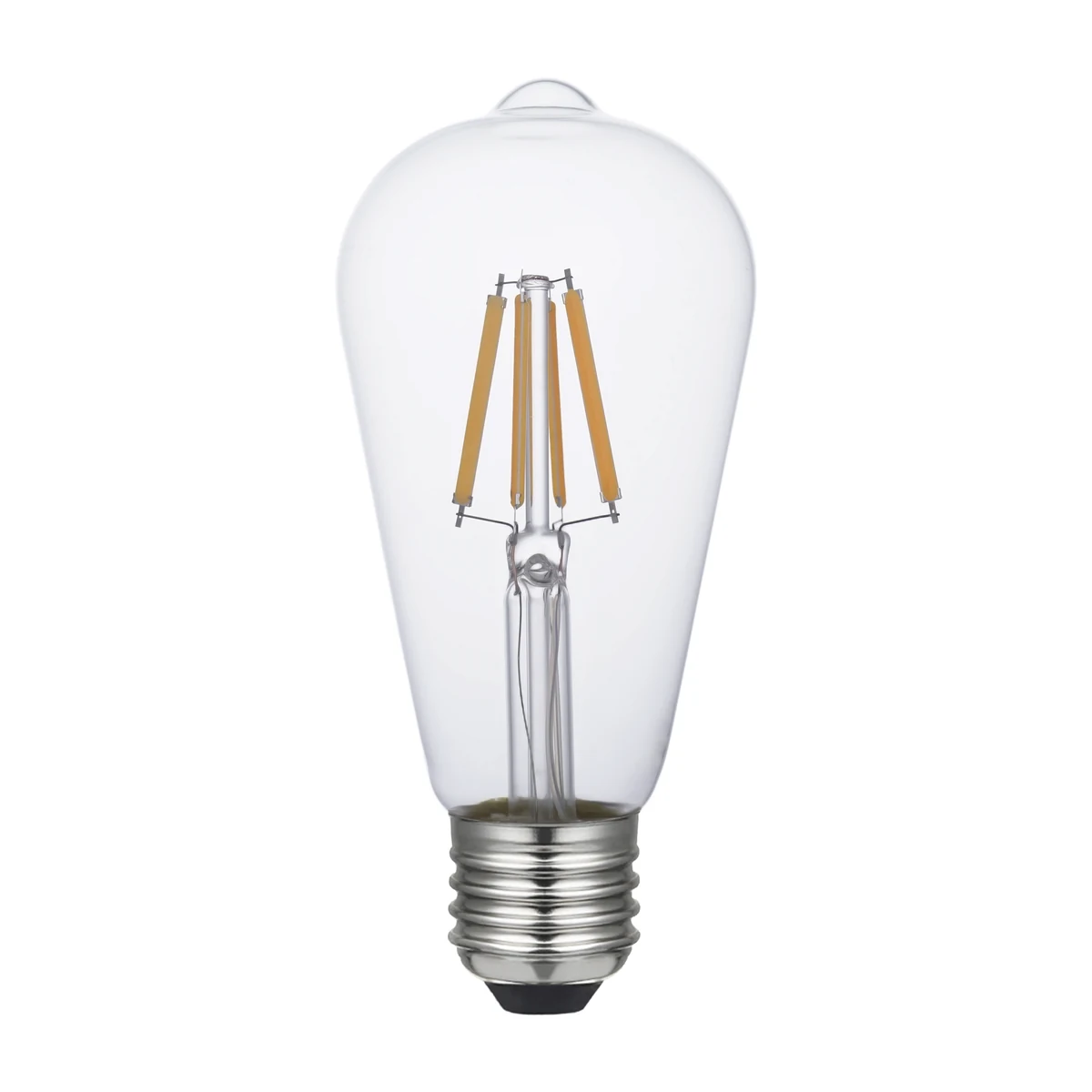
Consider a hypothetical order for a 4 W, 2200 K dimmable ST64 bulb. An old artwork file contains a working QR code, but the destination describes a 7 W, 2700 K model. Both products have an E27 cap and broadly similar silhouettes.
This is an illustrative scenario, not a HongYu customer case or a statement about a particular registered model.
A scan-only inspection passes. A model comparison fails immediately. A visual inspection might miss it because the decisive differences are not reliably visible through the glass.
When selecting EU vintage straight-filament bulbs, keep the chosen electrical and colour specification attached to the artwork approval. "Vintage ST64" is a buying category, not a sufficient identity for every variant within it.
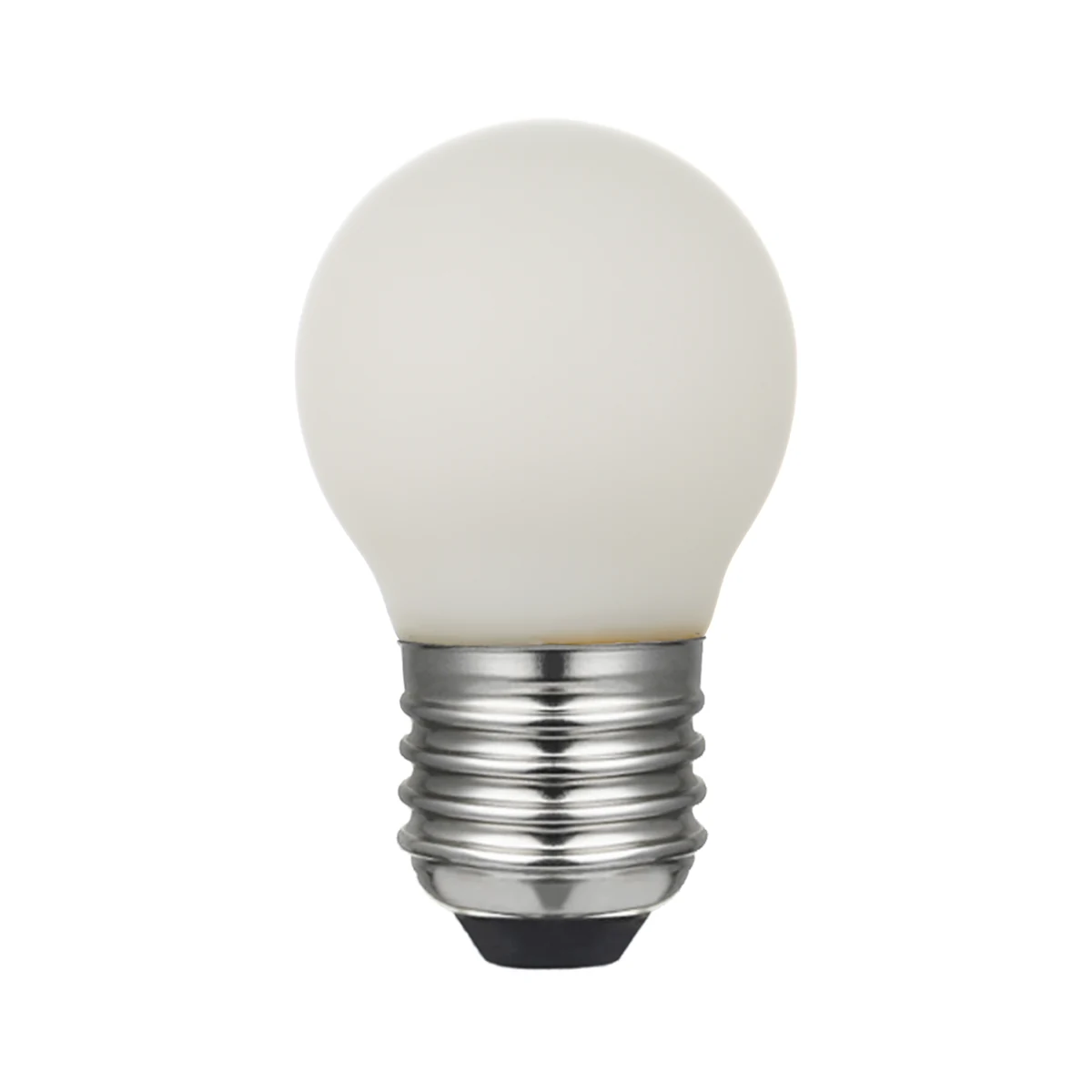
The same discipline applies to finish changes. A white globe should not inherit a clear bulb's paperwork merely because both use the same screw cap. For an order drawn from the EU porcelain filament bulb range, ask for the documentation associated with the selected finished configuration.
Do not turn this into the opposite blanket rule that every cosmetic change necessarily requires a new registration. Whether a change calls for an update, a distinct model or other action belongs with the responsible compliance assessment. The buyer's task is to prevent an undocumented substitution from slipping through as a graphic-design edit.
5. A Verified Supplier Is Not a Laboratory Approval of the Bulb
EPREL's organisation-verification process addresses supplier identity and eligibility to use the registration system. The Commission's guide describes organisation details, electronic verification and supporting identity arrangements.[5]
The procurement inference is limited but important: organisation verification should not be presented as independent laboratory approval of every lamp that organisation registers.
A matching public record is useful evidence of declared identity and information. It does not tell your incoming inspector that the carton contains the correct production variant. It also cannot answer every application question, such as compatibility with a specified dimmer or suitability for an enclosed installation.
Keep the registration review alongside the applicable technical documentation and shipment identification. Do not replace those controls with a screenshot of a database page.
Buyer judgment 4: Separate identity verification, declared model information and evidence about the physical product. All three can matter; none should silently stand in for the others.
6. Release One Controlled Data Pack to Three Teams
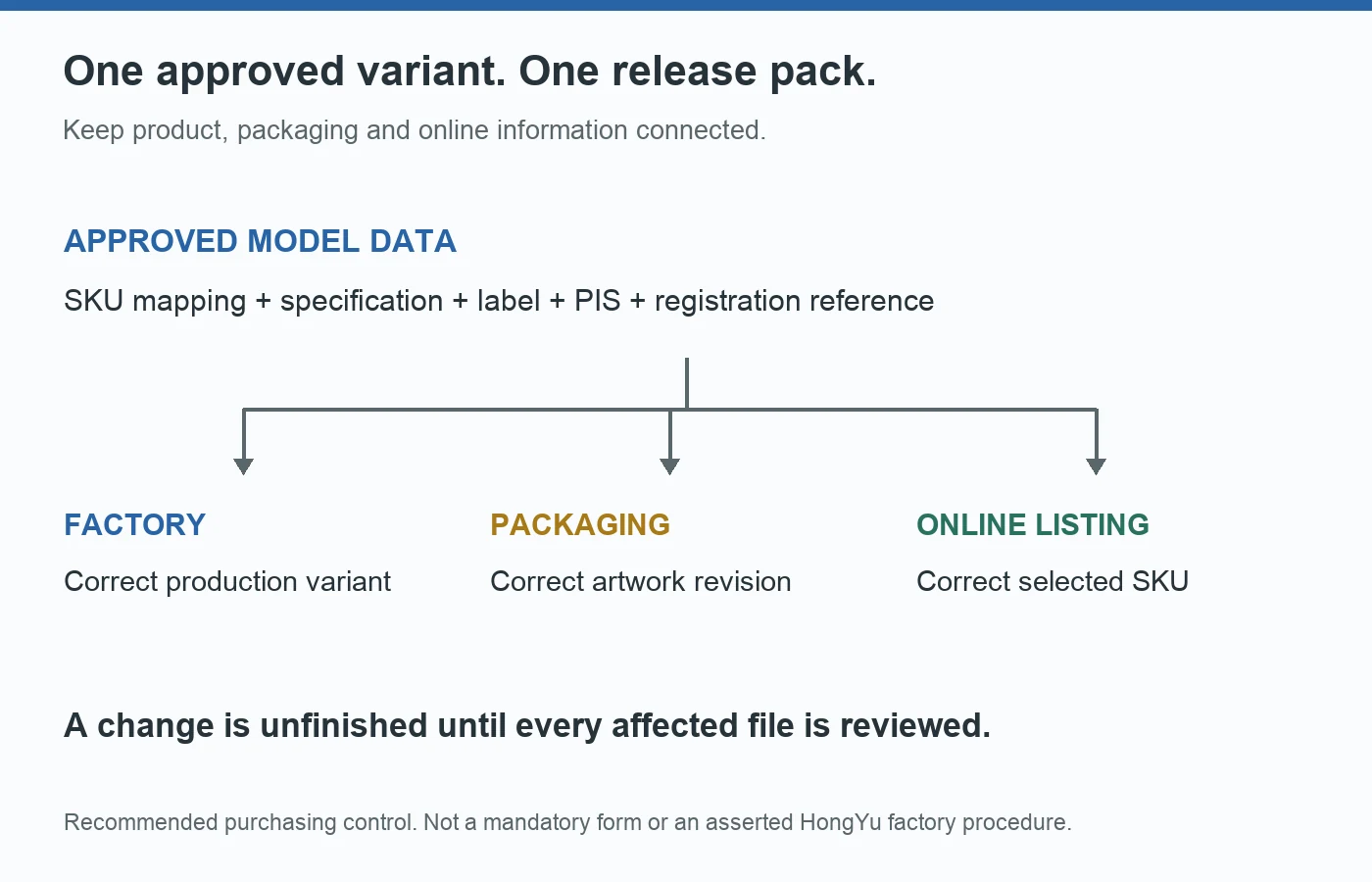
The factory, packaging designer and e-commerce team should not each reconstruct the model data from a different email chain.
Our recommended purchasing control is one versioned release pack for each approved commercial variant. Include the SKU-to-model crosswalk, registration reference, approved specification, label file, product information sheet, packaging revision and responsible contact. Record the date and reviewer, and retain the superseded version separately.
This is an operational recommendation, not a claim that HongYu already uses a particular internal system or that the following table is a legally prescribed form.
| Decision point | Evidence to retain | Recommended hold condition |
|---|---|---|
| Purchase-order confirmation | Agreed variant, identity crosswalk, responsible party and completion plan | Nobody owns registration, or the quoted variant is still ambiguous |
| Packaging print release | Approved label/PIS pair, artwork revision, QR destination and status review | QR belongs to another model, or required identity/data remain unresolved |
| Market-release readiness | Completed registration confirmation, public record when due, final packaging and listing check | Public availability is overdue, or physical and online information conflict |
| Reorder or product change | Change description, affected files and documented compliance decision | Old artwork is reused without reviewing a changed configuration |
For prelaunch print approval, explicitly record any outstanding public-visibility check, its owner and deadline. Printing boxes in advance and approving market release are different decisions. The responsible party must determine the applicable legal timing; a later retail launch date should not be assumed to postpone earlier obligations.
At the final check, scan a code from the actual printed packaging, not only from the designer's PDF. Open the listing as a customer would and check the selected variant, not just the default product page. Save the URL and review date so another person can repeat the check.
Buyer judgment 5: Release the box and the online listing from the same approved model data. A correction is unfinished if only one sales channel receives it.
A Short RFQ Clause Buyers Can Adapt
For each proposed EU-market variant, identify the responsible EPREL supplier, brand/model identifier, registration reference and mapping to our order SKU. Provide the current label and product information sheet, registration status and planned public-availability date. Submit specification, identity or artwork changes for review before implementation. Final market-release approval remains subject to the applicable compliance requirements and verification of consistent model information.
This is a suggested commercial request, not legal drafting. Adapt it to the parties' actual responsibilities. Its purpose is to make the deliverables explicit before a quotation becomes an order.
Conclusion
A working QR code is the beginning of the check, not the conclusion.
For an EU private-label LED bulb order, establish a controlled relationship between the physical variant, commercial identity, EPREL model and information used on packaging and online. Distinguish an assigned number from completed registration, and a legitimate prelaunch visibility delay from a missed release obligation.
The strongest purchasing question is not "Do you have EPREL?" It is "Show me how this exact order line, under this brand and model, connects to the record and files we are about to release."
References
Official guidance reviewed on 23 September 2026. Consult the applicable legislation and responsible compliance adviser for a binding, product-specific assessment.
- European Commission, Registration Quick Guide. Model creation, identifiers and initial registration status. Back to text.
- European Commission, When does a newly registered model become public?. Completion and scheduled public visibility. Back to text.
- European Commission, Light Sources. Energy-label information and product-group guidance. Back to text.
- European Commission, EPREL Information for Suppliers. Supplier roles and the distinction between legal supplier and brand/trademark. Back to text.
- European Commission, Profile Creation and Verification Quick Guide. Organisation-verification process. Back to text.