Featured image: Original editorial diagram. These are investigation paths, not findings about a HongYu product or an actual rejected shipment.
The buyer approved the sample. The factory kept a matching lamp. Both sides agreed that future shipments should look and perform like it.
Six months later, a new batch looks different beside the buyer's reference. Has production changed, or has the reference spent those months lighting a showroom display?
A signed sample can be valuable evidence of an approval. It is not a permanently fixed physical standard. Its usefulness depends on what was approved, how the sample has been used, and whether its present condition still represents the original agreement.
For decorative LED bulbs, this matters twice: the product has an unlit appearance and an operating performance. One well-travelled lamp cannot reliably stand in for every visual, electrical and optical requirement indefinitely.
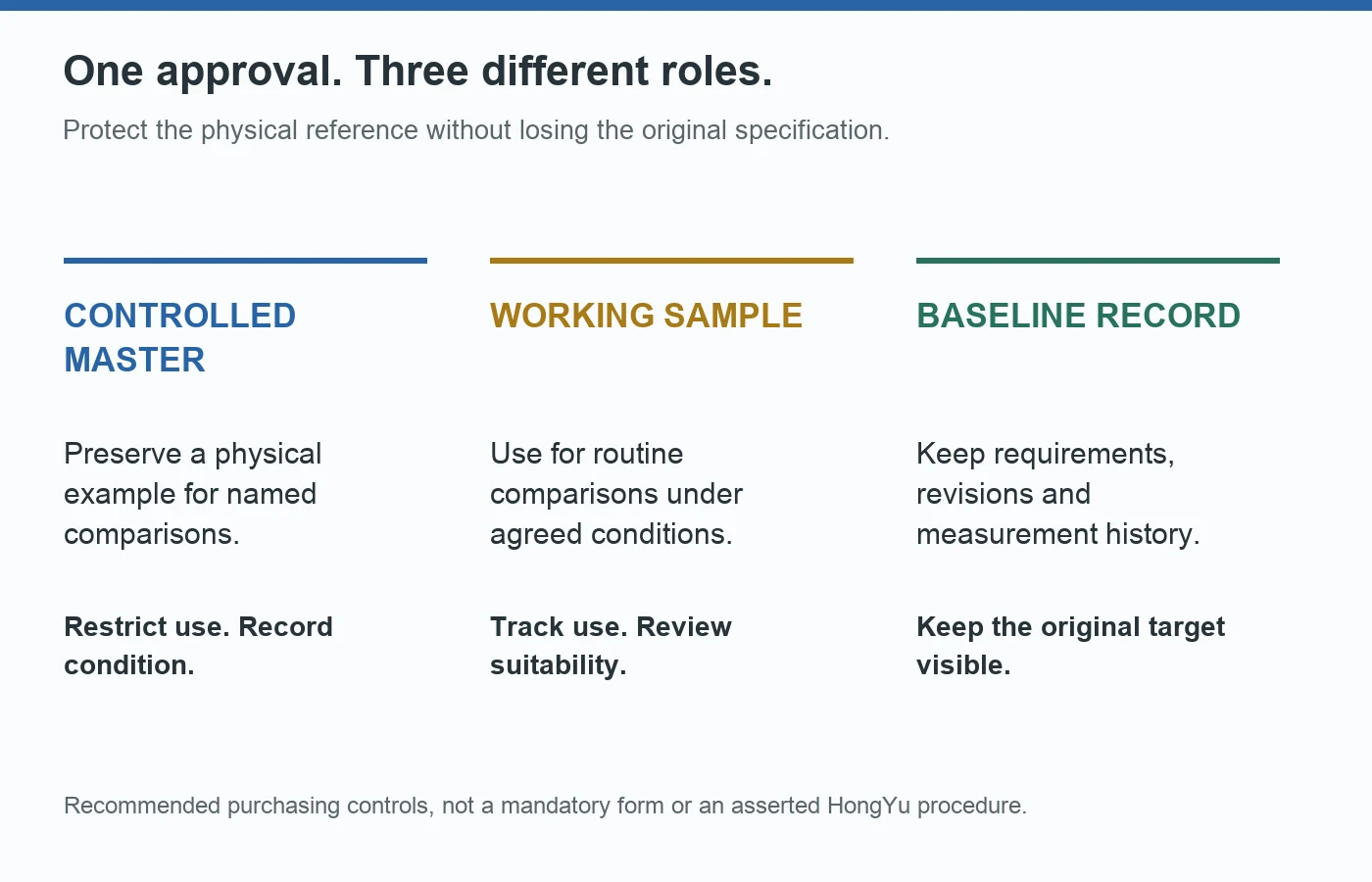
The practical solution is to manage the approval as a small evidence system: a controlled physical reference, a working comparison sample, and a versioned specification with baseline records.
1. A Signature Preserves Approval, Not Physical Condition
LED light output and colour can change with operation. DOE's 2020 review of LED-package maintenance discusses gradual changes in luminous flux and chromaticity rather than only abrupt failure.[1] This is component-level evidence of relevant mechanisms, not a prediction of how quickly a particular finished HongYu bulb will change.
There are also practical handling questions. Has the reference been repeatedly installed, cleaned, shipped or photographed? Does its surface still have the same condition recorded at approval? Was it used in a fixture different from the one specified for comparison?
Do not assume that every old sample has drifted. Equally, do not assume that a sample is unchanged because it still turns on and carries an approval sticker.
Buyer judgment 1: Give the approval record and the physical sample separate identities. The record states the agreed requirements; the sample is an object whose condition must remain suitable for its assigned role.
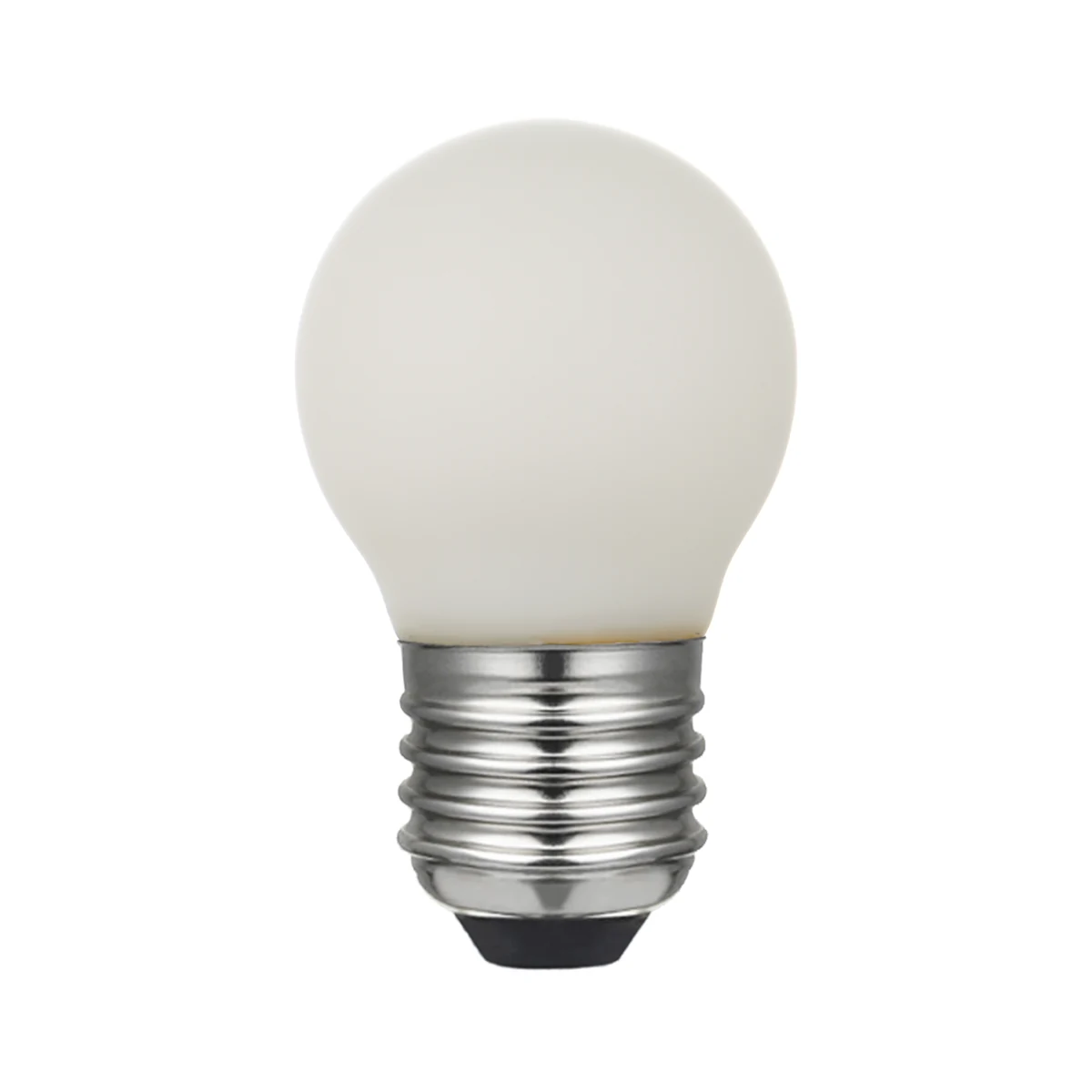
For an order from the EU vintage straight-filament bulb range, record which characteristics the physical reference represents: glass tint, filament arrangement, base appearance or another named feature. "Matches the sample" is too broad if the only documented approval concerned the appearance of the unlit bulb.

2. Separate the Master, the Working Sample and the Record
Our recommended arrangement is not to turn every approved lamp into a laboratory standard. It is to reduce unnecessary use of the evidence needed to resolve a later disagreement.
| Reference element | Main purpose | Control to agree |
|---|---|---|
| Controlled master sample | Preserve an approved physical example for defined comparisons | Unique ID, restricted use, suitable storage and documented condition reviews |
| Working comparison sample | Support routine checks and discussions | Usage history, review triggers and comparison against the approved baseline |
| Specification and baseline record | Define requirements independently of today's sample condition | Revision, method, measured results, uncertainty where relevant, and acceptance criteria |
| Approved limit samples, where useful | Illustrate an agreed visual acceptance boundary | Identify the characteristic represented and the conditions under which it is judged |
This is a suggested purchasing arrangement, not a mandatory standard or a claim about an existing HongYu procedure. The number of samples and the review frequency should fit the product, usage and risk.
If buyer and factory retain different physical units, identify both and document their initial relationship. Two lamps from the same batch are not literally the same reference. Record any accepted difference instead of assuming that a shared catalogue code makes them interchangeable.
A limit sample also has a different role from an ideal sample. An especially attractive hand-selected bulb does not show the permissible variation in filament alignment or finish. Conversely, a visual boundary sample does not define a numerical lumen limit unless that requirement is separately established.
Buyer judgment 2: Do not use the preserved master as the everyday demonstration lamp. Use a controlled working sample, and keep the approved baseline available when that sample needs review.
3. Record Exactly What "Approved" Means
Create a reference sheet before the samples separate. Include model, voltage, cap, wattage, CCT option, glass finish, dimming option and approved construction revision where available. Link the sheet to the purchase specification rather than relying on a handwritten label alone.
Record the sample IDs, approval date, approving parties and scope. Attach photographs for identification and visible features. For quantitative requirements, retain the measurements and their conditions, not just a photograph of an instrument display.
NIST describes metrological traceability as belonging to a measurement result and its documented calibration chain, including uncertainty. It cautions that calibrated equipment alone does not automatically establish traceability for every result produced with it.[2]
The purchasing implication is modest: a signed retail bulb is not automatically a calibration standard. If you require a numeric light-output result, use an appropriate measurement process. Do not tell a laboratory to adjust its instrument until the golden sample reads the original number; that could conceal sample change or measurement error.
Agree an order of precedence for contradictions. A sensible commercial starting point is that explicit numerical requirements are evaluated using the agreed method, while physical samples govern only the named visual attributes and boundaries. Any unresolved conflict returns to joint review. Applicable safety and regulatory requirements are not waived by signing a sample.
Buyer judgment 3: Approve characteristics and limits, not an unlimited promise to copy one object. A physical sample does not define every hidden component, future performance condition or permitted deviation.
4. Keep Unlit Appearance and Lit Performance Separate
When judging the unlit bulb, use a repeatable viewing arrangement: defined illumination, background, position and viewing direction. X-Rite's guidance on colour-measurement pitfalls specifically calls for defining the light-booth illumination used in visual evaluation.[3] That general principle is useful for finish comparisons; it is not a prescribed acceptance method for every decorative lamp.
For a product from the EU porcelain filament bulb range, the reference sheet might distinguish surface appearance when unlit from the uniformity or appearance required when lit. Do not let a pass in one state automatically approve the other.
Photographs help record orientation, construction and visible damage. Ordinary phone images should not be the final arbiter of a subtle glass tint or emitted-colour dispute: the lighting, capture settings, processing and display are additional variables. Keep original files and the capture setup where photographs form part of approval, but do not mistake that documentation for controlled photometry.
For operating comparisons, specify electrical input, fixture or holder, orientation, ambient conditions, control setting and stabilization procedure. IES LM-79-24 provides a method for reproducible optical and electrical measurements of solid-state lighting products under standard conditions.[4] Its public scope supports the need for a defined method; the full applicable procedure is required for a formal test claim.
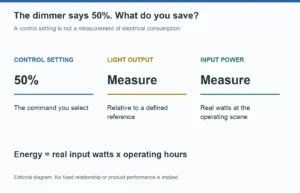
With EU dim-to-warm bulbs, record the actual control model, connected load and agreed operating points. A remembered knob position on a different dimmer is not a reproducible reference condition.
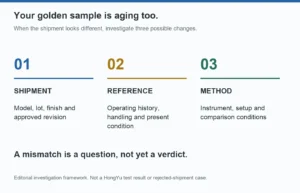
5. When Samples Disagree, Investigate Three Possible Changes
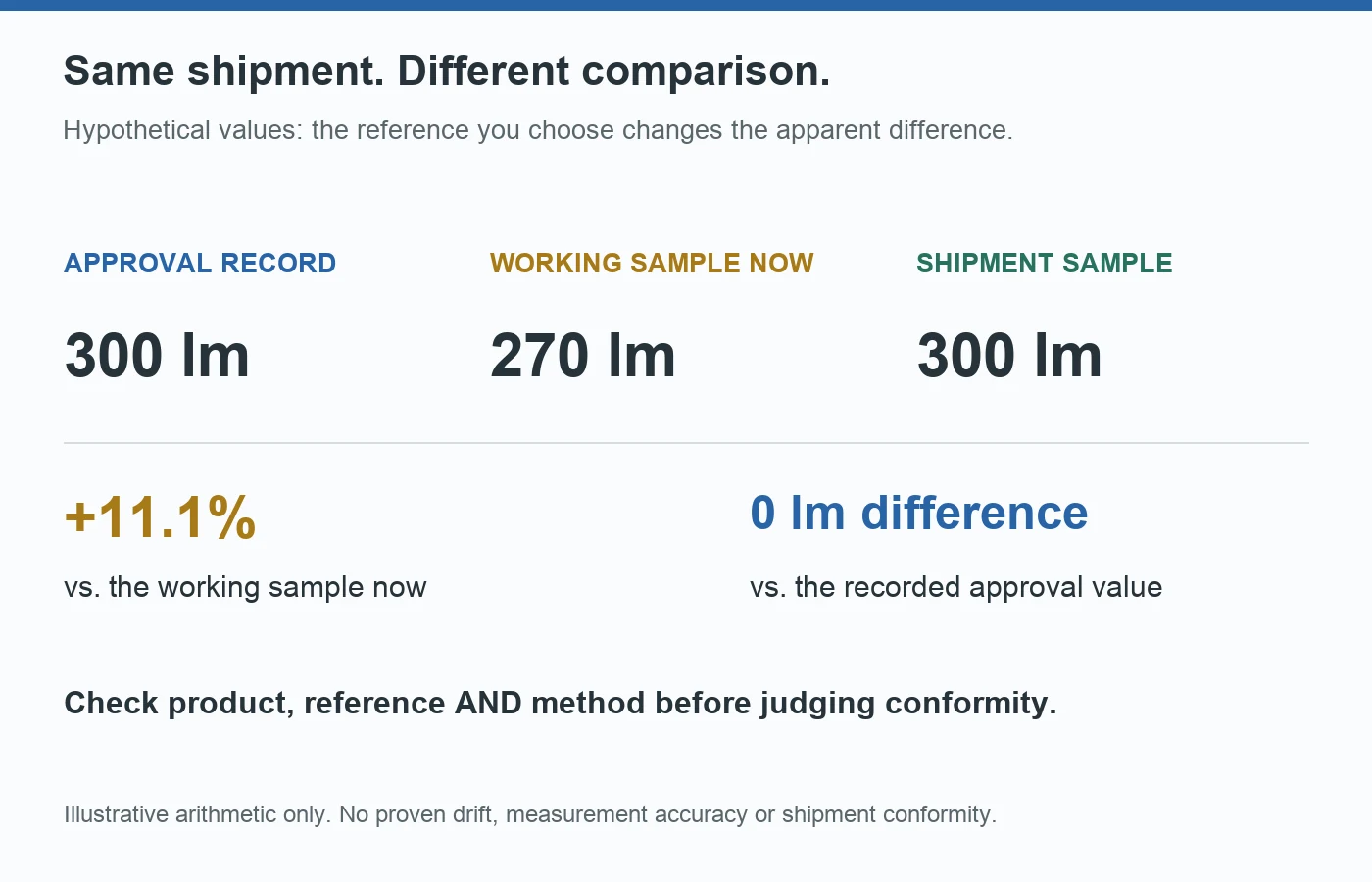
Consider this hypothetical example, not a HongYu customer case or test result:
- The working reference was recorded at 300 lm when approved.
- A later check records it at 270 lm.
- The shipment sample measures 300 lm in the current comparison.
Against the working reference's present output, the shipment sample is about 11.1% brighter: (300 - 270) / 270. Against the recorded approval value, its numerical difference is zero.
Those calculations illustrate how the choice of reference changes the comparison. They do not establish that the shipment passes, that the reference has physically degraded, or that either measurement is reliable. Method, conditions and measurement uncertainty still need review. The figures are not acceptance limits or an expected depreciation rate.
Start with three hypotheses:
- The shipment changed. Check the model, lot, finish, approved revision and applicable production records.
- The reference changed. Review its operating and handling history, condition and previous measurements.
- The comparison changed. Check instruments, setup, stabilization, control settings and the measurement procedure.
More than one can be true. Avoid forcing the investigation into a choice between "bad batch" and "bad sample" before examining the measurement system.
NIST's measurement-process guidance describes how check-standard histories can reveal changes in bias or variability. It also warns that process control cannot compensate for an improperly specified or calibrated method.[5] A product golden sample should not be assumed to be the stable check standard described in that metrology guidance. The laboratory must decide what reference and controls are appropriate.
Buyer judgment 4: A disagreement is a trigger to check product, reference and method separately. Do not reject a lot solely because it differs from an unreviewed working sample, or approve it solely because one number matches an old report.
6. Replace a Reference Without Moving the Acceptance Target
An old working sample can be replaced. What must not happen is a silent change to the product agreement.
Select a proposed replacement against the documented specification and approved visual criteria. Record its identity and baseline. Where the previous reference remains suitable, compare them under the agreed conditions; where it is damaged or suspect, do not make it the sole authority for the replacement.
Record differences and obtain the agreed approvals. Identify which orders use the new reference, withdraw the superseded working sample from routine use, and retain the prior records and disposition history. Do not relabel the new lamp with the old sample's ID.
Keep two change processes distinct: renewing the physical reference and changing the product specification. A new glass finish or revised performance target needs its own product-change approval. It should not be hidden inside a reference-renewal form.
| Review trigger | What to check | Decision to record |
|---|---|---|
| Repeated demonstration or routine testing | Operating history and comparison with baseline | Continue use, recheck or replace the working sample |
| Damage, cleaning incident or uncertain handling | Condition and the attributes that may be affected | Restrict the sample's role, withdraw it or obtain further assessment |
| Conflicting comparison results | Shipment identity, reference history and measurement setup | Hold the disputed decision pending an agreed investigation |
| Product or specification revision | Whether the previous reference still represents the order | Retain for the old revision or approve a new reference set |
| Long interval before a reorder | Current approval status and fitness for the intended comparison | Reconfirm the reference before using it for acceptance |
This table is a suggested review framework, not a standard-mandated form. It does not impose a universal six-month or annual expiry. Set intervals and triggers according to the reference's use, observed stability, storage requirements and the consequence of a mistaken decision.
Buyer judgment 5: Renew the sample through documented approval, not by borrowing a convenient lamp from the latest batch. Otherwise, the current production can become its own acceptance reference without anyone noticing.
Add a Reference-Sample Clause to the Purchase Order
Identify the approved sample IDs and the characteristics each sample represents. Retain the associated specification revision, baseline records and comparison conditions. Define custody, permitted use, review triggers and replacement approval. Quantitative requirements remain subject to the agreed measurement and acceptance procedure. Changes to the product specification require separate approval from replacement of a reference sample.
Adapt this suggested wording to the transaction. It is an operational request, not a claim that a physical sample alone can establish compliance or resolve every contractual dispute.
Conclusion
A golden sample should preserve the meaning of an approval, not gradually rewrite it.
Keep a protected master for its defined purpose, a controlled working sample for routine comparisons, and a versioned specification with baseline evidence. When a new batch looks different, investigate the batch, the reference and the method before deciding which one changed.
The most useful question at the next reorder is not simply "Do you still have our sample?" It is "Which approved reference are we using, what condition is it in, and what exactly does it authorise us to accept?"
References
Sources reviewed on 29 September 2026. General metrology and colour-control guidance is distinguished from LED product requirements; no source below establishes a universal golden-sample replacement interval.
- U.S. Department of Energy, Lumen and Chromaticity Maintenance of LED Packages Based on LM-80 Data, 2020 study summary. Component-level aging context, not a HongYu finished-lamp result. Back to text.
- NIST, Metrological Traceability: Frequently Asked Questions and Policy. Measurement-result traceability and its limitations. Back to text.
- X-Rite, Common Color Measurement Pitfalls. Defined illumination for visual evaluation; manufacturer guidance, not a lamp acceptance standard. Back to text.
- Illuminating Engineering Society, ANSI/IES LM-79-24: Optical and Electrical Measurements of Solid State Lighting Products. Public scope description. Back to text.
- NIST/SEMATECH, Issues in Controlling the Measurement Process. Check-standard monitoring and limitations of measurement-process control. Back to text.