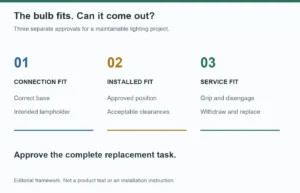
Featured image: Original editorial diagram. Not a product test or an installation instruction.
A decorative LED bulb can pass sample approval, screw into the correct socket and look excellent in the finished pendant. The maintenance problem may remain invisible until someone has to take it out.
The shade opening is too narrow for a hand. The glass globe was fitted before the final retaining ring. A long tubular lamp cannot clear the joinery below it. The spare bulb is correct, but the approved replacement procedure is missing.
For fixture brands, distributors and hospitality buyers, this is a different question from ordinary dimensional compatibility: can the lamp be removed and replaced through the intended service route, with the fixture installed and the surrounding space finished?
The answer belongs in sample approval, not in the facilities team's first maintenance call.
One Bulb, Three Different Fit Decisions
Treat fit as three separate approvals.
| Approval | What it establishes | What it does not establish |
|---|---|---|
| Connection fit | The specified lamp base matches the intended lampholder | Correct voltage, thermal suitability or accessible servicing |
| Installed fit | The assembled bulb occupies an acceptable position without prohibited contact | Enough room to grip, disengage and withdraw it |
| Service fit | The replacement task is possible using the permitted procedure in the installed location | Electrical, thermal or optical suitability of an alternative bulb |
This separation prevents an easy procurement mistake: accepting a photograph of an assembled fixture as proof that the fixture is maintainable.
Manufacturer instructions can be more specific than a base designation. For example, the Louis Poulsen light-source guide lists both maximum diameter and maximum height for the Panthella 320 Table. That is evidence that the lamp envelope is a separate selection criterion, not an endorsement of any HongYu replacement for that fixture.[1]
Buyer judgment 1: Approve the removal sequence, not just the assembled photograph. A successful factory assembly does not necessarily reproduce the conditions available after installation.
When shortlisting EU standard filament bulbs, request the exact model drawing and its agreed dimensional tolerances. A family name or catalog silhouette is useful for selection, but it is not a complete service envelope.
The Missing Dimension Is the Path Out
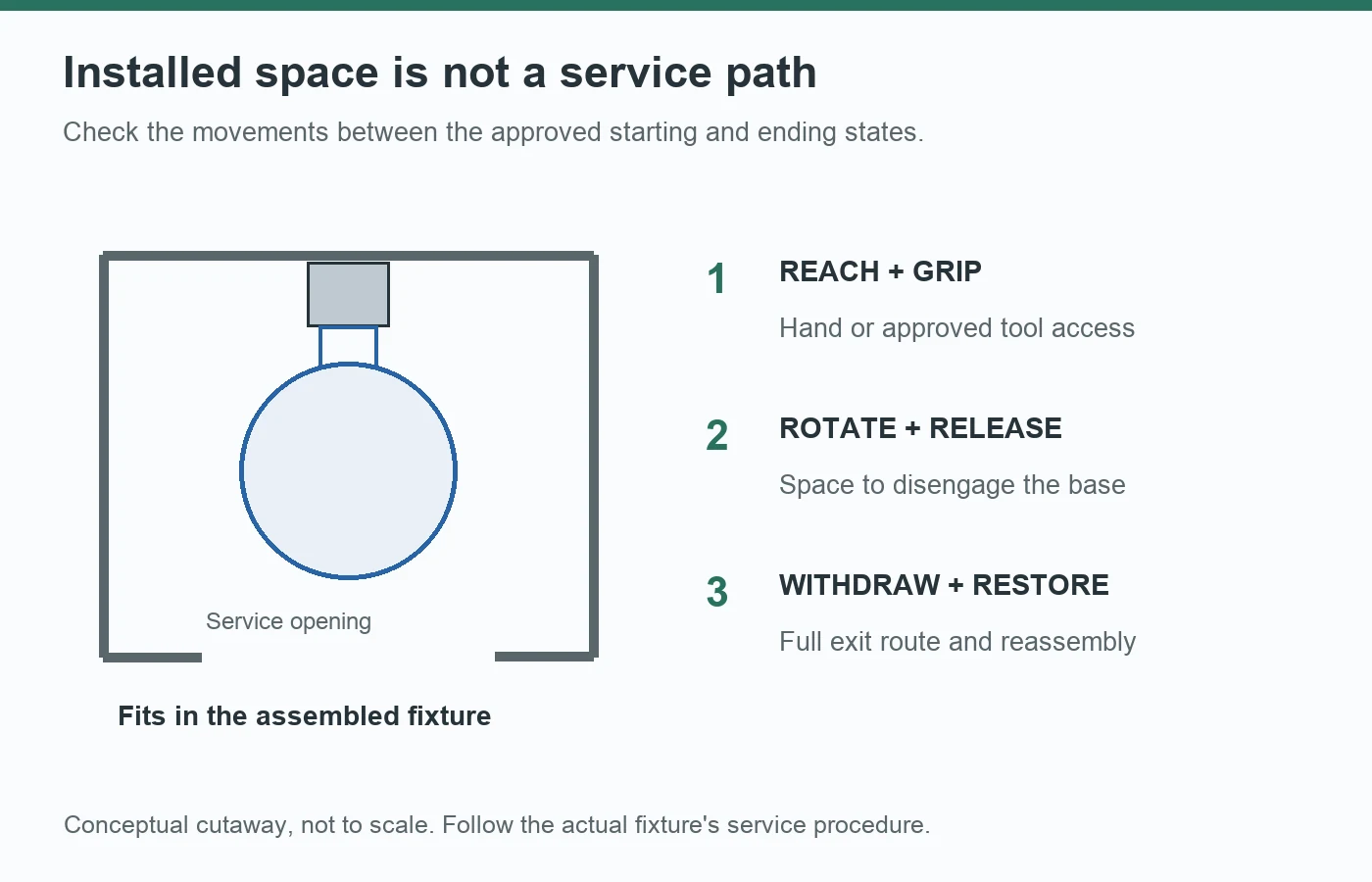
A drawing of the final position answers a static question. Replacement is a sequence of movements.
A screw-base lamp must be gripped, rotated, disengaged and moved away from the lampholder. Depending on the fixture, it may then need to pass through an opening or follow a permitted angled path. A long lamp may fit vertically while lacking the space needed to tilt it past an obstruction.
Start with these five items on the fixture review drawing:
- Lamp envelope: maximum diameter, overall length and shoulder or neck profile.
- Service opening: the smallest usable opening after only the permitted parts are removed.
- Disengagement space: movement needed to release the base without striking adjacent components.
- Handling space: access for the specified hand position or manufacturer-approved tool.
- Installed surroundings: walls, shelves, adjacent pendants, furniture and other permanent obstructions.
For a simple straight passage through a circular opening, compare the minimum opening dimension with the maximum relevant lamp diameter. A positive difference is only an initial geometry screen. It is not automatically enough for tolerances, misalignment, handling or a non-straight route.
Do not turn this into a universal “leave 5 mm” rule. A globe, a tube and an irregular decorative lamp do not create the same handling problem. The required margin must come from the actual geometry, supplier limits and an agreed demonstration.
Nor does “smaller” automatically mean “approved.” Philips' general safety-instruction icon guide includes shape and diameter restrictions, with applicability determined by the specific product instructions. Its examples show why replacing a lamp with a smaller one is not a universal workaround.[2]
Buyer judgment 2: Clearance around an installed bulb is not proof of clearance for a hand, tool or removal path. Keep those checks separate in the approval record.
The Assembly Order Can Hide the Problem
Consider an illustrative pendant assembled on a bench. The operator installs a globe bulb, places the shade around it and secures a lower ring. Everything fits.
At the site, the lower ring must be removed before the bulb can leave the shade. That may be entirely acceptable if the fixture is designed for it, the ring remains accessible and the procedure explains how to support the glass. It becomes a procurement problem when the buyer believed replacement required only unscrewing the lamp.
The difference is not whether disassembly exists. It is whether the required disassembly is approved, practical and included in the maintenance plan.
Ask the fixture supplier which parts are removable during routine servicing, which tools are required, who is permitted to perform the work, and whether any seals or replacement parts are needed afterward. Do not infer that a ring, diffuser or suspension component is service-removable just because it can be loosened.
Buyer judgment 3: A bulb that requires shade removal is not automatically a bad choice. An undocumented shade-removal requirement is a bad approval.
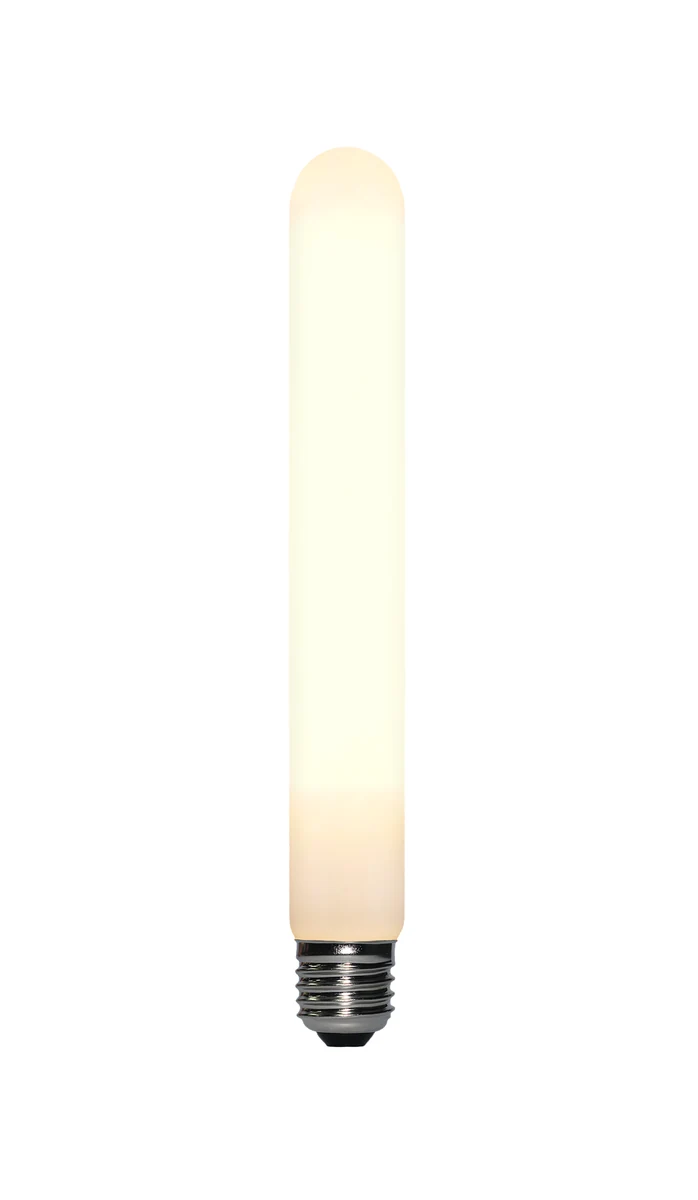
Long forms deserve their own check. When evaluating Edison tubular LED bulbs, confirm both the final position and the route needed to withdraw the full length. Substituting a narrower tube may solve one opening problem while leaving the axial-space problem unchanged.
Run a Serviceability Review Before the Purchase Order
Use the final fixture configuration, not just an exposed lampholder. Include the shade, retaining parts and representative installation obstructions. A safely arranged mock-up can reveal access problems without conducting an improvised trial at height.
The following is a recommended procurement review, not a certified test method or a report of tests already performed by HongYu.
| Review step | Evidence to retain | Reason to hold approval |
|---|---|---|
| Identify the configuration | Lamp SKU and drawing revision; fixture model and revision; installation arrangement | The sample cannot be tied to the intended production configuration |
| Confirm the permitted procedure | Current fixture instructions, service-removable parts and required tools | Servicing depends on an undocumented workaround |
| Demonstrate removal and insertion | A continuous sequence showing the installed starting state, full withdrawal, replacement and reassembly | The task works only before a non-service-removable part is assembled |
| Check handling and surroundings | Access assessment, representative obstructions and support needs for removed parts | The operator must force the glass, strain the fitting or use an unapproved tool |
| Record restoration | Covers, retaining parts and any specified seals correctly restored; required post-service checks | The fixture cannot be returned to its specified condition |
Follow the manufacturer's isolation and cooling instructions. Use competent personnel and a suitable access arrangement; stop if the task involves damaged components or unexpected access to wiring. A bulb-fit exercise is not authorization to modify a luminaire.
A continuous video is useful because still photographs can omit the difficult transition between two positions. Record what the demonstration covers and what it does not. One prototype does not establish that every production unit at the dimensional limits will behave identically.
Review the worst relevant combination of agreed lamp and fixture tolerances. If the margin is tight, ask the responsible engineering team to define how drawings, boundary-condition checks and production inspection will control it. Do not invent a universal sample count or a clearance threshold from a single successful trial.
Maintenance Cost Is Not the Price of the Spare Bulb
The economic consequence becomes clearer when replacement is counted as a task rather than a part.
For planning, separate the replacement lamp, hands-on labor, access-equipment setup, area preparation, reinstatement and disruption. Avoid double-counting setup if several lamps are replaced during one planned visit.
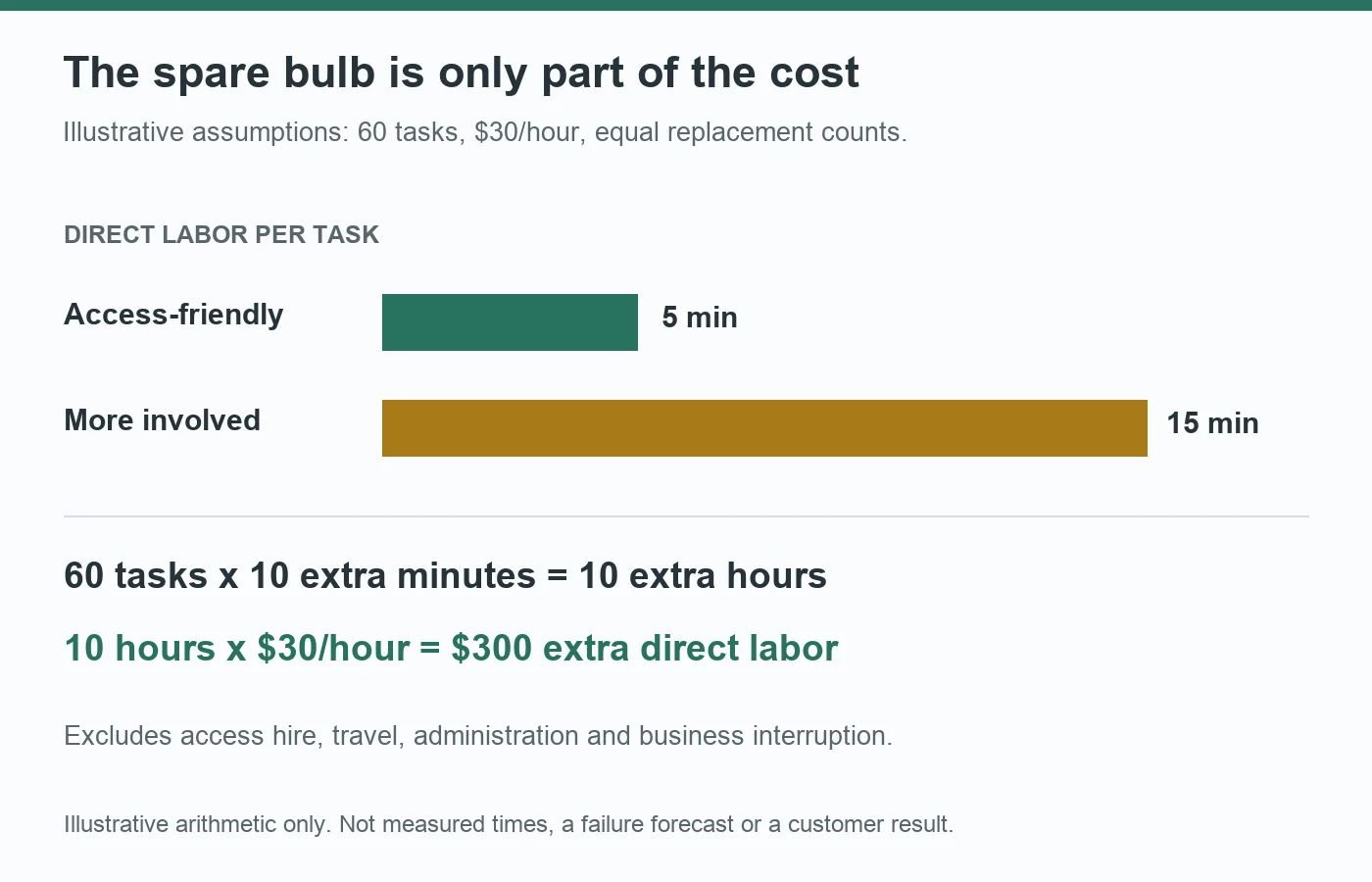
Here is an illustrative calculation, not a HongYu customer case or a forecast of lamp failures. Suppose a project has 60 individual replacement tasks during its chosen planning period. An access-friendly arrangement takes 5 minutes of direct labor per task; another takes 15 minutes. At an assumed labor cost of $30 per hour:
60 tasks × (15 − 5) minutes ÷ 60 × $30/hour = $300 additional direct labor.
That comparison assumes the same number of replacement tasks. It says nothing about which bulb lasts longer. It also excludes access hire, travel, administration and business interruption. Replace these assumptions with a site trial and the operator's actual costs.
For elevated installations, assess the access method separately from the lamp's geometry. HSE's UK guidance places avoidance of work at height first, followed by preventing falls and then limiting their consequences where necessary. It does not make a ladder the default solution for every lighting task; local requirements and the actual work remain decisive.[3]
Buyer judgment 4: Compare the cost of a completed replacement task, not only the replacement lamp. A small purchase-price saving can disappear when the servicing method adds labor or disruption.
Make the Approved Replacement Specific
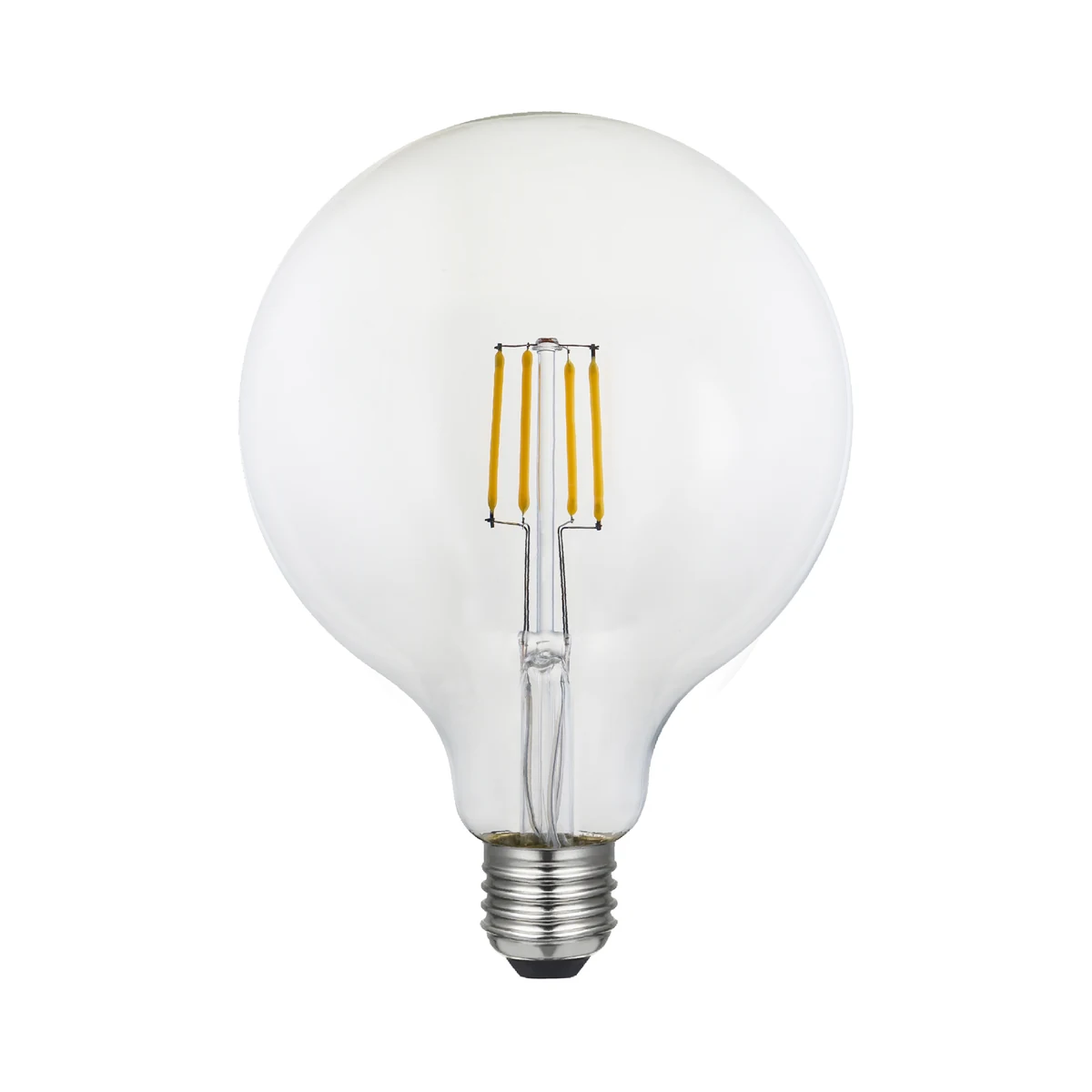
An alternative lamp can share the original base and nominal wattage yet have a different shoulder, overall length or surface that changes practical handling. Treat those differences as reasons to revisit service fit, alongside the separate electrical, thermal and lighting checks.
Changing from clear glass to a porcelain-finish filament bulb may be appropriate for the intended appearance, but finish is not a serviceability approval. Confirm the exact envelope and permitted handling rather than assuming that a visually similar catalog item behaves identically.
Keep a compact handover record:
- Approved lamp SKU, revision, dimensions and tolerances.
- Fixture model, revision and installation constraints.
- Permitted replacement procedure and required tools or removable parts.
- Responsible service personnel and the site's access plan.
- Accepted replacement alternatives and the checks supporting each one.
- A reference to the demonstration record and its limitations.
Suggested wording for a purchase specification:
The proposed lamp shall be removable and replaceable in the specified installed luminaire using its documented service procedure, without damage or unauthorized modification. The approval record shall identify the lamp and luminaire revisions, relevant dimensional limits, permitted disassembly, required tools and installation constraints. Alternatives affecting those conditions require review before use.
Adapt this clause with the fixture supplier; it is proposed commercial wording, not a claim of compliance with a particular standard.
Buyer judgment 5: Stock an approved replacement configuration, not merely another bulb with the same base. The spare is useful only if it preserves both application suitability and the service route.
Conclusion
“It fits” should mean more than a bulb sitting neatly inside a shade. For a maintainable lighting project, it should mean that the approved lamp can be reached, released, withdrawn and replaced, and that the fixture can be restored using its intended procedure.
Ask for that demonstration while the lamp, fixture and surrounding design can still be changed. The most useful procurement question is simple: show us the complete replacement task with the fixture in its installed condition.
References
- Louis Poulsen, Light Source Guide, Panthella 320 Table entry, printed page 15. Model-specific example of separate diameter and height limits. Check the current guide for the exact fixture and market. Back to text.
- Philips, Safety Instructions, Part B, English section, especially icons 27–33. This is a general icon guide; only the symbols specified for the particular product apply. Back to text.
- UK Health and Safety Executive, Introduction to Working at Height Safely. Guidance on planning and the hierarchy of controls, not product-specific bulb replacement instructions. Back to text.