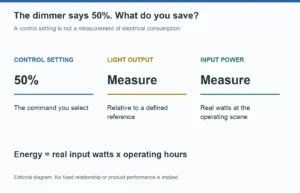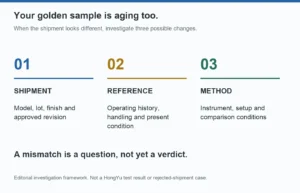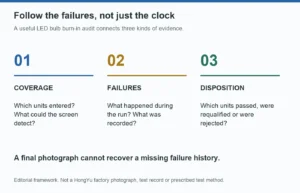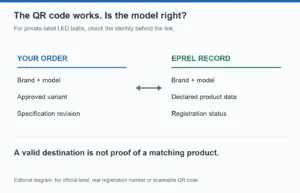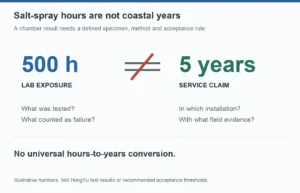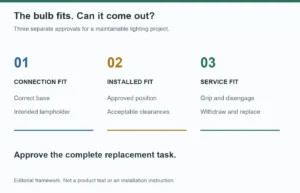
Featured image: Original editorial diagram. This is a recommended review framework, not a photograph or record of HongYu factory testing.
A factory sends a video of hundreds of LED bulbs glowing on an aging rack. The quotation promises burn-in before shipment. The purchasing team asks whether the test runs for eight hours, twenty-four hours or longer.
There is a better first question: What happens to a bulb that fails halfway through?
If that bulb is removed, repaired and returned without a traceable record, the final photograph can look perfect while the process remains difficult to evaluate. A long test with missing failure history may tell a buyer less than a well-defined screen with accountable results.
For importers and private-label brands, a useful burn-in review follows three things: the units entering the screen, the defects it can actually detect, and the disposition of every unit that does not pass first time. Duration matters, but only inside that framework.
1. Define What the Factory Means by "Aging"
The word can describe several different activities. Running a production batch to screen for early faults is not the same as measuring optical maintenance over time or qualifying a new design against an agreed test programme.
Ask the supplier to state the purpose before debating hours:
- Production screening: identify specified faults in the units being processed before release.
- Design qualification: assess an identified construction against defined requirements and conditions.
- Maintenance testing: measure changes in output, colour or other characteristics over time.
NIST's reliability handbook describes an early-failure region separately from the stable-life and wearout regions in the familiar bathtub model.[1] That model explains why early screening can be useful. It does not establish a universal early-failure period for every LED bulb or prove that a particular screen removes all vulnerable units.
Buyer judgment 1: Approve the purpose and detectable fault list before approving the duration. "Every bulb is aged" is an incomplete process description, not necessarily a false one.
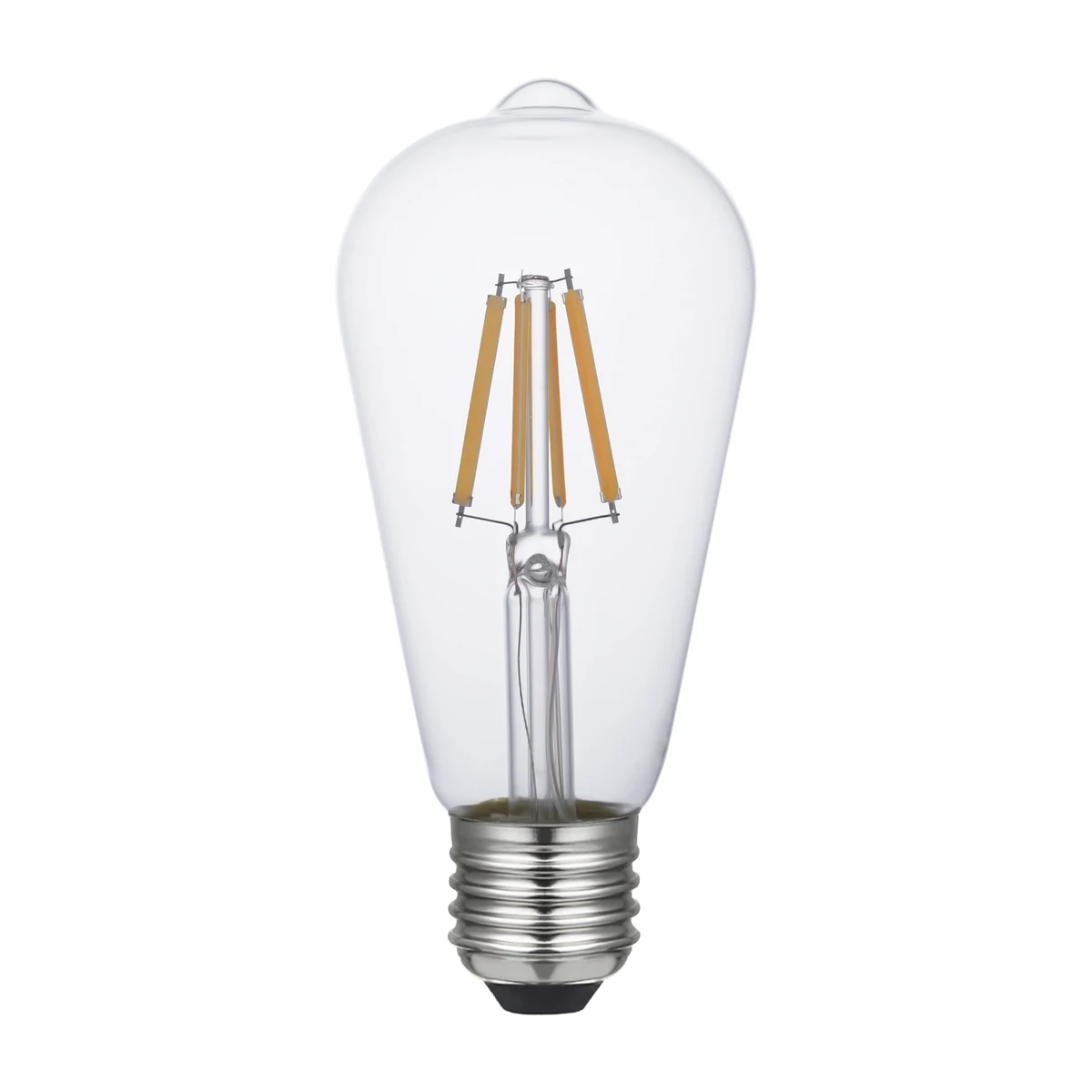
For a model selected from HongYu's EU standard filament bulb range, identify the ordered voltage, wattage, dimming option and production revision in the screening request. A general procedure for the product family needs a clear link to the variant on your purchase order.
2. Reconcile the Units, Not Just the Hours
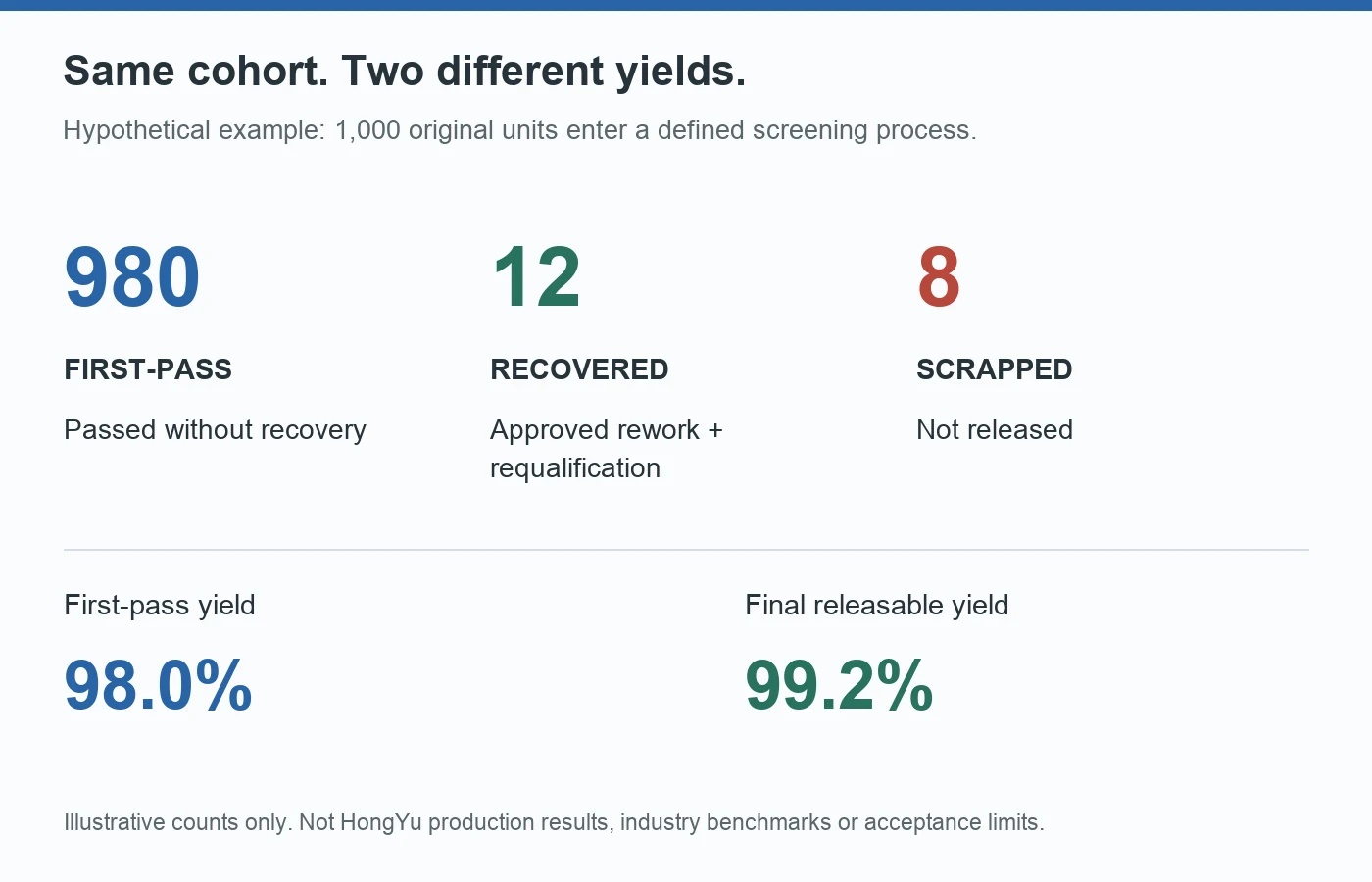
Start with one closed screening cohort: a defined group of units entering a specified process during a recorded period. Then request the numbers entering, passing first time, failing, entering approved rework, passing requalification, being scrapped and remaining on hold.
A simple example shows why these distinctions matter. The following figures are hypothetical, not HongYu production data, a customer case or an industry benchmark.
| Outcome for the original 1,000 units | Units | Interpretation |
|---|---|---|
| Passed the screen first time | 980 | No failure or rework within the defined screening process |
| Failed first time, then passed approved rework and requalification | 12 | Eligible for release only if rework is permitted and all required checks pass |
| Failed and were scrapped | 8 | Not released |
| Still on hold | 0 | No unresolved units in this example |
| Final releasable total from this cohort | 992 | 980 first-pass units plus 12 recovered units |
The first-pass yield is 980 / 1,000 = 98.0%. The final releasable yield is 992 / 1,000 = 99.2%. Twenty original units failed the screen on their first attempt, even though only eight were ultimately scrapped.
ASQ defines first-pass yield around units completing a process without reruns, retesting, rework or similar recovery activity.[2] Define your own process boundary clearly: planned checks belonging to the normal sequence are not the same as an extra test used to recover a failed unit.
Do not add the table's summary row to the outcome rows. Do not count the twelve repaired lamps as twelve additional new units. If replacement lamps are introduced to complete a shipment quantity, track their screening history separately rather than quietly changing the original denominator.
Buyer judgment 2: Request first-pass results and final disposition separately. A high final yield can coexist with substantial repair activity; neither number alone tells the whole story.
3. More Stress Is Not Automatically a Better Screen
Two racks running for the same number of hours can expose bulbs to different conditions. Supply voltage, airflow, spacing, orientation, ambient temperature and control state all belong in the procedure. A crowded rack and a sparsely loaded rack should not be assumed equivalent without checking the relevant conditions.
This does not mean every production bulb requires a dedicated temperature sensor. It means the supplier should explain how the setup is qualified, how representative positions are checked, and which operating variables are controlled or recorded.
NIST defines physical acceleration in terms of the same failure processes occurring faster under increased stress, and notes that different failure mechanisms generally have different acceleration factors.[3] An unexplained statement that one day on a hot rack equals several years in service is therefore not an adequate reliability argument.
Nor should a buyer instruct a factory to increase temperature or voltage arbitrarily. A suitable screen needs engineering justification, including consideration of damage or life consumption in otherwise acceptable units. Any stress testing should be performed by qualified personnel using a controlled, electrically safe setup, not improvised on a retail lighting circuit.
For EU dim-to-warm bulbs, distinguish full-power screening from checks of the dimming and colour response. A lamp can remain illuminated at full power without that observation establishing acceptable behaviour at the intended reduced-light settings. Agree which checks are production controls and which remain application qualification.
Buyer judgment 3: Do not rank screens by hours or temperature until the configurations and detection goals are comparable. A harsher condition needs evidence, not automatic approval.
4. Ask What the Screen Would Miss
"All bulbs were on at the end" is an endpoint observation. It cannot establish that every unit remained stable throughout the run.
Ask how intermittent extinguishing, visible instability, delayed startup and other relevant symptoms are detected. Continuous monitoring and periodic manual observations provide different coverage. Neither should be described as the other in the report.
Agree the observation interval and acceptance criteria in advance. If startup is a concern, define when startup is checked. If the requirement concerns light-output or colour change, define the measurement method and comparison conditions. Avoid treating a normal brightness change during thermal settling as a defect without an appropriate measurement procedure.
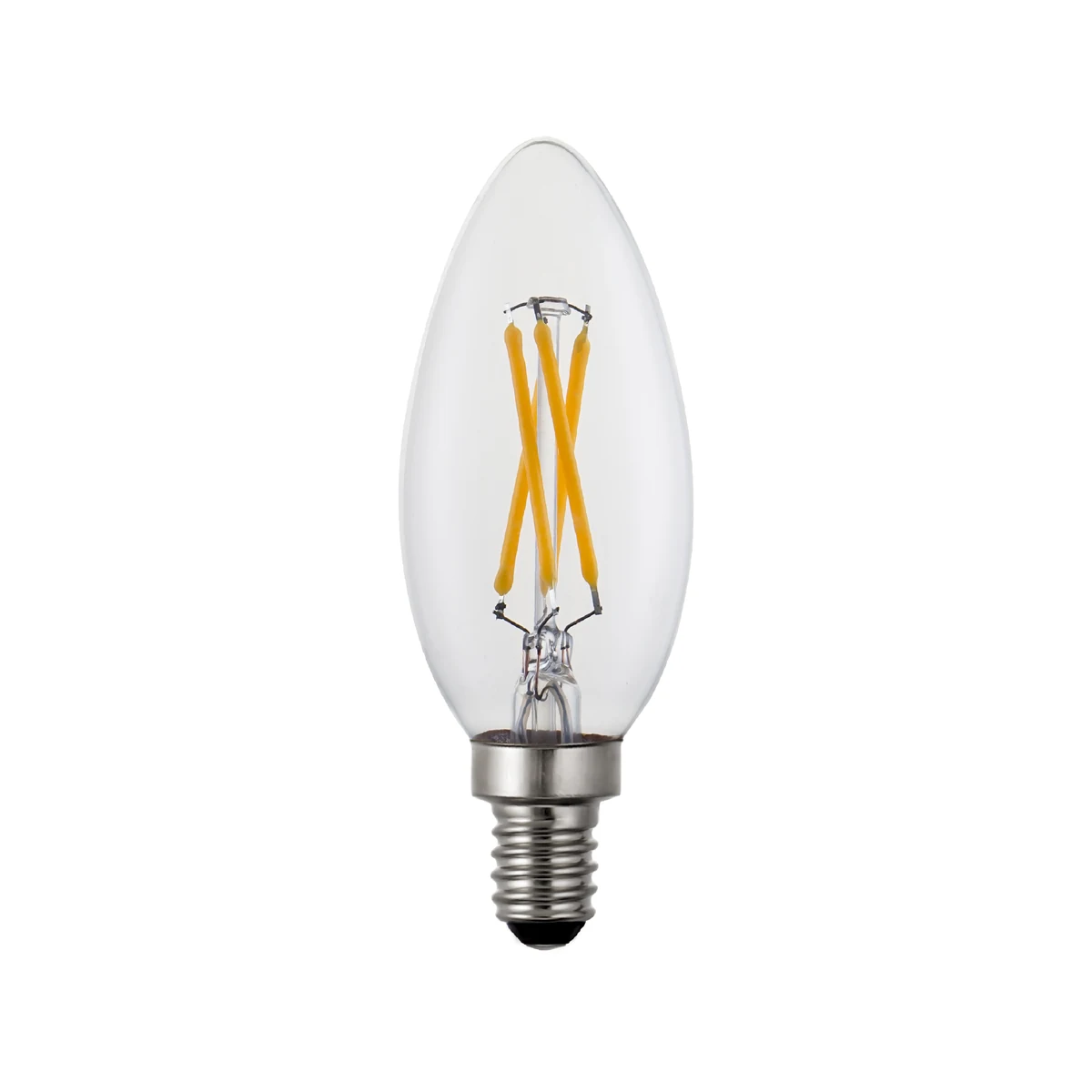
Appearance can also hide the observation you are trying to make. With a product from the EU porcelain filament bulb range, an opaque finish limits what can be seen of the internal construction. The check should address finished-lamp behaviour instead of relying on a view of individual filaments.
A practical audit asks the operator to explain an actual recorded exception: what was observed, when, which position was involved, whether the supply was present, and what happened next. A rack-supply interruption must not be confused with a simultaneous failure of every lamp. Conversely, a lamp that restarts should not have its earlier fault erased.
Buyer judgment 4: Retain intermittent faults and test interruptions in the record. A clean final snapshot must not overwrite a more complicated test history.
5. Close the Failure Loop Before Returning a Unit to Stock
The most revealing part of a factory review may be the route between the aging rack and the packing line.
Request a demonstration of how a failed lamp is identified, segregated, evaluated and dispositioned. Traceability can use serial numbers, tray/position records, batch travellers or another controlled method appropriate to the operation. The important question is whether the failure remains linked to the affected unit or controlled group, not whether the factory owns a particular software system.
Where rework is allowed, ask what was changed, who authorised it and which checks must be repeated. If the repair could affect electrical safety, mechanical integrity or the approved construction, a brief "lights again" check is not enough to justify release. The responsible technical team must define the necessary requalification. Some assemblies may be unsuitable for rework and should be scrapped instead.
These are recommended purchasing controls, not claims about an existing HongYu factory procedure or universal permission to repair finished lamps.
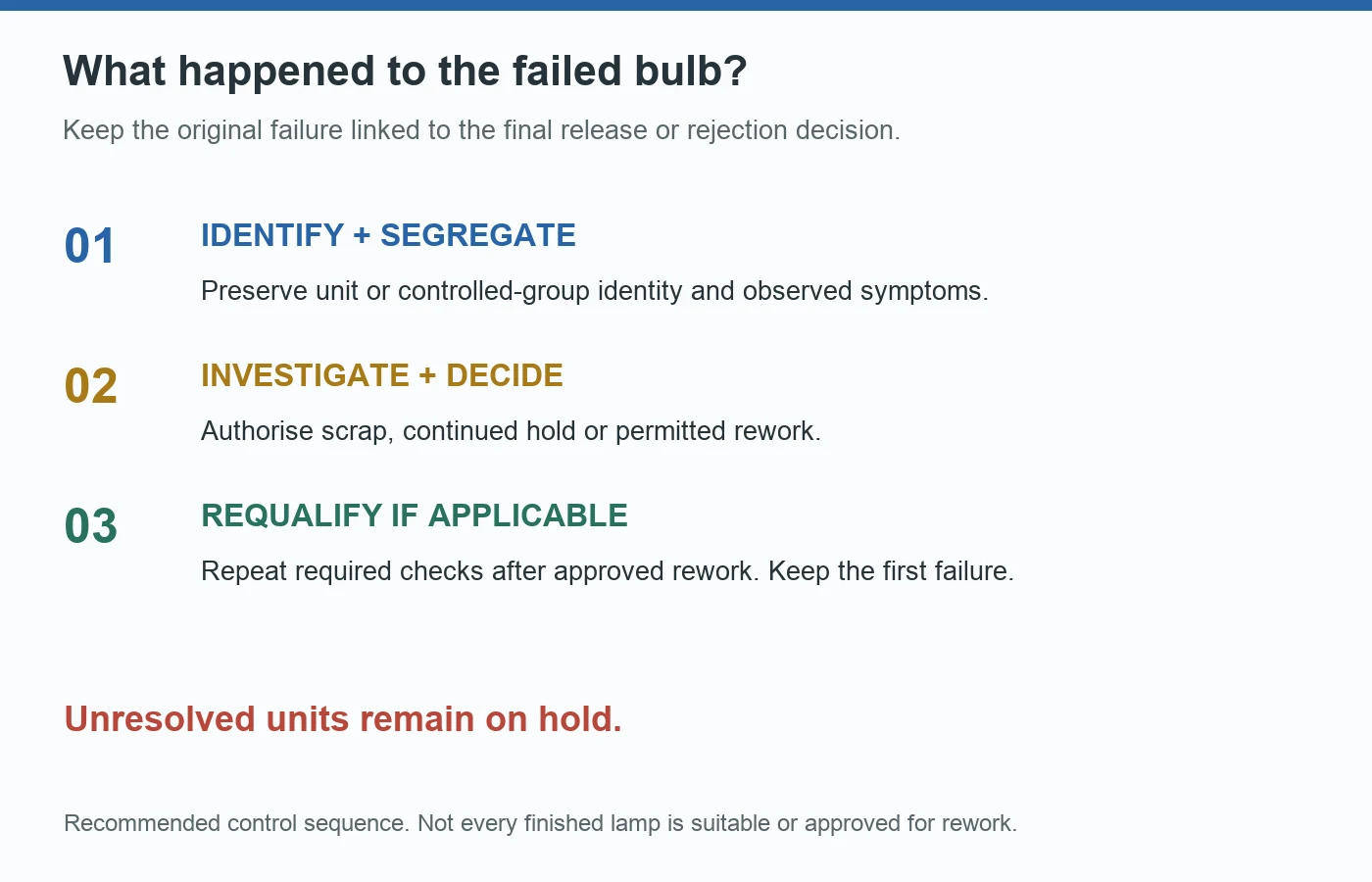
Repeated defects also deserve action beyond sorting individual units. A cluster tied to one production period, rack position or assembly revision should trigger investigation of both the product and the test setup. Replacing failed units until a batch looks acceptable does not resolve the cause of the failures.
Buyer judgment 5: Follow one failed unit all the way to its final disposition. If the trail stops at "repaired," the evidence needed for release is incomplete.
6. Use a Release Record That Someone Else Can Audit
The following is a suggested commercial checklist, not a standard-mandated form. It makes a screening claim inspectable without prescribing a universal duration, temperature or allowable failure percentage.
| Record field | Evidence to request | Reason to hold the screening sign-off |
|---|---|---|
| Identity and coverage | Model/revision, lot, quantity entering and whether coverage is full or sampled | Test population cannot be linked to the order |
| Method | Procedure revision, purpose, conditions and actual completed exposure | Quoted duration is recorded, but actual run history is unknown |
| Detection | Fault definitions, observation method and checkpoints | Pass means only that remaining lamps illuminated at the last check |
| Exceptions | Unit or controlled-group identity, symptoms, timing and interruptions | Failed units disappear from the record |
| Disposition | First-pass results, approved rework, requalification, scrap and hold quantities | Counts do not reconcile or recovered units lack release evidence |
| Change and approval | Setup/product changes, responsible reviewer and release decision | An unexplained change bypassed the agreed review |
Treat these as reasons to resolve an evidence gap, not automatic proof that the entire shipment is defective. Safety-related concerns require the applicable escalation and containment process, not negotiation over a cosmetic defect allowance.
A zero-failure run can be legitimate. A higher observed rejection percentage can reflect worse incoming quality, more effective detection, different conditions or inconsistent recording. Compare like-for-like cohorts and investigate patterns; do not reward a supplier merely for rejecting more bulbs or reporting fewer failures.
7. Keep the Lifetime Claim in a Separate Evidence File
When the discussion returns to a claimed operating life, request evidence appropriate to that claim rather than multiplying burn-in hours.
IES LM-84 addresses measurement of optical characteristics over time at the lamp, light-engine or luminaire level.[4] IES TM-28 addresses projection of long-term luminous-flux maintenance for LED lamps and luminaires.[5] The public descriptions establish their purposes; the applicable editions and full methods are needed when reviewing an actual report.
Neither title turns a production aging video into a lifetime demonstration. Nor does a luminous-flux projection by itself establish freedom from every electrical, mechanical or application-related failure.
For an RFQ, use a direct request:
Please separate the production screening procedure from design qualification and lifetime evidence. For the proposed screening process, identify the model/revision, intended defects, operating conditions, coverage, observation method, failure records and disposition controls. Provide a representative completed record with commercially sensitive customer details removed, and state what evidence will accompany our order.
Conclusion
The strongest burn-in evidence is not the brightest rack photograph or the largest hour count. It is a coherent record connecting the ordered product, the applied screen, the failures observed and the decision to release each unit or controlled group.
Ask how the process detects faults, preserves their history and prevents unresolved units from returning to stock. Then assess duration as one part of an engineered procedure, while keeping long-term performance claims separate.
Before accepting "100% aged before shipment," ask: Can you show what happened to the units that did not pass the first time?
References
Primary-source pages reviewed on 27 September 2026. NIST and ASQ provide general reliability and quality principles, not LED-bulb-specific screening thresholds. IES links are public scope descriptions, not substitutes for the full standards.
- NIST/SEMATECH, The Bathtub Curve. Early-failure, stable-life and wearout concepts. Back to text.
- American Society for Quality, Quality Glossary: First Pass Yield. Distinguishing first-pass completion from recovery activity. Back to text.
- NIST/SEMATECH, What Is Physical Acceleration and How Do We Model It?. Mechanism-specific stress acceleration. Back to text.
- Illuminating Engineering Society, ANSI/IES LM-84-20+E1: Measuring Optical Radiation Maintenance of LED Lamps, Light Engines, and Luminaires. Public scope description. Back to text.
- Illuminating Engineering Society, ANSI/IES TM-28-20: Projecting Long-Term Luminous Flux Maintenance of LED Lamps and Luminaires. Public scope description. Back to text.