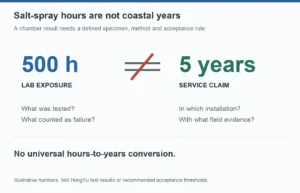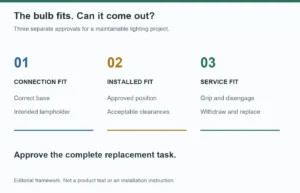
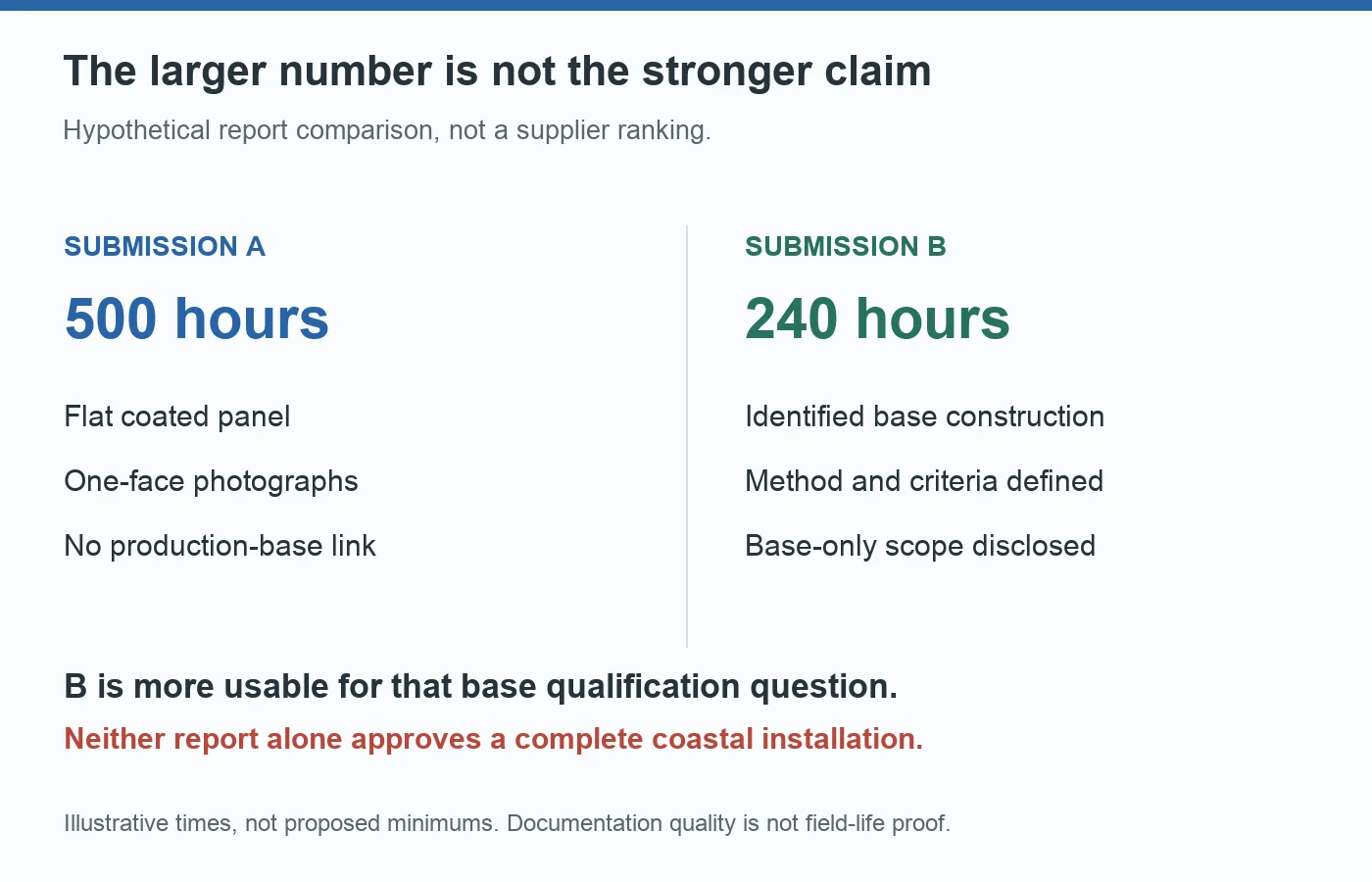
Featured image: Original editorial diagram. The numbers illustrate an unsupported conversion, not a HongYu test result or an acceptance threshold.
A supplier offers a decorative LED bulb with a reassuring line in the quotation: “500 hours salt-spray tested.” For a seaside restaurant or a coastal hotel, that sounds like a useful reason to choose it.
But what spent 500 hours in the chamber: a flat coated panel, an empty screw base, a complete bulb, or the bulb installed in its intended lampholder? What counted as failure? Was electrical safety assessed afterward, or did someone simply photograph the surface?
Those questions determine what the result can support. The hour count alone does not.
Salt-spray evidence can help qualify a defined material, process or assembly under specified conditions. It does not provide a universal conversion from chamber hours to years beside the sea. The 500-hour and five-year figures in this article illustrate a claim boundary; they are not HongYu test results or a recommended acceptance threshold.
First Separate Three Claims That Sound Similar
“The plating process passed our corrosion screen,” “the lamp assembly passed the agreed environmental evaluation,” and “this installation will last five years” are different statements.
| Claim | Evidence needed to support the stated scope | What must not be inferred automatically |
|---|---|---|
| A coating process meets its specification | Identified substrate and coating system, controlled specimens, defined exposure and evaluation criteria | That every finished component has the same result |
| An assembly meets a corrosion requirement | Identified assembly, relevant configuration, agreed method and post-exposure checks | Suitability for every socket, enclosure or installation |
| A product has a stated coastal service life | Application-relevant durability evidence and a justified relationship to service conditions | A life estimate derived only from chamber hours |
ASTM B117 describes a controlled salt-fog environment. Its published guidance cautions that standalone results have rarely correlated with natural-environment performance, and that extrapolation needs corroborating long-term atmospheric exposure evidence.[1]
The purchasing implication is not to discard salt-spray testing. It is to stop asking one test to answer a different question.
Buyer judgment 1: Accept a salt-spray result only for its documented purpose. Do not rewrite a process-screening result as an outdoor lifetime promise.
Ask What Was Exposed, Not Just How Long
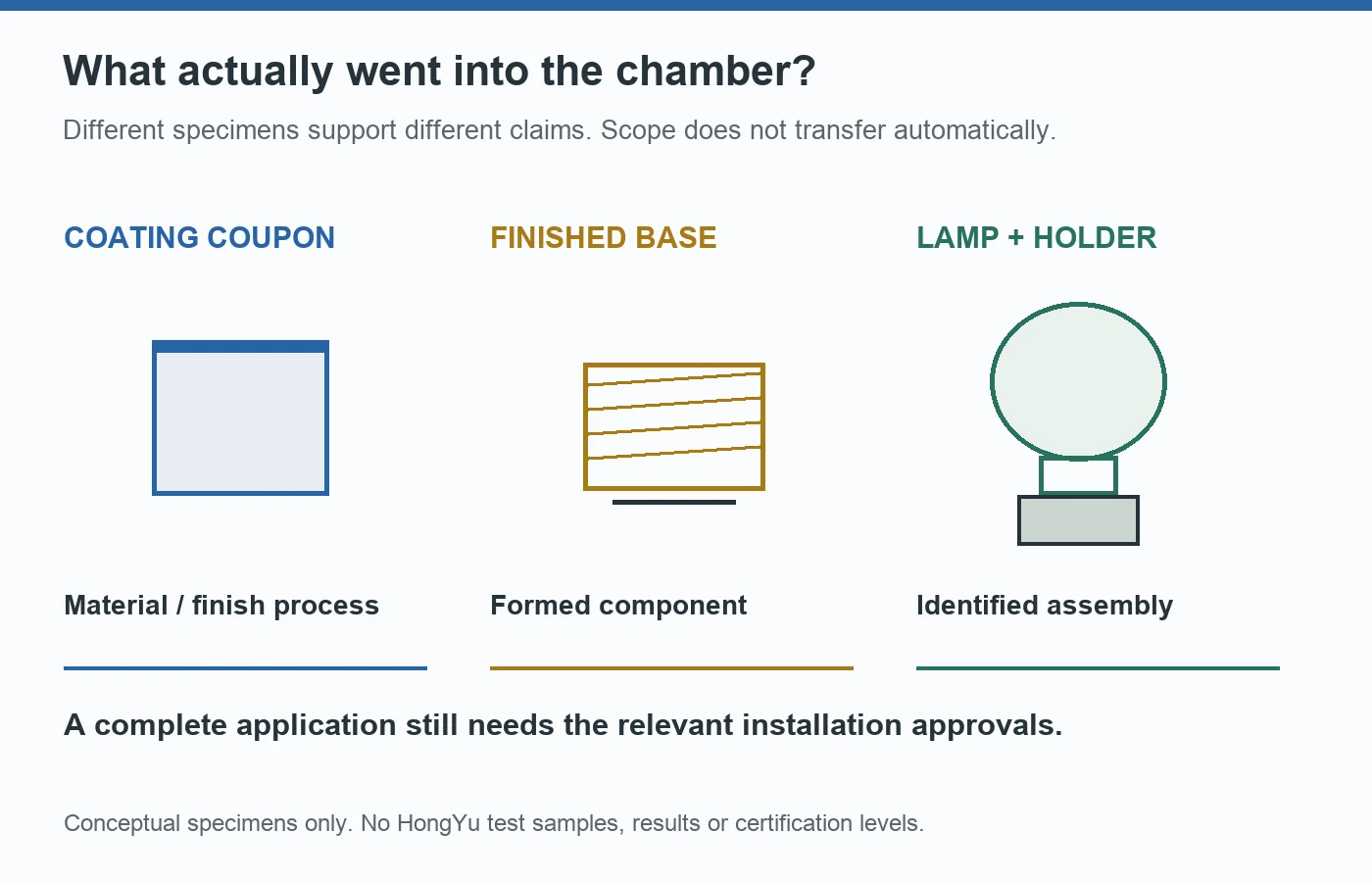
A flat coating coupon can be useful for monitoring a finishing process. It does not reproduce a formed screw thread, a seam, an assembled contact or the glass-to-base joint.
A finished empty base moves the evidence closer to the purchased part, but it still leaves the rest of the lamp outside the test. Conversely, a whole-bulb result may omit the actual holder and the areas shielded or exposed when the bulb is installed.
None of these specimens is inherently wrong. The error is failing to connect the specimen to the claim.
For an item selected from the EU standard filament bulb range, ask the supplier to identify the base substrate, surface-treatment specification and production revision in the qualification record. Do not infer them from the E27 designation or a silver-colored product photograph.
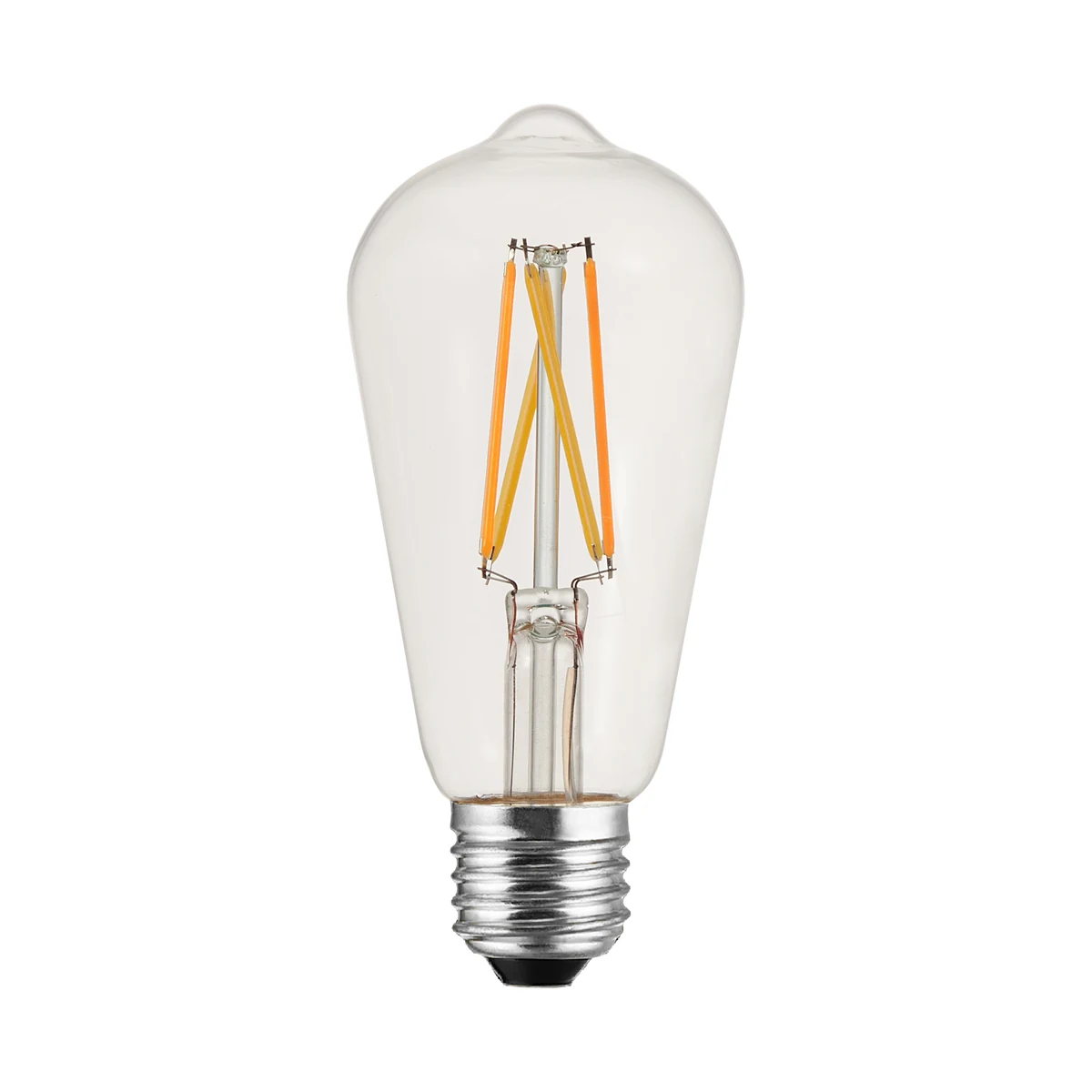
For an assembly-level claim, record the intended holder, mounting orientation, protective enclosure and any specified sealing arrangement. Ask which surfaces were exposed, masked or excluded from evaluation. These are part of the test definition, not minor photographic details.
Buyer judgment 2: A coupon report can support a coating decision. It cannot, by itself, approve the lamp-and-holder interface. Request the missing evidence or narrow the claim to the specimen actually tested.
“Salt Spray” Is Not a Complete Test Specification
A quotation should name the method and edition, not just the chamber time.
ISO 9227 covers neutral salt spray, acetic acid salt spray and copper-accelerated acetic acid salt spray. Its public scope leaves product-specific specimens, exposure periods and interpretation to the relevant specification. It also warns against using these tests to rank different materials for corrosion resistance or predict long-term resistance.[2]
That means a buyer should not create a universal league table in which the material with the longest salt-spray time is automatically best for the coast. The substrate, coating system, exposure and failure criterion all matter.
Cyclic salt-mist testing is another category. IEC 60068-2-52 addresses components or equipment intended to withstand salt-laden atmospheres and includes defined cyclic methods.[3] A report under that standard cannot be reduced to a continuous salt-fog hour count and compared as if the exposures were identical.
Do not prescribe “the harshest test” by default. Ask the responsible engineer or laboratory why the selected method answers the intended qualification question. More severe exposure is not automatically a better representation of the failure mechanism that matters to the application.
Buyer judgment 3: Do not rank suppliers by hours until the method, specimen, preparation and acceptance criteria are comparable. Even comparable chamber results do not automatically establish a ranking of field life.
Write the Failure Definition Before Testing Starts
“No visible rust” can be a legitimate criterion for a particular surface. It is not a complete requirement for every lamp base or assembled electrical interface.
Ask what the test is meant to protect: decorative appearance, coating integrity, mechanical function, electrical connection or safety. Then agree how each relevant outcome will be evaluated.
| Outcome to control | What to specify in the test plan | What a photograph alone cannot establish |
|---|---|---|
| Appearance | Evaluated areas, lighting and viewing conditions, defect categories and permitted extent | Whether unpictured areas meet the same requirement |
| Surface protection | Substrate and coating identity; which discoloration, deposits, blistering or substrate attack count | Coating thickness or condition beneath an intact-looking surface |
| Mechanical function | Relevant fit or serviceability check, procedure and agreed limits after recovery | Whether the assembled interface remains functional |
| Electrical performance and safety | Applicable post-exposure assessments, limits and responsible laboratory | Safe insulation or reliable connection merely because the lamp lights |
These are recommended planning categories, not universal test limits. Let the applicable product requirements and qualified technical team determine the measurements and thresholds.
The timing of evaluation also belongs in the plan. Record the specified recovery, cleaning and drying steps and when photographs and measurements were taken. Do not allow undocumented polishing or cleaning to substitute for an agreed assessment.
Do not improvise a powered salt-fog demonstration or energize a wet, salt-contaminated sample to “see whether it still works.” Exposure state and subsequent electrical checks must be defined and performed under an appropriate laboratory safety procedure.
Buyer judgment 4: “Still lights up” and “looks clean” are observations, not complete corrosion acceptance criteria. Decide which functions and safety requirements need evidence before commissioning the test.
The Higher Hour Count Can Be the Less Useful Report
Consider two hypothetical submissions for the same sourcing project. This is a document-review example, not a HongYu customer case or a comparison of real suppliers.
Submission A: “500 hours, passed.” The attachment identifies a flat coated panel, gives photographs of one face and provides no link to the production lamp-base drawing.
Submission B: “240 hours under the agreed method.” The report identifies the ordered base construction, specimen quantities, preparation, exposed surfaces, individual observations and predefined acceptance criteria. It also states explicitly that it covers the base only, not the complete lamp.
Submission B is more usable for the documented base qualification question. That does not prove its material is more durable, that 240 hours is enough for the project, or that its lamp is ready for an exposed coastal installation.
The right next step is to identify the evidence gap. If the contract requires an assembled interface evaluation, neither submission satisfies that requirement by itself. Buying A solely because 500 exceeds 240 would confuse the quantity of exposure with the relevance of evidence.
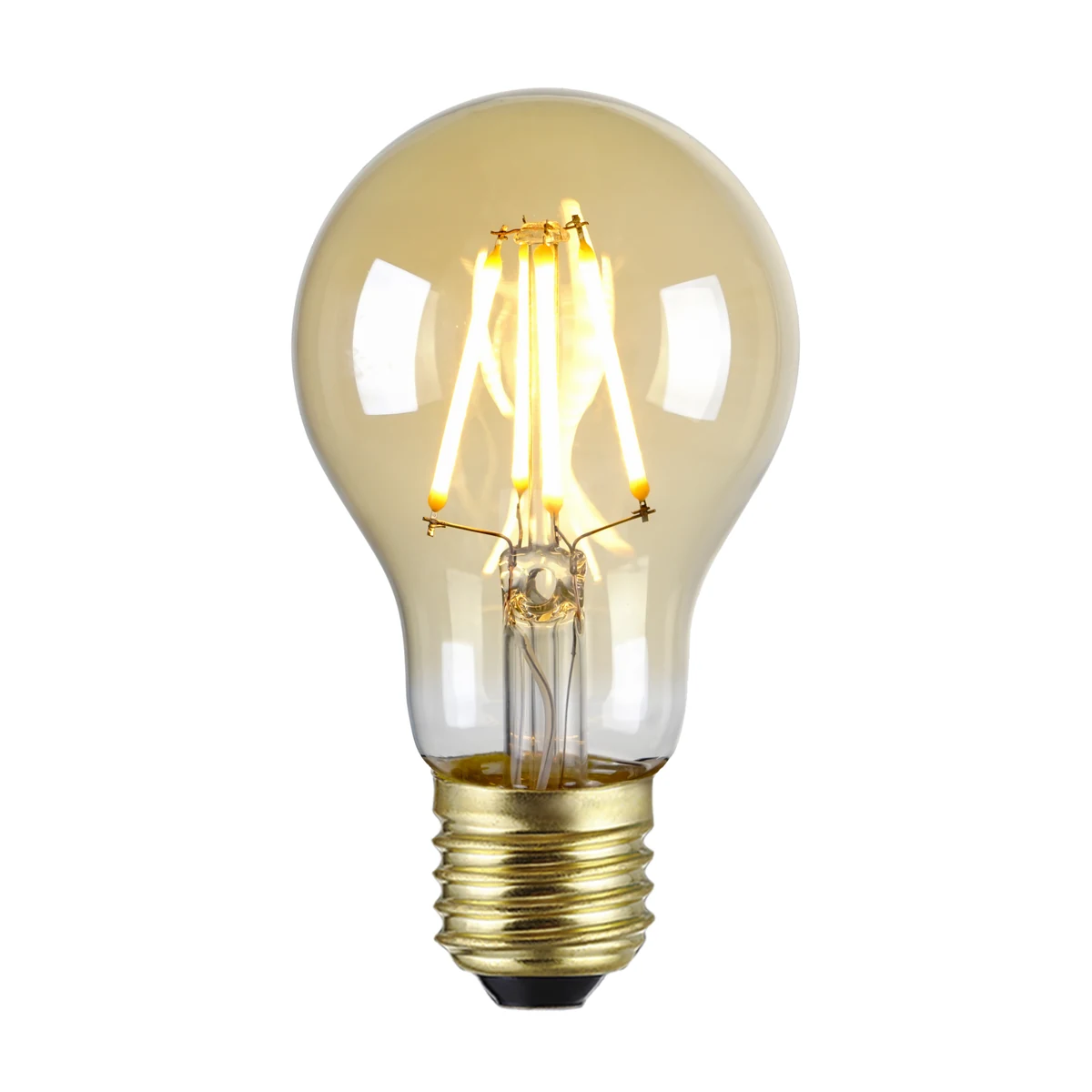
The same discipline applies to finish changes. An amber lamp from the EU vintage straight-filament collection may suit a project's visual brief, but amber glass and a gold-colored base are appearance choices, not evidence of a particular metal or corrosion protection. Confirm the ordered construction rather than carrying an approval across on appearance alone.
An IP Rating Answers a Different Question
IEC 60529 classifies the degrees of protection provided by electrical enclosures.[4] A stated IP code is not a substitute for the corrosion qualification described here, and a salt-spray result does not establish an IP classification.
Likewise, outdoor suitability is not a free extension of a component report. UL Solutions describes outdoor line-voltage luminaire evaluation as including the applicable wet-location requirements under UL 1598.[5] That is a separate assessment scope, not something a bulb-base salt-spray photograph establishes.
When reviewing US clear filament bulb models, confirm the exact lamp's markings, certification scope and permitted application together with the luminaire instructions. Listing a product family here is not a recommendation to expose every model to rain or coastal spray.
Buyer judgment 5: Keep corrosion evidence, enclosure protection and installation suitability as separate approval lines. Passing one does not fill in the other two.
Put the Evidence Request Into the RFQ
Before requesting a longer test, give the supplier an application brief: location, shelter, likely salt exposure, direct wetting, intended fixture, holder, orientation, cleaning practices and maintenance conditions. Distance from the shoreline alone is not a complete description of exposure.
Then request a corrosion evidence package with the following items:
- Claim and scope: the exact property being qualified and any proposed coastal-use statement.
- Construction: substrate, coating system, relevant drawing or process revision and sample-to-production relationship.
- Method: standard and edition, selected method, duration or cycles, preparation, configuration and documented deviations.
- Evaluation: specimen count, individual results, recovery procedure, assessed areas, failure definitions and relevant post-exposure checks.
- Limits: what was not tested, which configurations are excluded and whether any field-life correlation is actually supported.
Useful proposed purchase wording is:
Corrosion qualification shall identify the tested construction and configuration, exposure method, specimen preparation, duration or cycles, and agreed evaluation criteria. Reports shall state the scope and limitations of the result. Salt-spray exposure time shall not be represented as an equivalent outdoor service life without supporting application-relevant evidence.
This is a recommended procurement clause, not a standard-mandated form. Agree its details with the supplier and testing laboratory.
A warranty should also state what it covers. Lamp replacement, visible finish changes, labor and access costs are not necessarily the same commercial commitment. Read the terms rather than assuming that a test report creates warranty coverage.
Conclusion
Salt-spray testing is valuable when the buyer knows what question it answers. It becomes misleading when the hour count is detached from the specimen, method, acceptance rule and application.
For coastal decorative lighting, approve a defined construction against a defined requirement, and keep unsupported lifetime conversions out of the quotation. The better purchasing question is not “How many hours?” It is “What does this result allow us to claim about the product we are actually buying?”
References
- ASTM International, ASTM B117-26: Standard Practice for Operating Salt Spray (Fog) Apparatus, public Scope and Significance and Use. Supports the limitations on standalone field-performance extrapolation. Back to text.
- ISO, ISO 9227:2022: Corrosion Tests in Artificial Atmospheres, Salt Spray Tests, public abstract. Describes NSS, AASS and CASS, product-specific interpretation and limitations on material ranking and long-term prediction. Back to text.
- IEC, IEC 60068-2-52:2017: Test Kb, Salt Mist, Cyclic, public scope. Describes cyclic testing for components or equipment intended for salt-laden atmospheres. Back to text.
- IEC, IEC 60529, Consolidated Edition 2.2: Degrees of Protection Provided by Enclosures, IP Code, public scope. Back to text.
- UL Solutions, Landscape and Outdoor Lighting, line-voltage luminaire evaluation and applicable wet-location requirements. Back to text.