Choosing the wrong LED filament bulb supplier costs more than just the price of a bad shipment. It costs you customer returns, damaged relationships with your buyers, and the time and capital spent on a replacement sourcing cycle. The factory evaluation process — done properly before any money changes hands — is the highest-leverage activity in wholesale LED procurement.

This guide walks through the evaluation framework used by experienced importers: what to verify, what to ask, and which answers signal a trustworthy manufacturer versus a trading company or assembly workshop.
Step 1: Confirm You're Talking to the Actual Manufacturer
A significant portion of "factories" on B2B sourcing platforms are trading companies that resell products assembled elsewhere. Trading companies are not inherently bad — they sometimes offer better flexibility on small orders — but they cannot provide manufacturer-level quality control, and their prices include an extra margin layer.
To verify manufacturer status:
- Ask for the Business License (营业执照) and check whether the registered business scope includes manufacturing (制造)
- Request a factory video tour — a real manufacturer will have production lines, inspection stations, and raw material storage visible
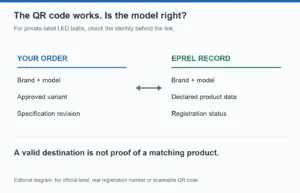
- Ask for the ETL listing number or CE test report and cross-check that the manufacturer name on the certificate matches the company you're dealing with
- Use Google Maps satellite view to check whether the address has a factory-scale footprint
Step 2: Verify Certifications Are Current and Applicable
Certificates expire, get transferred between products, or get applied to products they don't actually cover. Do not accept a certificate at face value.
- ETL: Verify the listing file number on the Intertek online directory. The specific product model should appear in the file.
- CE: Request the Declaration of Conformity and the underlying test reports (LVD, EMC, ErP). The DoC should be signed by a named representative and dated within the past 5 years.
- RoHS: Request the test report, not just a declaration. SGS, TÜV, or Bureau Veritas reports carry more weight than in-house declarations.
If a supplier says "we have CE" but cannot produce the Declaration of Conformity and test reports within 24 hours, that certification does not exist in any meaningful sense.
Step 3: Request Samples and Test Them Properly
Never place a bulk order without testing samples. But testing samples correctly matters — not just "does it turn on."
Run samples through at least the following checks:
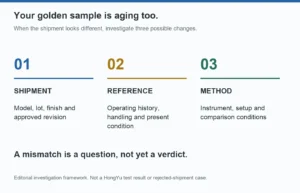
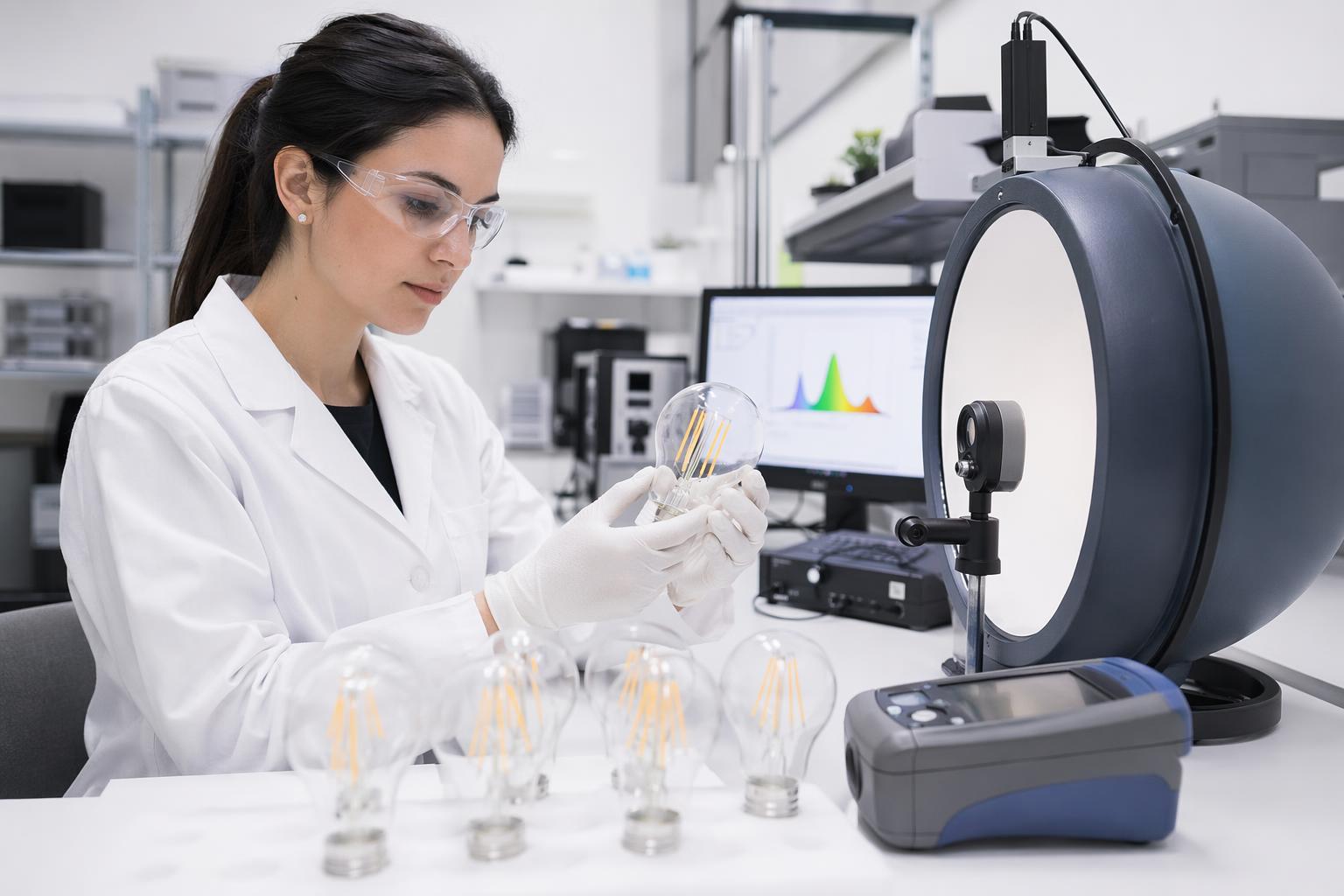
- Lumen output: Measure with an integrating sphere or photometer, or send to a third-party lab. Compare against the specification sheet. More than 15% below spec is a red flag.
- Color temperature: Check with a colorimeter. ±150K variance from the stated CCT is normal; ±300K+ is unacceptable for a premium product.
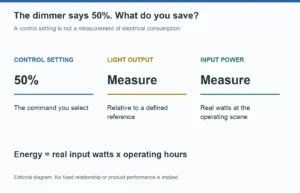
- Dimming behavior: Test with 3–5 different dimmers your customers commonly use. Note minimum dim level, flicker at low levels, and whether the bulb turns off cleanly at the bottom of the dimmer range.
- Heat at the base: After 30 minutes at full brightness, the base temperature should not exceed 65°C. Excessive heat is the primary cause of premature driver failure.
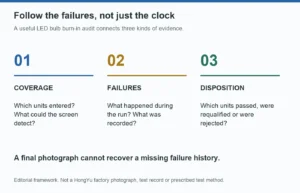
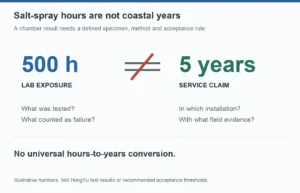
- Long-term burn test: Run a set of 10 bulbs continuously for 500 hours. Track any that fail or exhibit lumen depreciation greater than 10%.
Step 4: Understand the Production Process
Ask your supplier to walk you through how the bulb is assembled. Key questions:
- Where does the LED COB (the filament array) come from? In-house production versus purchased from third parties?
- What is the driver IC brand? (Reputable options include BPSEMI, iWatt, Silergy — generic unmarked ICs are a quality risk)
- What aging test (burn-in) does each bulb undergo before shipment? A minimum of 4–8 hours at full power is standard for quality manufacturers
- What is the production line rejection rate? A healthy rate is 0.5–2%; anything above 5% suggests quality control issues
Step 5: Assess Communication Quality
This sounds soft, but it is a strong predictor of how problems get resolved post-order. Evaluate:
- Response time: Are they replying within 24 hours during business days?
- Specification accuracy: Do they understand and correctly restate your technical requirements back to you?
- Problem acknowledgment: When you raise a concern during sample evaluation, do they engage constructively or become defensive?
A supplier who argues with your test results rather than investigating them will not be a good partner when you need a warranty claim honored six months into a product launch.

Step 6: Start Small Before Scaling
Even after passing all the above steps, make your first production order a trial run — typically 500–2,000 units, not your full annual volume. Inspect this first shipment thoroughly (or hire a third-party QC service in China to do so before it leaves the factory). Use this shipment to verify that bulk production quality matches your samples before committing to a long-term relationship.
Case Study: The Cost of Skipping Factory Evaluation
An Australian lighting importer placed a $47,000 order for 8,000 LED filament bulbs with a new supplier found on a B2B sourcing platform. The supplier's listing showed "CE certified" and provided professional-looking product photos. No factory verification was conducted, no samples were tested beyond a quick visual check, and no third-party inspection was arranged before shipment.
When the container arrived, a customs broker flagged that the CE Declaration of Conformity listed a different product model number than what was shipped — a common sign that the document had been recycled from another product. An independent lab test on 10 units showed:
- Actual lumen output: 38% below stated specification
- Color temperature: 3,400K measured vs. 2,700K stated
- Base temperature after 30 minutes: 78°C (vs. the 65°C safety maximum)
- Driver IC: generic unmarked component with no identifiable manufacturer
The importer could not legally sell the product. They attempted to negotiate a refund with the supplier, who offered a 15% credit on a future order. Total loss including freight, storage, and disposal: approximately $52,000 AUD. The importer has since implemented a mandatory sampling and third-party inspection protocol for all new suppliers.
Frequently Asked Questions
How do I verify an ETL listing without visiting China?
Go to the Intertek product certification directory (available at intertek.com) and search by company name or file number. The listing should show the specific product models covered, the test standard used, and the date of most recent follow-up inspection. If the supplier's company name does not appear, or the listed product models do not match what you are ordering, the certification does not apply to your product.
Should I use a third-party inspection service for my first order?
Yes — for first orders above $5,000–$10,000 USD with any new supplier, a pre-shipment inspection by a service such as SGS, Bureau Veritas, or QIMA is strongly recommended. The typical cost is $250–$400 USD per inspection day, which is negligible relative to the cost of a failed shipment. The inspection covers workmanship, quantity count, packaging, and basic functional testing.
How many samples should I request before placing a bulk order?
Request a minimum of 10 units for preliminary testing, and 20–30 units if you plan to run a burn-in test (500+ hours continuous operation). Also request samples from at least two different production batches if possible — this reveals whether the factory maintains consistent quality across runs, which is more informative than a single-batch sample.
What is a normal defect rate for LED filament bulbs in production?
A well-run LED filament bulb factory should have a production-line defect rate of 0.5%–2% (including aging-test failures). Defect rates above 5% indicate quality control problems that will eventually reach your customers. Ask your supplier for their internal QC data — a professional manufacturer tracks and reports this routinely.
What is the minimum viable burn-in test I can run on samples?
Run 10 units continuously at full power for 168 hours (one week). Measure lumen output at 0 hours and again at 168 hours. A quality LED filament bulb should show less than 5% lumen depreciation over this period. Any unit that fails or shows visible flickering during the test is a signal to reject the bulk order pending investigation.
Browse from HongYu Bulb: US ETL Clear Filament Bulbs → · EU Standard LED Filament Bulbs → · Custom OEM Solutions →
Not sure where to start your supplier search? Read our companion guide: How to Find a Reliable LED Lighting Manufacturer in China →.
Sourcing LED filament bulbs at wholesale? HongYu Bulb is a China-based LED manufacturer supplying wholesalers, importers, and hospitality brands worldwide. Request a quote → or browse our full LED filament bulb range →.
Related HongYu Bulb product pages
- LED Filament Bulb Product Range → — standard and decorative LED filament bulbs for wholesale and project sourcing.
- Big Decorative Bulbs → — oversized decorative filament bulbs for hospitality, retail and statement fixtures.
- Contact HongYu Bulb → — send specifications, target market, quantity and packaging requirements for quotation.