
For decorative LED bulbs, packaging is not a small detail at the end of an order. It is where product quality, shipping risk, retail presentation, warehouse efficiency, and landed cost meet.
This is the main insight many first-time buyers miss: the best packaging is not the strongest box, and it is not the cheapest box. It is the packaging system that matches the bulb's risk, the sales channel, and the logistics route.
A beautiful glass bulb can pass electrical testing and still fail commercially if the packaging creates breakage, scratches, barcode problems, high freight volume, or poor shelf presentation. For importers, wholesalers, lighting brands, and project suppliers, packaging should be discussed before mass production, not after the order is finished.
This guide explains how to choose practical packaging for wholesale decorative LED bulb orders from China.
The buyer's real packaging problem
Most packaging discussions start with unit price. That is too narrow.
For wholesale decorative bulbs, the real question is:
How do we protect a fragile visual product while keeping freight cost, retail needs, and warehouse handling under control?
Decorative bulbs often use clear glass, amber glass, smoky glass, porcelain finishes, mirror coating, custom colors, long tubular shapes, or oversized shells. These are not invisible components inside a fixture. The bulb itself is part of the design value.
Poor packaging can cause:
- Glass breakage during international shipping
- Scratches on coated, mirror, or colored glass bulbs
- Bent pins or damaged bases on small lamps
- Incorrect warehouse picking because labels are unclear
- Retail returns because the box looks weak or unprofessional
- Extra cost from replacement goods, air shipment, and customer complaints
For a buyer, one broken carton is not only the cost of several bulbs. It can also damage trust with a retailer, distributor, designer, or project client.
Factory note: In real decorative bulb orders, packaging problems usually appear in three places: the bulb moves inside the inner box, coated glass rubs against rough material, or the master carton becomes too heavy for normal handling. These are not always visible from the outside of the carton. That is why buyers should ask for inner packaging photos, not only a photo of the closed box.
A simple decision framework: product risk + channel + route
Before choosing white box, color box, window box, or custom packaging, classify the order using three questions.
| Question | Why it matters | Example |
|---|---|---|
| How fragile is the bulb? | Shape, coating, glass size, and base type determine inner protection. | G125, S14d, T30, top mirror, oversized decorative bulbs |
| Where will it be sold or used? | Retail, e-commerce, wholesale, and project orders need different packaging. | Retail shelf needs brand box; hotel project may need strong neutral box |
| How will it travel? | Sea freight, air freight, courier, pallet shipment, and e-commerce parcel delivery have different risks. | A palletized sea shipment differs from single-parcel online delivery |
This framework prevents a common mistake: using one packaging style for every product.
For example, a neutral white box may be enough for a hotel project order of standard clear filament bulbs. But the same structure may not be enough for oversized decorative bulbs sold through retail stores or shipped as individual e-commerce parcels.
From a factory point of view, the packaging decision should be made before the final quotation. Once the buyer changes from neutral packaging to color box packaging, or from palletized sea shipment to courier parcel delivery, the box size, carton quantity, labor process, and shipping volume may all change.
Choose packaging by sales channel
The first practical step is to define the sales channel.
Wholesale and distributor orders
Wholesale customers usually need reliable protection, clear labels, efficient carton sizes, and manageable cost. They may not need expensive full-color retail packaging.
Good options include:
- Neutral white box
- Brown kraft box
- Simple printed box
- Model stickers
- Strong master carton labels
This works well for distributors carrying regular LED filament bulbs, EU standard filament bulbs, US ETL filament bulbs, and mixed inventory for B2B customers.
Project and hospitality orders
For hotel, restaurant, cafe, and commercial interior projects, the buyer often cares less about shelf display and more about installation efficiency.
The packaging should help installers identify:
- Model number
- Wattage
- Voltage
- Base type
- Color temperature
- Dimming type
- Quantity per carton
For project orders using dim-to-warm LED bulbs or porcelain filament bulbs, clear labeling can prevent installation mistakes on site.
Retail and brand orders
Retail packaging has to protect the bulb and sell the product. It may need product photos, brand colors, selling points, barcode placement, warning text, and multilingual copy.
Retail packaging is useful for:
- Lighting stores
- Supermarkets and DIY channels
- Online marketplaces
- Branded bulb collections
- Private label programs
If the buyer sells under their own brand, packaging becomes part of the product experience. A premium decorative bulb in a weak or generic box can reduce perceived value.
E-commerce orders
E-commerce packaging is stricter because parcels are handled individually. A product that survives palletized sea freight may still fail in last-mile courier delivery.
For online sales, buyers should consider stronger inner fixing, tighter void control, and package testing. The International Safe Transit Association explains different test procedures for packaged products, including screening tests, general simulation tests, and parcel delivery testing. Buyers do not need to become packaging engineers, but they should understand that courier shipping needs more than a normal retail box.
Common packaging types for decorative LED bulbs
White box packaging
White box packaging is simple, flexible, and cost-effective. It is often used for wholesale orders, project orders, and first trial orders.
Best for:
- Distributor inventory
- Engineering projects
- Initial sample orders
- Buyers who will re-label goods locally
The advantage is low complexity. The disadvantage is weak retail presentation. If the buyer wants to build a consumer brand, white box packaging may look too generic.
Color box packaging
Color box packaging is suitable when the product is sold directly to consumers or retailers.
Best for:
- Retail stores
- Brand collections
- Marketplace listings
- Product lines with stable long-term demand
Before choosing custom color boxes, buyers should confirm MOQ, printing cost, artwork deadline, proofing process, and whether the same box design can cover several bulb models.
Window box packaging
Window boxes let customers see the real bulb shape and finish. This is useful for decorative products because the appearance is a major selling point.
Best for:
- Vintage LED filament bulbs
- Custom color bulbs
- Top mirror bulbs
- Oversized decorative bulbs
The risk is structural weakness. A window box must still protect the bulb during transport. The visible window should not make the box easy to crush.
Factory note: Window boxes are attractive for retail, but the window should not sit exactly where the glass bulb needs the most support. For globe bulbs, oversized bulbs, and top mirror bulbs, the display opening should be designed around the protection structure, not the other way around.
Blister or clamshell packaging
Blister packaging holds small bulbs firmly and presents them clearly on a hanging display.
Best for:
- G4, G9, MR16, and GU10 lamps
- Small replacement bulbs
- Hardware retail channels
For premium decorative filament bulbs, paper box packaging often looks more refined than blister packaging.
Match inner protection to bulb shape
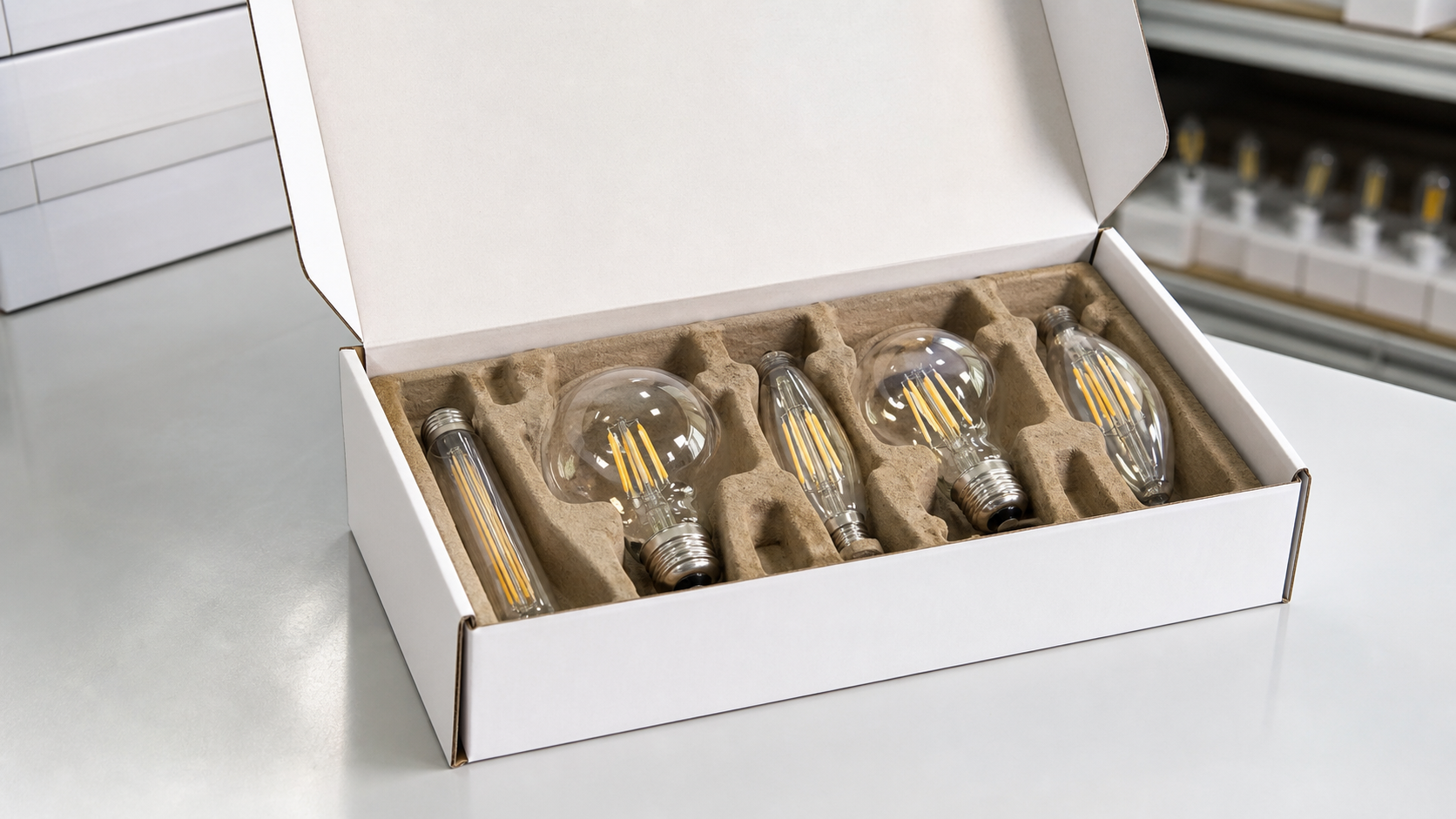
Inner protection is where many packaging failures happen. The outer box may look strong, but if the bulb moves inside the box, glass can still break or coating can be scratched.
Use the bulb shape to decide the protection structure.
| Bulb type | Packaging risk | Practical recommendation |
|---|---|---|
| A60, ST58, ST64 | Common shape, moderate risk | Standard inner box or folded insert can work if movement is controlled |
| G80, G95, G125 | Larger glass diameter | Leave more buffer space and avoid carton pressure on glass |
| T-series tubular bulbs | Long glass body | Use lengthwise support and avoid bending pressure |
| S14d linear bulbs | Long linear format, base alignment risk | Fix the bulb firmly so it cannot slide inside the box |
| Top mirror bulbs | Surface scratch risk | Avoid rubbing against rough paper or loose inserts |
| Porcelain or matte bulbs | Surface mark risk | Use clean inner materials and avoid abrasion |
| Oversized decorative bulbs | High volume and crush risk | Use stronger inner support and conservative master carton quantity |
For S14d linear LED bulbs, buyers should pay special attention to how the bulb is fixed inside the box. A long bulb that slides during shipping is much easier to damage.
Factory note: Long tubular bulbs and S14d linear bulbs need support near both ends, not only in the middle. If the bulb can slide left and right, the base area can take repeated impact during transport. For G125, G150, and other large glass bulbs, the problem is different: the widest part of the glass needs space away from the carton wall, otherwise side pressure can become the weak point.
For coated bulbs, the protection material also matters. Top mirror, smoky, gradient, porcelain, and matte finishes should not rub against rough paper edges or loose inserts. The goal is not only to prevent breakage, but also to keep the visible finish clean.
Do not design the retail box without the master carton
Many buyers focus on the small retail box first. That is understandable, but export damage is often controlled by the master carton.
A good master carton should define:
- Quantity per carton
- Carton size
- Gross weight and net weight
- Carton strength
- Label position
- Model and batch identification
- Pallet loading method if required
For fragile decorative bulbs, avoid making the master carton too heavy. A very large carton may reduce unit packaging cost, but it can increase handling damage because workers are more likely to drop or drag it.
The better question is not "How many bulbs can fit?" It is "How many bulbs can be handled safely through this route?"
Factory note: A common mistake is to maximize the number of bulbs per master carton because the carton price looks lower. For decorative glass bulbs, this can be false economy. A carton that is too heavy or too large is harder to move cleanly through factory packing, loading, customs inspection, distributor warehouses, and final delivery. Smaller cartons may cost slightly more in packaging material, but they can reduce handling risk for fragile or premium bulbs.
Balance protection and freight cost
Packaging protects the product, but it also takes space. More space can increase sea freight, air freight, express cost, and warehouse storage cost.
This creates a trade-off:
- Too little packaging increases breakage and replacement cost.
- Too much packaging increases freight and storage cost.
For high-value or fragile decorative bulbs, stronger packaging is usually worth the cost. For standard wholesale orders, a simple but well-tested structure may be better. For e-commerce, extra protection may be necessary because the parcel route is harsher.
The most useful way to compare options is to ask the supplier for the carton dimensions and quantity per carton, then calculate the packaging effect on freight volume before confirming mass production.
Packaging data should be part of the quotation
A serious quotation should not only include bulb price. For wholesale orders, buyers should also request packaging data.
Ask for:
- Inner box type
- Inner box size
- Master carton size
- Quantity per carton
- Gross weight
- Net weight
- Label content
- Barcode requirement
- Custom printing MOQ
- Packaging sample or photo
This information helps buyers compare suppliers more accurately. A slightly cheaper bulb may become more expensive if the packaging creates higher CBM, higher breakage risk, or extra relabeling work.
Factory note: When comparing quotations from different suppliers, ask whether the quoted price includes the same packaging level. One supplier may quote a cheaper unit price with simple bulk-style packaging, while another includes individual inner boxes, stronger inserts, or custom labels. Without packaging data, the comparison is incomplete.
5 quick judgment standards before approving packaging
Packaging does not need to be overcomplicated, but buyers should have a few clear standards before approving it. These checks are simple enough to use during sampling, quotation comparison, or pre-shipment confirmation.
1. The bulb should not move freely inside the inner box
After the bulb is placed in the inner box, gently shake the closed box by hand. The bulb should not slide, knock, or rotate loosely inside. A small amount of material flexibility is normal, but repeated glass-to-cardboard impact is a warning sign.
For long tubular bulbs and S14d linear bulbs, check both ends. For large globe bulbs, check whether the widest glass area is protected from side pressure.
2. A master carton should be easy to lift and handle
If one carton is too large or too heavy for normal warehouse handling, the damage risk increases. For fragile decorative glass bulbs, buyers should be cautious when a supplier tries to pack too many pieces into one master carton only to reduce carton cost.
As a practical check, ask the supplier for gross weight, carton size, and quantity per carton. If the carton cannot be lifted, stacked, opened, and repacked comfortably, it may not be a good export carton even if the cardboard looks strong.
3. Coated and matte bulbs should pass a surface-contact check
For top mirror, smoky, gradient, porcelain, and matte bulbs, protection is not only about breakage. The visible surface must also stay clean.
Before approval, check whether the bulb surface touches rough paper edges, loose inserts, staples, tape edges, or hard plastic. If the bulb finish can rub during vibration, the packaging should be adjusted.
4. Carton dimensions should be checked against freight cost
Packaging that looks safe may still create unnecessary freight cost if the carton is oversized. Buyers should compare carton dimensions and quantity per carton before confirming the order.
A useful calculation is total order CBM:
carton length x carton width x carton height x carton quantity
Use one unit consistently, usually meters for CBM calculation. This helps the buyer see whether stronger packaging creates acceptable extra volume or unnecessary freight waste.
5. Label and artwork should be checked against the final product, not an early sample
Before printing or shipment, check the packaging information against the final confirmed bulb specification. The most common risk areas are wattage, voltage, base type, color temperature, dimming description, certification marks, barcode, and SKU.
This is especially important when one box design is used across several bulb shapes or wattages. A small label mismatch can create warehouse confusion, retail returns, or compliance questions.
Barcode, label, and compliance details
Packaging is also an information system. For retail and warehouse operations, unclear labels create real cost.
For retail packaging, buyers may need barcodes and product identifiers. GS1 barcode standards are widely used in retail and supply chains, so buyers selling through formal retail channels should confirm barcode requirements before printing.
Important label details include:
- Brand name
- Model number
- Wattage
- Voltage
- Base type
- Color temperature
- Dimming information
- Certification marks
- Country of origin
- Warning text
- Barcode or SKU
- Batch number if required
For export markets, do not add certification marks casually. ETL, CE, RoHS, UKCA, and other marks should match the actual product and market requirement. If the buyer is unsure, the packaging artwork should be reviewed before printing.
For more background on certification differences, buyers can also read HongYu Bulb's guide to ETL vs CE certification for LED bulbs.
What to confirm before mass production
Before mass production, packaging should be confirmed with the same seriousness as electrical specifications.
Use this checklist:
- Confirm the final bulb model and dimensions
- Confirm the inner protection method
- Confirm retail box or neutral box design
- Confirm master carton size and quantity
- Confirm label content and barcode position
- Confirm printing artwork and color proof
- Confirm certification marks and warning text
- Confirm whether packaging photos are needed before shipment
- Confirm whether drop testing or shipment testing is required
- Confirm whether spare boxes or labels are needed
For custom packaging, buyers should approve artwork before production. Small mistakes in wattage, voltage, base type, dimming description, or certification marks can create sales and compliance problems later.
Factory note: Artwork approval should happen before the packaging material is ordered. Once color boxes are printed, changing a barcode, voltage, warning sentence, or certification mark is not a small edit. It can delay production or create unusable packaging inventory.
When custom packaging is worth it
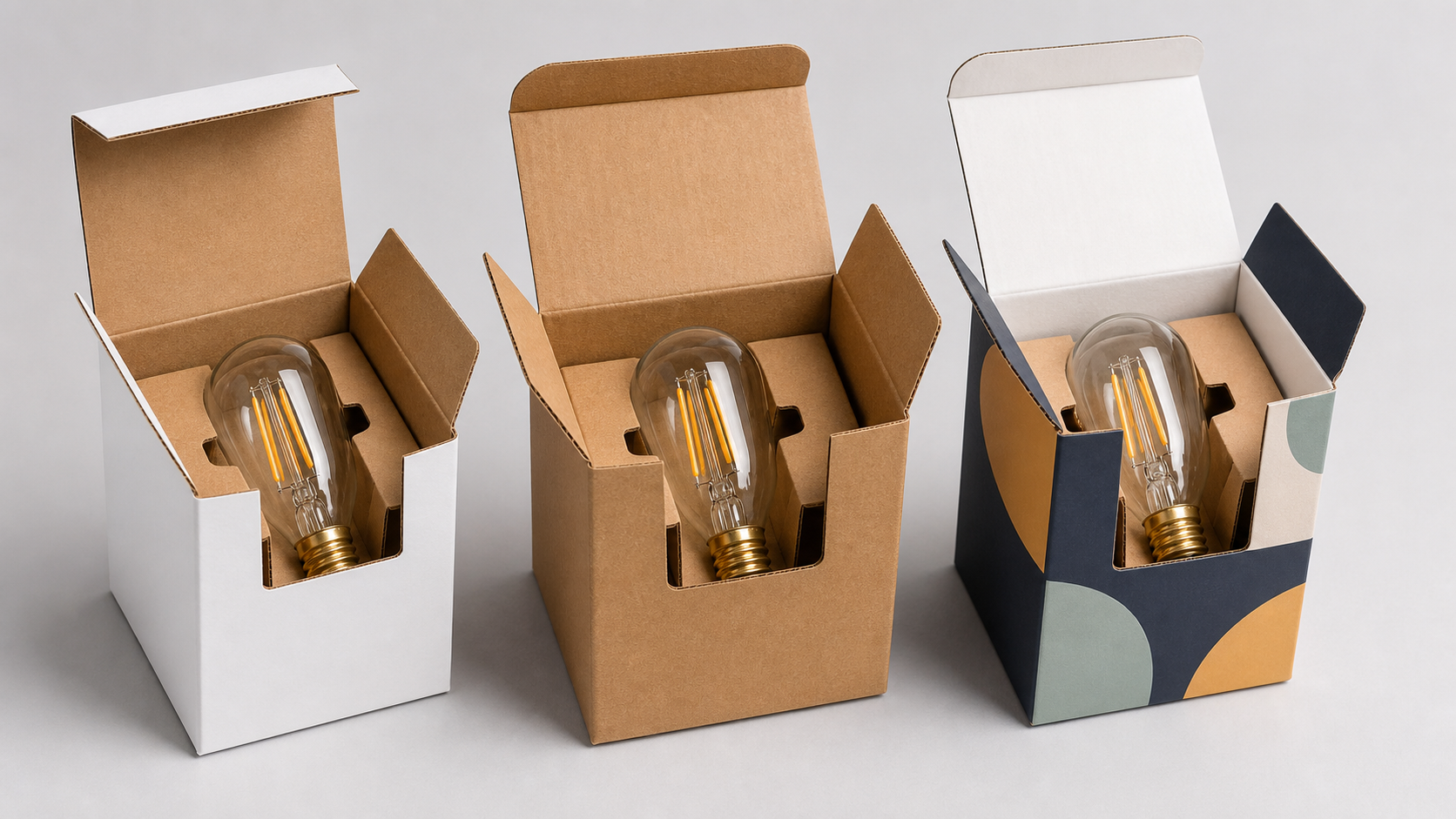
Custom packaging is worth considering when packaging helps the buyer sell more, reduce confusion, or build a long-term product line.
It is usually useful when:
- The product is sold under the buyer's own brand
- The buyer needs retail shelf presentation
- Several bulb models are sold as one collection
- The market needs multilingual packaging
- The buyer needs consistent barcodes, SKUs, and warehouse labels
- The packaging must match a premium lighting fixture brand
For small first orders, neutral packaging with custom stickers can be a practical start. After sales volume becomes stable, fully printed packaging can be developed.
For buyers developing their own line, HongYu Bulb can also support custom lighting solutions including custom bulb designs, finishes, logo bulbs, and packaging discussions.
Stronger supplier questions to ask
Instead of asking only "Can you make color box packaging?", buyers should ask more precise questions:
- How is this bulb fixed inside the inner box?
- Will the glass or coating rub against the insert?
- What is the master carton quantity and gross weight?
- Can you provide packaging photos before shipment?
- Can this packaging pass normal courier handling?
- Is the same box used for several wattages or shapes?
- Where will the barcode and model label be placed?
- What is the MOQ for custom printing?
- Can the box support multilingual text?
- What packaging would you recommend for sea freight versus e-commerce parcel delivery?
These questions quickly show whether the supplier treats packaging as a real part of product quality.
Final thoughts
For wholesale decorative LED bulb orders, packaging is not just a box. It is a risk-control system.
The right packaging protects fragile glass, reduces shipping damage, supports retail sales, improves warehouse handling, and helps the buyer avoid hidden costs after delivery. The wrong packaging can turn a good bulb into a bad purchasing experience.
When sourcing decorative LED filament bulbs, porcelain bulbs, top mirror bulbs, custom color bulbs, oversized bulbs, or S14d linear bulbs, discuss packaging early.
HongYu Bulb can help importers, lighting brands, wholesalers, and project buyers choose practical packaging for wholesale, retail, OEM, and custom decorative bulb orders.